
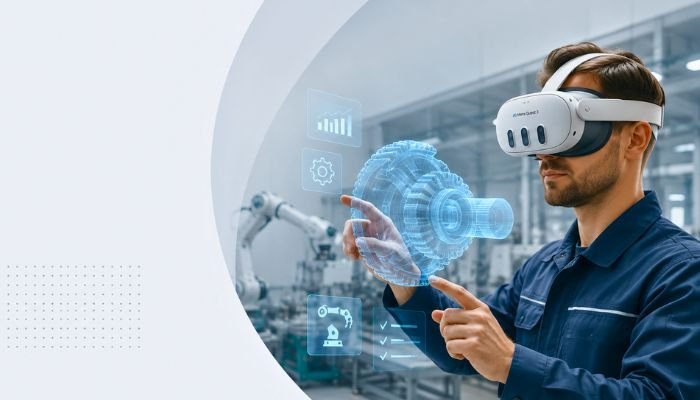
TL;DR: Innovative Augmented Reality Services for Manufacturing in USA 2026. Learn about costs, features, ROI, and how US brands use this technology in 2026.
01 — Introduction
AR Is Reshaping the US Manufacturing Floor in 2026 |
Walk onto the floor of a modern American manufacturing facility in 2026 and something is different. A technician assembling a complex aerospace component pauses, lifts their smart glasses, and a precise 3D overlay of the next assembly step appears directly over the part in their hands — highlighting the exact bolt hole, specifying the torque value, confirming the component orientation. No paper manual. No moment of uncertainty. Just accurate, contextual, real-time guidance exactly where it is needed.
A few bays over, a quality inspector runs a tablet slowly over a machined part. The screen displays a live comparison between the physical part and the approved digital model — tolerance deviations highlighted in red, within-spec dimensions confirmed in green, the inspection record auto-populated as they scan. What used to take 20 minutes of caliper measurements and manual data entry takes four.
This is what augmented reality in manufacturing looks like in practice — not science fiction, not a pilot programme, but a production-proven technology that US manufacturers are deploying at scale because the results are simply too compelling to wait any longer.
In 2026, the United States is at the leading edge of global AR manufacturing adoption. Driven by competitive pressure from highly automated international competitors, a domestic skilled-labour shortage that makes every trained technician more valuable and every training hour more expensive, and the maturation of AR hardware and software platforms to genuine industrial-grade reliability, American manufacturers across aerospace, automotive, electronics, pharmaceuticals, and heavy industry are deploying AR services and seeing measurable returns.
| 📌 Definition
Augmented Reality (AR) in manufacturing is the use of smart glasses, smartphones, tablets, or fixed AR displays to overlay digital information — 3D models, instructions, measurements, sensor data, and annotations — directly onto the physical manufacturing environment in real time, without replacing the operator’s view of the real world. |
At Ink N Algorithm, we design and build AR manufacturing solutions for US companies that need to move beyond the pilot stage and deploy AR at production scale. This guide gives you the complete picture — what the technology delivers, what it costs, and how to build an AR manufacturing strategy that creates lasting competitive advantage.
02 — Understanding AR
What Augmented Reality Means for Manufacturing |
Augmented reality is distinct from virtual reality in one critical way: it does not replace the real world. It adds to it. An AR system takes the operator’s real-world view — of a machine, an assembly, a facility — and layers contextually relevant digital information over it, precisely registered to the physical environment. The operator sees both simultaneously: the real part in their hands and the digital instruction telling them exactly what to do with it.
The Information Precision Advantage
The foundational value of AR in manufacturing is precision of information delivery. A paper work order tells a technician what to do. An AR overlay tells them exactly where, exactly how, and confirms in real time that they have done it correctly. This precision — delivering the right information to the right person at the right location on the right component at the right moment — eliminates the ambiguity that drives assembly errors, inspection misses, and maintenance mistakes.
Spatial Registration — The Technical Foundation
What makes AR different from a video instruction or a digital manual is spatial registration: the digital content is anchored to and tracking with the physical object in the user’s view. Modern AR systems achieve this through a combination of computer vision, SLAM (Simultaneous Localization and Mapping), depth sensing, and — on industrial platforms — marker-based tracking on parts and machinery. The result is that the 3D assembly guide stays precisely positioned over the physical component even as the operator moves around it.
The Connectivity Layer
In 2026, AR manufacturing systems are connected — to ERP systems, digital twin platforms, IoT sensor networks, and quality management systems. This connectivity means that the information an AR system displays is not static content loaded from a file, but live data: current machine status pulled from IoT sensors, current work order parameters from the ERP, current specification data from the digital twin, current quality hold status from the QMS. The AR display becomes a live window onto the operational intelligence of the facility.
03 — Use Cases
Five High-Impact AR Applications for US Manufacturers |
AR manufacturing applications fall into five primary use cases, each addressing a distinct operational challenge and delivering measurable returns independently. Most manufacturers begin with one and expand as the ROI evidence accumulates.
1. AR-Guided Assembly
AR-guided assembly is the most widely deployed AR manufacturing application in the US, and consistently delivers the strongest early ROI. Step-by-step 3D assembly instructions are overlaid directly onto the physical components being assembled — showing the operator precisely where each part goes, the correct orientation, the required fastener, and the correct torque value. Error-proofing logic prevents progression to the next step until the current step is confirmed correct, either through operator confirmation or computer vision verification.
The impact on first-time quality is substantial. Manufacturers deploying AR assembly guidance consistently report significant reductions in assembly errors, rework costs, and field warranty claims. For complex assemblies with hundreds of steps — aerospace structures, medical devices, complex electronics — AR guidance also dramatically reduces the skill level required to achieve consistent quality, addressing the technician shortage by making skilled work more accessible.
2. AR-Powered Quality Inspection
Quality inspection with AR transforms a process that has traditionally been time-consuming, inconsistent, and heavily dependent on experienced inspector judgement into one that is fast, consistent, and digitally documented. The AR system overlays the approved digital model over the physical part, highlighting dimensional deviations, surface defects, and assembly verification requirements. Tolerance ranges are displayed contextually — the inspector sees immediately whether each dimension is within specification without consulting a separate drawing.
Computer vision integration extends this capability to automated defect detection — the AR system flags anomalies that match trained defect patterns, surfacing them for inspector attention rather than relying on the inspector to find them. This combination of AR overlay and computer vision assistance has demonstrated the ability to reduce inspection time by 30 to 50 percent while simultaneously improving defect detection rates.
3. Remote Expert Support
Remote AR expert support may be the AR application with the broadest applicability across manufacturing sectors, because it addresses a universal problem: when a technician encounters an unfamiliar fault or complex repair requirement, the specialist who knows how to resolve it is rarely on site. Before AR, this meant flying an expert in (expensive and slow) or attempting to guide a technician over a phone call with no shared visual context (inefficient and error-prone).
With AR remote support, the on-site technician shares their live view through smart glasses or a mobile device. The remote expert sees exactly what the technician sees and can annotate directly onto that live view — drawing attention to the relevant component, marking the correct adjustment point, highlighting the fault location. AR annotations appear as if placed on the physical equipment. First-time fix rates for remote AR-supported maintenance calls consistently exceed 90 percent, compared to 60 to 70 percent for conventional remote support.
4. Predictive Maintenance Visualisation
AR brings predictive maintenance from dashboards into the physical plant. Instead of an operator monitoring sensor data on a separate screen and then walking to a machine to investigate, AR overlays live sensor data directly onto the machine itself — displaying temperature readings over the bearing they belong to, vibration spectra over the shaft they represent, pressure values over the pipe section they monitor. Anomaly alerts appear spatially positioned on the physical component that is approaching a maintenance threshold.
5. Immersive AR Training
AR training allows manufacturing operators to practice complex procedures on virtual representations of real equipment — gaining competency without production risk, without consuming machine time, and without the cost of training consumables. For hazardous operations, new equipment introductions, and rare but critical procedures, AR training delivers a level of experiential learning that no classroom or video-based alternative can replicate. Manufacturers deploying AR training report 25 to 35 percent reductions in time-to-competency for new operators.
04 — Market Intelligence
The US AR Manufacturing Market — 2026 Data |
The commercial case for AR in US manufacturing is backed by market data that makes the investment decision increasingly straightforward for companies that review it honestly.
Market Scale and Growth
The US augmented reality market for manufacturing applications has reached significant scale in 2026, driven by adoption across aerospace, automotive, electronics, pharmaceuticals, and heavy industry. The combination of hardware cost reductions — smart glasses platforms that once cost tens of thousands of dollars now start under two thousand — with the maturation of software platforms to genuine industrial reliability has unlocked adoption across mid-market manufacturers who previously considered AR technology inaccessible.
The Workforce Driver
The US manufacturing sector faces a well-documented skilled labour shortage that is simultaneously one of the most compelling drivers of AR adoption. With hundreds of thousands of manufacturing positions currently unfilled and an experienced workforce approaching retirement age, the ability of AR to compress training timelines, preserve institutional knowledge in digital form, and enable less-experienced operators to perform complex tasks reliably is not just a productivity story — it is an operational continuity story. AR is increasingly viewed by US manufacturing executives not as a technology investment but as a workforce strategy.
ROI Realisation Timelines
The most significant shift in the US AR manufacturing market in 2026 is the acceleration of ROI realisation timelines. Early adopters of AR manufacturing technology — those who deployed in 2020 and 2021 — frequently reported 18 to 24 month payback periods. Current deployments, benefiting from more mature platforms, better implementation practices, and lower hardware costs, are consistently achieving payback in 9 to 14 months. This compression of the payback period is dramatically expanding the population of manufacturers for whom AR represents a financially straightforward investment.
| $12.8B
US AR manufacturing market 2026 |
68%
US manufacturers adopting AR |
40%
Assembly error reduction |
90%
Remote first-time fix rate |
05 — Delivery Platforms
Mobile AR, Smart Glasses & Fixed Stations — Which Is Right? |
One of the first decisions any manufacturer considering AR deployment faces is platform selection. The three primary AR delivery platforms — mobile devices, smart glasses, and fixed AR stations — each have distinct strengths, cost profiles, and optimal use cases. In practice, most manufacturing environments benefit from a combination.
Mobile AR — The Lowest-Friction Entry Point
Mobile AR, delivered through smartphones and tablets, offers the lowest barrier to entry for manufacturing AR deployment. The hardware is existing or inexpensive, the deployment is rapid — WebAR experiences can be accessed through the device browser without app installation — and the use cases are broad. Mobile AR is particularly well-suited to quality inspection, inventory management, facility navigation, and remote expert support scenarios where hands-free operation is not required.
For manufacturers beginning their AR journey, mobile AR provides a cost-effective way to demonstrate value, build organisational familiarity with AR workflows, and generate the data needed to justify investment in more sophisticated platforms. Ink N Algorithm builds WebAR manufacturing applications that work in iOS Safari and Android Chrome without any hardware investment beyond the devices operators already carry.
Smart Glasses — The Hands-Free Production Tool
Smart glasses — including platforms such as the Microsoft HoloLens 2, RealWear industrial-grade wearables, and Magic Leap 2 — are the preferred AR platform for assembly, maintenance, and any manufacturing use case where the operator needs both hands free throughout the task. The ability to view AR overlays while maintaining full dexterity — without putting down a tool or holding a device — is fundamental to the productivity benefits that assembly-line AR delivers.
Industrial smart glasses platforms have matured considerably in 2026, with device robustness, battery life, and optical clarity now meeting the standards required for sustained production use. Platforms like RealWear are specifically engineered for industrial environments — rated for dust and moisture ingress, capable of voice control in noisy settings, and certified for use in hazardous locations.
Fixed AR Stations — High-Accuracy Shared Platforms
Fixed AR stations — large-screen displays or projector-based AR systems positioned at specific workstations — serve use cases where a single high-quality AR display serves multiple operators in sequence, or where the scale and resolution requirements exceed what portable devices can deliver. Complex quality inspection stations, CAD model comparison benches, and training simulation platforms all benefit from fixed AR configurations.
06 — Business Case
The ROI of AR in US Manufacturing Operations |
The ROI from AR manufacturing deployments is multi-dimensional — it accrues from error reduction, efficiency gains, training cost savings, support cost reductions, and quality improvements simultaneously. Understanding the full ROI picture requires looking across all these dimensions rather than focusing on a single metric.
The Error Cost Calculation
Manufacturing errors are expensive at every stage of the value chain, and the cost escalates dramatically the later an error is detected. An assembly error caught at the step it is made has minimal cost. The same error detected at final inspection requires rework that may cost hundreds to thousands of dollars. An error that reaches the field and generates a warranty claim can cost tens of thousands, and one that results in a product recall can cost millions. AR’s ability to prevent errors at the point of assembly — by providing precise guidance and real-time verification — delivers ROI at every stage of this escalating cost ladder.
Training Cost Reduction
Training is one of the most significant cost centres in US manufacturing, particularly in the current environment where operator turnover rates and new hire volumes are elevated. AR training platforms reduce time-to-competency for new operators by 25 to 35 percent, reduce training material costs by eliminating physical mockups, and allow training to be conducted in flexible schedules without dedicating production equipment or experienced trainer time. For manufacturers training dozens or hundreds of new operators annually, these savings are substantial.
Remote Support Economics
The cost comparison between AR-enabled remote support and traditional field service dispatch is stark. A field service visit for a specialised technician in US manufacturing environments typically costs $1,500 to $5,000 when travel, time, and opportunity cost are fully accounted for. An AR-supported remote call, where the on-site operator shares their live view and receives expert guidance in real time, costs a fraction of this amount and resolves in a fraction of the time. At a 90 percent first-time fix rate for AR-supported calls, the economics are compelling.
| AR Manufacturing Metric | Reported Impact |
| Assembly error rate reduction | 40% average improvement |
| Training time-to-competency | 25–35% reduction |
| Inspection time per part | 30–50% reduction |
| Remote support first-fix rate | 90%+ with AR assistance |
| Unplanned downtime reduction | Up to 28% improvement |
| Typical payback period | 9–14 months |
07 — Industry Sectors
Which US Manufacturing Sectors Lead AR Adoption? |
AR manufacturing adoption in the United States is not uniform across sectors. The industries leading deployment share common characteristics: high product complexity, high cost of errors, regulatory quality requirements, skilled labour scarcity, or some combination of all four.
Aerospace & Defence
US aerospace and defence manufacturers have been among the earliest and most aggressive adopters of AR manufacturing technology. The sector’s characteristics — extreme product complexity, zero tolerance for assembly errors, intensive regulatory documentation requirements, and very high error cost — make AR’s value proposition compelling at every stage of the production process. Boeing, Lockheed Martin, and Northrop Grumman have all deployed AR assembly guidance on production programmes, with published results demonstrating significant error reductions and assembly time improvements.
Automotive & EV Manufacturing
US automotive assembly plants have deployed AR guidance extensively for complex sub-assembly operations, quality inspection, and technician training. The EV manufacturing sector — growing rapidly with new plant openings across the American South and Midwest — has adopted AR from day one as a standard element of digital manufacturing strategy, recognising the technology’s ability to compress ramp-up timelines for new production facilities and new vehicle platforms.
Medical Devices & Pharmaceuticals
The medical device and pharmaceutical manufacturing sectors face the intersection of high product complexity, strict regulatory quality requirements, and severe consequences for manufacturing defects. AR quality inspection — providing documented, digitally recorded inspection records with computer vision assistance — is particularly valuable in regulated environments where inspection data must meet FDA and ISO quality system requirements. The digital audit trail that AR inspection systems produce natively addresses a significant compliance documentation burden.
Industrial Equipment & Heavy Manufacturing
For US manufacturers of large industrial equipment — turbines, compressors, pumps, heavy vehicles — AR remote support delivers outsized value, because the machines they produce are deployed in facilities across the country and around the world where immediate specialist support is not physically feasible. An AR remote support capability that allows a product expert in the manufacturer’s facility to guide an on-site technician through a complex diagnosis or repair transforms both the customer service capability and the service cost economics.
08 — Our Services
How Ink N Algorithm Delivers AR Manufacturing Solutions |
Ink N Algorithm is a technology studio built around immersive digital experiences — and AR manufacturing is one of our core service areas. We bring together the full stack of capabilities required to take an AR manufacturing initiative from strategy through deployment to production scale: AR application development, 3D asset creation, hardware platform integration, enterprise system connectivity, and ongoing optimisation.
WebAR Manufacturing Applications
Our WebAR manufacturing applications run in standard mobile browsers — no app installation, no hardware investment beyond existing smartphones and tablets. We build WebAR assembly guidance tools, inspection assistance applications, and remote support platforms that manufacturing teams can deploy in days rather than months. For manufacturers beginning their AR journey or needing rapid deployment, WebAR is the fastest path to AR value.
Smart Glasses Integration
For use cases requiring hands-free operation — assembly guidance, maintenance procedures, field service — we develop applications for leading industrial smart glasses platforms including Microsoft HoloLens 2, RealWear Navigator, and Magic Leap 2. Our integration work covers 3D spatial registration, voice command interfaces for noisy environments, ERP and digital twin connectivity, and offline operation for network-constrained locations.
Remote Expert AR Platform
Our remote expert platform connects on-site operators with off-site specialists through a shared live AR view. The remote expert can annotate directly onto the live scene — drawing attention to components, marking adjustment points, confirming correct configurations — with annotations appearing spatially anchored in the on-site operator’s view. The platform includes session recording for documentation and training purposes, and integrates with existing ticketing and work order systems.
Custom AR App Development
For manufacturers with specific workflows, unique equipment, or integration requirements that off-the-shelf platforms cannot address, we deliver custom AR application development across iOS, Android, and dedicated AR hardware. Our development process begins with a workflow analysis phase — mapping the existing process, identifying the high-value AR intervention points, and designing the AR experience around the operator’s actual task sequence rather than a generic template.
| 💡 Ink N Algorithm Note
We believe the most important factor in successful AR manufacturing deployment is not the technology platform — it is the quality of the operational workflow analysis that precedes it. The AR systems that deliver the strongest ROI are those designed around how operators actually work, not those that require operators to adapt to the technology. Every Ink N Algorithm AR manufacturing project begins with a two-week workflow discovery sprint before a line of code is written. |
09 — FAQ
Frequently Asked Questions |
How long does it take to deploy an AR manufacturing solution?
Timeline depends significantly on scope and complexity. A focused WebAR assembly guidance application for a single product line can be designed, built, and deployed in six to ten weeks. A full smart-glasses AR programme covering multiple use cases, with ERP integration and across multiple production lines, typically runs 16 to 24 weeks from workflow analysis to production deployment. Ink N Algorithm provides a detailed project timeline after an initial discovery session.
What hardware does AR manufacturing require?
It depends on the use case. Mobile AR requires only standard iOS or Android devices — which most manufacturing environments already operate. Smart-glasses AR requires industrial AR headset hardware from platforms like RealWear, HoloLens 2, or Magic Leap 2, at hardware costs ranging from approximately $1,500 to $4,500 per device. Ink N Algorithm provides hardware recommendations and procurement support as part of every AR manufacturing engagement.
Can AR systems integrate with our existing ERP and MES?
Yes — and this integration is often where the greatest AR value is unlocked. Ink N Algorithm’s AR manufacturing platforms are built API-first, designed to connect with SAP, Oracle, Microsoft Dynamics, and custom ERP and MES systems. Work order data, product specifications, quality standards, and machine sensor data can all be surfaced in real time within the AR interface, making the AR system a live window onto your operational intelligence rather than a standalone tool.
Is AR manufacturing appropriate for small and mid-size US manufacturers?
Absolutely — and 2026 represents a particularly favourable moment for mid-market manufacturers to begin AR deployment. Hardware costs have fallen to levels that are accessible without enterprise budgets, WebAR applications remove hardware barriers entirely, and the ROI case is now well-evidenced across a broad range of manufacturing environments. Ink N Algorithm specialises in AR manufacturing deployments for growth-stage and mid-market manufacturers — designing solutions that deliver measurable returns without requiring the technology infrastructure of a Fortune 500 company.
10 — Conclusion
Your AR Manufacturing Journey Starts Now |
The US manufacturing sector is at an inflection point. The companies that invest in augmented reality now — while the technology is proven but not yet ubiquitous — will enter the next decade with operational capabilities, talent advantages, and quality metrics that competitors playing catch-up will struggle to match. The companies that wait will find themselves deploying AR as a defensive necessity rather than a competitive weapon.
The evidence is clear. Assembly errors fall by 40 percent. Inspection times are cut in half. Remote support first-time fix rates exceed 90 percent. Operator training is compressed by a third. These are not projections — they are reported results from US manufacturers who have deployed AR manufacturing solutions and measured the outcomes.
At Ink N Algorithm, we have built the expertise, the technology stack, and the deployment methodology to take your AR manufacturing initiative from strategy to production scale — reliably, within budget, and with the workflow-centred design philosophy that ensures operators adopt and value the technology from day one.
| 🚀 Book Your Free AR Manufacturing Consultation — inknalgorithm.com |
Every AR manufacturing deployment we have delivered has begun with a single conversation — a frank discussion about the operational challenges you are facing, the outcomes you need to achieve, and the realistic path from where you are today to an AR-enabled manufacturing environment. That conversation costs nothing and takes 30 minutes. Let us have it.
| About Ink N Algorithm
Ink N Algorithm is an innovative technology studio specialising in Augmented Reality (AR), Virtual Reality (VR), Web Configurators, App Development, and Website Development. We build immersive digital experiences that transform how businesses operate, sell, and train. Based in Hanover Park, IL, we serve US manufacturers, retailers, and technology brands seeking to build genuine competitive advantage through immersive technology. www.inknalgorithm.com | AR/VR Services • Web Configurators • App Development • Website Development |
Ready to get started? Contact Ink & Algorithm to discuss your project—we’ll help you create results that drive sales.