
TL;DR: Product Configurators for Fashion and Apparel. Learn about costs, features, ROI, and how US brands use this technology in 2026.
01 — Introduction
What Is a Fashion Product Configurator? |
Fashion has always been personal. The shirt that fits perfectly, the sneaker in exactly the right colourway, the team jersey with your name stitched across the back — these are not just purchases; they are expressions of identity. But for decades, the apparel industry has operated on a fundamental tension: personalisation is what customers want, and mass production is how brands stay profitable. Bridging that gap has been the industry’s great unsolved challenge.
Until now. The product configurator for fashion and apparel is the technology that finally reconciles these two opposing forces — making it possible to offer genuinely personalised clothing at industrial scale, with the economics of mass production and the experience of bespoke service. And in 2026, brands that have not yet deployed one are already feeling the competitive pressure from those that have.
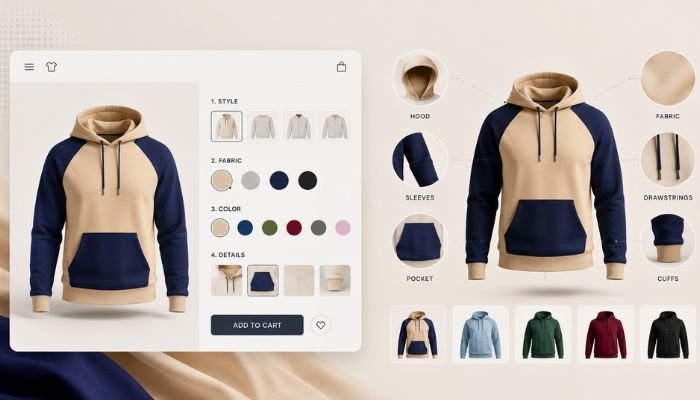
A fashion product configurator is an interactive web application that lets customers — or B2B buyers — build their own version of a garment in real time. They choose the silhouette, select the fabric, pick the colour, add personalisation, see the result rendered in photorealistic 3D, and place an order that flows directly into production. No manual quoting, no back-and-forth email chains, no specification errors. Just a customer who designed exactly what they wanted, and a production pipeline that received exactly what it needs to make it.
| 📌 Definition
A Fashion Product Configurator is a web-based interactive application that enables real-time garment customisation — colour, fabric, cut, logo, and sizing — with live 3D visualisation, instant pricing, and direct-to-production order output. It bridges the gap between on-demand personalisation and scalable manufacturing. |
At Ink N Algorithm, we build product configurators that go far beyond simple colour pickers. Our fashion configurators are intelligent systems — with built-in rules engines, live pricing logic, production-ready output, and AR-powered try-on — designed to convert browsers into buyers and individual orders into scalable production runs.
02 — How It Works
Step-by-Step Inside a Fashion Configurator |
The customer-facing experience of a fashion configurator feels simple and intuitive — almost like playing a design game. But beneath that smooth interface lies a sophisticated system coordinating 3D rendering, product rules logic, pricing engines, and production data management simultaneously.
Step 1 — Choose the Garment Silhouette
The journey begins with the customer selecting the garment type and cut — a crew-neck T-shirt, a slim-fit shirt, a zip-up hoodie, a performance polo. The 3D model updates immediately, presenting the selected silhouette on a neutral avatar or a mannequin sized to the customer’s measurements. This first step establishes the canvas on which every subsequent choice will be layered.
Step 2 — Select Fabric & Material
Next, the customer selects from available fabric options — cotton, polyester, bamboo, performance blend, organic twill. In a high-quality configurator, fabric selection is not just a dropdown label: the 3D model updates its surface rendering to reflect the actual material characteristics — the sheen of a satin weave, the texture of a brushed fleece, the drape of a lightweight linen. Physically-based rendering (PBR) makes these material distinctions visually accurate and commercially persuasive.
Step 3 — Customise Colour & Pattern
With fabric selected, colour and pattern choices are applied to the 3D model in real time. A full-spectrum colour palette, Pantone-matched swatches, gradient tools, and pattern upload capabilities allow an extraordinary range of aesthetic personalisation. Critically, the rules engine prevents combinations that are not manufacturable — certain fabrics only come in certain colours; certain dyes are incompatible with certain materials — guiding the customer through what is genuinely possible rather than creating false expectations.
Step 4 — Add Personalisation
This is where the emotional magic of a fashion configurator happens. Customers add their name, initials, team number, brand logo, or custom artwork — positioning it precisely on the garment using drag-and-drop tools, selecting embroidery or print technique, choosing thread colours or ink finish. For B2B buyers ordering team kits or corporate uniforms, bulk personalisation tools allow roster data to be uploaded, generating individualised specifications for every item in the order automatically.
Steps 5 & 6 — 3D Preview and Order
With configuration complete, the customer sees their creation rendered at high quality — rotating the 3D model, zooming into details, previewing on different avatar body types. Pricing updates live with every choice. When satisfied, the customer places the order, which is transmitted in production-ready format — cut tickets, colour specifications, embroidery files, size breakdowns — directly to the manufacturer or factory integration system.
03 — Key Features
What Every Fashion Configurator Must Have in 2026 |
The gap between a basic colour-picker and a genuinely high-performing fashion configurator is enormous. These are the features that separate tools that convert customers from tools that frustrate them.
Real-Time 3D Visualisation
Every selection — colour, material, logo position, sleeve length — must be reflected on the 3D garment model immediately, with no perceptible lag. Customers will not wait three seconds for a render to update; they will click away. Achieving real-time responsiveness requires optimised WebGL pipelines, pre-baked lighting environments, and carefully compressed 3D assets. Done right, it delivers an experience that makes customers feel like they are holding the garment in their hands.
Intelligent Rules Engine
A fashion configurator without a robust rules engine is a liability, not an asset. The rules engine is the layer that knows which fabrics come in which colours, which personalisation techniques work on which materials, which combinations are manufacturable within acceptable cost ranges, and which size and cut pairings are valid. It prevents customers from designing items that cannot be produced — protecting both the customer experience and the brand’s operational integrity.
AI-Powered Size Recommendation
Size uncertainty is one of the biggest barriers to online clothing purchase and one of the biggest drivers of returns. An integrated AI size recommendation tool — using body measurements, fit preferences, and garment specification data — eliminates this uncertainty at the point of configuration, before the order is placed. The result is fewer returns, higher customer satisfaction, and stronger repeat purchase rates.
Seamless ERP & Production Integration
For a fashion configurator to deliver its full commercial value, it must connect directly to the production systems that fulfil orders. This means API integration with your ERP, order management system, warehouse management platform, and ideally your factory floor production scheduling. When this integration is clean and reliable, a customer order placed at 2am becomes a production ticket at 2:01am — no human intervention, no transcription errors, no delays.
04 — The Business Case
ROI, Statistics & Revenue Impact |
The investment in a fashion product configurator needs to be justified by measurable business impact. Here is the evidence that makes the case clearly.
Personalisation Drives Purchase
Consumer research consistently shows that shoppers are significantly more likely to purchase — and to pay a premium — for products they have personally configured. The act of designing activates a psychological ownership effect: the customer has invested creative energy in the item, making abandonment feel like a loss rather than simply deciding not to buy. This ownership effect is particularly pronounced in fashion, where the product is worn publicly and identity is at stake.
Dramatic Return Rate Reduction
Fashion returns are one of the industry’s most damaging cost centres — driven primarily by size uncertainty and colour disappointment. A configurator addresses both simultaneously: AI size recommendation reduces wrong-size orders, and accurate 3D rendering eliminates colour surprises. Brands deploying fashion configurators consistently report meaningful reductions in return rates, with corresponding improvements in margin and customer satisfaction.
Higher Average Order Value
Configured products carry higher average order values than standard catalogue purchases for two reasons: customers are paying a legitimate premium for personalisation, and the configurator journey surfaces upsell opportunities naturally — a better fabric, an additional embellishment, a matching accessory — in a way that feels helpful rather than pushy.
| 36%
More likely to buy custom items |
40%
Fewer returns with 3D preview |
2.5×
Higher AOV on configured orders |
80%
Gen-Z prefer personalised fashion |
05 — Fashion Segments
Who Benefits Most From Apparel Configurators? |
Fashion product configurators are not a one-size-fits-all solution — different segments of the apparel market benefit in different ways and need different configuration capabilities. Here is how the technology applies across key categories.
Footwear — The Pioneer Segment
Footwear brands have led the adoption of product configurators, with major athletic brands offering detailed online customisation for years. Today, a well-built sneaker configurator allows customers to independently colour every panel of the upper, select midsole and outsole options, choose premium material upgrades, and add personalised text to the heel tab — all rendered in photorealistic 3D from every angle. The emotional engagement this creates is extraordinary, and conversion rates for custom footwear pages consistently outperform standard product pages.
Corporate & B2B Uniform Supply
For brands supplying corporate workwear, team uniforms, hospitality attire, and branded staff clothing, the B2B configurator transforms what was a painfully manual process — spreadsheets, email chains, artwork approvals — into a streamlined self-service platform. Procurement managers configure their complete order specification, receive an accurate quote, upload their logo, specify roster personalisation, and submit a production-ready order — all without a single sales conversation. The efficiency gains are dramatic on both sides of the transaction.
Direct-to-Consumer Bespoke Fashion
The DTC fashion brands growing fastest in 2026 are those offering genuine bespoke personalisation at accessible price points. A fashion configurator is the technology infrastructure that makes this possible at scale — allowing a brand to offer thousands of unique product combinations without the inventory risk of stocking every variant, and without the operational cost of a traditional made-to-order process.
Sportswear & Team Kits
Sports clubs, schools, universities, and amateur leagues represent a substantial and underserved market for apparel configurators. A team kit configurator that allows a club administrator to design their jerseys, upload the club badge, specify player names and numbers, and place an order for 15 to 500 items — with accurate pricing and a visual proof — is a transformational tool for this segment. It eliminates the need for a sales rep, accelerates the design approval process, and scales to serve thousands of clubs simultaneously.
06 — 3D & AR Visualisation
The New Standard for Fashion Retail Experience |
The visual quality of a fashion configurator is not a cosmetic consideration — it is a commercial one. The more accurately a customer can visualise the item they are creating, the more confident they are in their purchase, the less likely they are to return it, and the stronger the emotional connection they form with the brand.
From Static Photography to Dynamic 3D
Static product photography has served fashion e-commerce for 25 years — and its limitations have never been more apparent than in the context of customisation. A photograph can only show the product as it exists in one fixed configuration. A 3D model can show the product in any configuration, from any angle, at any scale, under any lighting condition — updating instantly with every customer selection. For fashion configurators, 3D visualisation is not a premium enhancement; it is the minimum viable experience that customers now expect.
WebAR Try-On — Wearing Before Buying
WebAR (web-based augmented reality) takes fashion visualisation a step further, allowing customers to see how a configured garment looks on their own body — using their smartphone camera, without downloading an app. For categories like outerwear, footwear, and accessories, WebAR try-on has demonstrated significant conversion rate improvements and meaningful return rate reductions. The technology works directly in Safari and Chrome, making it accessible to virtually any smartphone user with no friction. Ink N Algorithm builds WebAR try-on experiences that integrate seamlessly with the configuration workflow — so the AR preview reflects exactly the custom garment the customer has designed, not a generic product sample.
| 💡 Ink N Algorithm Note
Our fashion configurators use physically-based rendering (PBR) throughout — the same rendering pipeline used in high-end product photography and film VFX. This means the 3D fabric textures, material sheen, and colour accuracy in our configurators meet the quality standard customers have come to expect from premium fashion brands. We combine this with WebAR capability that requires no app download — delivering the full try-on experience to any customer with a modern smartphone. |
07 — Scale
Custom Clothing at Scale — From 1 Piece to 1 Million |
The most transformative promise of the fashion product configurator is this: it makes personalisation profitable at scale. Not one-at-a-time bespoke production at luxury price points, and not mass production of identical items. Something entirely new — on-demand manufacturing, where every item in a production run can be unique, and the factory receives exactly the specification it needs for each one automatically.
The Digital-to-Physical Production Bridge
The critical infrastructure that makes custom fashion at scale possible is the integration between the configurator and the production systems downstream. When a customer finalises their configuration and places an order, the configurator must transmit production-ready data — not a sales order that requires manual interpretation, but a complete technical specification: cut ticket, colour codes (Pantone or RAL), material grade, personalisation artwork files, embroidery digitisation, size breakdown, and delivery timeline. Ink N Algorithm’s configurators are built to generate and transmit this production data in the formats your factory, supplier, or third-party manufacturer requires.
Batch Personalisation for B2B
For B2B buyers ordering personalised uniforms or team kits at volume, configurators support batch personalisation workflows. The buyer designs the master garment specification, then uploads a roster file — names, numbers, sizes — and the configurator generates individual production specifications for every item in the order automatically. What previously required hours of manual spreadsheet management and back-and-forth artwork approvals becomes a five-minute self-service process.
Inventory-Free Retail Model
One of the most commercially compelling benefits of a fashion configurator is the ability to sell garments that do not exist until they are ordered. Instead of forecasting demand, holding inventory across hundreds of SKU combinations, and managing markdown risk when variants do not sell, a configurator-powered brand operates an inventory-free model: the product is created only when a customer orders it, in exactly the configuration they chose. This on-demand model eliminates inventory risk, reduces waste, and allows brands to offer an effectively unlimited product range without the operational complexity that would normally entail.
08 — Why Ink N Algorithm
The Fashion Configurator Partner Built for Your Growth |
Building a fashion product configurator that genuinely performs — that converts browsers into buyers, scales to handle peak demand, integrates with your production systems, and ranks in organic search — requires a partner with a specific combination of capabilities that most development agencies simply do not have.
Deep Configurator Expertise
Web configurators are not a side service for us — they are core to what we do. Our team has built configurators across fashion, industrial, furniture, automotive, and technology categories, and every project deepens the expertise we bring to the next. We know where the technical pitfalls are, how to structure rules engines that handle real-world fashion complexity, and how to design UX flows that guide customers to confident purchase decisions.
End-to-End Development
From 3D asset creation and WebAR integration to rules engine development, ERP connectivity, and Shopify or WooCommerce embedding — we handle the complete development stack. You work with one team, one point of contact, and one integrated system rather than coordinating between a 3D studio, a web developer, and a backend integration specialist.
Platform Flexibility
Our configurators integrate with the commerce and production platforms you already use. Whether your store runs on Shopify, WooCommerce, Magento, or a custom platform — and whether your production connects to an ERP, a third-party manufacturer’s API, or a direct factory integration — we build the bridges that make data flow seamlessly from customer configuration to production output.
| Project Phase | Typical Timeline |
| Discovery & Strategy | 1–2 weeks |
| 3D Asset Production | 2–4 weeks |
| Configurator Development | 4–8 weeks |
| ERP & Platform Integration | 2–3 weeks |
| Testing & QA | 1–2 weeks |
| Launch & Optimisation | Ongoing |
09 — FAQ
Frequently Asked Questions |
How complex can the configuration options be?
Extremely complex. Our rules engine can handle thousands of configurable attributes with intricate dependency logic — if fabric A is selected, only colours B, C, and D are available; if personalisation type E is chosen, the minimum order quantity is F; if size G is combined with cut H, a different pattern I applies. The rules engine is the backbone of the configurator’s commercial reliability, and we build it to handle real-world fashion complexity without exposing that complexity to the customer.
Can the configurator handle bulk B2B orders?
Yes. Our B2B configurator mode supports bulk ordering workflows: master garment configuration, roster-based personalisation upload, volume pricing tiers, quote generation, purchase order processing, and direct-to-production specification output. We have built B2B fashion configurators for uniform suppliers, corporate merchandise brands, and sports kit manufacturers handling orders from 10 to 50,000 units per run.
Will it integrate with our existing Shopify store?
Yes — Shopify is one of our most common integration targets. Our configurator embeds cleanly into Shopify product pages, pushes configured product data into Shopify’s order management system, and respects Shopify’s product taxonomy. We also integrate with WooCommerce, Magento, BigCommerce, and custom e-commerce platforms. The integration layer is built API-first, so connecting to your specific platform is a defined and predictable scope of work.
What file formats does the production output support?
Production output from our configurators includes all major manufacturing formats: cut tickets as PDF or structured JSON, colour specifications as Pantone or RAL codes, artwork files as AI, EPS, or high-resolution PNG, embroidery files as DST or PES, and size run breakdowns as CSV or direct ERP data transfer. The specific output format is configured to match your manufacturer’s or factory’s input requirements.
How long does a fashion configurator project take?
A focused single-garment configurator for a DTC fashion brand typically takes 8 to 12 weeks from discovery to launch. A full-featured multi-category configurator with B2B functionality, ERP integration, and WebAR try-on typically takes 16 to 24 weeks. Every project begins with a fixed-price proposal and detailed milestone timeline, so you have complete visibility into what will be delivered and when.
10 — Conclusion
Your Custom Clothing Future Starts Here |
The fashion industry stands at an inflection point. Customers have tasted personalisation — through social media aesthetics, curated style feeds, and the occasional brand configurator — and their appetite for it is growing, not shrinking. The question for fashion brands is no longer whether to offer customisation, but how to offer it at the quality, scale, and price point that makes it commercially viable.
The fashion product configurator is the answer to that question. It is the technology that makes bespoke accessible, that makes personalisation profitable, that makes on-demand manufacturing a real operational model rather than a marketing aspiration. It turns your product catalogue into a creative canvas, your customers into co-designers, and your marketing content into something customers create and share voluntarily.
At Ink N Algorithm, we have built the expertise, the technology stack, and the production integration experience to deliver fashion configurators that perform from day one — converting visitors, reducing returns, scaling effortlessly, and integrating cleanly with every system downstream. We would love to show you what that could look like for your brand.
| 🎯 Ready to Configure Your Future?
Visit inknalgorithm.com to explore our web configurator portfolio and book a free strategy consultation. Our team will review your product range, your production setup, and your commercial objectives — and come back with a clear, honest picture of what a fashion configurator could deliver for your specific brand. No obligation. Just clarity. |
The brands defining fashion’s personalised future are building now. Let us build yours together.
| About Ink N Algorithm
Ink N Algorithm is an innovative technology studio specialising in Web Configurators, Augmented Reality (AR), Virtual Reality (VR), App Development, and Website Development. We build digital experiences that captivate audiences and drive measurable business growth — from interactive 3D product configurators to immersive VR brand worlds. Based in Hanover Park, IL, we serve brands across fashion, retail, manufacturing, and technology. www.inknalgorithm.com | Web Configurators • AR/VR • App & Web Development |
Ready to get started? Contact Ink & Algorithm to discuss your project—we’ll help you create results that drive sales.