

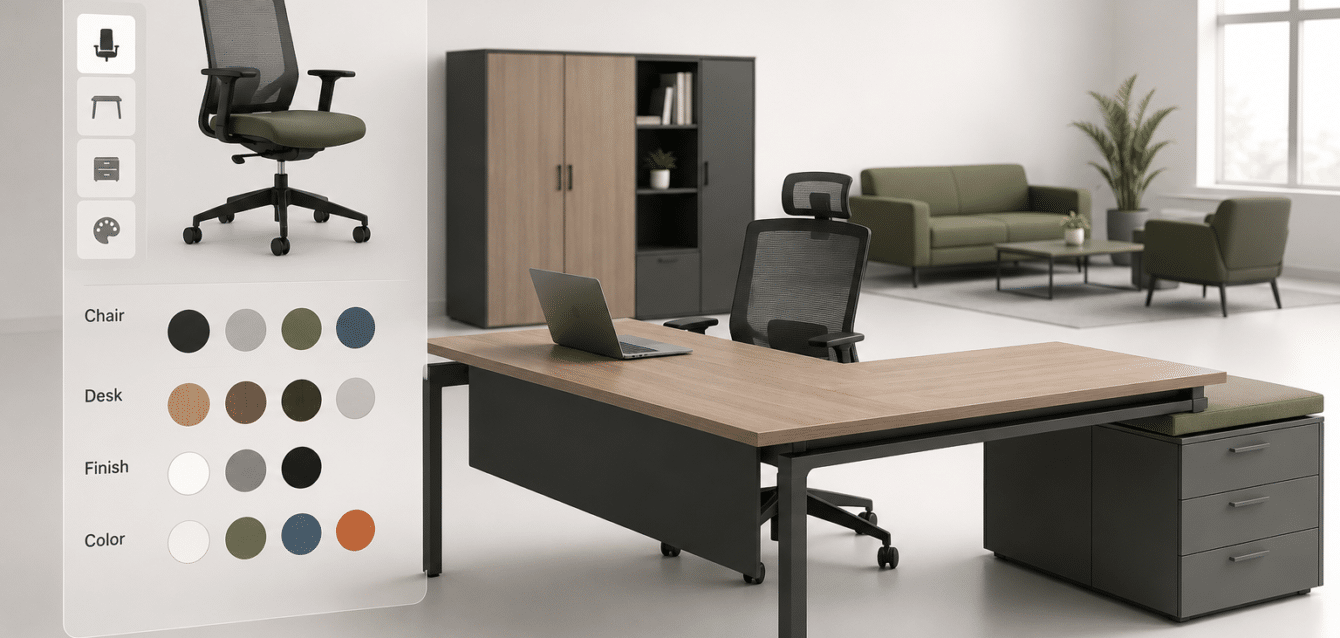
⚡ TL;DR — Quick AnswerA 3D configurator for office furniture is an interactive web tool that lets facilities managers, procurement teams, and workspace designers configure commercial furniture — selecting desk dimensions, finish, seating specifications, storage modules, and privacy panel arrangements — while seeing every combination rendered accurately in 3D. US commercial furniture brands use 3D office furniture configurators to close the specification gap between what a buyer imagines and what gets installed, reducing costly post-delivery reconfiguration and replacing time-consuming sample requests with instant visual confirmation. Ink & Algorithm, based in Hanover Park, Illinois, builds custom 3D configurators for commercial and office furniture brands across the USA — integrating directly with dealer portals, CRM platforms, and ERP systems.
Introduction
Commercial and office furniture sits in an unusual position among configurable product categories — it has higher specification complexity than most consumer furniture, significantly higher per-unit values, and a buyer who is making decisions for dozens or hundreds of workstations simultaneously. A facilities manager specifying 200 workstations for a new corporate headquarters cannot afford the same error tolerance as a consumer buying a single sofa. And yet, until recently, the tools available to commercial furniture buyers were essentially the same as those available to everyone else: product catalogues, finish sample books, and static renders of showroom configurations that bear limited resemblance to the actual space being furnished.
A 3D configurator for office furniture changes this completely. A procurement team can load the actual floor plan dimensions of a planned workspace and configure workstations, seating, storage, and collaboration zones — seeing every finish selection and arrangement rendered accurately in 3D, in the actual spatial context of the space. Specification errors are caught before an order is placed. Finish combinations are confirmed visually before samples are ordered. And the specification document that emerges from a completed configuration session is the exact order — not a re-transcription of decisions made in a PDF comment thread.
Ink & Algorithm builds 3D configurators for commercial and office furniture brands from Hanover Park, Illinois — delivering the specification accuracy, floor plan integration, and dealer workflow connectivity that the B2B contract furniture sales process demands. This guide covers the specific use cases, commercial mechanics, and technical approach behind a production-grade commercial furniture configurator in 2026.
Key Commercial Metrics
| 60%
Reduction in post-installation reconfiguration requests when 3D configurators are used in commercial furniture procurement |
3×
Faster specification approval cycles — B2B furniture buyers confirm configurations visually rather than through multiple sample rounds |
35%
Higher average order value as upgrade finishes become visually comparable to base options |
80%
Reduction in specification errors reaching manufacturing when configurators enforce compatibility rules |
Why Commercial Furniture Configurators Are Different From Residential
Commercial furniture procurement differs from residential purchasing in ways that make a 3D configurator for office furniture a fundamentally different tool from a residential furniture configurator. Understanding these differences explains why an off-the-shelf residential configurator rarely serves the contract furniture market effectively — and why purpose-built commercial furniture configurators require a different scope of development. Our custom vs off-the-shelf configurator guide covers this decision framework in detail for enterprise buyers.
Fleet Scale — Hundreds of Units, Not One
A residential furniture buyer configures one sofa. A facilities manager configuring a 300-person open plan office configures 300 workstations, 60 collaborative tables, 300 task chairs, and 45 storage units — and needs all 705 items to be specified correctly, at the same time, to a consistent standard. A 3D office furniture configurator must handle fleet-scale specification — applying a configuration template across a large number of units while allowing exceptions for specific zones, accessibility requirements, or team area differentiation.
Space Integration — Real Dimensions, Not a Neutral Background
Commercial furniture decisions are fundamentally spatial decisions. A workstation that is 1400mm wide works in one floor plan and creates a circulation aisle conflict in another. A standing-height collaboration table that works visually in a generic studio render may be visually overwhelming in an actual 2.8m ceiling space. A production-grade 3D configurator for office furniture allows the buyer to work within the actual floor plan dimensions of their planned space — because a neutral background is commercially inadequate for space-critical specification. This is the capability gap that most standard product configurators cannot fill. Our apartment configurator guide covers how this spatial integration works in real estate contexts — the same principle applies with greater complexity in commercial office planning.
Multi-Stakeholder Approval — Procurement, Design, and Finance
Commercial furniture procurement involves committees. The facilities manager has specifications requirements. The interior designer has aesthetic standards. The finance team has budget constraints. The operations team has ergonomic requirements. A commercial furniture configurator that produces shareable configuration outputs — a 3D render, a specification summary, and a priced bill of materials — allows all stakeholders to review the same configured design, in the same visual format, before a purchase order is issued. This replaces the multi-document, multi-round approval process that currently adds weeks to commercial furniture sales cycles.
Dealer and Distribution Integration
Commercial furniture is typically sold through dealer networks, not direct to end users. A 3D office furniture configurator must integrate with dealer workflows — routing configured specifications to the correct dealer, generating dealer-ready quotation documentation, and mapping product codes to the manufacturer’s order management system. Without this integration, the configurator generates impressive visuals that then require manual re-entry into the actual order system — creating the specification error risk that the configurator was built to eliminate.
6 Commercial Furniture Categories Where 3D Configurators Deliver Strongest ROI
1. Open Plan Workstations and Benching Systems
Open plan workstation systems — benching, panel-based workstations, and height-adjustable desk platforms — involve the highest configuration complexity of any office furniture category. Bay count, desk width and depth, panel heights and materials, wire management integration, storage module selection, and accessory rail configurations must all be specified simultaneously for each zone. A 3D configurator for office furniture in this category handles full floor plan placement, automatic circulation aisle checking, zone-by-zone finish differentiation, and fleet-scale pricing — replacing the specification spreadsheets and CAD drawings that currently define this procurement process.
2. Task Seating and Ergonomic Chair Specification
Commercial seating specification involves arm height options, lumbar adjustment specifications, seat depth variants, fabric and mesh selection, and base finish choices. For a fleet procurement of 200+ chairs, the configuration matrix is substantial. A commercial furniture configurator lets procurement teams configure the standard fleet specification, mark exceptions for accessibility requirements, and visualize fabric and mesh selections accurately before committing to sample orders. The 3D configurator returns reduction data covers how visual pre-confirmation consistently reduces order changes and post-delivery adjustments across configurable product categories.
3. Collaboration and Meeting Room Furniture
Meeting room furniture — conference tables, collaborative round tables, media tables with integrated technology — requires spatial planning in addition to product specification. A 3D office furniture configurator places meeting room configurations in accurate room dimension models — showing whether a specified table length creates adequate circulation, whether the screen position works with the window placement, and whether the seating count matches the room’s usable capacity. This spatial confirmation is exactly the capability that static product renders cannot provide.
4. Private Office and Executive Furniture
Private office furniture — executive desks, credenzas, bookcase systems, and lounge seating — involves the highest individual unit values in the commercial furniture category, and the strongest buyer preference for visual confirmation before purchase. A 3D configurator for office furniture in the executive category needs photorealistic material rendering — the difference between walnut veneer and wenge finish, between polished chrome and brushed nickel hardware — to be commercially useful. Our Unreal Engine 5 configurator guide covers how UE5 pixel streaming delivers cinema-grade material rendering for premium furniture categories.
5. Storage and Filing Systems
Commercial storage systems — lateral filing cabinets, mobile pedestals, overhead storage bridges, and open shelving — require dimension compatibility checking against workstation systems and spatial placement within specific zones. A 3D commercial furniture configurator handles storage system configuration as part of the same session as workstation specification — generating a complete floor plan layout with all storage integrated, rather than requiring separate configuration tools for furniture and storage categories. This unified approach is a significant capability differentiator for brands in the systems furniture category.
6. Lounge, Breakout, and Collaboration Zones
Lounge and breakout zone furniture — soft seating, café-height tables, phone booth pods, and acoustic seating — has the widest fabric and finish selection of any office furniture category and the least standardized floor plan placement. A 3D office furniture configurator lets designers specify lounge zone layouts freely, with accurate fabric rendering across dozens of options, and spatial confirmation within the actual zone dimensions of the planned space. This is the category where AR room placement adds the most value — buyers can see the configured lounge zone in their actual space before the order is placed. Ink & Algorithm’s AR development services cover the WebAR integration that extends the 3D configurator into real-space placement for commercial buyers.
“The commercial furniture buyer’s single biggest pain point is specification errors discovered at installation. A 3D configurator that enforces compatibility rules and generates accurate specifications eliminates this at the source — not at delivery.”
— Ink & Algorithm, Commercial Furniture Configurator Practice
3D Configurator vs Traditional Commercial Furniture Specification
| Specification Need | Traditional Approach | 3D Configurator |
|---|---|---|
| Fleet specification accuracy | Spreadsheets + CAD drawings + manual cross-reference | ✅ Rules engine validates compatibility automatically |
| Finish confirmation | Physical sample books, 2-3 week sample ordering cycle | ✅ PBR render shows exact finish in real time |
| Spatial fit validation | 2D floor plan overlays — no 3D confirmation | ✅ 3D placement in actual room dimensions |
| Multi-stakeholder review | PDF documents emailed across teams | ✅ Shareable configuration link — same visual for all |
| Specification document for order | Manual transcription from approval notes | ✅ Auto-generated from configurator session |
| Dealer routing | Manual dealer allocation after specification | ✅ Configurator routes to dealer CRM automatically |
| Post-delivery reconfiguration | Common — 20-40% of commercial projects | ✅ Rare — visual pre-approval eliminates expectation gap |
How Ink & Algorithm Builds 3D Configurators for Commercial Furniture Brands
Ink & Algorithm builds 3D configurators for commercial and office furniture brands from Hanover Park, Illinois — starting from the manufacturer’s actual product specifications, CAD files, and material sample libraries. Every 3D model in a commercial furniture configurator is built to precise dimension accuracy — because a workstation that renders as 1400mm but ships as 1600mm creates the specification error the configurator was designed to prevent.
Our configurator development approach for commercial furniture covers five specific capabilities that general-purpose configurators typically lack: floor plan spatial integration (working within client-supplied room dimensions), fleet-scale specification management (applying and modifying configurations across large unit counts), compatibility rules engine with commercial furniture-specific logic (desk/storage dimensional compatibility, circulation aisle minimums, panel height-to-workstation compatibility), shareable configuration links for multi-stakeholder review, and dealer-ready specification export with product codes, quantities, and pricing structured for direct order entry.
The platform integration layer connects the 3D office furniture configurator directly to dealer CRM platforms, ERP systems, and quote generation tools — so a completed configuration session produces an order-ready document without any manual re-entry. Browse our web configurator services and portfolio for deployed examples. Our complete guide to product configurator development covers the full technical architecture and development approach for enterprise configurator projects.
Frequently Asked Questions
What is a 3D configurator for office furniture?
3D configurator for office furniture is an interactive web tool that lets facilities managers, procurement teams, and interior designers specify commercial furniture — choosing dimensions, finishes, fabric options, and layout arrangements — while seeing every selection rendered accurately in 3D. It handles fleet-scale specification for large commercial projects, integrates with floor plan dimensions for spatial validation, and generates dealer-ready specification documents from completed configuration sessions. Ink & Algorithm builds custom 3D office furniture configurators for commercial furniture brands across the USA.
How is a commercial furniture configurator different from a residential one?
A commercial furniture configurator differs from residential in four specific ways: fleet-scale specification (hundreds of units, not one), floor plan spatial integration (real room dimensions, not neutral backgrounds), multi-stakeholder approval workflows (procurement, design, finance all reviewing the same configured output), and dealer/ERP system integration (specification documents route directly to order management). Our custom vs off-the-shelf configurator guide covers how to choose the right development approach for enterprise configurator requirements.
What office furniture categories benefit most from 3D configurators?
The highest ROI commercial furniture configurator categories are open plan workstations and benching systems (highest specification complexity), task seating fleet specifications, meeting room furniture (spatial validation critical), executive office furniture (premium material rendering required), commercial storage systems (dimensional compatibility with workstations), and lounge/breakout zones (widest finish selection, AR extension most valuable). See our 3D configurators for furniture brands guide and complete furniture configurator guide for residential category context — the commercial approach extends the same principles to B2B scale and complexity.
Can a 3D commercial furniture configurator integrate with floor plans?
Yes. Production-grade 3D office furniture configurators built by Ink & Algorithm allow buyers to work within the actual floor plan dimensions of their planned space — uploading a floor plan and placing configured furniture within accurate spatial context. This floor plan integration is what enables the spatial validation that commercial furniture procurement requires: confirming that workstation configurations create adequate circulation aisles, that meeting room tables fit with required seating counts, and that storage systems work within available zone dimensions.
How does a commercial furniture configurator reduce specification errors?
Specification errors in commercial furniture are primarily caused by three things: incompatible product combinations (a workstation depth that conflicts with a storage module), incorrect spatial assumptions (a layout that works in a 2D plan but creates circulation problems in 3D), and expectation gaps between what was specified and what was delivered. A 3D configurator for office furniture addresses all three: the rules engine prevents incompatible combinations at the selection stage, floor plan integration confirms spatial fit visually, and PBR material rendering closes the expectation gap between specified and delivered finishes. Our 3D configurator returns reduction data covers the documented impact on post-delivery reconfiguration rates.
How long does it take to build a commercial furniture configurator?
A focused 3D office furniture configurator covering a single product line (one workstation system with standard option matrix, floor plan integration, and dealer CRM export) typically launches in 12–18 weeks. Multi-line platforms covering a full commercial furniture range with ERP integration and advanced space planning tools span 20–32 weeks. Contact Ink & Algorithm with your product range and dealer network requirements for a scoped proposal within one business day.
The 3D Configurator for US Commercial Furniture Brands
The commercial furniture category is one of the few remaining product sectors where the specification process is significantly more painful than it needs to be — and where the investment in a production-grade 3D configurator for office furniture pays back directly in specification error reduction, sales cycle compression, and specification-to-order accuracy.
US commercial furniture brands that invest in purpose-built 3D office furniture configurators are not just delivering a better buying experience — they are fundamentally changing how commercial furniture is specified, approved, and ordered. The configurator becomes the specification system, the approval tool, and the order document, simultaneously. Ink & Algorithm builds this capability for commercial furniture brands from Hanover Park, Illinois — delivering the floor plan integration, fleet-scale specification management, compatibility rules enforcement, and dealer workflow connectivity that the contract furniture market requires.
Ready to Build a 3D Configurator for Your Commercial Furniture Brand?
Tell Ink & Algorithm about your product range, your dealer network, and your procurement workflow.
Our team responds within one business day with a scoped proposal for your configurator project.