
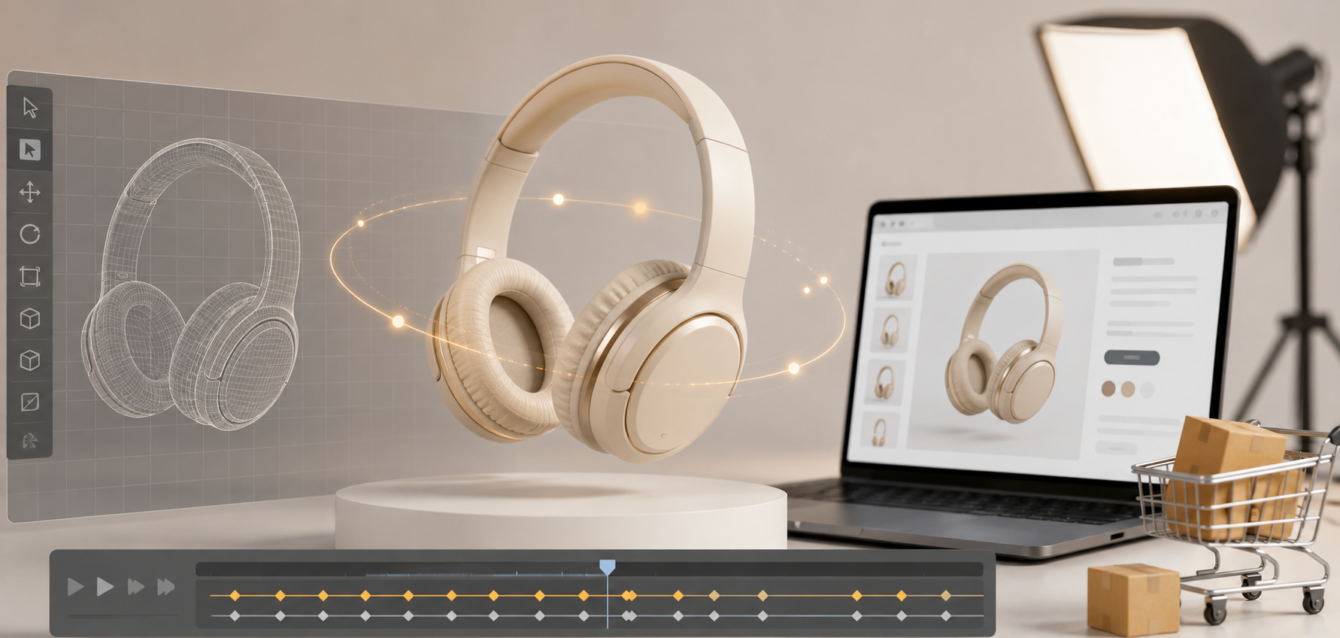
⚡ TL;DR — Quick Answer
3D product animation for ecommerce creates photorealistic video and motion content of physical products — hero shots, 360° rotations, exploded views, lifestyle scenes, and social media clips — entirely in 3D software, without photographing the physical product. US ecommerce brands use 3D product animation to launch products before manufacturing completes, show internal components that photography cannot capture, produce unlimited marketing variations without reshoots, and create interactive product content that lifts conversion rates and reduces returns. Ink & Algorithm, based in Hanover Park, IL, builds 3D product animation for ecommerce brands across the USA — from consumer goods and electronics through to automotive, furniture, and specialty products.
Introduction
Walk through any successful ecommerce product category in 2026 and the pattern is visible: the brands generating the highest conversion rates are not using the most expensive photographers. They are using 3D product animation. The product spins in perfect light at every angle. The internal mechanism reveals itself in an exploded view. The surface texture reads as accurately as it would in a physical store. The product exists in a lifestyle scene that was never actually staged — because the room, the lighting, and the environment are all 3D renders, built precisely to communicate what the product is and why it belongs in the buyer’s life.
This is not a production shortcut. It is a production upgrade. 3D product animation gives ecommerce brands visual capabilities that photography cannot match — unlimited angles, any lighting scenario, any configuration, any scale of detail, and the ability to show what exists inside the product. For US brands competing in product categories where visual confidence drives the purchase decision, it has become the production standard that determines who wins the comparison moment.
Ink & Algorithm is a digital experience agency headquartered in Hanover Park, Illinois — building 3D product animation, interactive configurators, and immersive AR/VR experiences for ecommerce brands and enterprises across the USA.
Key Commercial Metrics
| 40%
Higher conversion rate for products with 3D animation vs static photography |
30%
Return rate reduction when buyers see accurate 3D product detail before purchase |
∞
Variants from one 3D model — any color, finish, or configuration, no reshoot |
72%
Of US consumers prefer video content for product research over static images |
What Is 3D Product Animation?
3D product animation is the creation of photorealistic video content of a physical product using 3D modeling and rendering software — Cinema 4D, Blender, Autodesk Maya, or Unreal Engine 5 — rather than photographing the physical object. A 3D model of the product is built to precise specifications, given physically accurate material properties (PBR materials), placed in a 3D environment with accurate lighting, and rendered as video frames composed into animation.
The result is indistinguishable from high-end product photography — but with capabilities that photography cannot provide. A 3D product animation can show the product from any angle, in any lighting scenario, in any environment, at any scale of detail. It can animate the product opening, assembling, or operating. It can peel back the exterior to show internal components. It can place the product in ten different lifestyle scenes without staging a single one.
6 Types of 3D Product Animation Every Ecommerce Brand Should Know
The term 3D product animation covers six distinct content types, each built for a specific commercial purpose in the ecommerce funnel.
1. Hero Shot Animation — The Product at Its Best
A hero shot animation shows the product rotating, approaching, or revealing itself in a controlled studio environment — cinematic lighting, perfect composition, and motion that communicates premium quality before the buyer reads a single word. Used as the primary product image on product detail pages, hero animations establish visual authority and reduce the amount of copy needed to communicate the product’s quality tier. Brands in premium categories — consumer electronics, beauty, jewelry, specialty goods — use hero shot 3D product animation as the first impression that earns the buyer’s continued attention.
2. 360° Product Rotation — Total Visual Control
A seamless 360° rotation shows the product from every angle in a single looped animation — replacing the multiple static photography angles that traditionally require separate shots and significant post-processing. For products where shape, profile, and form are key purchase factors — footwear, bags, consumer electronics, eyewear — a 360° 3D product animation gives buyers the visual completeness that reduces the hesitation that delays purchases and increases abandoned carts.
3. Exploded View Animation — Inside the Product
An exploded view animation separates a product into its component parts — showing internal structure, material layering, mechanism, or assembly — with each component floating outward in choreographed motion before returning to form the complete product. This is the content type that product photography literally cannot produce. For products where internal construction is a purchase argument — footwear with layered sole technology, audio equipment with driver components, tools with mechanism engineering — the exploded view 3D animation makes the invisible visible.
4. Lifestyle Scene Animation — Product in Context
Lifestyle scene animations show the product in a realistic environment — a kitchen, a living room, an office — without staging a physical set or hiring models. The entire scene is 3D: the room, the furniture, the ambient light, and the product. For brands that need multiple lifestyle contexts, 3D product animation delivers all of them without the cost of multiple photoshoots. The same 3D assets that power the animation can power a product configurator and AR product placement on the same product page.
5. Feature Callout Animation — Explaining What Matters
Feature callout animations highlight specific product details through directed camera movement and focused reveals — the waterproofing seal, the edge stitching detail, the brushless motor inside a power tool. These are short, punchy 3D product animations — 10 to 30 seconds — formatted for ecommerce PDP galleries, social media feeds, and email marketing. They are the animation equivalent of a well-designed feature callout section: specific, visual, and faster to process than copy.
6. Social Media Product Animation — Built for the Feed
Social media 3D product animations are purpose-built for Instagram Reels, TikTok, YouTube Shorts, and paid social placements — square or vertical format, under 30 seconds, with dynamic motion that earns attention in a scrolling feed. US ecommerce brands running social advertising increasingly use 3D animation for paid placements because a single 3D asset production generates ten variations — different color options, different angles, different speed edits — that can be A/B tested without additional production cost.
“A product photograph shows what a product looks like in one lighting scenario, at one angle, on one day. A 3D product animation shows what it looks like in every scenario a buyer might need to see.”
Why US Ecommerce Brands Are Choosing 3D Animation Over Photography
Pre-Launch Production — Animate Before You Manufacture
US brands launching new products face a consistent problem: marketing materials and pre-launch social content all need to exist weeks before the physical product is available for photography. 3D product animation solves this entirely — the 3D model can be built from CAD files or design specifications, and full production-quality animation can be delivered while manufacturing is still underway. Brands can launch presale campaigns with visually complete product content months before a physical sample exists.
Variant Coverage — Every SKU, No Reshoot
A product with 12 color options and 3 size variants represents 36 photography sessions if every combination needs a dedicated hero shot. With 3D product animation, the 3D model is built once and the material library covers every color and finish option — generating all 36 variant renders from a single asset production. For ecommerce brands managing large SKU catalogs, this efficiency compounds dramatically: each new colorway or seasonal variant is a material swap on an existing model, not a new photoshoot.
Technical Products — Show What Photography Cannot
Products where internal construction, mechanism operation, or assembly process is a commercial argument cannot be communicated through photography at all. The exploded view animation, the operating mechanism reveal, the layer separation — these are uniquely 3D animation capabilities. US brands in consumer electronics, tools, sports equipment, medical devices, and specialty goods use 3D product animation as the primary vehicle for communicating engineering quality that their physical exterior does not reveal.
Product Categories Where 3D Animation Delivers Strongest ROI
Consumer Electronics & Technology
Electronics buyers evaluate products on design quality, build precision, and internal component specification. 3D product animation delivers all three: surface material and manufacturing quality read accurately in photoreal 3D renders, exploded views show chipset layout and thermal management, and operating animations show how controls and interfaces respond.
Footwear & Apparel
Footwear brands use exploded view 3D product animation to show sole technology layering — EVA foam density, carbon fiber plate placement, cushioning zone mapping — that is invisible in standard product shots. Apparel brands use 3D animation for fabric behavior simulation, showing how a technical fabric drapes, stretches, or performs under conditions that a studio shoot cannot replicate.
Furniture & Home Goods
Furniture ecommerce brands use 3D product animation to show the same sofa in ten different room contexts, in every fabric option, from every camera angle — without staging any of them. Combined with AR product placement integration, the same 3D asset library that generates the animation also powers the WebAR room placement experience on the product page.
Automotive Parts & Powersports
Automotive aftermarket brands sell complex products — brake systems, suspension components, performance parts — where installation context, fitment accuracy, and component interaction matter commercially. 3D product animation shows installation sequences, component interaction in operation, and fitment specificity that product photography cannot communicate.
Health, Wellness & Medical Devices
Consumer health products and FDA-approved devices benefit from 3D animation’s ability to show internal components, mechanism precision, and material properties through cross-section reveals and exploded views that build trust for high-consideration health purchases.
How 3D Animation Integrates With Configurators and AR
Combined Asset Strategy
The same 3D model that produces animation content can power:
- A web-based interactive 3D product configurator
- A WebAR product placement experience
- A virtual showroom environment
All from one asset production — dramatically lower cost-per-deployment.
The most commercially efficient 3D product animation investment is one that generates multiple content types from a single 3D asset production. Ink & Algorithm builds every 3D product animation project with downstream asset efficiency in mind — the same 3D model and material library that produces animation content can power an interactive web-based 3D product configurator and a WebAR product placement experience.
This shared asset pipeline means a US ecommerce brand that invests in 3D product animation through Ink & Algorithm can deploy the same product in a real-time browser configurator, in a WebAR session, and in a virtual showroom environment — all from one asset production, at dramatically lower cost-per-deployment than treating each as a separate production.
3D Product Animation vs Product Photography
| Factor | Product Photography | 3D Product Animation |
|---|---|---|
| Unlimited angles | ❌ Requires reshoots | ✅ Any angle from one model |
| All color variants | ❌ Separate session per variant | ✅ Material swap — no reshoot |
| Pre-launch content | ❌ Physical product required | ✅ Build from CAD/specs |
| Exploded view / internals | ❌ Not possible | ✅ Core capability |
| Lifestyle scenes | ❌ Physical staging required | ✅ Full 3D scene — no staging |
| Social format cuts | ❌ Limited reediting | ✅ Infinite format outputs |
| AR / configurator extension | ❌ Not compatible | ✅ Shared 3D asset |
| Long-term variant expansion | ❌ New session each time | ✅ Material swap — low cost |
How Ink & Algorithm Builds 3D Product Animation
Ink & Algorithm produces 3D product animation for US ecommerce brands from our base in Hanover Park, Illinois — combining 3D modeling, PBR material production, animation, and rendering with the ecommerce platform and configurator integration that connects the visual content to commercial outcomes.
Every 3D product animation project begins with the product’s actual specifications — CAD files, physical samples, reference photography, technical documentation. We do not build generic 3D approximations; we build accurate digital twins that render correctly because they are built correctly. PBR material production matches physical sample reference — the leather grain, the anodized aluminum surface, the matte plastic texture — to ensure the digital render communicates the same material quality the buyer will receive.
Deliverables are formatted for every deployment context: high-resolution MP4 for product pages, square and vertical cuts for social media, WebM for web performance, and USDZ/GLB assets for AR deployment where the project scope includes configurator or AR extensions. All animation assets are delivered with full usage rights and working files.
Frequently Asked Questions
What is 3D product animation and how does it differ from photography?
3D product animation creates photorealistic video content of a product entirely in 3D software — no physical product needs to be photographed. Unlike photography, 3D animation can show the product at any angle, in any lighting scenario, in any environment, with internal components revealed, and in every color variant — all from one 3D model production.
Which ecommerce platforms does it work with?
3D product animation video assets work across all ecommerce platforms — Shopify, WooCommerce, Magento, BigCommerce, and custom frontends — as standard MP4 or WebM video files on product detail pages, in image galleries, as autoplay hero content, and in paid social advertising.
Can 3D animation be produced before the physical product is ready?
Yes. Using CAD files, design specifications, and technical documentation, Ink & Algorithm can build the 3D model and produce full-quality animation before manufacturing completes. Brands can launch pre-sale campaigns and social media content with production-quality product visuals months before a physical sample exists.
How many SKU variants can one 3D model cover?
One 3D product animation model can cover unlimited color, material, and finish variants — each variant is a material swap in the 3D scene rather than a separate photography session. Ink & Algorithm builds material libraries matched to every product variant, enabling brands with large SKU ranges to generate all hero shots and lifestyle scenes at dramatically lower per-variant cost than photography.
What is an exploded view animation?
An exploded view animation separates a product into its component parts in choreographed 3D motion, showing internal structure, material layering, or mechanism. Use it when internal construction is a commercial argument: footwear sole technology, electronics components, tool mechanisms, mattress construction, medical device engineering.
How long does a 3D product animation project take?
A focused project — single product, hero shot plus 360° rotation, two lifestyle scenes, and social media cuts — typically delivers in 4–8 weeks. Larger projects covering multiple products, complex exploded views, and full SKU range variant coverage span 8–16 weeks.
The US Ecommerce Brands
3D product animation has crossed from a premium production option into a competitive requirement for US ecommerce brands in product categories where visual information drives the purchase decision. The brands generating the strongest conversion rates and lowest return rates in consumer electronics, footwear, furniture, automotive parts, and health products are not those with the best photographers — they are those with the most comprehensive 3D asset libraries.
The commercial logic is straightforward: a 3D product animation asset built correctly — from accurate product specifications, with physically accurate materials — is a permanent commercial asset. It generates hero shots in any color, lifestyle scenes in any environment, exploded views of internal engineering, social content in any format, and the 3D files that power configurators and AR experiences. Photography generates photographs. Ink & Algorithm builds the 3D asset infrastructure that US ecommerce brands need to compete visually in 2026 — from Hanover Park, Illinois, serving brands nationwide.
Ready to Build Your 3D Product Animation Library?
Tell Ink & Algorithm about your products, your ecommerce platform, and the content types you need.
Our team responds within one business day with a scoped approach for your 3D animation project.