
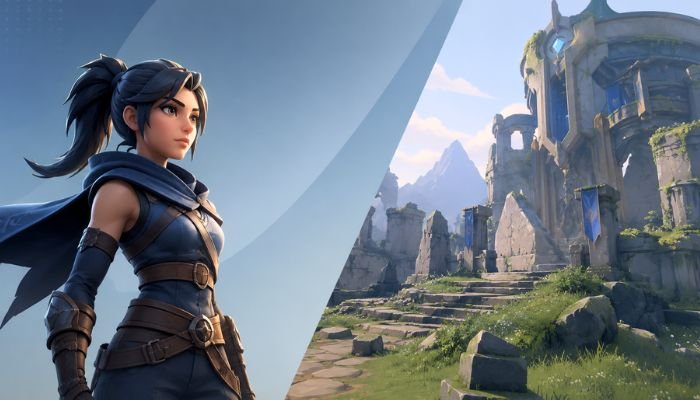
TL;DR: Game Animation Services for Characters & Environments in USA 2026. Learn about costs, features, ROI, and how US brands use this technology in 2026.
01 — Introduction
Game Animation in 2026 — Why It Defines the Player Experience |
Open any discussion about a great game and notice how quickly animation enters the conversation. The way a character hesitates before speaking. The way an enemy’s body language telegraphs an attack a half-second before it lands. The way a ruined city feels lived-in even though every building is empty. None of these are accidents. They are the result of skilled game animators making thousands of deliberate decisions that the player processes unconsciously, building a world they believe in.
In 2026, game animation is no longer a supporting discipline — it is a primary driver of commercial success. Players raised on decades of improving visual standards now have finely tuned expectations. A character whose movement feels stiff, whose transitions are abrupt, whose facial expressions lag behind their dialogue — that character breaks immersion in a fraction of a second. And a player who loses immersion is a player who stops playing, stops recommending, and stops buying DLC.
The US gaming market is the largest and most competitive in the world — valued at $101 billion in 2026, with studios ranging from indie teams of five to publishers employing thousands across multiple continents. What unites the most successful across all scales is investment in animation quality as a non-negotiable. This article covers every dimension of professional game animation services in 2026 — from character rigs to environment pipelines, motion capture to procedural systems — and explains what Ink N Algorithm brings to US studios of every size.
| 📌 What Is Game Animation?
Game animation is the design, production, and integration of all motion in a video game — character movement, facial expression, creature behaviour, environmental animation, VFX, and cinematic sequences. Unlike film animation, game animation must function across thousands of interactive states simultaneously, requiring a unique combination of artistic skill, technical depth, and performance optimisation. |
02 — Character Animation
From Hero Rigs to Creature Bosses — The Full Character Stack |
Character animation is the emotional core of any game. Before a player reads a single line of dialogue, before they absorb a word of lore, they form a relationship — positive or negative — with the characters moving on screen. Great character animation creates that relationship instantly and sustains it for hundreds of hours. Poor character animation undermines every other element of the game, no matter how strong the concept, writing, or level design.
Humanoid Animation — The Foundation
Humanoid characters form the majority of game animation work — player characters, NPCs, enemies, companions. A professional humanoid animation package for a single character includes a complete locomotion system (walk, run, sprint, crouch, swim, climb), a combat system (attacks, blocks, dodges, hit reactions), and an idle and social behaviour system (ambient animations, dialogue gestures, environmental interaction). Each of these exists as a state machine with smooth blended transitions between states — ensuring the character feels continuously alive, not like a series of discrete animations stapled together.
Creature and Monster Rigs
Non-humanoid characters — creatures, monsters, animals, vehicles, mechanical entities — require custom skeletal architectures designed from scratch around the anatomy and movement logic of the subject. A quadruped creature needs a skeleton that correctly propagates motion through a four-limbed gait. A winged creature needs a rig that handles the mechanical relationship between wingbeat and body lift. A giant boss character needs a rig that maintains visual weight and physical credibility at enormous scale. This is among the most technically demanding work in game animation, and among the most visually impactful.
Facial Animation and Lip Sync
Facial animation has become a critical differentiator for story-driven games — players respond to expressions with the same unconscious social intelligence they apply to real human faces. Modern facial rigs use FACS-based blend shapes (Facial Action Coding System) to achieve the full range of human expression with anatomical accuracy. Lip sync is driven by a combination of automated phoneme mapping and hand-keyed refinement for emotional alignment — the mouth shapes must match not just the sounds but the emotional register of the dialogue. For games targeting performance capture quality at budget-appropriate cost, Ink N Algorithm offers a hybrid approach: automated lip sync as the base layer, with hand-keyed refinement on priority dialogue moments.
03 — Environment Animation
Building Worlds That Breathe — Environment & Scene Animation |
A game environment is not a static backdrop — it is a participant in the player’s experience. Trees move in the wind. Water flows and reacts to disturbance. Smoke drifts from ruins. Flags catch a breeze on a castle wall. The cumulative effect of these ambient animations is a world that feels inhabited and real, rather than a painted set. Ink N Algorithm’s environment animation work covers four interconnected disciplines.
Biome and Terrain Animation
Environment animation begins at the macro level: the large-scale motion systems that animate entire biomes. Wind systems that propagate through vegetation using material shaders and vertex animation — individual leaf movement resolved from a single wind direction vector applied globally across thousands of instances. Water systems that animate surface ripples, ocean swells, and waterfall cascades. Weather systems that animate precipitation, atmospheric haze, and storm-state transitions. These systems operate procedurally in real time — they are not pre-baked animations but responsive simulations that vary with weather, time, and player interaction.
Architectural and Structural Animation
Doors, drawbridges, elevators, machinery, and mechanical systems all require animation that communicates physical weight, mechanical logic, and satisfying feedback. A heavy iron gate should feel massive when it opens — the hinges straining, the motion slightly uneven, dust falling from the frame. A futuristic airlock should feel pressurised and precise. The difference between a door that opens and a door that feels real is entirely in the animation — and that animation must also satisfy interaction requirements: it must be triggerable, interruptible, responsive to player input without breaking physical logic.
04 — Market Context
The US Game Animation Landscape in 2026 |
Understanding the commercial context of game animation in the United States helps clarify why investment in professional animation services has accelerated so sharply in 2026.
| $101B
US gaming market 2026 |
78%
Studios outsourcing animation |
3×
Player retention with quality anim |
60fps
Next-gen animation standard |
The Quality Ratchet
Each generation of successful games raises the minimum quality threshold for the next. When players experience the fluid motion of a major AAA release, their expectations recalibrate — and those expectations apply to games at every price point, not just the titles with eight-figure animation budgets. Indie studios in 2026 are competing for attention in a market where the player’s reference point for character animation quality is set by the industry’s best. This quality ratchet is the primary driver of increased demand for professional game animation services across the full spectrum of US studios.
The Outsourcing Shift
78% of US game studios now outsource some portion of their animation work — a figure that reflects both the economics of maintaining large in-house animation teams between projects and the availability of high-quality external studios capable of meeting AAA pipeline requirements. For smaller studios, outsourcing provides access to senior-level animation talent and specialised expertise (motion capture, creature rigging, procedural systems) that would be impractical to maintain in-house. For large publishers, outsourcing accelerates production timelines by running animation work in parallel with internal development streams.
05 — Production Pipeline
Ink N Algorithm’s Game Animation Workflow |
A professional game animation pipeline is a carefully sequenced series of interdependent stages — each one creating the foundation for the next, and each one requiring clear client communication and approval before production investment is committed. Ink N Algorithm’s six-stage pipeline is designed to maximise quality at each stage while maintaining the schedule discipline and budget predictability that game development requires.
Stage 1 — Concept and Art Direction
Before any polygon is modelled or any joint is placed, the visual and motion language of the characters and environments must be defined. What reference materials define the visual style? Is the animation aiming for photorealistic fidelity or stylised expressiveness? What are the technical constraints from the target platform and game engine? What emotional tone should character movement convey? The answers to these questions become the art direction bible — the reference document that keeps every subsequent stage aligned.
Stages 2–4 — Modelling, Rigging, and Animation
High-poly models are built in ZBrush or Maya for maximum detail, then retopologised to game-ready low-poly meshes with hand-painted or PBR texture sets. Rigs are constructed with the game engine’s runtime requirements in mind — joint limits, bone counts, IK chain performance — with full control interfaces for the animators who follow. Animation is produced as a library of state-machine-compatible clips, each with defined entry and exit points for seamless blending, reviewed iteratively against the game’s control system and design documentation.
Stages 5–6 — VFX and Engine Integration
Visual effects are designed and produced in Houdini or the target engine’s native particle system — Niagara for Unreal Engine 5, VFX Graph for Unity 6 — with materials and shaders developed alongside to ensure VFX and character/environment assets share a coherent visual language. Final delivery includes fully integrated assets in the target engine, with state machine setup, animation blueprint or animator controller configuration, and performance profiling documentation. Explore our VR and interactive portfolio to see the production standard we bring to every project.
06 — Tools & Technology
The Tech Stack Behind Professional Game Animation |
Professional game animation requires mastery of a broad and constantly evolving toolset. Ink N Algorithm’s team works across the full professional software stack, with deep engine-specific expertise in both Unreal Engine 5 and Unity 6 — the two platforms that collectively power the majority of US game production in 2026.
Unreal Engine 5 — The Next-Gen Pipeline
UE5’s animation system represents the current frontier of real-time character and environment animation. Control Rig provides a node-based rigging environment directly within the engine. Motion Warping adapts root motion dynamically to environment geometry — a character stepping over an obstacle adjusts their foot placement procedurally to the specific height and shape of that obstacle in real time. Full Body IK resolves complex multi-limb constraint problems that previously required extensive manual keyframing. Ink N Algorithm’s UE5 team is certified and production-experienced across all these systems.
Motion Capture and Retargeting
Motion capture dramatically accelerates the production of naturalistic human movement — particularly for facial performance, complex athletic motion, and large volumes of dialogue animation. Ink N Algorithm offers motion capture recording sessions using Xsens inertial suits and optical tracking where appropriate, with full mocap data clean-up, retargeting to production rigs, and blending with keyframe animation for non-capturable motion elements. For app development projects requiring real-time avatar animation, we integrate Rokoko-compatible streaming mocap pipelines directly into mobile and desktop builds.
07 — Game Genres
Animation Across Every Genre — How Style Changes the Work |
Game animation is not a single style — it is a broad practice that adapts its aesthetic and technical approach to the genre, audience, and platform of each project. Understanding how animation requirements differ across genres is essential for scoping a project correctly and allocating resources where they will have the most impact.
RPG and Action-Adventure
RPG character animation demands the widest vocabulary of any genre — players spend hundreds of hours with their character and demand an animation system that never looks repetitive or mechanical. A well-animated RPG character has multiple variants of every basic animation (at least two or three idle variations, contextual walk animations, directional strafes) and a rich social and emotional animation library for narrative sequences. Environment animation in RPG worlds must support day-night cycles, weather systems, and the lived-in quality of a world that existed before the player arrived.
FPS and Tactical Shooters
First-person animation is uniquely demanding because the player’s viewpoint is always inches from the hands holding the weapon. Every reload animation, every weapon raise and lower, every sprint and stumble is visible in close-up with no margin for imprecision. FPS environment animation focuses on tactical readability — the visual communication of danger, cover opportunity, and navigability that players process in fractions of a second.
Horror and Survival
Horror game animation is the art of threat communication — the monster whose movement is genuinely unsettling, the environment whose ambient animation creates dread rather than comfort. Broken movement, anatomically plausible but unexpected motion, and carefully timed environmental events (a shadow moving across a wall, a door slowly opening) are the animator’s tools in horror. The technical challenge is creating animation that reads clearly at varying distances, in varying lighting conditions, without losing the threatening quality.
08 — Why Ink N Algorithm
Your Game Animation Partner for the US Market |
Ink N Algorithm is a technology and creative studio with deep roots in immersive digital experience — VR and AR development, interactive web configurators, and app development — and game animation is the discipline where all of those capabilities converge. Our game animation team brings production pipeline discipline, engine-native technical expertise, and artistic range across every genre and platform that US studios are building for in 2026.
What Makes Our Approach Different
Most animation studios are optimised for one pipeline — either film or games, either one engine or another, either characters or environments. Ink N Algorithm operates across the full game animation stack with genuine depth in each area. Our character animators work alongside our riggers during rig development to ensure the animation control systems are designed for the specific motion they will need to deliver. Our environment animators work with our VFX team to ensure particles and material animations are visually coherent with geometry animation. Our technical animators work directly in the target engine, not handing off assets and hoping for the best at integration stage.
Scales to Match Your Production
Whether you are an indie studio with a single character to animate and six weeks on your timeline, or a mid-size publisher with a 200-animation library and a 12-month production window, Ink N Algorithm scales to your requirements. We provide fixed-price scoping proposals, weekly milestone reviews, and engine-integrated delivery as standard. Visit our portfolio to see production examples, or go straight to our contact page to start the conversation about your project.
| Service | Indicative Range |
| Character animation (per clip) | $800–$3,500 depending on complexity |
| Full character rig | $2,500–$8,000 (humanoid to creature) |
| Facial rig + blend shapes | $3,000–$6,000 |
| Environment animation system | $4,000–$15,000+ |
| Mocap session + retarget | $2,000–$6,000 per day |
| UE5 / Unity integration | $1,200–$4,000 per character |
09 — FAQ
Common Questions from US Game Studios |
Do you work with both indie studios and large publishers?
Yes. Ink N Algorithm structures every engagement around the client’s production context — timeline, budget, team size, and pipeline maturity. We have delivered single-character animation packages for indie teams of five and multi-thousand-clip animation libraries for mid-size publishers. The process is the same: a scoping session, a fixed-price proposal, milestone reviews, and engine-integrated delivery.
Can you integrate with our existing internal animation team?
Absolutely — the majority of our US studio engagements are collaborative, working alongside internal animation teams rather than replacing them. We commonly provide specialist work that is outside the internal team’s capacity or expertise: creature rigging, facial blend shapes, procedural animation systems, or mocap data processing. We work in your version control system, follow your naming conventions, and review in your pipeline tools.
What engines do you support?
Our primary engine expertise is Unreal Engine 5 and Unity 6, which collectively cover the vast majority of US game production. We also support Godot, CryEngine, and custom engine pipelines where documentation is provided. Final delivery can be in engine-native format (UE5 asset packages, Unity packages) or in exchange format (FBX, glTF) for client-side integration.
How long does a character animation package take?
A complete locomotion set for a humanoid character (walk, run, sprint, crouch, jump, land — with transitions) typically takes 3 to 5 weeks. A full combat animation library for an action RPG character runs 8 to 16 weeks depending on move count and complexity. A creature rig and animation package runs 6 to 14 weeks. All timelines are confirmed in the project proposal with milestone checkpoints.
10 — Conclusion
Animation Is How Players Fall in Love With Your Game |
At the moment a player picks up a controller or sits at a keyboard, they are asking a single question: is this worth my time? The answer that good game animation gives — before a word of dialogue, before the first mechanic is explained, before the first quest objective appears — is an unambiguous yes. The character moves like a real person. The world responds like a real place. The investment of time feels justified.
That quality is not an accident of talent — it is a product of process, expertise, and genuine care for the craft. Ink N Algorithm brings all three to US game studios at every scale. If your current or upcoming project has animation requirements that exceed your internal capacity, or if you want to benchmark external quality against your in-house standard, we would welcome the conversation. Visit inknalgorithm.com to explore our capabilities, or contact us directly at inknalgorithm.com/contacts to discuss your project.
| 🎮 Start Your Game Animation Project — inknalgorithm.com/contacts |
| About Ink N Algorithm
Ink N Algorithm is an innovative technology studio specialising in Game Animation, VR, AR, Web Configurators, App Development, and Website Development. We partner with US game studios, developers, and interactive media companies to deliver animation, immersive experiences, and digital products that raise production standards and drive commercial results. Based in Hanover Park, IL. VR Services • AR Services • Web Configurators • App Development • Portfolio |
Ready to get started? Contact Ink & Algorithm to discuss your project—we’ll help you create results that drive sales.