
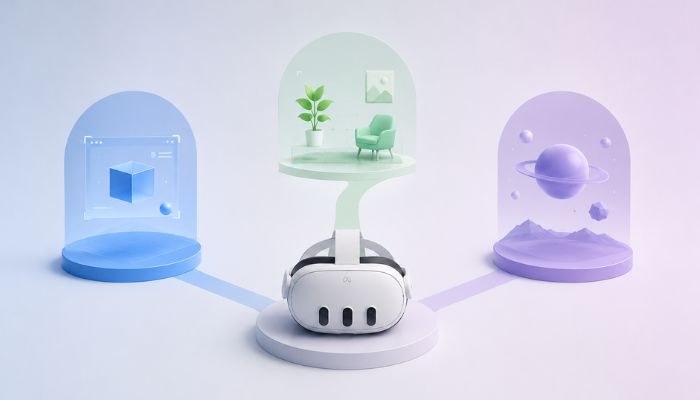
TL;DR: A Decision Framework for Choosing Between AR, VR, and MR. Learn about costs, features, ROI, and how US brands use this technology in 2026.
You walk into a strategy meeting, and someone drops the question that has quietly haunted boardrooms for the last five years: “Should we go with AR, VR, or MR?” Heads nod. People pretend to know. A junior team member opens a tab and starts Googling. By the end of the meeting, a decision gets made, often based on whoever spoke with the most confidence rather than whoever had the clearest reasoning.
This is exactly how immersive technology budgets get burned through with very little to show for it.
The truth is, AR, VR, and MR are not interchangeable. They solve different problems, reach different audiences, and demand very different commitments in terms of time, money, and content strategy. Choosing the wrong one is not just a small misstep; it can be the difference between a project that quietly transforms your customer experience and one that ends up shelved six months after launch.
At Ink & Algorithm, we have worked with brands across retail, real estate, automotive, education, and enterprise training, and the single biggest factor that separates successful immersive projects from forgotten ones is not the size of the budget. It is the quality of the initial decision. So let us walk through a clear, practical framework you can use to choose the right reality for the right reason.
First, Let Us Strip the Jargon
Before any framework is useful, the definitions need to be honest and human. Marketing materials tend to blur these terms because they all sound futuristic. They are not the same thing.
Augmented Reality (AR) keeps your real world intact and adds a digital layer on top of it. You point your phone at a living room, and a virtual sofa appears in the corner. You scan a museum painting, and the artist’s biography pops up beside it. The physical environment is the canvas. The digital content is paint.
Virtual Reality (VR) does the opposite. It replaces the real world entirely. You put on a headset, and you are transported somewhere else, whether that is a Tokyo street, a Mars surface, a virtual training facility, or a fully built but unconstructed apartment. There is no real world anymore, at least for the duration of the experience.
Mixed Reality (MR) is the more sophisticated cousin of both. It places digital objects into your real environment, but those objects understand the space. A virtual ball does not just float through the air; it bounces off your actual table. A digital screen does not just hover in front of you; it stays anchored to your real wall as you walk around. MR understands depth, occlusion, and physical surfaces. Devices like the Apple Vision Pro and Microsoft HoloLens are the most well-known examples.
Each of these has a personality. AR is accessible and casual. VR is intense and immersive. MR is contextual and aware. Choosing between them starts with understanding what kind of experience you actually want to deliver.
Why Picking the Trendiest Option Will Burn You
Here is a pattern we see often. A company hears about a competitor launching a VR experience. Suddenly, a VR project lands on the next quarter’s roadmap, with very little discussion about whether VR actually fits the customer or the problem.
Six months later, that project is collecting dust because customers do not own headsets, the content cannot be updated easily, and the original goal, which was probably “improve product engagement” or “boost online conversions,” could have been solved with a much simpler AR or 3D solution.
Immersive tech is not a trophy. It is a tool. And tools only work when they match the job.
The decision should never start with “which technology do we want?” It should start with “what outcome are we trying to create, and for whom?” Once you answer that, the right format becomes much more obvious.
The Six-Pillar Decision Framework
This is the framework we walk our clients through before a single line of code or 3D asset gets produced. It is built around six pillars. Score honestly across each one, and the right path tends to reveal itself.
Purpose
Start by writing down, in one sentence, what you want the experience to do for the user. Not what it should look like. What it should accomplish.
If the purpose is to help someone visualize a product in their own space before buying it, AR is your answer. If the purpose is to immerse someone in a fully designed environment they cannot physically access, such as an unbuilt property, a remote facility, or a simulated training scenario, VR fits. If the purpose is to let a worker, designer, or learner interact with digital objects while still using their hands in the real world, MR is the strongest match.
Purpose is not just a marketing line. It is the filter that prevents you from building something visually impressive but practically useless.
Audience
Who is going to use this, and what device do they already own?
This pillar alone kills more bad ideas than any other. AR works on the smartphones already sitting in your audience’s pockets. That gives it instant reach. VR requires a headset, which means your audience needs to either own one or come to a physical location where one is available. MR is even more demanding, with hardware that is still expensive and not yet mainstream.
If you are targeting millions of online shoppers, AR scales easily. If you are training a closed group of employees in a controlled setting, VR is practical because you can provide the hardware. If you are building for high-end design teams, surgeons, or industrial engineers, MR becomes a serious contender because the value justifies the hardware.
Match the format to where your audience actually lives, not where you wish they were.
Budget Reality
Each format has different cost structures, and they do not scale the same way.
AR projects, especially WebAR experiences that run in a browser, are typically the most cost-effective entry point. There is no app to download, no hardware to ship, and updates can be rolled out instantly. Our team at Ink & Algorithm often pairs AR with 3D web-based configurators for clients who want a low-friction, high-conversion experience.
VR projects sit in the middle to higher range, depending on the depth of the environment. A walkthrough of a single space might be moderate in cost. A fully interactive training simulation with branching scenarios, voiceovers, and physics-based interactions can run significantly more.
MR projects are usually the most expensive because they require highly optimized 3D content, deep spatial awareness, and tight integration with specific hardware platforms. The audience is smaller, so the cost per user is higher.
Be honest about what your budget can sustain. Not just for the build, but for content updates, support, and future expansion. A cheaper format done well always outperforms an ambitious format done halfway.
Content Lifespan and Update Cycle
How often will the content need to change?
If your product catalog updates every quarter, you need a format that allows fast iteration. AR is the most flexible here. New product models can be added, swapped, or removed without requiring a user to download anything new.
VR experiences are heavier to update because environments are more complex and often require app updates. If your content is meant to last for years with minimal change, like a real estate showcase of a flagship property, this is not a problem. If your content is meant to evolve monthly, this becomes friction.
MR sits closer to VR in terms of update cycles, with the added complexity of testing across different spatial environments.
Think long term. The cheapest version of any immersive project is the one that does not need to be rebuilt every year.
Engagement Depth Versus Reach
There is a natural tradeoff in immersive technology between how deeply someone engages and how easily they can access the experience.
AR delivers wide reach and shorter, lighter engagement. Most AR sessions last seconds or minutes. People dip in, accomplish a task, and exit. This is perfect for product visualization, retail try-ons, and interactive marketing campaigns.
VR delivers narrow reach but extremely deep engagement. People can spend twenty or thirty minutes inside a virtual reality experience without feeling time pass. The audience is smaller, but the emotional and educational impact is far greater.
MR sits between the two, with potential for both reach and depth as the hardware becomes more accessible.
Decide whether you need millions of light touches or thousands of deep ones. Both have value. They just serve different goals.
Measurement and ROI
Finally, ask how you will measure success. This is the pillar most companies skip, and it is the one that turns immersive projects from creative experiments into business wins.
For AR campaigns, you can typically track engagement rate, time spent, share rate, and conversion lift. For VR, you measure training completion, knowledge retention, behavior change, or qualified leads generated. For MR, the metrics are often productivity gains, error reduction, or speed of decision-making in specialized workflows.
If you cannot answer how you will measure success before the project begins, you are not ready to choose a technology yet. Define the metric first. Then pick the format that best supports it.
Walking Through Real-World Scenarios
Frameworks are easier to understand when you see them in motion. Here are a few situations that come up often, and how the framework would steer the decision.
A furniture brand wants to reduce returns by helping customers visualize products before buying. The purpose is product visualization. The audience is shoppers on their phones. The budget is moderate. The content updates seasonally. The engagement is short but high-intent. This points cleanly to AR, ideally paired with a configurator so customers can also customize colors and materials.
A real estate developer wants to sell apartments in a building that will not be finished for two years. The purpose is to give buyers a real sense of the space before it exists. The audience is high-intent prospects, often in a sales gallery. The budget is significant. The engagement needs to feel emotional and complete. This is a VR job, possibly extended with AR on mobile devices for buyers who cannot visit in person.
A medical device company wants to train surgeons on a new procedure. The purpose is high-fidelity skill development. The audience is small, professional, and willing to use specialized hardware. The budget supports premium development. Engagement depth is essential. This is where VR shines, with MR being a serious option if the procedure involves working with real instruments alongside digital guidance.
A car brand wants to let customers configure a vehicle online and see it in their driveway. The purpose is dual: configuration and visualization. The audience is broad. The budget is moderate. This points to a 3D web configurator paired with AR, exactly the kind of project featured throughout our portfolio.
Notice that in each case, the technology was the last thing chosen, not the first.
Industry Snapshots
Different industries lean toward different formats for good reason. Here is a quick map of where each technology tends to fit best.
Retail and e-commerce lean heavily toward AR and 3D configurators because the audience is mobile-first, the buying journey is short, and product variations are wide. Letting a shopper place a product in their own space removes hesitation faster than any product photograph.
Real estate and architecture lean toward VR because clients are evaluating spaces they cannot yet visit. A fully immersive walkthrough creates emotional commitment that flat renderings cannot match. AR plays a supporting role for site visits and on-location previews.
Education and training use VR most effectively when the goal is to simulate real-world scenarios safely. Pilot training, emergency response, surgical practice, and complex machinery operation all benefit from controlled, repeatable immersion. AR works well for on-the-job learning, where a worker needs information overlaid onto real equipment.
Manufacturing and industrial operations are increasingly turning to MR because workers need to keep their hands free while accessing digital information about the machines or environments around them. Maintenance, assembly, and quality control are strong use cases.
Entertainment and marketing can use all three, but the choice depends on whether the goal is broad social reach (AR), deep brand immersion (VR), or premium experiential moments (MR).
Automotive has become one of the most exciting playgrounds for all three formats. AR for showroom visualization, VR for design reviews and dealer training, and MR for engineering collaboration.
If your industry is not on this list, the framework still applies. Start with purpose, audience, and budget, and the right format will surface.
Common Pitfalls That Sink Immersive Projects
Even with a good framework, projects can fail in predictable ways. Here are the traps we watch out for.
Building for the wrong device. Designing a VR experience for an audience that does not own headsets means your reach is essentially zero. Always verify hardware ownership before committing.
Treating immersive tech as a one-time launch. The most successful AR and VR projects evolve over time. Plan for content updates, version improvements, and new features from day one.
Ignoring user comfort. Long VR sessions without thoughtful pacing cause fatigue and motion discomfort. Cluttered AR overlays cause cognitive overload. Good immersive design respects the user’s physical and mental experience.
Skipping the prototype phase. Jumping straight from concept to full development is the fastest way to discover, six months in, that the experience does not work the way the team imagined. A short prototype catches problems before they get expensive.
Confusing visual polish with experience design. A beautifully rendered environment is not the same as a useful one. Make sure interaction design gets at least as much attention as visual design.
Forgetting about discoverability. An AR experience hidden behind a QR code with no marketing support will sit unused. A VR experience locked inside a niche app will never reach its potential audience. Distribution is part of the project.
Validating Your Choice Before Going Big
Once your framework points you toward a format, do not commit your full budget right away. Build a small prototype first. This is the single most valuable investment you can make in immersive technology.
A prototype does not have to be polished. It just needs to test the core experience: can a user accomplish the goal, does the interaction feel natural, does the content load fast enough, does the environment hold attention?
A two-week prototype can save six months of misdirection. Some of the most successful projects we have shipped at Ink & Algorithm started as small, scrappy tests that revealed exactly what the full version needed to be.
Treat the prototype as a learning tool, not a deliverable. The point is not to impress stakeholders with a finished product. The point is to confirm or correct your assumptions while the cost of changing direction is still small. A good prototype should answer three questions clearly: does the experience hold attention long enough to deliver value, does the technology perform reliably across the devices your audience actually uses, and does the user emerge from the experience with the intended emotion, knowledge, or action?
If the answer to any of those questions is no, that is not a failure. That is the prototype doing its job. Adjust the format, refine the interaction, or revisit the framework. It is far better to discover misalignment now than after a full production cycle.
Future-Proofing Your Decision
The lines between AR, VR, and MR are starting to blur. New devices are emerging that handle all three formats in a single interface. This is good news, but it does not change the framework. It just means that whatever you build today should be designed with portability in mind.
A few practices to keep your project future-ready:
Keep your 3D assets in formats that work across platforms, not locked into one engine or one device. Treat your content as modular, so an AR experience can be repurposed for VR later without rebuilding from scratch. Design interactions that focus on intent rather than specific gestures, so they can adapt as hardware evolves. Plan for accessibility from the start, because immersive tech that excludes users is immersive tech with a shrinking audience.
The companies that will win the next decade of immersive technology are not the ones chasing the newest device. They are the ones with a flexible, well-designed content library that can move with the industry.
Where Ink & Algorithm Fits Into the Picture
The framework above is the same one we use internally with every new client. We do not start projects by asking what you want built. We start by asking what you want to achieve, who needs to experience it, and what success looks like on the other side.
Our team specializes in augmented reality development, virtual reality experiences, 3D web-based configurators, and animation that brings concepts to life across industries. Whether you are still trying to figure out which format fits your goal or you have a clear vision and need a partner to execute it, we can help you move from concept to launch with clarity and confidence.
You can explore our recent work in our portfolio, browse more insights on our blog, or reach out to start a conversation about your project.
Final Thought
AR, VR, and MR are not competing technologies. They are different instruments in the same orchestra. The wrong choice is not picking the wrong tool. The wrong choice is picking a tool without knowing what song you are trying to play.
Start with the outcome. Understand your audience. Be honest about your budget and timeline. Prototype before you commit. And remember that the most powerful immersive experiences are not the ones with the highest-end graphics or the newest hardware. They are the ones built with intention.
Ready to get started? Contact Ink & Algorithm to discuss your project—we’ll help you create results that drive sales.
Cost & Pricing
| Service | Cost Range | Timeline |
|---|---|---|
| Basic package | $5,000-$15,000 | 2-4 weeks |
| Standard package | $15,000-$50,000 | 4-8 weeks |
| Premium package | $50,000-$150,000+ | 8-16 weeks |
FAQ
How much does a decision framework for choosing cost?
The cost varies based on project scope and complexity. Contact us for a custom quote tailored to your specific needs.
How long does a decision framework for choosing take?
Typical projects take 2-8 weeks depending on scope. We provide detailed timelines during consultation.
Do you work with US brands?
Yes, we work with US brands across all 50 states. Our team understands the US market and delivers solutions that drive results.