
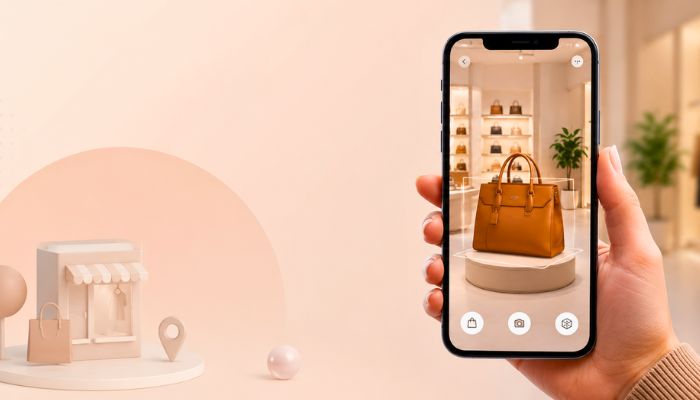
TL;DR: AR App Development for Retail. Learn about costs, features, ROI, and how US brands use this technology in 2026.
Let’s be honest — shopping has changed. Customers no longer just walk into a store, pick something off the shelf, and call it a day. They research, they compare, they visualize. And increasingly, they expect the brands they buy from to meet them at that level of experience. That is exactly where augmented reality (AR) comes in.
AR app development for retail is no longer a futuristic experiment reserved for tech giants. It is a practical, proven strategy that businesses of all sizes are using to bridge the gap between the digital and physical world. Whether it is letting someone virtually try on a pair of sunglasses from their couch or placing a sofa inside their living room before clicking “buy,” AR is doing something traditional e-commerce never could — giving customers confidence before they commit.
This article breaks down everything you need to know: what AR in retail actually looks like, why it works, what features matter, and how to get started building one for your business.
What Is AR App Development for Retail, Really?
Augmented reality overlays digital content — 3D models, animations, information, or interactive elements — onto the real world through a camera-enabled device. In a retail context, this means a customer can use their smartphone or tablet to see exactly how a product looks in their own space, on their own body, or in motion before making a purchase.
AR app development for retail refers to the full process of designing, building, and deploying these experiences — from the initial concept and 3D asset creation all the way through to app testing, launch, and ongoing updates. It is part software engineering, part creative design, and part deep understanding of consumer psychology.
Unlike virtual reality, which requires a headset and takes users into a fully digital environment, AR works within the real world. That practicality is exactly why it has taken off in retail — no extra hardware required, no learning curve, just point your phone and see.
The Different Types of AR Experiences in Retail
- Product visualization: See furniture, appliances, or décor placed inside your actual room
- Virtual try-on: Try clothing, eyewear, shoes, jewelry, or even makeup on your face or body in real time
- In-store AR navigation: Guide shoppers to products using AR overlays on their phone camera
- Packaging AR: Scan a product box to unlock videos, recipes, instructions, or brand stories
- AR marketing campaigns: Social filters and shareable AR experiences that drive brand engagement
Why AR App Development for Retail Actually Matters Right Now
There is a reason major retail brands have been quietly pouring resources into AR over the past few years. The numbers tell a clear story. Return rates in e-commerce hover around 30% on average — and a significant chunk of those returns happen because the product looked different in person than online. AR directly attacks that problem by letting customers make more informed decisions upfront.
Beyond reducing returns, AR creates a completely different kind of engagement. When someone can place a virtual coffee table in their living room and see exactly how it fits, that is no longer a passive browsing experience — it is an interactive, personal one. And interactive experiences convert significantly better than static ones.
The Business Case: Real Numbers Behind the Technology
Retailers who have integrated AR into their customer journeys report measurable lifts across multiple KPIs. Conversion rates improve because shoppers who engage with AR features are more confident in their purchase decisions. Average order values increase because customers who interact with products virtually tend to explore more options and upgrade more readily. And return rates drop because the guesswork is removed.
Customer satisfaction scores also improve. When people feel empowered to make the right choice — when they are not relying on luck or a product description — they walk away happier. That satisfaction translates directly into repeat purchases, positive reviews, and organic word-of-mouth growth.
Perhaps most importantly, AR creates a meaningful brand differentiator at a time when competition in retail has never been fiercer. Offering an AR experience signals to customers that your brand is forward-thinking, customer-focused, and invested in their experience beyond the transaction.
Which Retail Sectors Are Benefiting Most from AR?
AR is not a one-size-fits-all solution, and honestly, that is part of its appeal. Different retail categories find different kinds of value depending on their products and customer base. Here is how AR is showing up across the industry:
Home Furnishings and Interior Design
This is arguably where AR has had the most obvious and dramatic impact. Buying furniture online has always carried risk — dimensions are easy to misread, and colors on screen rarely match real life. AR lets shoppers place true-to-scale 3D models of sofas, beds, shelves, and lighting fixtures directly in their rooms. They can walk around them, check clearances, and compare options side by side. The decision that used to require a trip to the showroom can now happen from the bedroom at 11pm.
Fashion and Apparel
Virtual try-on technology has matured rapidly in recent years. Modern fashion AR can map clothing to body shapes in real time using front-facing cameras, allow shoppers to try multiple colors or styles without loading times, and even simulate fabric drape and movement. The result is a try-before-you-buy experience without the changing room — and without the shipping back-and-forth when something does not fit right.
Beauty and Cosmetics
The beauty industry was one of the earliest adopters of AR try-on, and for good reason. Makeup is deeply personal and deeply visual. Being able to see how a lipstick shade or foundation tone looks on your actual skin, under your actual lighting, is a game-changer for online shoppers who previously relied entirely on swatches and user reviews. AR in beauty also opens doors for real-time product recommendations based on skin tone detection — a genuinely useful, personalized experience rather than just a gimmick.
Consumer Electronics
Buying a TV, monitor, or sound system online involves a lot of guesswork around size and placement. AR removes that entirely. Shoppers can place a life-size 3D model of a 65-inch television on their actual wall, see how it compares to their current setup, and confirm it fits before ordering. For accessories like headphones or wearables, virtual fitting eliminates the “is this too bulky?” uncertainty.
Core Features That Make a Retail AR App Actually Work
Not all AR apps are created equal. The difference between an AR experience that genuinely helps customers and one that feels like a tech demo comes down to a handful of key features and design decisions. Here is what separates good AR retail apps from great ones:
Accurate Surface Detection and Spatial Mapping
If a virtual product floats above the floor or clips through a wall, the experience immediately breaks. The foundation of any good AR retail app is robust surface detection — the ability to identify floors, walls, and horizontal surfaces accurately so that 3D objects anchor correctly. Technologies like ARKit for iOS and ARCore for Android have matured significantly, making this more reliable than ever, but it still requires careful implementation and testing across diverse real-world environments.
High-Quality 3D Product Models
The 3D models you use define the quality of the experience. Realistic textures, accurate dimensions, and proper lighting response are non-negotiable. Customers will notice if a sofa looks plastic-y or if a shoe lacks detail — and they will make purchase decisions accordingly. This is an area where investing in quality pays for itself directly through higher conversion rates. It is also worth noting that 3D assets created for AR can often be repurposed for web-based 3D configurators, product pages, and marketing materials, making them a versatile investment.
Seamless Integration with Your Product Catalog
An AR feature that only covers ten products out of a thousand is not doing its job. Effective AR app development for retail requires a scalable pipeline — a way to create, update, and manage 3D assets across your full product catalog as it grows and changes. Integration with your existing e-commerce platform, inventory system, and CMS ensures the AR experience stays current without requiring a massive manual effort every time a product changes.
One-Tap Sharing and Social Features
Some of the best free marketing a retailer can get comes from customers sharing AR product photos with friends or on social media. “Look at this sofa I’m thinking about” is genuine, organic word-of-mouth. Building easy, frictionless sharing into your AR app turns every engaged user into a potential brand ambassador — and the visual nature of AR content makes it naturally compelling to share.
Direct-to-Cart Functionality
The AR experience should be a step in the purchase journey, not a detour from it. When a customer has visualized a product and they are ready to buy, they should be able to add it to their cart directly from the AR view — no jumping back to a product page, no friction. The shorter the path from “I love this” to “I bought this,” the better.
What Does the AR App Development Process Actually Look Like?
One of the most common questions retail brands ask when exploring AR is: how does this actually get built? The process is more structured than most people expect, and understanding it helps set realistic timelines and expectations.
Step 1: Discovery and Strategy
Every successful AR project starts with clarity about what you are trying to achieve. Are you trying to reduce returns? Drive more online conversions? Differentiate from competitors? The goals shape every decision downstream — which features to build, which products to prioritize for 3D modeling, which platforms to support, and how to measure success. A good development partner spends time here before writing a single line of code.
Step 2: 3D Asset Creation
This is often the most time-intensive part of the process, especially for retailers with large catalogs. Each product needs a 3D model built from reference materials — product photos, technical drawings, physical samples, or CAD files if available. The models are then optimized for mobile performance without sacrificing visual quality. Setting up an efficient 3D pipeline early makes scaling far more manageable.
Step 3: AR Development and Integration
With assets ready, the development team builds the AR experience itself — surface detection, object placement, scaling, rotation, lighting, and all the interaction logic. This layer is then integrated with your existing e-commerce infrastructure: product catalog, user authentication, cart functionality, and analytics. A well-architected integration means the AR feature grows seamlessly with your business.
Step 4: Testing Across Real-World Conditions
AR behaves differently across device models, lighting conditions, surface types, and real-world environments. Testing needs to be rigorous and deliberately varied — not just across device models but across the kinds of spaces and conditions your actual customers will use. A coffee table that renders beautifully in a developer’s bright, open-plan office might behave strangely in a small, dimly lit apartment. Real-world testing is not optional.
Step 5: Launch, Measure, and Iterate
An AR app is not a set-and-forget project. Post-launch, you will have real data on how customers are using the feature — which products they visualize most, where they drop off, what leads to purchases. That data is gold. The best AR experiences improve continuously based on actual usage, expanding to more products, adding new features, and refining based on what customers show you they want.
How to Choose the Right AR App Development Partner for Your Retail Business
Choosing a development partner for an AR project is a significant decision, and it is worth being deliberate about it. Here are the qualities that matter most:
- Retail-specific experience: Have they built AR for retail before, or are they primarily a gaming or enterprise AR studio? Retail has unique requirements around catalog management, mobile optimization, and the purchase journey.
- Strong 3D capabilities: AR is only as good as the assets behind it. Look for agencies with in-house 3D modeling and rendering talent, not just developers who outsource the visual work.
- End-to-end ownership: The best partners handle strategy, 3D creation, development, integration, and post-launch support — rather than handing you off between vendors for different pieces.
- Transparent process: Good agencies keep you involved at every stage. You should know what is being built, why decisions are being made, and how progress is being measured.
- Portfolio you can see and touch: Ask to interact with their previous AR work, not just see screenshots. The hands-on quality of an AR experience tells you far more than any case study.
Common Mistakes to Avoid When Building Retail AR
A lot of early retail AR implementations failed not because the technology does not work, but because of avoidable mistakes in execution. The most common pitfalls are worth knowing upfront:
- Low-quality 3D assets: Nothing kills an AR experience faster than plastic-looking models. If the virtual product does not look good, customers associate that quality with the real product.
- Poor mobile performance: Slow loading and laggy AR cause immediate abandonment. Optimization for mobile hardware is not optional.
- Treating AR as a gimmick: AR works when it genuinely helps customers make better decisions. If it is added just for novelty without solving a real problem, customers will use it once and never return.
- Forgetting the non-AR path: Not every customer will use AR. Make sure the traditional shopping experience is still excellent — AR should enhance the journey, not replace a broken one.
- Skipping measurement: If you are not tracking AR engagement, conversion rates, and return rates, you have no way to prove value or improve the experience.
The Future of AR in Retail: Where This Is All Heading
The trajectory of AR in retail points in one direction: deeper integration and wider adoption. A few trends worth watching closely:
WebAR — augmented reality experiences that run directly in a mobile browser without requiring an app download — is rapidly maturing. This dramatically lowers the barrier to entry for customers and eliminates the friction of app installation. Retailers who build AR-first shopping experiences that work natively in the browser will have a meaningful advantage in reach.
AI-powered personalization is beginning to combine with AR in interesting ways. Imagine an AR experience that not only lets you try on glasses but recommends frames based on your face shape, skin tone, and past purchase history — all in real time. That kind of deeply personalized AR is becoming technically feasible, and the retailers who build it first will earn serious loyalty.
Social commerce is also pulling AR along. As platforms increasingly blur the line between discovery and purchase, AR filters and experiences that live natively in social environments will become a primary touchpoint in the retail customer journey — not a supplementary one.
Final Thoughts: Is AR App Development Right for Your Retail Business?
If you sell products where fit, size, scale, color, or style matters — and honestly, what retail category does not? — AR app development is worth taking seriously. This is not a technology in search of a problem. The problem has existed for as long as online retail has: customers cannot touch or try what they are buying, and that uncertainty costs everyone.
AR addresses that uncertainty directly. It gives customers the confidence to buy, the tools to decide well, and an experience they remember and share. For retailers, the downstream effects — fewer returns, higher conversions, stronger brand loyalty — are measurable and real.
The question is not really whether AR fits retail. It is whether you want to be among the brands that led the shift or among those who followed once it became standard. The technology is ready. The customer appetite is there. The only remaining variable is whether your business is ready to meet them in it.
At Ink & Algorithm, we build immersive AR experiences for retail brands that want to go beyond the ordinary. From 3D asset creation to full AR app development and e-commerce integration, we handle every piece of the process so you can focus on what you do best — running your business. If you are ready to explore what AR could look like for your brand, let’s talk.
Ready to get started? Contact Ink & Algorithm to discuss your project—we’ll help you create results that drive sales.
Cost & Pricing
| Service | Cost Range | Timeline |
|---|---|---|
| Basic package | $5,000-$15,000 | 2-4 weeks |
| Standard package | $15,000-$50,000 | 4-8 weeks |
| Premium package | $50,000-$150,000+ | 8-16 weeks |
FAQ
How much does ar app development for retail cost?
The cost varies based on project scope and complexity. Contact us for a custom quote tailored to your specific needs.
How long does ar app development for retail take?
Typical projects take 2-8 weeks depending on scope. We provide detailed timelines during consultation.
Do you work with US brands?
Yes, we work with US brands across all 50 states. Our team understands the US market and delivers solutions that drive results.