
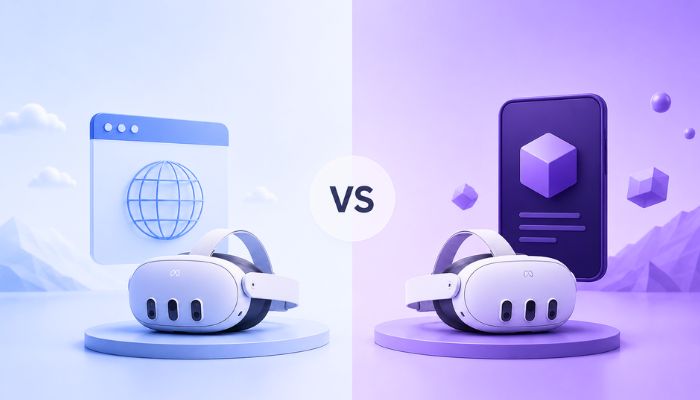
TL;DR: WebVR vs Native VR App Development. Learn about costs, features, ROI, and how US brands use this technology in 2026.
Introduction: Two Roads Into the Same Immersive Future
If you’re planning a VR project in 2026, you’ll eventually hit a fork in the road that every product owner, developer, and business stakeholder has to navigate: do you build for the browser, or do you build a native application?
It sounds like a simple technical decision. It isn’t. The choice between WebVR and native VR app development shapes your budget, your timeline, the devices your audience can use, the depth of experience you can deliver, and even how discoverable your product is. Get it right, and you build something that reaches the right audience efficiently. Get it wrong, and you might spend months building a beautiful experience that almost nobody can access.
This article breaks down exactly how WebVR and native VR development differ in 2026, where each one shines, where each one falls short, and how to make the right call for your specific project. Whether you’re a startup founder, a marketing director, or a product manager evaluating your options, by the end of this you’ll have a clear framework for deciding.
What Is WebVR (and WebXR) in 2026?
Browser-Based Immersion, No Installation Required
WebVR — now more accurately referred to under the broader WebXR standard — refers to virtual reality experiences that run directly inside a web browser. There’s no app to download, no app store approval process, and no installation step standing between a user and the experience. A user simply clicks a link, and the VR environment loads, ready to explore either on a headset or, in many cases, as a 3D interactive scene on a standard screen.
This browser-native approach has matured enormously since the early days of experimental WebVR prototypes. In 2026, WebXR-based experiences support full headset tracking, hand controller input, spatial audio, and high-quality real-time rendering — all running through standard web technology.
How WebVR Technology Works
Modern WebVR experiences are built using WebGL and WebGPU rendering pipelines, often powered by JavaScript frameworks designed specifically for 3D and XR content. These frameworks handle the complex work of rendering 3D scenes, managing headset input, and optimizing performance — all while running inside the sandboxed environment of a web browser.
Because everything runs through the browser, a single WebVR build can typically be accessed across a wide range of devices and headsets that support WebXR — without separate builds for each platform. This cross-compatibility is one of WebVR’s most significant advantages, and a major reason agencies like Ink N Algorithm increasingly recommend it for projects that prioritize broad accessibility.
What Is Native VR App Development in 2026?
Built for the Platform, Optimized to the Metal
Native VR development means building an application specifically for a target VR platform — using that platform’s software development kit, native programming languages, and direct access to hardware capabilities. The resulting app is downloaded and installed from a platform-specific store, just like any other mobile or desktop application.
Because native apps have direct, low-level access to the device’s hardware — its processor, graphics chip, sensors, and memory — they can achieve a level of performance and visual fidelity that browser-based experiences often struggle to match, particularly for graphically demanding or highly interactive content.
How Native VR Development Works
Native VR apps are typically built using dedicated game engines that compile directly to the target platform, giving developers fine-grained control over rendering, physics, and performance optimization. This level of control allows native apps to push visual quality, frame rates, and interaction complexity further than is typically possible in a browser environment.
The tradeoff is platform fragmentation. A native VR app built for one headset ecosystem generally needs to be rebuilt, or at least substantially reconfigured, to run on a different one — multiplying development effort for projects that need to reach users across multiple VR platforms.
WebVR vs Native VR: Side-by-Side Comparison
Here’s how the two approaches stack up across the factors that matter most when making this decision:
| Factor | WebVR / WebXR | Native VR App |
| Accessibility | Instant access via link, no install required | Requires download and install from app store |
| Development Cost | Generally lower — one build, multiple platforms | Higher — often rebuilt per platform |
| Performance | Good, improving rapidly, some ceiling vs native | Best possible — direct hardware access |
| Visual Fidelity | High quality, occasional limits on complex scenes | Highest achievable fidelity |
| Distribution | Share a link — social media, email, QR code | App store listing, discovery, approval process |
| Update Speed | Instant — update the web build, done | Requires app store review for updates |
| Offline Use | Limited without additional setup | Fully supported natively |
| Cross-Platform Reach | Broad — most modern headsets support WebXR | Narrow — typically one ecosystem per build |
| Best For | Marketing, product demos, virtual tours, broad reach | Training sims, games, enterprise tools needing top performance |
When You Should Choose WebVR
You Need Maximum Reach With Minimum Friction
If your goal is to get as many people as possible into your VR experience — for a marketing campaign, a product launch, or a virtual showroom — WebVR is almost always the right call. The ability to share a single link that works across devices, with zero installation required, removes the single biggest drop-off point in any digital funnel: the moment a user is asked to download something before they’ve even experienced the value.
Your Project Has a Limited or Uncertain Timeline
Marketing campaigns, trade show activations, and seasonal promotions often have tight, fixed deadlines. WebVR’s faster development cycle and single-build-multiple-platform approach make it far better suited to these time-sensitive projects than native development, which typically requires longer build and testing cycles.
You Want to Reach Users Who Don’t Own Dedicated Headsets
Not every potential user owns a VR headset, but WebXR experiences can often be explored in a degraded but still useful form directly on a phone or desktop screen — letting users without VR hardware still engage with a 3D, interactive version of the experience. This dramatically expands your addressable audience compared to a native app that requires specific hardware from the outset.
You Need to Update Content Frequently
If your VR experience needs to change regularly — new products, seasonal content, evolving messaging — WebVR’s instant update capability is a significant advantage. There’s no app store review process standing between making a change and your users seeing it.
When You Should Choose Native VR Development
Performance and Visual Fidelity Are Non-Negotiable
For projects where every frame matters — high-end training simulations, complex industrial visualization, or VR gaming — native development’s direct hardware access delivers a level of performance and visual quality that browser-based experiences can struggle to match consistently across all devices.
You Need Offline Functionality
Training environments deployed in factories, remote sites, or areas with unreliable internet access often require fully offline functionality. Native apps handle this naturally, while WebVR experiences generally depend on a stable connection, at least for initial loading.
Your Project Is a Long-Term Platform, Not a Campaign
If you’re building an ongoing product — an enterprise training platform, a VR fitness app, a persistent virtual environment — the investment in native development often pays off over time through better performance, deeper platform integration, and a more polished user experience that builds loyalty.
You Need Deep Integration With Device Hardware
Certain features — advanced haptic feedback, specific sensor data, deep integration with platform-specific social or store features — are sometimes only accessible through native development kits, making native the only viable path for projects that depend on this level of hardware integration.
The Hybrid Approach: Using Both Strategically
In 2026, an increasing number of businesses aren’t choosing one approach exclusively — they’re using both strategically across the customer journey.
A common and highly effective pattern looks like this: a WebVR experience serves as the top-of-funnel touchpoint — easily shareable, instantly accessible, used for marketing, lead generation, and initial product exploration. For users who convert into deeper engagement — enterprise clients, trained staff, loyal customers — a native app delivers the premium, fully-featured experience once that relationship is established.
This hybrid strategy lets businesses maximize reach at the top of the funnel without sacrificing performance and depth where it matters most. Development teams experienced in both approaches, like those at Ink N Algorithm, can help architect this kind of layered strategy rather than forcing an either-or decision.
Industry-Specific Considerations for 2026
Real Estate
WebVR dominates here. Property tours need to be shared instantly via a link, viewed by buyers on any device, and updated frequently as listings change. The friction of requiring an app download for a single property viewing would eliminate most potential buyers before they even saw the listing.
Automotive
Automotive configurators and showroom experiences increasingly favor WebVR for the same reach-driven reasons as real estate, though flagship dealership installations sometimes use native VR for the most premium, fully controlled in-showroom experience.
Corporate Training and Industrial Simulation
Native VR remains the standard here, particularly for safety-critical training where performance, offline reliability, and precise hardware integration directly affect training quality and outcomes.
Education
A mixed picture: WebVR works well for broadly accessible educational content reaching many students across varied devices, while native apps suit dedicated VR labs and immersive learning environments where schools have invested in specific headset hardware.
E-Commerce and Product Visualization
WebVR is the clear winner for most e-commerce use cases, where the priority is letting as many potential customers as possible experience a product in 3D or VR without any barrier to entry.
A Practical Framework for Making the Decision
Use these questions to guide your decision-making process:
- How important is reach versus depth? If your priority is reaching the widest possible audience with minimum friction, lean WebVR. If you need the deepest, most polished experience for a defined user base, lean native.
- What’s your timeline and budget? WebVR typically offers faster development and lower cost due to its single-build-multiple-platform nature. If your timeline or budget is constrained, this matters significantly.
- Does your use case require offline functionality? If yes, native is generally necessary. If users will always have internet access, WebVR remains fully viable.
- How often will content need to update? Frequent updates favor WebVR’s instant deployment over native’s app store review cycles.
- Is this a campaign or a long-term platform? Time-limited campaigns favor WebVR’s speed and reach. Long-term, evolving platforms may justify native’s upfront investment.
- Could a hybrid approach serve both goals? Consider whether a WebVR front door paired with a native app for deeper engagement might outperform either approach alone.
WebVR and Native VR Trends Heading Into Late 2026
The gap between WebVR and native VR continues to narrow as browser technology advances. Here’s what to watch:
- WebGPU adoption: the newer WebGPU rendering standard is closing much of the performance gap that previously separated browser-based and native rendering, enabling more visually complex WebVR experiences than ever before.
- Progressive Web Apps with offline VR support: emerging capabilities are allowing WebVR experiences to cache content for limited offline use, chipping away at one of native’s traditional advantages.
- Standardized WebXR device support: as more headset manufacturers fully commit to WebXR standards, cross-device compatibility for browser-based VR continues to improve.
- AI-assisted development pipelines: tools that help generate and optimize 3D assets and interactions are reducing development time for both WebVR and native projects, narrowing the cost gap between the two approaches.
For ongoing insights into how these trends are shaping real client projects, Ink N Algorithm continues to track developments across both WebVR and native VR development as the technology evolves.
Frequently Asked Questions
Is WebVR as good as native VR in 2026?
WebVR has closed much of the performance gap with native development, particularly with the adoption of WebGPU. For most marketing, product visualization, and broad-reach use cases, WebVR delivers a genuinely excellent experience. For the most graphically demanding or performance-critical applications, native development still holds an edge.
Can a WebVR experience be turned into a native app later?
In many cases, yes — particularly if the underlying 3D assets and logic were built with portability in mind. However, it’s rarely a simple copy-paste process; expect some level of rebuilding to take full advantage of native platform capabilities.
Which is more cost-effective for a small business?
WebVR is generally more cost-effective for small businesses, particularly because a single build can reach users across multiple devices and platforms without the cost multiplication that comes with building separate native apps for different VR ecosystems.
Conclusion: There’s No Universal Right Answer
WebVR and native VR development aren’t competing technologies fighting for the same use case — they’re different tools designed for different jobs. WebVR wins when reach, speed, and accessibility matter most. Native VR wins when performance, depth, and platform-specific capability are the priority.
The businesses getting the most value from VR in 2026 aren’t the ones dogmatically committed to one approach — they’re the ones who’ve taken the time to understand their specific goals, audience, and constraints, and chosen the technology that actually serves them.
If you’re still weighing this decision for your own project, working with a team that has genuine experience across both WebVR and native VR development — rather than a team that only knows one — makes a real difference in getting the recommendation right. Ink N Algorithm works across both approaches, helping businesses choose and build the VR strategy that actually fits their goals, not just the one that’s easiest to sell.
Ready to get started? Contact Ink & Algorithm to discuss your project—we’ll help you create results that drive sales.