
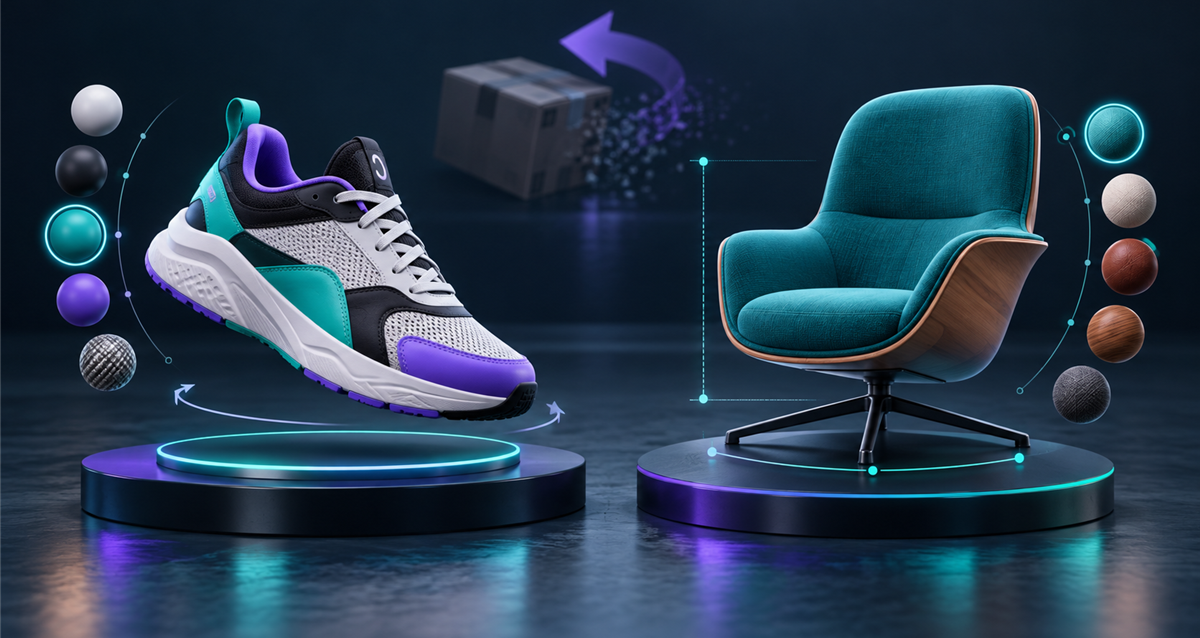
Ecommerce returns erode margin twice: once through refunded revenue and again through reverse logistics, inspection, repackaging, discounting, and customer-support costs. For customized products, the damage can be even greater because returned inventory may be difficult to resell.
A high-performance 3D product configurator helps close the expectation gap before checkout. Shoppers can inspect scale, materials, finishes, proportions, and compatible options in real time, creating a clearer mental model of what will arrive. The result is not simply more engagement—it is better-informed purchase intent.
The Ecommerce Return Crisis: Why Visual Expectation Mismatch Is So Expensive
Direct answer: Ecommerce return rates rise when the product received does not match the shopper’s visual or functional expectations. Apparel, footwear, furniture, and customized goods are especially exposed because fit, scale, material, color, and option compatibility are difficult to judge from static images alone.
Return-rate benchmarks vary by category, market, and methodology, but retailers frequently report that apparel and customized products experience materially higher returns than standard goods. A 20% to 35% range may appear in industry discussions, yet the more important metric is the reason code behind each return.
If “not as expected,” “wrong size,” “color looked different,” or “configuration did not fit” repeatedly appears in return data, the product page is failing to communicate a purchase-critical detail. Adding more gallery images may help, but it does not always solve the underlying uncertainty.
A configurator changes the decision environment. Instead of asking shoppers to infer the final product from separate swatches and thumbnails, it assembles the selected choices into one interactive, coherent preview. This is particularly valuable when a product has many variants or when one option changes the appearance of another.
The Sensory Gap: Where Flat Product Photography Falls Short
Direct answer: Flat photography communicates a fixed view under one lighting setup, but it cannot fully show dimensional scale, surface roughness, reflections, depth, or how multiple selected components work together. Interactive 3D reduces this sensory gap by letting shoppers examine the product from relevant angles and conditions.
Scale and Proportion
A furniture image may look convincing while still leaving the shopper unsure about its true footprint. Accurate dimensions, human-scale references, room context, and interactive measurement callouts help buyers understand whether a product fits their space. The same principle applies to luggage, machinery, footwear, fixtures, and accessories.
Material Roughness and Reflectivity
Physically based rendering can communicate meaningful differences between matte, brushed, polished, woven, leather, plastic, and metallic surfaces. The goal is not cinematic exaggeration. The lighting and material response should be calibrated to represent the product faithfully across common viewing conditions.
Color Under Varied Lighting
Color accuracy depends on source texture quality, display calibration, tone mapping, and lighting. A configurator can offer neutral studio light and selected environmental conditions, helping customers understand how a finish may appear in brighter, warmer, or cooler settings. Clear disclaimers should still acknowledge normal display variation.
Ink & Algorithm’s web-based 3D configurator development focuses on accurate product communication as well as visual quality.
Psychological Ownership and the Endowment Effect
Direct answer: Psychological ownership begins when shoppers invest attention and personal choices into a product. Rotating a model, selecting materials, and building a preferred configuration can make the item feel personally relevant before purchase, increasing confidence and emotional commitment to the final selection.
Passive browsing asks customers to evaluate a product chosen by the merchant. Configuration asks them to participate. Each selection—color, finish, component, engraving, accessory, or size—becomes part of a small creation process.
This interaction can strengthen the endowment effect, in which people assign more value to something they perceive as theirs. In commerce, the practical benefit is not manipulation; it is decision clarity. The buyer understands what they selected, why they selected it, and how the final combination should look.
The interface must preserve that confidence. If selections reset, prices update unexpectedly, or the cart shows generic variant names, ownership collapses into uncertainty. The configured preview, summary, price, SKU or BOM data, and cart line-item details should remain synchronized from product page to checkout.
Measuring the Impact of 3D Configuration on Returns
Direct answer: The impact of a 3D configurator should be measured with controlled ecommerce data, not engagement alone. Compare return rates, return reasons, conversion, configuration completion, support contacts, and net revenue by product cohort before and after launch while accounting for seasonality and merchandising changes.
Claims of 28% to 40% return reduction may be achievable in some implementations, but no responsible partner should guarantee that range without baseline data. Results depend on product category, existing photography quality, configuration accuracy, traffic mix, fulfillment, sizing, and the reasons customers currently return products.
A practical measurement framework includes:
- Return rate: returned units divided by delivered units for comparable products.
- Expectation-mismatch returns: returns attributed to color, material, appearance, scale, fit, or incorrect combinations.
- Net conversion rate: completed orders that remain kept after the return window.
- Configuration completion: shoppers who reach a valid, purchasable configuration.
- Support burden: presale questions and post-purchase complaints related to product understanding.
- Net margin: revenue after refunds, reverse logistics, refurbishment, and discounting.
Teams should instrument both the configurator and the commerce platform. Events such as first interaction, variant selection, invalid combination, dimension-view use, save or share, add to cart, purchase, and return reason create a useful behavioral trail.
For complex builds, our guide to headless 3D configurator architecture explains how rendering, application state, and commerce APIs can remain decoupled.
A Five-Step Shopify Plus Implementation Checklist
Direct answer: A return-reduction configurator needs accurate assets, calibrated materials and lighting, visible dimensions, validated product rules, and dependable Shopify cart synchronization. Performance must also be budgeted so the 3D experience improves product confidence without damaging mobile speed or Core Web Vitals.
1. Audit Return Reasons Before Designing the Experience
Begin with return data, customer-service transcripts, reviews, and merchandising feedback. Identify which uncertainties the configurator must resolve. If most returns are sizing-related, a beautiful color customizer alone will not solve the business problem.
2. Build Calibrated 3D Assets and Lighting
Optimize CAD or source models for real-time delivery while protecting the silhouette and purchase-critical details. Use physically based materials, approved color values, and repeatable lighting rigs. Validate output with product, brand, and merchandising stakeholders before launch.
3. Add Accurate Dimensions and Context
Show dimensions where they influence the purchase decision. Depending on the product, this may include measurement overlays, room-scale placement, component clearance, size comparisons, or fit guidance. Callouts should be readable on mobile without covering the product.
4. Validate Variants and Configuration Rules in Real Time
Prevent impossible combinations before they reach the cart. The interface should explain why an option is unavailable and present a valid alternative. Shopify variant IDs, custom properties, pricing, inventory, SKU data, and enterprise CPQ rules must remain synchronized.
5. Protect Performance and Measure the Outcome
Serve an immediate 2D fallback, reserve stable layout space, lazy-load the renderer, compress geometry with Draco, use KTX2 textures, and split optional assets. Ink & Algorithm combines high-performance web development with real-time 3D engineering so conversion improvements do not come at the cost of page speed.
Turn Product Confidence Into Higher Net Margin
Direct answer: The strongest business case for interactive 3D is not novelty—it is better purchase accuracy. When shoppers understand dimensions, materials, colors, and valid combinations before checkout, retailers can improve customer confidence, protect net margin, and reduce avoidable expectation-mismatch returns.
A 3D product configurator should be planned around the causes of profit erosion, not simply around visual features. The right implementation connects accurate product visualization with variant rules, analytics, cart data, and measurable operational outcomes.
If your Shopify Plus team is evaluating interactive 3D for footwear, fashion, furniture, or customized goods, schedule a technical consultation with Ink & Algorithm. We can review your return reasons, product complexity, performance targets, and integration requirements before defining the right architecture.
Frequently Asked Questions
Direct answer: Retail teams commonly ask whether 3D configurators genuinely reduce returns, how they connect with Shopify variants, and whether WebGL harms mobile performance. The answers depend on implementation quality, product accuracy, and measurement discipline rather than the presence of a 3D viewer alone.
Can a 3D product configurator reduce ecommerce returns?
It can reduce returns caused by visual expectation mismatch, incompatible choices, misunderstood scale, and unclear materials. It will not solve fulfillment errors, product defects, inaccurate sizing data, or permissive return policies by itself.
Will a WebGL configurator slow down Shopify?
Not when it is engineered with strict performance budgets. Lazy loading, compressed geometry, KTX2 textures, modular assets, an immediate 2D fallback, and real-device testing can protect Core Web Vitals and mobile interaction.
How does a configurator connect to Shopify Plus?
Standard selections can map to Shopify variants, while custom choices are stored as line-item properties or configuration IDs. Enterprise implementations may also connect to CPQ, ERP, CRM, inventory, and manufacturing systems through APIs.
Which products benefit most from interactive 3D?
Products with meaningful visual variation, complex compatibility rules, difficult-to-communicate scale, premium materials, or costly returns often have the clearest business case. Common examples include footwear, furniture, equipment, fixtures, vehicles, and made-to-order goods.