
What is WebAR and how is it disrupting US retail in 2026?
WebAR is augmented reality delivered directly through a mobile browser — no app download required. A shopper scans a QR code on product packaging, clicks a link in a social ad, or taps a button on a product page and immediately enters an AR experience through Safari or Chrome. In US retail in 2026, WebAR is disrupting four critical areas: ecommerce product visualization (try before you buy), in-store activation (scan-and-experience packaging), social commerce (AR try-on filters that link to checkout), and B2B showrooming . US retailers deploying WebAR report 94% higher conversion for AR-engaged shoppers, 40% lower return rates, and 2.4× higher social sharing rates. Ink & Algorithm builds custom WebAR experiences for US retailers — browser-delivered, zero friction, connected to Shopify and WooCommerce.
The App Download Problem That WebAR Finally Solved
For the better part of a decade, augmented reality’s commercial potential in US retail was held back by a single friction point: the app download. Brands built impressive AR experiences — virtual try-on, product placement, interactive packaging — and then watched adoption rates fall flat because requiring users to download an app before experiencing the content eliminated the majority of potential users before the experience even began. A 20% drop in user intent is a reasonable estimate for the friction of an app store visit. In reality, the numbers were often worse.
WebAR eliminated this barrier entirely. WebAR for retail delivers augmented reality directly through the device’s mobile browser — no installation, no account creation, no storage consumption. A shopper scans a QR code on a product tag, clicks a link in an Instagram ad, or taps a button on a product detail page, and they are inside an AR experience within seconds, in the same browser session where their shopping was already happening. This frictionless access model is the reason WebAR is disrupting US retail in 2026 in ways that native AR apps never achieved at comparable scale.
This guide covers what WebAR actually means for US retail businesses — which categories it is reshaping, how the underlying technology works, which commercial outcomes are documented and repeatable, and how Ink & Algorithm builds WebAR experiences for US retailers who are ready to close the gap between browsing and buying.
| 94%
Higher conversion: AR-engaged shoppers vs non-engaged |
40%
Return rate reduction from AR product preview |
2.4×
Social sharing uplift from WebAR campaign content |
0
App downloads required — browser-only delivery |
What WebAR Is — and What Separates It From Native AR Apps
WebAR is augmented reality built on open web standards — specifically the WebXR Device API and frameworks like 8th Wall and Zappar — and delivered through a standard mobile browser without any app installation. When a user accesses a WebAR experience, the browser handles camera access, device orientation tracking, surface detection, and 3D rendering — all within the same runtime environment as a standard web page.
The distinction from native AR apps is primarily one of delivery and friction. A native AR app delivers higher tracking precision and can access more device capabilities — but it requires a download, takes up storage, and must be found in the app store before it can be used. For retail use cases where the AR experience is often the first (and sometimes only) touchpoint with the brand’s digital presence, the download requirement is a commercial disqualifier.
| Capability | Native AR App | WebAR (Browser) | |
|---|---|---|---|
| App download required | ✅ Required | ❌ None — browser only | |
| Access friction | High — store visit | Zero — link or QR scan | |
| Cross-platform delivery | Per-platform build | Single experience, any device | |
| Tracking precision | Higher | Good — sufficient for retail | |
| Campaign deployment speed | Weeks (store approval) | Days (URL-based) | |
| Social link sharing | App store link | Direct AR experience URL | |
| Ecommerce page embedding | Requires redirect | Native embed — same page | |
| QR code trigger | App required to scan | Browser opens directly |
Four Ways WebAR Is Disrupting US Retail in 2026
- Product Visualization — Try Before You Buy, Without Leaving the Page
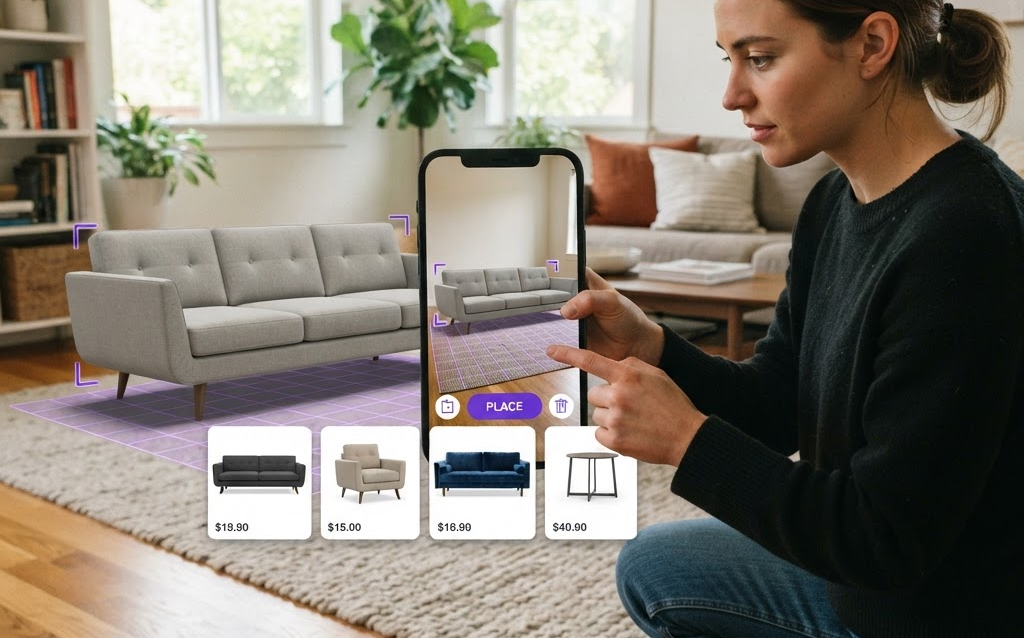
The most commercially impactful WebAR application in US retail is product placement and try-on — letting shoppers see products in their actual context before purchasing. WebAR retail visualization covers two core scenarios: spatial placement (furniture, décor, appliances — placed in the shopper’s room at accurate scale through their phone camera) and face/body try-on (glasses, cosmetics, jewelry, hats — overlaid on the shopper’s live camera feed with accurate scale and position tracking).
The commercial impact is documented and consistent. Shoppers who interact with a WebAR product visualization convert at rates 94% higher than non-AR-engaged shoppers on the same product pages. Return rates drop significantly — 40% is a commonly reported figure among US furniture and apparel retailers — because shoppers are making decisions based on accurate visual information rather than approximation and hope.
The key enabling factor in 2026 is that this visualization runs in-browser at sufficient quality to drive commercial trust. Early WebAR experiences suffered from surface tracking inconsistency and visual quality that looked obviously artificial. Current WebAR platforms — 8th Wall, Zappar, and browser-native WebXR — deliver tracking stability and rendering quality that meets the commercial bar for purchase-level confidence.
- Interactive Packaging and In-Store Activation
Physical retail touchpoints — product packaging, shelf talkers, in-store displays, receipts — become WebAR triggers when a brand places a QR code that opens an AR experience directly in the shopper’s browser. This is where WebAR creates a capability that was genuinely unavailable in the pre-WebAR era: a brand can activate thousands of physical retail touchpoints as AR entry points with a URL-based deployment that requires no per-location infrastructure.
US brands using WebAR packaging activation report measurable improvements in post-purchase engagement — the moment a shopper opens a package and scans a QR code that opens an AR brand experience is a loyalty-building moment that static packaging cannot create. A food brand whose packaging opens a recipe AR experience, a cosmetics brand whose outer box opens a makeup tutorial AR filter, an electronics brand whose quick-start guide opens an interactive 3D setup walkthrough — all delivered through the shopper’s browser without any app.
- Social Commerce — AR Filters That Link Directly to Purchase
Social AR — Instagram filters, Snapchat lenses, TikTok effects — has demonstrated the sharing mechanics of augmented reality at consumer scale. WebAR extends this into the purchase flow: a brand-hosted WebAR try-on experience shared via link or embedded in a social bio generates engagement that links directly to the product detail page, not to an app store.
The commercial difference is significant. A Snapchat lens drive-to-app creates a multi-step path from AR engagement to purchase — filter experience → app store → browse → find product → add to cart. A WebAR social commerce experience creates a single-step path — link click → AR experience → add to cart → checkout. For US retailers who have spent years trying to compress the social-to-purchase funnel, WebAR delivers a genuine structural improvement rather than a marginal optimization.
- B2B Showrooming — Presenting Products Without Physical Inventory
Beyond consumer retail, WebAR is disrupting B2B commercial relationships in US retail — particularly for brands that sell through retail channels and need to present product ranges to buyers without the cost and logistics of physical showrooms. A furniture manufacturer presenting a new collection to Target buyers, a CPG brand showing packaging variations to Walmart merchandising teams, a hardware brand demonstrating product lines to Home Depot category managers — all of these presentations are more effective and more efficient when delivered as browser-based WebAR experiences that buyers can explore in their own time without physical samples.
📱 Building a WebAR experience for your retail brand?
Ink & Algorithm builds browser-based WebAR for US retailers — product visualization, interactive packaging, and social AR connected to your ecommerce platform. → inknalgorithm.com/augmented-reality-ar
US Retail Categories Where WebAR Delivers Strongest ROI
WebAR disruption is not uniform across all retail categories. The commercial return concentrates in categories where visual confidence drives purchase decisions and where the gap between online browsing and physical evaluation has historically cost sales.
| Item | Detail |
|---|---|
| Furniture & Home Décor | Spatial placement at accurate 1:1 scale in the shopper’s room — the single most powerful conversion tool in the category. 40% return rate reduction reported by US furniture brands deploying WebAR. |
| Fashion & Footwear | Virtual try-on for glasses, shoes, hats, and accessories using face and body tracking. US fashion brands report 2× conversion rate on AR-engaged product pages. |
| Beauty & Cosmetics | Foundation shade matching, lipstick try-on, eyeshadow preview — face-tracked WebAR running in the mobile browser with live camera feed. Reduces shade-mismatch returns significantly. |
| Consumer Electronics | 3D scale preview showing how a TV, appliance, or speaker will look in a specific room space. Reduces the “it looked bigger online” return driver that afflicts this category. |
| Home Improvement | Paint color visualization on actual walls through phone camera. Flooring and tile patterns placed on actual floors. US home improvement retailers report 30%+ reduction in color-related returns. |
| Automotive Accessories | Wheel, body kit, and exterior accessory visualization on a specific vehicle. US aftermarket brands deploying WebAR for accessories report higher AOV from visible upgrade confirmation. |
| Outdoor & Sporting Goods | Kayak placed in an actual water environment via AR, tent pitched in a backyard, bike sized against a rider — WebAR spatial preview addresses the scale uncertainty that drives hesitation in this category. |
| Luxury & Jewelry | Ring and watch try-on on actual hands via WebAR — the category where visual precision most directly translates to purchase confidence for high-value items. |
The Technology Behind WebAR for Retail — What Actually Runs in the Browser
Understanding what WebAR technology delivers — and where its 2026 capabilities sit relative to what retail use cases require — helps US brands evaluate the platform choices available and set realistic expectations for what a browser-based AR experience can and cannot do.
| Item | Detail |
|---|---|
| 8th Wall (Niantic) | The leading WebAR platform for US retail. Runs entirely in the browser without WebXR device support required — meaning consistent performance across iOS Safari and Android Chrome. Powers most major US retail WebAR campaigns. Ink & Algorithm builds on 8th Wall for retail visualization and packaging activation. |
| WebXR Device API | Browser-native WebAR standard supported in Chrome and Samsung Internet on Android. Delivers OS-level AR tracking quality on compatible devices. Growing iOS Safari support makes this increasingly viable for US retail’s iOS-heavy user base. |
| Zappar | UK-based WebAR platform with strong brand campaign focus. Good surface tracking and face AR. Used extensively for FMCG and CPG packaging activations in US retail. |
| Shopify AR (USDZ/GLB) | Shopify’s built-in AR capability using USDZ on iOS and GLB on Android — placing 3D product models in the shopper’s space through native device AR without a third-party platform. Simpler than full WebAR platforms but sufficient for product placement use cases for Shopify-hosted retailers. |
| Three.js / A-Frame WebXR | Open-source WebGL-based AR for custom implementations. Used by Ink & Algorithm for fully bespoke WebAR experiences where platform licensing is not appropriate or where unique interaction requirements exceed platform capabilities. |
The Business Case for US Retailers — ROI Metrics That Matter
The commercial case for WebAR in retail rests on documented, repeatable metrics across conversion rate, average order value, return rate, and customer acquisition efficiency. Each metric moves in a commercially favorable direction when WebAR is deployed with product accuracy and appropriate commerce integration.
| Metric | Without WebAR | With WebAR | Direction |
|---|---|---|---|
| Product page conversion | Baseline | +94% for AR-engaged | ⬆ Strong |
| Return rate | 15-25% (category avg) | −30-40% for AR purchases | ⬇ Significant |
| Session duration | Short | 5-8× longer | ⬆ Strong |
| Social sharing rate | Organic only | 2.4× higher | ⬆ New channel |
| AOV (upgrade selection) | Baseline | +20-40% visible upgrades | ⬆ Strong |
| Customer acquisition cost | Standard media cost | Organic AR shares reduce CPA | ⬇ Improved |
| App download barrier | High friction | Zero — browser direct | ⬇ Eliminated |
One metric deserves particular attention for US retailers evaluating WebAR ROI: return rate reduction. In categories where average return processing costs $15-40 per item (shipping, inspection, restocking, potential markdown), a 30-40% reduction in returns represents a direct margin improvement that compounds significantly across high-volume SKUs. For many US furniture and apparel retailers, this margin impact alone justifies the WebAR investment independent of the conversion uplift.
How Ink & Algorithm Builds WebAR for US Retail
Ink & Algorithm is a US-based creative technology agency headquartered in Hanover Park, Illinois, that builds WebAR experiences for retail brands across the United States. Our WebAR retail practice combines 3D asset production optimized for browser-based rendering, AR interaction design built around retail-specific user behavior, and direct integration with the ecommerce platforms US retailers already use — Shopify, WooCommerce, and custom commerce backends.
Every WebAR experience Ink & Algorithm delivers is built around a specific commercial objective — not around showcasing the technology. A furniture WebAR placement experience is built to reduce the hesitation that drives cart abandonment, with 3D models matched to actual product dimensions and PBR materials matched to physical samples. A beauty try-on experience is built with face tracking accuracy calibrated for shade selection confidence. A packaging activation is built with a QR trigger flow optimized for the few seconds of attention a shopper will give before deciding whether to engage further.
Ink & Algorithm WebAR Retail Capabilities
WebAR Product Placement: Furniture, appliances, and large consumer goods placed in the shopper’s real space through their browser camera at accurate 1:1 scale. Built on 8th Wall with surface detection and lighting estimation tuned for indoor home environments.
WebAR Virtual Try-On: Face and body tracking for glasses, cosmetics, jewelry, hats, and accessories. Runs in the mobile browser with real-time camera overlay — no filter app required.
WebAR Packaging Activation: QR code on physical packaging opens an AR brand experience in the shopper’s browser. Recipe AR, product story, setup guide, loyalty mechanic — delivered without an app from a URL printed on the box.
WebAR Social Campaign: Brand-hosted WebAR experiences shareable via link — embedded in social bios, included in DMs, linked from social ads. Users click the link and enter AR directly in their browser.
Shopify + WooCommerce Integration: WebAR experience embedded on product detail pages with direct add-to-cart connectivity. 3D models optimized for platform-native AR (USDZ for iOS, GLB for Android) plus enhanced WebAR for advanced interactions.
B2B Product Presentation: WebAR-delivered product catalogs and range presentations for retail buyer meetings — products explorable in 3D or placed in simulated retail environments without physical samples.
🚀 See Ink & Algorithm’s WebAR portfolio View our work for US retail brands — product visualization, packaging AR, and social commerce WebAR experiences. → inknalgorithm.com/portfolio
Common Mistakes US Retailers Make With WebAR — And How to Avoid Them
✗ Deploying without commerce integration
A WebAR experience that ends without a path to purchase loses the conversion intent it creates. Every Ink & Algorithm retail WebAR experience connects to cart and checkout — the AR session is a step in the purchase flow, not a detached brand activation.
✗ Using inaccurate 3D models
A WebAR product placement experience built from approximate 3D models — not matched to actual product dimensions and materials — creates an expectation gap at delivery that drives returns. The return rate reduction benefit of WebAR requires accurate 3D, not generic geometry.
✗ Optimizing for desktop demo, not mobile reality
WebAR is a mobile experience. Brands that develop and optimize on desktop and then discover performance issues on actual iOS Safari or Android Chrome in the field have inverted the priority. Ink & Algorithm tests on target devices throughout development, not at launch.
✗ Treating WebAR as a one-time campaign
WebAR assets — especially accurate 3D product models — are infrastructure, not single-use content. Brands that treat a WebAR campaign as a one-off miss the compounding value of a 3D asset library that generates product visualization, packaging AR, and social content simultaneously from the same base models.
✗ Not measuring AR-specific conversion data
WebAR that is not instrumented to track AR engagement, AR-to-cart conversion, and AR session depth produces no data to justify the next investment. Ink & Algorithm instruments every WebAR deployment with AR-specific analytics from day one.
Frequently Asked Questions
Q: What is WebAR for retail?
A: WebAR for retail is augmented reality delivered through a mobile browser — no app download required. US retailers deploy WebAR for product visualization (placing furniture in a room, trying on glasses), interactive packaging (QR codes that open AR brand experiences), social commerce (AR experiences shared via link that connect to checkout), and B2B product presentation. Ink & Algorithm builds WebAR experiences for US retailers on 8th Wall, WebXR, and Shopify’s native AR platform.
Q: How does WebAR increase retail conversion rates?
A: WebAR increases retail conversion by giving shoppers visual certainty about products before purchasing — eliminating the uncertainty that drives hesitation and abandonment. Shoppers who interact with WebAR product visualization convert at rates documented to be 94% higher than non-AR-engaged shoppers on the same products. The combination of zero download friction and accurate visual preview creates a purchase confidence that static product pages and photo galleries cannot match.
Q: Does WebAR work on iPhone (iOS Safari)?
A: Yes. Modern WebAR platforms — particularly 8th Wall, which Ink & Algorithm builds on for retail experiences — deliver consistent WebAR performance on iOS Safari without requiring any app download or WebXR API support. This cross-platform delivery is why WebAR has become commercially viable for US retail in 2026: the same experience works across iOS and Android in the browser the user already has.
Q: What is the difference between WebAR and a native AR app?
A: A native AR app requires a download from the App Store or Google Play, takes up device storage, and must be discovered before it can be used. WebAR delivers the AR experience directly through a mobile browser via a link or QR code scan — zero downloads, zero storage, zero discovery friction. For retail use cases where AR is often the first digital touchpoint, WebAR’s frictionless access model is commercially decisive.
Q: Can WebAR integrate with Shopify and WooCommerce?
A: Yes. Ink & Algorithm builds WebAR experiences with direct Shopify and WooCommerce integration — embedding the WebAR experience on product detail pages and connecting AR engagement directly to cart and checkout. Shopify’s native AR support (USDZ/GLB models) is also integrated for retailers who want platform-native AR alongside enhanced WebAR experiences for advanced interactions.
Q: How long does it take to build a WebAR retail experience?
A: A focused WebAR product visualization experience — one product category with accurate 3D models and ecommerce integration — typically launches in 6-12 weeks. More complex WebAR deployments covering full product catalogs, packaging activation, and social campaign integration span 12-20 weeks. Ink & Algorithm provides realistic timelines during project scoping based on the scope of 3D asset production, AR interaction complexity, and integration requirements.