

| ⚡ TL;DR — Quick Answer
AR helps industrial maintenance and field service workers in 2026 by delivering hands-free digital work instructions, enabling remote expert assistance from anywhere in the world, projecting predictive maintenance data directly onto equipment, and accelerating technician training. Modern industrial AR runs on Microsoft HoloLens 2, Magic Leap 2, RealWear Navigator, and mobile devices — dramatically reducing errors, downtime, and travel costs. Ink n Algorithm builds custom industrial AR platforms for manufacturing, energy, utilities, aerospace, and specialty enterprises worldwide. |
Something has shifted quietly but significantly in industrial workplaces. Walk into a modern manufacturing plant, an offshore oil platform, or a utility field site in 2026, and you will notice technicians wearing lightweight AR headsets, glancing at floating instruction overlays, and speaking with remote experts thousands of miles away. This is not a technology demonstration. This is how industrial maintenance and field service work actually happens now.
AR augmented reality — has moved from experimental novelty to genuine enterprise infrastructure. The reason is measurable business results. Reduced equipment downtime. Fewer maintenance errors. Faster technician onboarding. Lower travel costs for expert dispatches. Better safety compliance. At Ink n Algorithm, we build custom AR platforms for industrial enterprises facing these exact challenges. This guide explores how AR is transforming industrial maintenance and field service work in 2026, which technologies power it, and where the strongest business returns are happening.
What Industrial AR Actually Looks Like in 2026
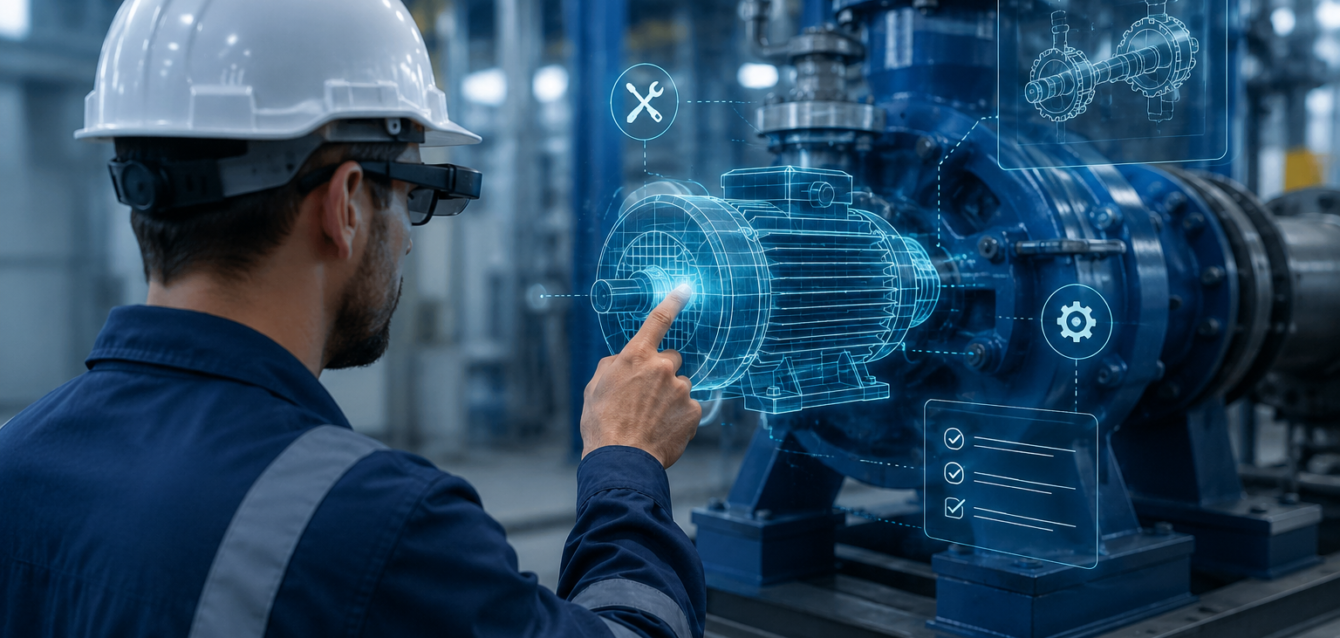
The AR of 2026 is not the smartphone novelty most people encountered years ago. Industrial AR means hands-free digital content overlaid directly onto the physical work environment — through headsets, smart glasses, or occasionally handheld tablets when hands-free is not required.
A field technician working on a compressor unit sees exactly which bolt to remove first, in what sequence, with what torque specification — all floating in space next to the actual component. A maintenance engineer diagnosing an electrical issue sees real-time sensor readings overlaid onto the physical control panel. A trainee learning to operate industrial equipment practices with visual guidance that responds to what they actually do, correcting mistakes in real time. This is the reality of industrial AR today — practical, focused, and delivering measurable operational improvements.
7 Ways AR Transforms Industrial Maintenance & Field Service
The industrial applications of AR in 2026 fall into seven distinct categories, each solving specific operational challenges that traditional approaches handle poorly or expensively.
- Remote Expert Assistance
When a field technician encounters an unfamiliar problem, traditional workflows required flying in specialists — often from other continents — at significant cost and delay. AR remote assistance changes this completely. The technician wears an AR headset that shares their exact viewpoint with a remote expert. The expert can annotate what the technician sees, drop virtual arrows onto specific components, and guide repair steps in real time. Complex issues get resolved in hours instead of days, and expert knowledge scales across multi-site operations. Ink n Algorithm’s AR platforms support this remote assistance workflow across enterprise deployments.
- Hands-Free Digital Work Instructions
Paper manuals slow work, get damaged in harsh environments, and are impossible to update fluidly. AR replaces them with hands-free digital work instructions overlaid onto the actual equipment. Technicians see the next step visually — which valve to close, which lever to move, which reading to record — while their hands stay free for the actual work. Content updates propagate instantly across all technicians globally. Training refreshers happen automatically. Errors drop because instructions cannot be misread when they float next to the physical component.
- Predictive Maintenance Visualization
Modern industrial equipment generates massive sensor data. But that data lives in dashboards on distant screens — not where technicians actually work. AR brings predictive maintenance data directly onto the physical asset. Walk up to a pump, and see its temperature history, vibration analysis, and predicted failure timeline hovering next to it. Maintenance planners spot developing issues before they become emergencies. Field teams prioritize work based on data, not guesswork. Downtime shifts from reactive crisis to planned intervention.
- Training and Onboarding Acceleration
Training new industrial technicians has always been expensive, time-consuming, and inconsistent across sites. AR transforms this by letting trainees practice on real equipment with visual guidance overlaid onto the machinery. They see exactly what to do, get immediate corrective feedback when they make mistakes, and build skills through experience rather than passive video watching. Time-to-competency drops dramatically, and skills transfer consistently across every trainee. Ink n Algorithm’s AR training platforms have delivered this transformation for manufacturing and specialty industrial clients.
- Equipment Inspection and Documentation
Traditional equipment inspection generates paper checklists, handwritten notes, and photographs that must be manually organized later. AR inspection replaces this with structured digital workflows. Inspectors see exactly which points to check, capture readings and images against those specific points automatically, and generate compliant documentation without additional data entry. Field inspection times drop while data quality improves. Regulatory compliance becomes systematic rather than dependent on individual technician diligence.
- Warehouse and Logistics Operations
Warehouse workers pick, pack, and locate materials constantly — activities where AR delivers immediate productivity gains. Pick-by-vision systems guide workers to exact locations via arrows floating in their field of view. Package sorting becomes visually guided rather than requiring memorized codes. Inventory audits happen faster because auditors see what the system expects at each location overlaid onto reality. Modern AR in warehousing is measurably more efficient than voice-picking or handheld scanner approaches.
- Safety Protocols and Hazard Awareness
Industrial workplaces contain hazards that vary by location, equipment state, and operational context. AR makes these hazards visible in real time. Workers see exclusion zones around energized equipment, gas detection alerts before entering confined spaces, and lockout-tagout status overlaid onto machinery. Safety compliance moves from posted signs and memorized protocols to real-time visual awareness. This is one of the strongest business cases for industrial AR — measurable reductions in workplace incidents that directly reduce insurance costs and human suffering.
| See Ink n Algorithm’s AR Portfolio
Explore industrial AR platforms Ink n Algorithm has built for manufacturing, energy, and specialty enterprises worldwide. |
The Hardware Powering Industrial AR in 2026
Understanding industrial AR means understanding the hardware platforms it runs on. Different devices serve different use cases, and choosing the right hardware matters enormously for deployment success.
Microsoft HoloLens 2 remains the workhorse for hands-free industrial AR — enterprise-grade build quality, mature developer ecosystem, and strong Azure integration for enterprise workflows. Its stereoscopic display and comfortable form factor make it suitable for full-shift wear in most manufacturing environments.
Magic Leap 2 targets similar enterprise applications with lighter weight and a wider field of view — often preferred for training applications and roles requiring extended headset time. RealWear Navigator 520 serves rugged industrial environments with a monocular display that integrates with standard hard hats, making it ideal for construction, energy, and utilities work where full stereoscopic AR is impractical.
Vuzix Blade 2 and Google Glass Enterprise Edition 2 provide lightweight smart glasses options for scenarios where minimal hardware footprint matters more than immersive visual overlays. And modern iOS and Android tablets equipped with LiDAR sensors deliver capable handheld AR for inspection and documentation workflows where hands-free is not essential.
Industries Where Industrial AR Delivers Real ROI
Certain industries deliver especially strong returns from strategic AR investment. Understanding which industries are winning helps clarify where AR makes commercial sense right now.
Manufacturing leads industrial AR adoption — assembly guidance, quality inspection, equipment maintenance, and operator training all deliver measurable improvements. Energy and oil & gas operations use AR heavily for remote expert assistance to offshore platforms, hazardous area work, and complex maintenance procedures where errors have serious consequences.
Utilities — electrical, water, and gas — deploy AR for field technician support, safety compliance, and infrastructure inspection. Aerospace uses AR for complex assembly work, maintenance documentation, and training where regulatory compliance demands consistency. Automotive manufacturing integrates AR throughout production lines for quality checks and operator guidance.
Healthcare equipment maintenance and medical device servicing use AR for guided repair on complex equipment where mistakes affect patient care. Warehousing and logistics operations see measurable productivity gains from AR picking and sorting workflows. Each of these industries has moved beyond pilot programs into production AR deployments — the technology is genuinely mature enough for enterprise use.
Common Challenges in Deploying Industrial AR
Deploying industrial AR successfully requires understanding the challenges that derail unprepared organizations. Learning from common failures helps enterprises succeed on the first attempt rather than waste initial pilots.
Content development is where most projects fail. Buying AR hardware is straightforward. Creating high-quality AR content — the digital instructions, overlays, and workflows that actually deliver value — requires specialized development capability. Enterprises without experienced AR development partners typically produce content that looks impressive in demos but frustrates workers in daily use.
Integration with existing enterprise systems is the second common obstacle. Industrial AR only delivers full value when connected to CMMS platforms (Maximo, SAP Plant Maintenance), ERP systems, IoT sensor networks, and enterprise asset management databases. Isolated AR applications generate less value than connected ones. Ink n Algorithm’s AR development approach prioritizes this integration from project scoping onward.
Change management and worker adoption matter more than technology decisions. Introducing AR workflows into established industrial teams requires thoughtful rollout — pilot sites, worker input, gradual expansion, and ongoing support. Organizations that treat AR deployment as pure technology projects consistently struggle. Those treating it as combined technology and change management initiatives succeed.
How Ink n Algorithm Builds AR for Industrial Enterprises
Ink n Algorithm builds custom industrial AR platforms for manufacturing, energy, utilities, aerospace, and specialty enterprises. Our approach combines AR development expertise with practical understanding of what actually works in industrial environments — durable hardware selection, integration with existing enterprise systems, and content development that field workers find genuinely useful rather than frustrating.
Our AR development pipeline covers Microsoft HoloLens 2, Magic Leap 2, RealWear Navigator, smart glasses, and mobile AR for iOS and Android — matching hardware choice to each client’s specific operational reality. We integrate with major CMMS platforms, ERP systems, and IoT infrastructure. Content development follows proven pedagogical structures rather than defaulting to impressive-looking demonstrations that fail in daily production use.
Every industrial AR project starts with commercial scoping — understanding your specific operational challenges, workforce structure, hardware constraints, and success metrics. Only after establishing this strategic clarity do we recommend AR approaches and technology choices. Our worldwide client base ranges from mid-size manufacturers deploying AR for the first time through global enterprises expanding existing AR programs across multi-site operations.
Frequently Asked Questions
What does AR mean for industrial maintenance workers?
For industrial maintenance workers, AR means hands-free digital guidance overlaid onto the equipment they actually work on. Instead of reading manuals or looking at separate screens, technicians see instructions, sensor data, and safety information floating next to the physical asset. Ink n Algorithm builds industrial AR platforms delivering exactly this capability worldwide.
Which AR headsets work best for industrial environments?
The best industrial AR hardware depends on use case. Microsoft HoloLens 2 excels for hands-free work requiring stereoscopic overlays. Magic Leap 2 offers lighter weight and wider field of view. RealWear Navigator integrates with hard hats for rugged environments. Smart glasses like Vuzix suit lightweight scenarios. Ink n Algorithm helps clients select hardware based on specific operational requirements.
Can industrial AR integrate with our existing enterprise systems?
Yes. Ink n Algorithm’s industrial AR platforms integrate with CMMS platforms (Maximo, SAP Plant Maintenance), ERP systems, enterprise asset management databases, IoT sensor networks, and custom enterprise applications. Integration architecture is planned from project scoping to ensure AR delivers full operational value.
How does industrial AR compare to traditional training?
Industrial AR training augments rather than replaces traditional training in most contexts. However, AR delivers advantages traditional training cannot match — practice on real equipment with visual guidance, immediate corrective feedback, consistent training delivery across multi-site organizations, and objective performance measurement based on actual task completion.
How long does industrial AR deployment take?
Focused AR use cases typically deploy in 12-20 weeks. Enterprise AR platforms with multiple integrated workflows span 20-30 weeks. Multi-site rollouts require additional planning time depending on scale. Ink n Algorithm provides realistic timelines with every proposal based on scope and integration requirements.
How do I start an industrial AR project with Ink n Algorithm?
Contact Ink n Algorithm with a brief description of your operational challenges — the maintenance or field service work you want to improve, your workforce structure, and any existing enterprise systems requiring integration. A senior team member responds within one business day with a scoped approach for your industrial AR project.
The Bottom Line for 2026
Industrial AR has crossed the threshold from experimental technology to genuine enterprise infrastructure. Manufacturing plants, energy operations, utilities, aerospace facilities, and warehousing operations worldwide deploy AR not because it looks impressive but because it delivers measurable business results — reduced downtime, faster training, fewer errors, better safety compliance, and lower operational costs. What matters most is choosing an AR development partner with genuine industrial experience combined with technical expertise. Ink n Algorithm brings both to every project, worldwide.
| Ready to Deploy Industrial AR That Actually Works?
Tell Ink n Algorithm about your operational challenges. Our team responds within one business day with a scoped approach for your specific industrial AR project — from focused pilots through enterprise-wide deployments. |
FAQ
How much does ar helps industrial maintenance cost?
The cost varies based on project scope and complexity. Contact us for a custom quote tailored to your specific needs.
How long does ar helps industrial maintenance take?
Typical projects take 2-8 weeks depending on scope. We provide detailed timelines during consultation.
Do you work with US brands?
Yes, we work with US brands across all 50 states. Our team understands the US market and delivers solutions that drive results.