
| ⚡ TL;DR — Quick Answer
Augmented reality is transforming automotive sales in 2026 across seven practical applications: AR vehicle configurators that let buyers customize cars in real time, AR-powered virtual showrooms that bring full-scale vehicles into customer driveways, AR test drive previews using smartphone cameras, AR-enhanced dealership tablets for sales staff, AR-driven interior walkthroughs, AR overlays for technical features and specifications, and AR-integrated marketing campaigns triggered from print or social media. The technology delivers measurable commercial outcomes — shorter sales cycles, higher conversion rates, reduced reliance on physical inventory, and expanded reach to buyers who never visit traditional showrooms. Ink n Algorithm designs and develops custom augmented reality applications for automotive dealerships, OEMs, and mobility brands across the United States and globally. |
The way customers buy cars has fundamentally changed across the past three years. Buyers no longer start their journey by walking into a dealership — they begin online, often on a smartphone, comparing vehicles, customizing trims, and narrowing options long before they ever speak to a sales representative. By the time a buyer arrives at a physical showroom, they typically know exactly which model they want, what specifications they prefer, and what they expect to pay. This shift has put enormous pressure on automotive dealerships and OEMs to deliver compelling pre-showroom buying experiences. The most powerful technology making this possible is augmented reality.
Augmented reality in USA has matured from experimental marketing gimmick into serious commercial infrastructure for the automotive industry in 2026. Dealers use augmented reality to put full-scale vehicles in customers’ driveways before they ever visit a showroom. OEMs use augmented reality marketing to bring magazine spreads and billboards to life. Sales teams use augmented reality dealership tools to demonstrate features that would be impossible to show on a physical car. This guide walks through the seven most practical applications of augmented reality in automotive sales in 2026 — written by the team at Ink n Algorithm based on years of building AR experiences for automotive, retail, and immersive commerce clients across the United States.
What is augmented reality in the automotive industry?
Augmented reality in automotive contexts refers to applications and experiences that overlay digital 3D content — vehicles, interiors, specifications, branding, or interactive elements — onto a customer’s real-world view through a smartphone, tablet, dealership kiosk, or AR-capable wearable device. Unlike virtual reality, which fully replaces the user’s environment with a simulated world, augmented reality keeps the real world visible while adding digital elements that respond to actual physical space, lighting conditions, and customer movement.
In automotive sales specifically, augmented reality solves a fundamental commercial problem: how do you show a customer a vehicle they cannot physically see? Whether the dealership lacks the specific trim in inventory, the OEM has not released the model yet, the customer is geographically distant, or they simply want to visualize how a car looks in their actual driveway — augmented reality bridges that gap by placing photorealistic vehicles directly into the customer’s real environment via their smartphone camera. Ink n Algorithm builds custom augmented reality applications for automotive clients using ARKit on iOS, ARCore on Android, and WebAR for browser-based experiences.
The underlying technology has matured significantly. Modern augmented reality uses sophisticated spatial mapping to anchor virtual objects accurately to real-world surfaces. Photorealistic rendering ensures the displayed vehicle responds correctly to actual ambient lighting. Mobile graphics processors handle the rendering load smoothly even on mid-range smartphones. The result is augmented reality experiences that feel genuinely convincing rather than obviously digital — which directly translates into commercial confidence at the buying decision.
How is augmented reality transforming automotive sales? Seven practical applications
Seven specific augmented reality applications are driving real commercial outcomes for automotive dealerships and OEMs in 2026. Each application addresses a different stage of the customer buying journey, and most successful automotive brands deploy multiple augmented reality use cases simultaneously rather than relying on a single deployment.
1. AR vehicle configurators with real-time customization
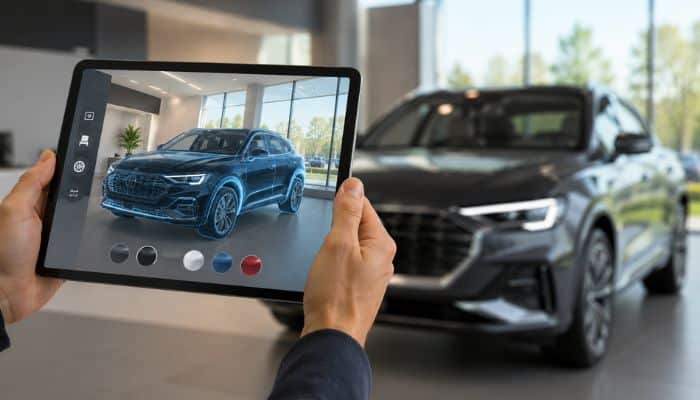
Augmented reality vehicle configurators let buyers customize a car — exterior color, wheel design, trim level, interior materials, optional packages — and see those choices reflected in a photoreal AR preview placed directly in their environment. Unlike traditional desktop configurators, augmented reality configurators give customers true scale perception. A car looks dramatically different at full size in your actual driveway than it does on a website. This realism translates directly into faster decision-making and stronger emotional buyer commitment. Ink n Algorithm’s combined AR development and web configurator capabilities produce particularly powerful hybrid experiences for automotive clients.
2. AR-powered virtual showrooms
Augmented reality virtual showrooms let customers explore an entire vehicle lineup from anywhere — bringing models that physically do not exist at the local dealership into the customer’s actual living room. Buyers walk around the vehicles, open virtual doors, change colors, and examine details from any angle. This is particularly valuable for dealerships in smaller markets that cannot stock every model variant, and for OEMs launching new models before physical units have shipped to dealers.
3. AR test drive previews on mobile
Augmented reality test drive previews let prospective buyers experience driving simulations through their smartphone camera before scheduling an actual test drive. The application shows interior dashboard layouts, infotainment behavior, visibility from the driver’s seat, and even simulates dynamic features like adaptive headlights or driver assist systems. This screening tool dramatically improves the quality of leads who eventually arrive for in-person test drives — they show up already convinced rather than still evaluating.
4. AR-enhanced dealership sales tablets
Sales staff at dealerships use augmented reality tablets to demonstrate features that are difficult to show on a physical car — engine cutaways, drivetrain animations, safety system visualizations, hidden technology like wireless charging or autonomous parking sensors. The augmented reality tablet becomes a sales tool that lets the team show what the vehicle does, not just what it looks like. This addresses one of the biggest gaps in traditional automotive sales: the difficulty of explaining complex technology to non-technical buyers.
5. AR interior walkthroughs and feature highlights
Augmented reality interior walkthroughs let buyers explore vehicle interiors from anywhere. The application overlays interactive hotspots on different cabin elements — explaining materials, demonstrating storage features, showing infotainment workflows, and highlighting safety technology. Buyers tap any element to learn more, watch animated demonstrations, or compare different trim packages. This interactive depth is impossible to deliver through traditional brochures or static photography.
6. AR technical specifications and feature overlays
Augmented reality applications can overlay technical specifications directly onto vehicles when customers point their cameras at a parked car. The application identifies the vehicle, then displays performance specifications, fuel economy, safety ratings, comparable models, and pricing — turning any physical vehicle into an interactive information source. This is particularly powerful at automotive events, trade shows, and pre-owned dealerships where rapid information access drives buyer confidence.
7. AR marketing campaigns triggered from print and social
Augmented reality marketing campaigns activate from QR codes printed on magazine ads, billboards, brochures, social media posts, and direct mail. Customers scan the code and watch a static print ad come alive — the vehicle drives off the page, exterior colors cycle through options, or a virtual sales representative explains features. This bridges the gap between traditional advertising channels and digital interaction, dramatically increasing engagement rates from formats that would otherwise be passive.
| An honest performance reality
Augmented reality only transforms automotive sales when implemented seriously. A poorly built AR application — inaccurate scale, broken lighting, stuttering performance, ugly 3D models — actively damages dealer credibility more than not having augmented reality at all. The automotive brands winning with augmented reality in 2026 treat the technology investment as serious infrastructure rather than a marketing experiment, working with experienced AR development teams like Ink n Algorithm who understand both the technical craft and the automotive commercial context. |
What commercial outcomes does augmented reality deliver for automotive sales?
Dealerships and OEMs investing seriously in augmented reality report consistent commercial improvements across several measurable dimensions. These outcomes compound — a brand achieving augmented reality success does not just sell more cars; they sell them faster, at better margins, with better customer satisfaction.
- Shorter sales cycles as buyers arrive at dealerships more informed and decision-ready
- Higher conversion rates from augmented reality interaction to test drive to purchase
- Expanded geographic reach to customers who cannot easily visit physical dealerships
- Reduced dependency on holding physical inventory across every trim and configuration
- Lifted average transaction values through premium customization adoption
- Improved post-purchase satisfaction because buyers know exactly what they are getting
- Stronger brand differentiation against competitors lacking augmented reality capability
What technology powers augmented reality applications for automotive sales?
Modern automotive augmented reality applications combine several technical layers working together. Understanding the technology helps brands brief projects intelligently and avoid being oversold on irrelevant features.
Spatial tracking frameworks
ARKit (Apple) and ARCore (Google) handle the underlying spatial mapping that anchors virtual vehicles to real-world surfaces. These frameworks track the camera’s position in 3D space, detect floors and ground planes for vehicle placement, and adjust to changes in lighting and movement. Web-based augmented reality uses WebXR through browsers like Safari and Chrome.
Real-time 3D rendering engines
Unreal Engine, Unity, and WebGL-based engines like Three.js handle the actual rendering of vehicles within the augmented reality environment. The rendering must produce photoreal quality while maintaining smooth performance on mobile devices — a serious technical challenge that requires specialized expertise. Ink n Algorithm’s team works across all major rendering platforms based on each client’s specific augmented reality use case.
Mobile app frameworks and WebAR
Augmented reality applications are typically delivered through native iOS apps (using Swift), native Android apps (using Kotlin), or cross-platform builds (using React Native or Flutter). WebAR runs directly in mobile browsers without requiring app downloads — particularly useful for marketing campaigns triggered from QR codes. The right approach depends on the specific commercial context. Ink n Algorithm’s app development capabilities cover all delivery models.
Backend infrastructure and CRM integration
Serious automotive augmented reality applications integrate with dealership management systems, OEM CRM platforms, inventory databases, and sales workflow tools. Every customer augmented reality interaction generates structured data — which vehicles configured, which trims explored, which features generated interest — flowing into the sales pipeline for follow-up.
How much does augmented reality development cost for automotive applications?
Augmented reality automotive application pricing varies significantly by scope, fidelity, integration depth, and platform requirements. Use these ranges as realistic starting points for serious 2026 projects.
- Simple WebAR campaign experience: USD 15,000 to USD 35,000
- Standard native AR vehicle visualization app: USD 50,000 to USD 120,000
- Premium augmented reality configurator with full vehicle lineup: USD 100,000 to USD 250,000
- Enterprise dealer AR tool with CRM integration: USD 150,000 to USD 400,000
- Multi-platform augmented reality ecosystem covering customer apps, dealer tools, and marketing: USD 300,000 and upward
Lower-end pricing reflects simpler scope and limited integration. Premium augmented reality automotive pricing reflects photoreal 3D vehicle models for the full lineup, multi-platform deployment, deep dealership management system integration, ongoing content updates as new models launch, and senior creative direction throughout — which is what separates augmented reality projects that genuinely transform sales from those sitting unused after launch.
| Planning augmented reality for your automotive brand or dealership?
Ink n Algorithm designs and develops custom augmented reality applications for automotive dealerships, OEMs, and mobility brands across the United States and internationally. Our team handles every aspect in-house — 3D vehicle modelling, photoreal materials, AR development across ARKit and ARCore, dealer tool integration, and ongoing support. Tell us about your augmented reality automotive project at https://inknalgorithm.com/contacts/ and a senior team member will respond within one business day with platform recommendations, indicative timelines, and budget framing. You can also explore complete augmented reality services and recent automotive AR projects in the Ink n Algorithm portfolio. |
Frequently asked questions
What is the difference between augmented reality and virtual reality in automotive sales?
Augmented reality overlays digital content onto the real world through a smartphone camera or tablet — buyers see virtual vehicles in their actual driveways. Virtual reality replaces reality entirely with a simulated environment accessed through a headset — buyers experience driving simulations or showroom walkthroughs in fully immersive 3D space. Augmented reality offers broader reach because it runs on existing smartphones; virtual reality offers deeper immersion but requires dedicated hardware. Most serious automotive brands deploy both technologies for different commercial purposes.
How do dealerships actually use augmented reality day-to-day?
Dealerships use augmented reality across multiple daily touchpoints: customers explore vehicles on smartphones before visiting, sales staff demonstrate features on AR-enabled tablets during showroom visits, technicians use AR for repairs and service explanations, and marketing campaigns drive QR-triggered WebAR experiences from print and social media. The augmented reality applications work together as an integrated sales toolkit rather than isolated experiments.
Does augmented reality require buyers to download an app?
Not always. Native augmented reality apps offer the highest fidelity and best performance, but require download from Apple App Store or Google Play. WebAR runs directly in mobile browsers — buyers scan a QR code and experience augmented reality without any download. Most automotive brands deploy both approaches: native apps for dedicated brand experiences and WebAR for marketing campaigns. Ink n Algorithm recommends the right delivery model based on each client’s specific commercial goals.
How accurate is augmented reality vehicle visualization?
Modern automotive augmented reality applications deliver dimensionally accurate vehicle representations — buyers see vehicles at true full scale in their actual environments. Photoreal materials respond correctly to real lighting conditions. The combination produces visualizations indistinguishable from actual photography in many cases. This accuracy is what makes augmented reality genuinely commercial rather than just impressive.
How long does augmented reality automotive app development take?
A standard automotive augmented reality application typically takes 16 to 24 weeks from kickoff to App Store launch. Premium projects with full vehicle lineups, multi-platform deployment, and deep dealership integration extend to 24 to 36 weeks. WebAR marketing campaigns sit at the faster end, often launching in 8 to 12 weeks. Project complexity and content scope drive the timeline more than the technical platform itself.
How do we start an augmented reality automotive project with Ink n Algorithm?
Contact Ink n Algorithm through the contact page with a brief description of your augmented reality automotive project — which vehicles need to be visualized, target audience, intended platforms, and integration requirements with existing dealer or OEM systems. A senior team member will respond within one business day, typically with a structured discovery call to scope the augmented reality project properly before any formal proposal.
FAQ
How much does does ar augmented reality transform cost?
The cost varies based on project scope and complexity. Contact us for a custom quote tailored to your specific needs.
How long does does ar augmented reality transform take?
Typical projects take 2-8 weeks depending on scope. We provide detailed timelines during consultation.
Do you work with US brands?
Yes, we work with US brands across all 50 states. Our team understands the US market and delivers solutions that drive results.