
| TL;DR — Quick answer
Furniture brands in 2026 use AR place-in-room apps to let shoppers see exactly how a sofa, bed, dining table, or cabinet would look in their actual home — at full scale, in the right lighting, before they buy. The technology reduces returns dramatically (the single biggest profit killer in online furniture), lifts average order value, captures premium pricing on customization, and converts hesitant browsers into committed buyers. Brands without AR are losing market share to brands that have invested in it. |
Buying furniture online has always had one fundamental problem. You see a sofa on a screen, you read its dimensions, you study the swatches — and you still cannot quite picture it in your living room. Will the colour clash with your existing curtains? Will it overwhelm the space? Will the proportions feel right against your coffee table? These small uncertainties have driven the furniture industry’s notoriously high return rates for years, costing brands enormous money in reverse logistics, restocking, and lost margin.
Augmented reality place-in-room apps have changed the calculation completely. By letting shoppers point their phone camera at their actual room and see a full-scale 3D model of the furniture appear exactly where it would sit if delivered, AR collapses the visualization gap that used to drive returns. This guide explains how furniture brands actually use AR place-in-room apps in 2026, what business outcomes they deliver, the technology behind them, what they cost to build, and how to commission one without burning budget.
What is an AR place-in-room app for furniture?
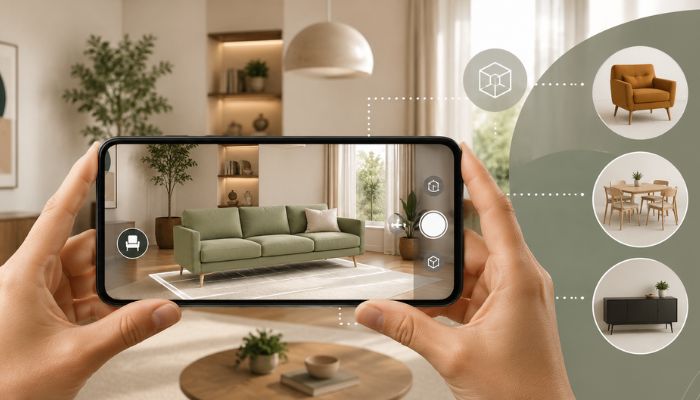
An AR place-in-room app is a smartphone application — either a standalone branded app or a feature inside an existing e-commerce app — that uses the phone’s camera and motion sensors to anchor a photorealistic 3D model of a furniture piece into the shopper’s actual physical room. The shopper sees the sofa, bed, table, or cabinet appear life-sized on the floor exactly where they aim the phone, accurate to within centimetres of the real-world position.
The technology works using two underlying frameworks. On iPhones and iPads, Apple’s ARKit handles the spatial tracking, surface detection, and lighting estimation. On Android devices, Google’s ARCore does equivalent work. Both frameworks have matured significantly since their early years — modern AR is reliable, accurate, and runs smoothly on mid-range devices, not just flagships. WebAR is the third deployment option, running through a mobile browser without requiring an app download at all.
Behind the spatial technology sits the furniture brand’s 3D product library — every chair, table, sofa, and cabinet built as a high-quality 3D model with accurate dimensions, photorealistic materials, and proper proportions. When the shopper taps a product in the app, the corresponding 3D model loads into their room. They can walk around it, change the colour or upholstery, view it from any angle, and see how the light from their actual windows affects how the materials appear. For furniture brands, this is the closest thing to a try-before-you-buy experience that online commerce has ever produced.
How do furniture brands use AR place-in-room apps in 2026?
Furniture brands deploy AR place-in-room apps across seven specific commercial scenarios. Most successful brands implement several of these simultaneously rather than treating AR as a single-purpose tool.
1. Reducing the return rate on large items
This is the headline benefit. Furniture returns are brutally expensive — reverse logistics costs often exceed the original delivery cost, restocking damaged items is sometimes impossible, and large items frequently cannot be resold at full margin once they have been in a customer’s home. AR place-in-room directly addresses the root cause of most returns: the buyer thought the piece would look different in their actual space. When the shopper has seen the exact sofa at exact scale in their exact living room before purchase, the disappointment-on-arrival moment that drives most returns largely disappears. Brands report significant return-rate reductions within months of launching AR.
2. Converting hesitant browsers into confident buyers
Furniture buyers spend weeks comparing options because the stakes feel high — a wrong choice means a four-figure mistake sitting in their living room. AR shortens this deliberation period dramatically by giving buyers confidence in their decision. When a shopper can see the sofa in their actual room, the hesitation that drives long deliberation collapses. The decision happens faster, and the buyer feels committed rather than uncertain at checkout.
3. Selling customization at premium prices
Most premium furniture brands offer customization options — fabric choices, dimension variants, leg styles, finish options. The challenge has always been helping the buyer visualise their custom choice before paying for it. AR solves this beautifully. The buyer configures their preferences in the app, then places the configured piece in their room to see exactly how their custom fabric looks against their actual wall colour. Studios offering combined web configurator and AR development deliver this integrated configure-and-place experience as a single seamless flow.
4. Capturing buyers who hate showroom visits
A large segment of furniture buyers — particularly younger demographics — actively dislike showroom visits. They find them time-consuming, sales-pressured, and inconvenient. AR effectively replaces the showroom for this segment by letting the buyer experience the product without leaving home. Brands that build strong AR experiences expand their addressable market to include buyers who would never have visited the physical store.
5. Supporting interior design conversations
Most furniture purchases involve more than one decision-maker. Couples discussing a sofa choice, families planning a dining set, designers helping clients select pieces — these conversations historically happened with PDFs, fabric swatches, and uncertainty. AR transforms them. The shopper screenshots the AR view of a configured piece in their room and shares it via WhatsApp or email. The conversation now happens around an accurate visualisation rather than abstract specifications, and the agreement comes faster and more confidently.
6. Building brand differentiation in a commoditized market
Most furniture brands look remarkably similar online — the same generic product photography, the same lifestyle shots, the same competitive pricing. A polished AR experience instantly differentiates the brand by signalling investment, sophistication, and customer-led thinking. Buyers feel the difference even before they have tried the AR feature — the brand simply seems more credible than competitors stuck on flat product pages.
7. Generating social proof and word-of-mouth
AR experiences are inherently shareable. Buyers screenshot their AR views, share them on Instagram and Pinterest, send them to friends asking for opinions, and post unboxing videos comparing the AR preview to the delivered furniture. Each share is unpaid marketing reach the brand could not have generated through conventional advertising. Furniture has always been a social-proof category — neighbours and friends notice — and AR amplifies this organic momentum dramatically.
| A practical reality check
AR only delivers these benefits when implemented properly. A poorly built AR experience — inaccurate scale, broken lighting, slow performance, ugly 3D models — actively damages the brand more than not having AR at all. The furniture brands winning with AR treat the build as a serious technology investment with proper 3D craft, not as a quick add-on to an existing e-commerce app. |
How is an AR place-in-room app actually built?
Behind a smooth AR experience sits a multi-stage development pipeline. Understanding roughly how it works will help furniture brand leaders brief the project intelligently and avoid being oversold on irrelevant features.
Stage 1: 3D product modelling
Every furniture piece in the AR catalogue starts as a high-quality 3D model — accurate dimensions, proper proportions, and the geometric detail necessary to look convincing at the scale it will appear in the buyer’s room. Cheap or rushed 3D models look stiff and unconvincing in AR; well-crafted models look indistinguishable from photography. This stage is typically the largest single investment in AR app development for furniture brands with extensive catalogues.
Stage 2: Materials and texturing
Each material option — different fabrics, leathers, wood finishes, metals, fabrics — is built as a physically based material that responds to light realistically. Premium AR experiences use scanned real-world material samples for cinema-grade accuracy. This level of material craft is what makes the difference between AR that builds buyer confidence and AR that undermines it.
Stage 3: Platform selection — native or WebAR
Native iOS apps using ARKit and native Android apps using ARCore deliver the highest performance and deepest platform integration. WebAR runs in the browser without app download but accepts some performance trade-offs. For furniture brands building long-term branded experiences, native is usually the right choice. For marketing campaigns and broad-reach experiences, WebAR wins on accessibility. Studios offering AR development across all platforms help brands choose the right platform for their specific business goals.
Stage 4: App development and AR integration
The actual app is built using Swift for iOS, Kotlin for Android, or React Native or Flutter for cross-platform builds. The AR functionality integrates with the broader app — product browsing, shopping cart, account management, and checkout flows. The AR experience cannot feel like a bolted-on feature; it has to flow naturally into the buying journey.
Stage 5: E-commerce integration
The AR app connects to the brand’s e-commerce backend — Shopify, WooCommerce, Magento, or custom platforms — so that products viewed in AR can be added to cart and purchased seamlessly. Pricing, availability, customization options, and order management all flow through the brand’s existing commerce infrastructure. Strong integration is one of the most important parts of the build to get right.
Stage 6: Performance testing and deployment
AR is performance-intensive. The app must run smoothly on mid-range three-year-old phones, not just latest flagships — because that is exactly the device most buyers actually use. Cross-device testing, battery impact profiling, and thermal behaviour under sustained use are all critical. After testing, the app submits to Apple App Store and Google Play, including the review and approval process. Studios that handle end-to-end app development rather than just the AR component deliver more polished final products.
How much does an AR place-in-room app cost to build in 2026?
Pricing depends on catalogue size, customization depth, platform choice, and e-commerce integration complexity. Use these ranges as starting reference points.
- Basic AR feature for existing e-commerce app (10-20 products): USD 25,000 to USD 60,000
- Standalone branded AR app with curated catalogue (30-50 products): USD 60,000 to USD 150,000
- Premium AR app with full customization and configurator integration: USD 100,000 to USD 250,000
- Enterprise AR platform for retailer with extensive catalogue: USD 200,000 and upward
Lower-end pricing reflects shorter timelines and simpler 3D asset libraries. Premium pricing reflects senior 3D craft, scanned real-world materials, sophisticated configuration logic, deep commerce integration, and ongoing support — which is what separates AR apps that genuinely convert buyers from AR apps that sit unused in app stores after launch.
What trends are shaping AR furniture apps in 2026?
AI-suggested room layouts
Modern AR apps increasingly use AI to suggest furniture configurations based on the shopper’s room dimensions, existing furniture, and style preferences. Instead of starting from a blank choice, the buyer gets a tailored starting point they can refine — reducing decision fatigue while preserving the customization feel that drives premium pricing.
Social configuration and sharing
AR apps are becoming inherently social. Shoppers send their AR views to partners, families, or interior designers for feedback before purchase. The AR experience becomes a collaborative touchpoint, not just a solo shopping tool — and that social activity drives more traffic back to the brand.
Spatial measurement and room scanning
Newer AR apps can measure room dimensions automatically using the phone’s LiDAR or depth sensors. The buyer scans their room once and every piece automatically adjusts to fit. This eliminates the manual measurement step that used to be one of the major sources of furniture-buying mistakes.
Integration with brand animation and marketing
Furniture brands increasingly integrate AR with broader brand content — cinematic product animation that introduces the piece, AR that places it in the buyer’s room, and configurator that lets them customize it. The shared 3D asset pipeline across all three formats dramatically reduces cost-per-asset across the brand’s full marketing investment.
| Planning your furniture brand’s AR place-in-room app?
Ink n Algorithm designs and develops AR place-in-room apps, native iOS and Android applications, web configurators, and immersive 3D experiences for furniture brands, home goods retailers, and lifestyle companies across the United States and internationally. We build everything in-house — 3D modelling, photoreal materials, AR development, app engineering, and e-commerce integration. Tell us about your brand at https://inknalgorithm.com/contacts/ and a senior team member will respond within one business day. You can also explore recent AR and configurator projects in our portfolio. |
Frequently asked questions
How accurate is AR place-in-room visualization for furniture?
Modern AR place-in-room visualisation is accurate to within one to two centimetres at typical room scales using ARKit on recent iPhones or ARCore on flagship Android devices. The scale, position, and orientation of the virtual furniture closely match how the real piece would sit if delivered. Lighting accuracy depends on the implementation — premium AR apps adjust to the room’s actual ambient light, while basic implementations use generic lighting that can look slightly artificial.
How much does it cost to build an AR app for a furniture brand in 2026?
Costs range from around USD 25,000 to USD 60,000 for a basic AR feature added to an existing e-commerce app with a small product catalogue, up to USD 100,000 to USD 250,000 for a premium standalone AR app with full customization and configurator integration. Enterprise AR platforms for retailers with extensive catalogues typically start above USD 200,000. The largest cost drivers are the size of the 3D product library and the depth of customization options offered.
How long does AR app development take?
Typical timelines range from eight to twelve weeks for a basic AR feature added to an existing app, to four to six months for a full standalone AR app with extensive customization and commerce integration. Enterprise platforms with very large product catalogues can extend further. The biggest single timeline variable is usually how many products need 3D models built — that work scales linearly with catalogue size.
Should furniture brands build a native AR app or use WebAR?
Native apps generally win for furniture brands because the buying journey is considered and high-value — buyers will download an app for a significant purchase. Native apps offer higher visual fidelity, smoother AR performance, and deeper integration with the brand’s loyalty programs and personalisation. WebAR makes sense for marketing campaigns, time-bound promotions, and reaching casual browsers who would not download an app. Most serious furniture brands implement both.
Do AR place-in-room apps work on older phones?
Most iPhones from the past six years and most Android flagships from the past four years support AR at usable performance levels. WebAR works on virtually any modern smartphone with a browser. The bigger question is whether the AR experience runs smoothly on mid-range and older devices, which is a function of how well the app is engineered. Well-built AR apps perform smoothly on older devices; poorly built ones stutter even on flagships.
Can AR apps integrate with Shopify or other e-commerce platforms?
Yes. Modern AR apps integrate cleanly with Shopify, WooCommerce, Magento, BigCommerce, and custom commerce backends. The AR experience captures buyer engagement data — which products were viewed, which configurations were tried, which were added to cart — and pushes that data into the commerce platform for analytics, remarketing, and conversion attribution. Strong commerce integration is critical to whether the AR app actually drives revenue or just looks impressive.
Ready to get started? Contact Ink & Algorithm to discuss your project—we’ll help you create results that drive sales.
FAQ
How much does furniture ar place-in-room apps guide cost?
The cost varies based on project scope and complexity. Contact us for a custom quote tailored to your specific needs.
How long does furniture ar place-in-room apps guide take?
Typical projects take 2-8 weeks depending on scope. We provide detailed timelines during consultation.
Do you work with US brands?
Yes, we work with US brands across all 50 states. Our team understands the US market and delivers solutions that drive results.