
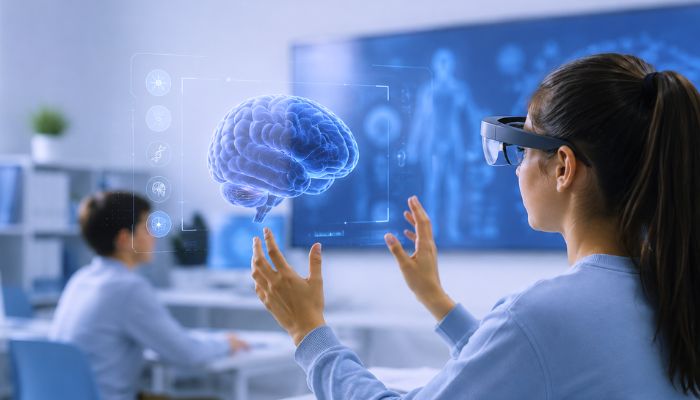
TL;DR: Augmented Reality for Education in USA 2026. Learn about costs, features, ROI, and how US brands use this technology in 2026.
Walk into almost any science classroom in America right now, and you will see students doing something that was not possible five years ago. They are holding a tablet over their desk and watching a three-dimensional DNA strand rotate in the air above it. They are zooming into the double helix, separating the base pairs, and seeing exactly how replication works — not by reading a diagram in a textbook, but by physically interacting with a model that behaves like the real thing.
That is augmented reality for education in action. And in 2026, it is not a pilot program at a few forward-thinking schools. It is an accelerating shift that is touching K-12 classrooms, university laboratories, medical training programs, corporate learning and development departments, vocational schools, and military training centers across the United States.
The reason for this acceleration is not primarily technological — it is pedagogical. AR is not just a more engaging way to deliver the same content. It is a fundamentally different way to learn. When students can see, touch, rotate, and interact with a concept in three dimensions, their understanding deepens and their retention rises in ways that no other medium has been able to consistently reproduce at scale.
At Ink & Algorithm, we build augmented reality experiences for educational institutions, corporate training programs, and professional certification bodies across the United States. This guide covers the full landscape: what AR in education actually looks like in 2026, where it is being used and why, what the research says about learning outcomes, and what it takes to implement AR in your institution or training program.
What Does Augmented Reality for Education Actually Mean in 2026?
Augmented reality overlays digital content — 3D models, animations, text, sound, and interactive elements — onto the real world through a camera-enabled device. In an educational context, this means a student can point their smartphone, tablet, or AR glasses at a page in their textbook, an object in the classroom, or a marker on a wall and see additional digital content appear, anchored to the real environment and responsive to their movement.
In 2026, the definition has expanded significantly beyond marker-based AR overlays. Modern educational AR includes fully spatial experiences where students walk through virtual representations of historical events, scientific processes, or engineering systems. It includes face and body tracking that allows students to see how biological processes play out in their own body. It includes collaborative AR environments where an entire class can see and interact with the same shared 3D model simultaneously, each from their own device.
What makes educational AR distinctively powerful is the combination of presence and interactivity. A video can show you how a volcanic eruption works. A textbook can explain it. But an AR experience that places you inside the geological process — where you can see the magma chamber below, watch the pressure build, observe the eruption sequence, and zoom into the molecular changes happening in the lava — creates a learning experience that is qualitatively different from passive consumption.
The Science Behind Why AR Works for Learning
The effectiveness of AR in educational contexts is not simply anecdotal — it is grounded in well-established cognitive science. The dual-coding theory of cognition, developed over decades of learning research, demonstrates that information processed simultaneously through verbal and visual channels is retained more deeply and recalled more accurately than information processed through a single channel alone. AR is one of the most powerful implementations of this principle ever developed.
Spatial cognition research adds another dimension: our brains are particularly well-suited to learning in three-dimensional environments, because that is the environment in which human intelligence evolved. Flat representations of three-dimensional concepts — the diagrams and illustrations that make up the bulk of traditional educational materials — require learners to perform mental translation between 2D and 3D that imposes a significant cognitive load. AR eliminates that translation, presenting concepts in the dimensionality in which they naturally exist and in which the brain most readily processes them.
| “When a student can rotate a molecule, disassemble an engine, or walk through the chambers of the heart in augmented reality, they are not studying the concept. They are inhabiting it. That is a fundamentally different cognitive experience — and it produces fundamentally different learning outcomes.” |
How US Schools and Training Centers Are Using AR in 2026
The applications of augmented reality in education span every subject area, every age group, and every institutional type. Here is how the most impactful use cases are playing out across the US education and training landscape in 2026.
Science Education — From Molecules to Solar Systems
Science is the subject area where AR has had the most dramatic and well-documented impact. The core challenge of science education has always been that the most important processes — cellular biology, chemical reactions, atomic structure, planetary mechanics — occur at scales that are either too small, too large, or too slow to observe directly in a classroom. AR makes these processes visible, interactive, and correctly scaled.
In biology classrooms, students dissect virtual frogs and human organs, isolating systems and removing layers to understand structural relationships in ways that would require expensive physical specimens or elaborate diagrams. In chemistry, they see molecular bonding happen in real time, with atoms that respond to temperature changes. In physics, they manipulate gravity and observe its effects in environments that would be impossible to replicate in a school laboratory. The result is not just more engaging lessons — it is demonstrably deeper understanding of the underlying concepts.
Medical and Healthcare Training
Medical and healthcare training is one of the highest-stakes applications of AR technology in the US, and one of the most rapidly growing. The challenge of medical education has always been the difficulty of providing students with sufficient practice on realistic anatomical structures before they encounter real patients. Cadaver labs are expensive, logistically complex, and emotionally challenging for many students. Clinical placements provide rich experience but limited control over what conditions students encounter.
AR addresses both problems simultaneously. Medical students can dissect a photorealistic 3D human body, exploring anatomy in three dimensions with the kind of unrestricted access that no physical specimen can provide. They can practice procedures — suturing, catheter insertion, airway management — on AR simulations that respond realistically to technique and pressure. They can be tested on anatomical identification under conditions that replicate examination pressure without requiring institutional access to physical resources. US medical schools using AR anatomy programs consistently report higher exam scores and faster clinical competency development compared to cohorts trained through traditional methods.
K–12 Classroom Engagement and STEM Learning
For K-12 educators, one of the most persistent challenges is sustaining genuine student engagement over the course of a school year. Traditional classroom materials — however well-designed — inevitably become familiar, and familiarity erodes the novelty that drives attention. AR introduces a dynamic that changes this equation: because AR experiences can be updated, personalized, and varied continuously, they maintain the quality of novelty over time in a way that physical textbooks and static materials cannot.
In STEM subjects specifically, where engagement is most critical and hardest to sustain, AR has shown consistent results. Schools implementing AR-based STEM curricula in the US report improved student performance on standardized assessments, reduced behavioral issues in science and mathematics classes, and — critically — measurably higher rates of students expressing interest in STEM career pathways compared to control groups using traditional materials. These effects are particularly pronounced among students who have historically been underrepresented in STEM fields.
Corporate Training and Workforce Development
The corporate training market in the US has embraced AR technology at a faster rate than traditional education, largely because the return on training investment is more directly measurable in a business context. Companies can calculate the cost of errors, the value of accelerated competency, and the savings from reduced training time with more precision than educational institutions can.
Safety training is the most widespread corporate AR application in the US in 2026. Industries including construction, manufacturing, oil and gas, and healthcare use AR to place employees in simulated versions of hazardous environments where they learn to recognize and respond to dangerous situations without any actual risk. Fire safety, chemical spill response, height work procedures, and electrical safety training delivered through AR show consistent improvements in both knowledge retention and real-world hazard recognition rates.
Onboarding and process training are also major applications. New employees at manufacturing facilities use AR overlays to learn complex assembly processes step by step, with visual guidance superimposed on the actual machinery they are working with — rather than trying to translate written instructions into physical actions. Our AR development team at Ink & Algorithm builds these applications with the logic complexity required to handle real manufacturing environments, not just simplified training simulations.
Vocational and Trade School Training
Vocational training programs — for electricians, plumbers, automotive technicians, HVAC specialists, and construction workers — are using AR to bridge the gap between classroom instruction and hands-on apprenticeship. The challenge in vocational training is that students need to practice on real systems, but real systems are expensive, and mistakes on real systems can cause damage or injury. AR allows students to practice on virtual versions of the systems they will work with — diagnosing faults, following procedures, and handling edge cases — before they ever touch the real equipment.
History, Geography, and Social Studies
Augmented reality brings history and geography to life in ways that no amount of descriptive text can replicate. Students who can stand in a virtual recreation of ancient Rome, walk the streets of 1960s Birmingham during the Civil Rights movement, or explore the geography of the Amazon basin in a way that communicates its actual scale are not just reading about history — they are developing a spatial and experiential relationship with it that creates lasting memory. US history teachers using AR field trips report dramatic improvements in student engagement and in post-unit assessment performance on questions about context and causation, which are typically the hardest for students to answer correctly.
| 📎 Related Reading: See Our AR Development Portfolio and Past Projects |
What the Research Says: AR Learning Outcomes Across US Institutions
The evidence base for AR in education has grown substantially over the past three years. Here is what US institutions are consistently reporting from implemented AR programs in 2026.
Retention and Recall
The most consistently reported benefit of educational AR is improved knowledge retention. Students who learn through interactive AR experiences consistently outperform peers using traditional materials on delayed recall tests — tests conducted days or weeks after the initial learning experience. The effect is most pronounced for conceptual material that involves spatial relationships, process understanding, and systems thinking — precisely the areas where two-dimensional representations are most limited.
Long-term retention studies — tracking students one semester after an AR-supported unit — show that the retention advantage compounds over time. Students who learned through AR not only remember more, but they remember more of the right things: the underlying conceptual structures rather than the surface-level details that traditional study techniques tend to encode preferentially.
| ↑ 80% | improvement in knowledge retention reported by US schools using AR vs traditional textbook-only instruction |
| ↓ 40% | reduction in training time required to reach competency benchmarks in corporate AR training programs |
| ↑ 70% | first-time pass rate improvement for certification exams in programs using AR-based preparation |
Engagement and Behavioral Impact
Engagement is both a leading indicator of learning outcomes and a significant institutional challenge in its own right. US teachers consistently report that AR-supported lessons produce higher levels of voluntary participation, more student-generated questions, and lower rates of off-task behavior compared to equivalent lessons delivered through traditional media.
The engagement effect appears to be particularly strong for students who have historically been disengaged from formal education — students with attention difficulties, students with learning differences, and students from populations that have been underserved by traditional educational approaches. Several US school districts that implemented AR programs in schools with high proportions of at-risk students report dramatic improvements in attendance and disciplinary incident rates alongside the academic outcome improvements.
Equity and Accessibility
One of the most important and least discussed benefits of educational AR is its potential to improve educational equity. Traditional advanced education resources — well-equipped science laboratories, experienced specialist teachers, access to museums and cultural institutions, international travel — are not equally distributed across US schools. A student at a well-funded suburban school has access to resources that a student at an underfunded rural or urban school does not.
AR has the potential to change this distribution. A high-quality AR science program on a tablet gives a student in rural Mississippi access to the same learning experience as a student at a well-equipped private school in Massachusetts. AR field trips provide access to cultural and historical experiences that are simply not available to most students outside a small geographic radius. As hardware costs continue to fall and connectivity continues to improve across the US, the equity argument for educational AR becomes increasingly compelling.
How to Implement AR in Your School or Training Program
Moving from interest in AR to a functioning, effective AR program in a US educational or training institution requires more than selecting a platform and buying devices. Here is a structured approach that consistently produces positive outcomes.
Step 1: Learning Needs Assessment and Content Mapping
Every successful educational AR implementation starts with clarity about the learning problem being solved. Which subjects or skills are students struggling with? Where is the gap between instruction and understanding most significant? Which concepts require three-dimensional visualization to be properly understood? This mapping exercise identifies the content areas where AR will deliver the greatest return and prevents the common mistake of implementing AR as a novelty across all content rather than deploying it strategically where it addresses a genuine pedagogical challenge.
Content suitability assessment runs alongside the needs assessment. Not all educational content benefits equally from AR. Material that is inherently spatial — anatomy, molecular biology, engineering, geography, physical processes — benefits most. Material that is primarily conceptual or language-based benefits less. Identifying the highest-value content for initial AR deployment allows institutions to demonstrate ROI quickly, which is essential for building the internal support needed for sustainable implementation.
Step 2: AR Content Development and Curriculum Integration
AR educational content can be sourced from existing platforms, adapted from content libraries, or built from scratch to meet specific curriculum requirements. Our development team at Ink & Algorithm works with educational institutions to build custom AR content that is aligned with specific curriculum standards, assessment objectives, and pedagogical approaches — rather than providing generic content that requires teachers to find ways to fit it into their existing programs.
Curriculum integration is as important as content quality. AR that is positioned as an add-on to existing instruction — something students do separately from their main learning program — is consistently less effective than AR that is woven into the fabric of the lesson itself. The most effective implementations are those where AR is the primary mode of first instruction for specific concepts, not a supplementary resource used for enrichment or revision.
Step 3: Platform, Device, and Infrastructure Selection
Platform selection depends on the use case, the existing technology infrastructure of the institution, and the age and tech literacy of the students. For K-12 applications, tablet-based AR that runs through standard iOS and Android devices is typically the most practical approach — it requires minimal additional hardware investment where tablets are already in use. For higher education and professional training applications where higher fidelity is required, dedicated AR headsets or sophisticated mobile applications developed using our AR and app development capabilities provide the immersion quality that advanced learning objectives require.
Connectivity and device management infrastructure must be addressed before deployment. AR applications are typically data-intensive — they require reliable, high-bandwidth connectivity for cloud-based content delivery, and robust device management systems to ensure software is consistently up to date across large fleets of student devices. Institutions that skip this infrastructure planning phase consistently encounter implementation problems that are preventable.
Step 4: Educator Training and Pedagogical Support
The most sophisticated AR content delivers disappointing results when deployed by educators who are not confident using it or do not understand how to integrate it effectively into their teaching. Teacher training is not a support function for an AR implementation — it is a core component of it. Institutions that invest in comprehensive initial training, ongoing pedagogical support, and communities of practice where educators share strategies and experiences consistently achieve better outcomes from the same technology than those that treat teacher training as an optional extra.
Pedagogical training should go beyond how to operate the technology and address how to structure lessons that use AR effectively — when to use AR for first instruction, when to use it for practice and reinforcement, how to facilitate collaborative AR experiences with a class of 30 students, and how to assess learning from AR-based experiences. These are questions that require pedagogical expertise to answer well, not just technical training.
Step 5: Measurement, Iteration, and Scaled Deployment
Define success metrics before deployment, not after. For educational AR, relevant metrics typically include pre-and post-unit assessment scores, comparison with matched cohorts using traditional instruction, long-term retention measured at the end of the semester or academic year, student engagement indicators (participation rates, behavioral incidents, self-reported motivation), and teacher confidence and satisfaction scores. Establishing these baselines before launch allows institutions to demonstrate clear impact and make data-driven decisions about scaling and iteration.
Iteration based on early deployment data is essential. No AR implementation performs perfectly out of the box. Early cohorts provide invaluable data about which content is most effective, where students encounter difficulties, and how teachers are actually using the tools versus how they were designed to be used. Building a structured review cycle — typically at the end of each term — ensures that the implementation improves continuously and that the investment compounds in value over time.
| 📎 Related Reading: Explore Our Full AR & Immersive Services |
The Business and Institutional Case: ROI of AR in Education
Educational institutions and corporate training departments face legitimate pressure to demonstrate return on technology investment. Here is how the ROI case for AR in education and training holds up in practice.
Reduced Training Cost Per Competency
For corporate training departments, the most directly measurable benefit of AR is the reduction in cost per competency achieved. AR-based training reduces the need for expensive physical training environments, specialist instructors, travel and accommodation for residential training, and repeat training sessions required when trainees fail to retain skills from a single in-person session. US corporate training programs consistently report a 40-50% reduction in cost per trained employee after implementing AR-based delivery for skills-based training content.
Faster Competency Achievement
AR reduces the time required to achieve specific competency benchmarks, which has direct commercial value for corporate training programs where employee downtime during training has an associated opportunity cost. For manufacturing companies where new employees need to reach production competency quickly, AR-based process training consistently reduces the time from onboarding to independent productive work. For healthcare organizations where clinical competency must be demonstrated before patient contact, AR simulation accelerates the demonstration timeline.
Reduced Error Rates and Incident Costs
For safety-critical training applications — manufacturing, construction, healthcare, aviation — the reduction in post-training error rates is often the single most significant ROI driver. An AR safety training program that reduces workplace incidents by 30% in a manufacturing facility with a workforce of 500 employees generates returns that can be calculated in hundreds of thousands of dollars annually — returns that dwarf the investment in the AR program many times over.
Student Outcome Improvement and Institutional Reputation
For educational institutions, the ROI calculation includes factors that are harder to quantify in dollar terms but are strategically significant. Schools and universities that demonstrably improve learning outcomes through AR programs build institutional reputation that affects enrollment, ranking, and funding. Accreditation bodies increasingly recognize innovative use of technology as a positive factor in evaluation. And the competitive pressure to provide AR-supported learning is increasing as leading institutions implement it — those that do not respond risk a widening gap in perceived educational quality.
| “AR does not just make education more engaging. It makes it more effective. And in 2026, those two things increasingly cannot be separated — because students who are not genuinely engaged are not genuinely learning.” |
How to Choose the Right AR Development Partner for Education
Selecting the right development partner for educational AR is one of the most consequential decisions in an implementation program. Here is what distinguishes partners worth working with from those who are not.
- Educational expertise, not just technical capability: The best AR development partners for education combine technical excellence with genuine understanding of pedagogy, curriculum design, and the institutional context of schools and training organizations. Technical sophistication without pedagogical alignment produces visually impressive experiences that do not reliably improve learning outcomes.
- Proven track record in educational or training applications: Review work that has been deployed in actual educational or training environments — not just demos or proofs of concept. Our portfolio includes AR experiences built for training and immersive learning applications that have been tested with real users under real institutional constraints.
- End-to-end capability: The best partners handle content development, AR application development, device and platform integration, educator training support, and post-launch iteration. Fragmented delivery across multiple vendors introduces consistency problems and diffuses accountability for outcomes.
- Accessibility and equity consciousness: Educational AR that only works on high-end devices, or that requires high-bandwidth connectivity that is not universally available in US schools, is not a solution for most institutions. Partners who design for the real infrastructure constraints of US schools — including those in rural and underserved areas — produce implementations that work for all students, not just those in well-resourced environments.
- Measurement and analytics capability: The partner should be able to build learning analytics into the AR experience from the start — tracking engagement, performance, and behavior within the AR environment in ways that generate the data institutions need to demonstrate impact and continuously improve the program.
Frequently Asked Questions About AR in Education
What devices do students need to use educational AR?
Most educational AR applications in 2026 are designed to run on standard iOS and Android tablets and smartphones that most US schools already have in their device fleets. Marker-based AR and spatial AR both work on mid-range tablets without requiring expensive specialist hardware. For higher-fidelity applications in medical training or advanced vocational programs, dedicated AR headsets are used — but for the majority of K-12 and corporate training applications, existing device infrastructure is sufficient.
How long does it take to develop custom AR educational content?
Development timelines depend heavily on the complexity of the content and the level of interactivity required. A focused AR module covering a single curriculum concept — a 3D molecular model with interactive labeling for a biology unit, for example — can be developed in four to eight weeks. A comprehensive AR curriculum package covering an entire subject area with multiple interactive experiences, assessments, and teacher resources typically takes four to six months. Our AR development team works within curriculum calendars and accreditation timelines to ensure delivery aligns with institutional planning cycles.
Can existing curriculum materials be converted to AR?
Yes — and this is one of the most cost-effective approaches to educational AR adoption. Existing textbook content, laboratory protocols, and training materials can be augmented with AR layers that add the three-dimensional and interactive dimensions that the original materials lack. This approach preserves the curriculum structure that teachers are familiar with while adding the engagement and comprehension benefits that AR provides.
How is AR different from VR for education?
Both augmented reality and virtual reality have valuable educational applications, but they serve different purposes. AR adds digital content to the real world — students remain in their classroom or training environment, with physical awareness of their surroundings, while interacting with AR content overlaid on their real environment. VR replaces the real world entirely with a digital environment — students are fully immersed in a virtual space with no visual awareness of their physical surroundings. AR is generally more appropriate for classroom and group settings, where students need to interact with each other and with a teacher while using the technology. VR is more appropriate for experiences that benefit from full immersion — surgical simulation, hazardous environment training, or historical recreation — where complete separation from the real-world environment enhances the learning experience.
Final Thoughts: AR in Education Is Not the Future — It Is the Present
The US schools and training programs that treated augmented reality as a future technology in 2022 are discovering in 2026 that their students are falling behind peers at institutions that moved earlier. The learning outcome advantages of AR are not marginal — they are substantial, documented, and compounding. Students who learn through AR retain more, understand more deeply, and engage more persistently than those who learn through traditional materials alone.
The implementation challenges are real but manageable. The technology is more accessible than it has ever been. The evidence base is more robust than it has ever been. The question that remains for US educational leaders and training directors is not whether to implement AR, but how to implement it well enough to capture the full range of benefits — and how quickly to move, given that the institutions already moving are already building advantages that will be difficult for latecomers to replicate.
The answer to the ‘how to implement it well’ question almost always involves the same set of factors: strategic content selection, genuine curriculum integration, serious investment in educator preparation, and a measurement framework that generates the data needed for continuous improvement. These are not technology problems — they are organizational and pedagogical ones. The technology, when chosen and built with the right expertise, delivers.
Ink & Algorithm builds augmented reality experiences for US educational institutions and corporate training programs that need more than impressive technology — they need content that provably improves learning outcomes. From custom AR science modules for K-12 schools to sophisticated medical training simulations, from corporate safety training applications to professional certification preparation — we build every experience to the standard your learners deserve. Let’s talk about your program.
Ready to get started? Contact Ink & Algorithm to discuss your project—we’ll help you create results that drive sales.