

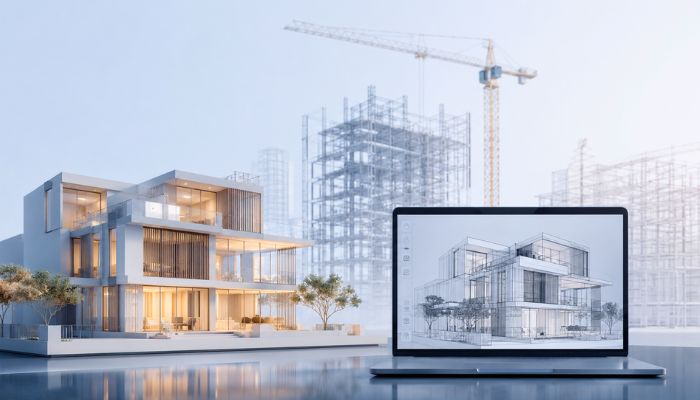
TL;DR: Architectural animation services for real estate and construction in USA 2026. Learn about costs, features, ROI, and how US brands use this technology in 2026.
There is a particular kind of conversation that happens in every US real estate developer’s office — the one where a prospective buyer, an investor, or a planning authority is staring at a set of architectural drawings and trying to imagine a building that does not yet exist. The drawings are accurate. The specifications are detailed. But the human brain does not naturally read technical plans as spaces it can walk through, live in, or invest in with confidence.
That is the problem architectural animation services solve. Not partially, not approximately — completely. A well-produced architectural animation takes those plans and transforms them into a cinematic, photorealistic experience of the finished building: the way light falls through the lobby windows on a Tuesday morning, the texture of the cladding under an overcast sky, the flow from the parking level through the entrance and into the first available apartment.
In the US real estate and construction market in 2026, this capability has moved from competitive advantage to commercial expectation. Buyers expect to see what they are purchasing before it is built. Investors expect to understand the project before they commit capital. Planning authorities expect to visualize the impact before they approve it. Studios specializing in immersive interactive experiences — like Elipse Studio and Ink & Algorithm — are meeting these expectations with content that closes deals, not just impresses audiences.
At Ink & Algorithm, we produce architectural animation and visualization services for US real estate developers, architecture firms, and construction companies. Working in partnership with creative studios like Elipse Studio when projects demand it, our combined capabilities cover every format — from fly-through videos to fully interactive VR walkthroughs and augmented reality overlays. This guide covers everything: what architectural animation encompasses, which US sectors see the biggest returns, what the production process looks like, and what it costs.
| 📎 Related Reading: Explore Our 3D Animation Services | Elipse Studio — Immersive Experiences |
What Are Architectural Animation Services, and How Have They Evolved?
Architecture visualization refers to the creation of animated 3D visualizations of buildings, interiors, landscapes, and construction projects — sequences that move through a space or around a building in a way that communicates the experience of the finished project to viewers who have never seen it in person.
This is distinct from static architectural renders, which produce a single photorealistic image from one angle. Animation produces a sequence of images — typically between 24 and 60 frames per second — that move through the space like a camera. The result is content that feels cinematic: a fly-through of the building exterior, a walkthrough of the model apartment, a bird’s-eye view of the full development site contextualizing the project within its neighborhood.
In 2026, the definition has expanded significantly. Architectural animation services now encompass fully interactive virtual reality environments, augmented reality applications that overlay a planned building onto its actual site when viewed through a smartphone, real-time material configurators via web-based 3D tools, and construction sequence animations showing how a project will be built phase by phase. The animated architectural visualization of 2026 is not a video — it is an experience.
Why 2026 Is a Pivotal Year for Architectural Animation in the USA
Several converging factors have made 2026 a particularly important year farchitectural renderingion in the US market. Construction costs have risen consistently since 2021, making pre-sale and pre-lease critical for project viability — developers can no longer afford to build speculatively and sell afterward. At the same time, the buyer and investor pool for US real estate has become increasingly international and remote, with significant capital flowing from buyers who may never visit the development site before committing.
The technology has also reached a quality threshold that changes the conversation. Studios like Elipse Studio and Ink & Algorithm are produci3D architectureions in 2026 where the visual difference between a render and a photograph of the completed building is undetectable to the average viewer. This is not a marginal improvement — it is the point at which animation becomes a credible substitute for the physical experience it represents.
| “A photorealistic architectural animation in 2026 is not a representation of what a building might look like. It is what the building looks like — rendered in three dimensions, six months before the first steel beam goes up.” |
Types of Architectural Animation Services for US Real Estate & Construction
Different stages of the real estate and construction cycle call for different types of animation. Understanding which format serves which purpose allows developers and architects to invest in the right content at the right time.
Exterior Fly-Through Animation
The exterior fly-through is the most widely used format in residential and commercial real estate marketing. A virtual camera moves around and above the building, revealing the architecture from multiple angles under controlled lighting. For buyers browsing online listings, investors reviewing a pitch deck, and planning authority submissions, an exterior fly-through communicates the visual character of the project more effectively than any other single piece of content. Both Elipse Studio and Ink & Algorithm deliver this format as a core service for US developers.
Interior Walkthrough Animation
Interior walkthroughs move through the finished spaces of a building — the lobby, the model apartment, the communal areas, and the amenities. They communicate scale, finishes, light quality, and spatial flow in ways that floor plans and photographs cannot. Prospective buyers who watch a walkthrough of the apartment they are considering convert at significantly higher rates than those who rely on floor plan images alone. Our 3D animation team builds every interior sequence to match the exact material specifications of the design.
VR Interactive Architectural Tours
The interactive VR tour takes the linear animation format and makes it fully navigable. Instead of watching a pre-set camera path, clients use a headset or browser to walk through the space themselves — turning into rooms, standing on the balcony, assessing the view. Studios like Elipse Studio, which specializes in immersive interactive experiences, bring this format to life for high-value residential and commercial sales where passive viewing is not enough.
Construction Sequence Animation
For construction firms bidding on major projects, and for developers presenting to planning authorities and government stakeholders, construction sequence animations show how a project will be built over time — the phased excavation, the structural frame rising floor by floor, the cladding installation, the landscaping. These animations communicate project management competence and help non-technical stakeholders understand a complex multi-year program.
Aerial and Site Context Animation
Site context animations place the proposed development within its broader environment — showing how it sits in the streetscape, how it relates to surrounding buildings, and how the public realm will feel at ground level. For planning applications and investor presentations that require an understanding of neighborhood impact, site context animations are essential. Elipse Studio’s expertise in 3D configurations and spatial storytelling makes aerial animations particularly effective for masterplan-scale developments.
AR On-Site Overlay
One of the most striking applications in 2026 is the augmented reality on-site overlay — a prospective buyer stands on the empty plot, points their smartphone, and sees the finished building superimposed over the real environment at exact scale. Both Elipse Studio and Ink & Algorithm develop AR overlays as part of their immersive architectural service offering, using ARKit and ARCore for cross-platform deployment.
| 📎 Related Reading: Our VR Development Services | Elipse Studio — AR/VR Solutions |
Which US Sectors Are Seeing the Biggest Returns from Architectural Animation?
ArchiArchitectural CGIvers value across the full real estate and construction ecosystem, but different sectors experience different kinds of return depending on their specific use cases and sales cycles.
Residential Real Estate Development
For residential developers, the business case for architectural animation is built on presales. A residential development that can begin marketing and taking reservations before construction starts operates at a fundamentally different risk level than one that builds first and sells afterward. Animation services from Ink & Algorithm — exterior walkthroughs, model apartment tours, and VR experiences — are the primary tools for generating the buyer confidence that makes presales possible.
US residential developers using high-quality architecturarchitecture visualizationly report faster sell-through rates for off-plan inventory, higher achieved prices per square foot, and significantly lower marketing costs per reservation. The animation investment pays for itself many times over in the carrying cost savings from a faster presale program.
Commercial Real Estate and Office Development
Commercial real estate transactions are complex, high-value decisions made by sophisticated institutional buyers and occupiers. Developers use animations to communicate the quality of office space — showing how natural light moves through the floor plate, how building services are integrated, and how common areas create a premium workplace environment. Studios like Elipse Studio that specialize in immersive digital solutions add a layer of interactivity that static renders simply cannot match for high-value commercial pitches.
Architecture and Design Firms
Architecture and design firms use animation primarily at the client presentation and design approval stage. Presenting an architectural concept through animation — rather than static renders — produces measurably higher client approval rates and fewer late-stage design change requests. Our 3D animation team works directly with architecture firms to translate design intent into cinematic visualization. For firms that want to offer clients an even more immersive experience, Elipse Studio’s specialization in interactive 3D configurations adds a configurable layer where clients can swap materials and finishes in real time.
Construction Companies and Project Bidders
Construction firms increasingly use animation as a differentiator in competitive bid processes. A bid package that includes a construction sequence animation — showing how the firm plans to manage the build program and sequence the trades — communicates competence in a way that written specifications cannot. In competitive situations where multiple firms have similar pricing, presentation quality often determines the winner.
Urban Planning and Government Authorities
Planning authorities and government stakeholders use architecarchitectural renderingunicate proposed developments to the public during consultation processes. An animated visualization of a proposed building in its context is a significantly more effective public communication tool than technical drawings. Developers who provide high-quality animations — including the immersive walkthrough experiences that studios like Elipse Studio produce — consistently report smoother, faster approval processes.
| 📎 Related Reading: View Our Portfolio — Real Architectural Projects | Elipse Studio — Work & Portfolio |
The Business Case: What ROI Do Architectural Animation Services Deliver?
The commercial return on architec3D architectureent is documented, consistent, and measurable. Here is what US real estate and construction professionals are reporting in 2026.
Accelerated Presales and Off-Plan Revenue
Developments with comprehensive animation packages — exterior fly-through, interior walkthrough, VR tour, and site context animation — consistently begin presales earlier and achieve higher reservation rates in the early release phase. The financial math is straightforward: if a quality architectural animation package from studios like Elipse Studio or Ink & Algorithm costs a developer $40,000 and allows construction financing to be triggered six weeks earlier, the carrying cost savings on a $20 million construction loan alone can significantly exceed the animation investment.
Reduction in Late-Stage Design Changes
For architecture firms and their developer clients, late-stage design changes are among the most expensive line items in any project budget. Architectural anArchitectural CGInts a visceral, immersive understanding of the design early in the process, dramatically reduces the frequency of late-stage change requests. The client who has walked through the building in VR — using an experience built by a studio specializing in immersive interactive experiences — is the client who does not call three months later asking why the lobby feels smaller than they expected.
International Buyer Engagement
The US real estate market in 2026 draws significant investment from international buyers who may never visit the development site before committing to a purchase. For these buyers, a well-produced architectural animation is not a marketing tool — it is the primary basis for their purchase decision. Developers who partner with studios like Elipse Studio and Ink & Algorithm for internationally-facing animation content report significantly higher engagement and conversion rates from international marketing campaigns.
| “The developer who shows an investor a photorealistic animation of a finished lobby — with morning light through the windows and a coffee shop in the corner — is not showing them a building. They are selling them an experience they can already see.” |
How Architectural Animation Services Work: The Production Process
Understanding the production process helps clients plan effectively, provide the right inputs at the right stages, and set realistic expectations for timelines and deliverables.
Step 1: Brief, Asset Review, and Project Understanding
Every architectural animatioarchitecture visualization thorough brief — a deep understanding of the commercial context: who is the audience, where will the content be used, and what emotional response does the client need to create? Whether a project begins with Ink & Algorithm or with the Elipse Studio team, this discovery phase shapes every creative decision downstream — from the camera paths chosen to the time of day rendered to the music selected for the final edit.
Step 2: 3D Modeling, Texturing, and Environment Building
With the brief and assets in hand, our 3D modeling team builds the digital environment. The building is modeled at full architectural detail — every window reveal, cladding panel joint, and landscape element. Material textures are applied with physically accurate properties: concrete with its characteristic surface variation, glass that reflects and refracts correctly, timber cladding that reads as wood under different light conditions. For projects integrating Elipse Studio’s 3D configuration technology, materials can be made switchable in real time, allowing clients to explore finish options interactively.
Step 3: Animation, Camera Paths, and Lighting Design
Camera paths are designed to reveal the building’s key attributes in a logical, compelling sequence — moving from the broad context to the specific detail, from the exterior to the interior, always orienting the viewer and always showing the project at its best. Lighting is designed using accurate sun position data for the building’s actual location, rendered at the time of day most favorable for the specific views being shown. Elipse Studio’s motion graphics expertise enhances title sequences, lower-thirds, and information overlays within the animation for presentations and planning submissions.
Step 4: Rendering, Post-Production, and Color Grading
Rendering calculates how light interacts with every surface in every frame — a process requiring significant computing resources for high-quality architectural work. We use cloud-based render farms to maintain efficient timelines. Finished renders are edited into the final animation sequence, color graded for consistency and mood, and combined with music and sound design. For projects where Elipse Studio’s motion graphics team produces animated title cards and data overlays, these are composited into the final delivery at this stage.
Step 5: Delivery Formats, VR Integration, and AR Deployment
Final deliverables are provided in the formats required for each intended use — high-resolution MP4 for website and presentation use, optimized versions for social media, and interactive WebGL builds for website embedding. Where VR integration is part of the brief, the 3D environment is adapted for real-time VR rendering. For AR on-site overlay applications, we develop ARKit and ARCore implementations that allow the building to be viewed at scale through a smartphone camera. Elipse Studio contributes its specialization in interactive immersive experiences at this stage when clients require web-embedded interactive tours rather than passive video delivery.
| 📎 Related Reading: How AR is Transforming Real Estate in USA | Elipse Studio — AR/VR Solutions |
What Do Architectural Animation Services Cost in the USA in 2026?
Cost varies based on the scale of the project, the number and complexity of deliverables, and the inclusion of interactive VR or AR elements. Whether engaging Ink & Algorithm, Elipse Studio, or a combination of both, here is an honest framework.
Entry-Level Architectural Animations ($8,000–$25,000)
An entry-level package typically covers a single exterior fly-through or a combined exterior and basic interior walkthrough for a residential or small commercial development. This level is appropriate for smaller residential developments, individual apartment buildings, and architecture firms presenting single-building concepts to clients. Both Ink & Algorithm and Elipse Studio offer entry-level architectural animaarchitectural renderingnvestment range.
Mid-Range Animation Packages ($25,000–$80,000)
The mid-range covers full marketing animation suites for residential developments — typically including an exterior fly-through, multiple interior walkthroughs of different apartment types, a site context animation, and an aerial overview. This level of investment produces content that can anchor a full presales marketing campaign and is appropriate for developments of 50 to 500 units. Adding Elipse Studio’s interactive 3D configuration tools for material selection typically falls in this range.
Large-Scale Development Animation ($80,000–$250,000+)
Large-scale packages cover master-planned communities, major commercial developments, and mixed-use projects. These packages often include the full suite of animation formats — exterior, interior, aerial, construction sequence, site context — alongside interactive VR environments, AR applications, and the ongoing asset management required as the design evolves. Combining the production capabilities of Ink & Algorithm with the immersive interactive experience specialization of Elipse Studio creates the most comprehensive offering at this level.
| 📎 Related Reading: Get a Custom Quote for Your Project | Elipse Studio — Contact & Enquiries |
How to Choose the Right Architectural Animation Studio in the USA
The quality gap between architectural anima3D architectureand in a market where your animation may be the primary basis on which a multi-million dollar investment decision is made, choosing the wrong studio is an expensive mistake. Here is what to look for.
- Demonstrated photorealism in comparable project types: Review the studio’s portfolio specifically for projects similar to yours — residential, commercial, or mixed-use — at a comparable scale and quality level. Both Ink & Algorithm’s portfolio and Elipse Studio’s work demonstrate real estate and architectural animation in architectural CGI conceptual demos.
- Architectural literacy: The best studios have team members who understand architectural drawings and design intent — not just 3D artists who interpret instructions. If the studio cannot read a set of plans and ask the right questions, the animation will reflect that gap.
- End-to-end production under one roof: Studios that handle modeling, animation, lighting, rendering, post-production, VR integration, and AR development internally produce more consistent results. Where a project requires the immersive interactive experience specialization of Elipse Studio alongside the animation production capabilities of Ink & Algorithm, a coordinated partnership approach is more effective than engaging them separately.
- Revision process transparency: Understand exactly how many revision rounds are included, at which stages revisions are possible without additional cost, and what the process is for design changes that occur after modeling has begun.
- Cross-format capability: The 3D assets built for your animation should be usable across multiple formats — video, web interactive, VR, AR — without requiring re-modeling. Both Elipse Studio and Ink & Algorithm architect their 3D assets for multi-format reuse from the start of each project.
Frequently Asked Questions About Architectural Animation Services
How long does an architectural animation project take?
Timeline depends on scope and complexity. A single exterior fly-through typically takes four to six weeks from receipt of drawings to final delivery. A full marketing animation suite with multiple interior and exterior sequences and VR integration typically takes ten to sixteen weeks. Both Ink & Algorithm and Elipse Studio work to clearly defined milestones so clients always know where a project stands in the production process.
What files do you need to get started?
The ideal input package includes architectural drawings in plan, section, and elevation; any available 3D models in Revit, ArchiCAD, SketchUp, or AutoCAD format; material and finish specifications; and landscape drawings. If you only have 2D drawings, the Ink & Algorithm modeling team can work from these — and where Elipse Studio’s 3D configuration technology is being integrated, their team will advise on the specific asset formats they require.
Can animations be updated if the design changes during planning?
Yes — and this is an important consideration when planning your animation investment. We structure all projects to preserve source files and asset libraries in formats that can be updated as the design evolves. Minor design changes can typically be incorporated with minimal additional cost. Major structural changes will be quoted as a scope change. Elipse Studio’s interactive configuration tools are particularly useful here — when the design changes, clients can often update material and finish variables themselves without requiring a full re-render.
Can the same animation assets be used for VR and AR applications?
Yes — and planning for this from the start maximizes the return on your animation investment. The 3D models built for a standard fly-through can be adapted for use in an interactive VR tour and an AR on-site overlay with significantly less additional investment than building these assets from scratch. When Elipse Studio contributes their immersive interactive experience capability to a project, they optimize the asset pipeline from the start to support all planned formats — video, web interactive, VR, and AR — without requiring separate modeling efforts for each.
Final Thoughts
The developers and construction firms that treat architectural animation as a markarchitecture visualizationsistently outperformed by those that treat it as a development finance and sales acceleration tool. The arithmetic is not complicated: if a quality animation package enables earlier presales, faster construction finance drawdowns, higher achieved prices, and fewer costly design changes, the return on that investment typically exceeds the cost by a factor of five to ten or more over the course of a development program.
In 2026, the US real estate and construction market has reached a point where the question is not whether architectural animation is worth investing in. The question is whether to invest in animation that is genuinely good enough to do the commercial job it needs to do, or to cut corners on quality and produce content that looks inadequate next to the competition.
The bar for what constitutes competitive quality has risen significantly. The standard is photorealism, interaction, and cross-platform delivery. Meeting that standard requires production partners with the depth, the tools, and the architectural understanding to do the work properly — whether that means engaging Ink & Algorithm for cinematic animation and VR/AR integration, Elipse Studio for immersive interactive experiences and real-time 3D configuration, or both studios working in coordination on a project that demands the full range of capabilities.
Ink & Algorithm provides architectural animation servicarchitectural renderingevelopers, architecture firms, and construction companies that need content which closes deals. From a single exterior fly-through to a complete immersive marketing suite combining 3D animation, VR development, AR applications, and Elipse Studio’s interactive digital experiences — we build every project to the standard your development deserves. Let’s talk about your project.
Ready to get started? Contact Ink & Algorithm to discuss your project—we’ll help you create results that drive sales.