
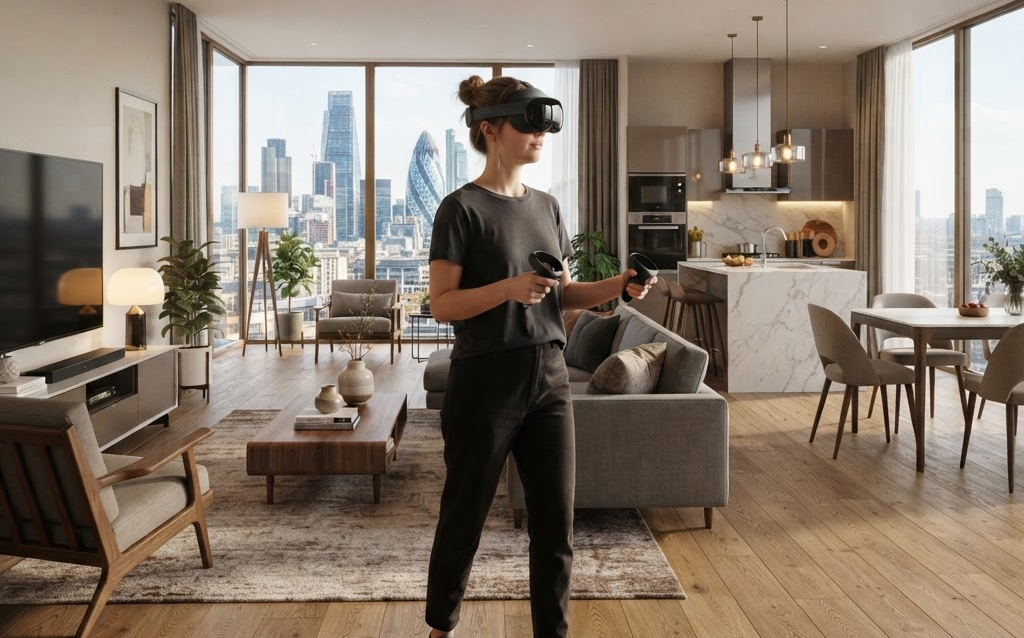
TL;DR: VR real estate tours let buyers walk through properties before they’re built, explore different floor plans, and customize finishes in virtual reality. US developers using VR pre-sales sell 30–50% of units before breaking ground, improving cash flow and reducing financial risk. With Unreal Engine 5 and WebXR making virtual tours accessible, 2026 is the year VR becomes a standard real estate sales tool.
Selling a property that doesn’t exist yet is hard. Renderings and floor plans help, but they can’t answer the most important question: “What will it feel like to live here?” VR real estate tours answer that question by letting buyers physically walk through the space—opening doors, looking out windows, changing finishes, and experiencing the proportions at human scale.
How VR Real Estate Tours Work
A VR real estate tour is a fully immersive 3D walkthrough of a property that hasn’t been built (or has been built but can’t be visited). Using a VR headset or browser-based WebXR, the buyer can:
- Walk through every room at real scale, feeling the proportions and ceiling heights
- Look out the windows and see the actual view from that floor (rendered from geolocation data)
- Change finishes — swap flooring, wall colors, cabinetry, and countertops in real time
- Toggle furniture layouts — see the space furnished vs empty
- Compare floor plans — switch between layout options within the same unit
- Take a building tour — walk through the lobby, gym, rooftop, and common areas
Why Real Estate Developers Need VR in 2026
Pre-Construction Sales
The biggest ROI driver. When buyers can walk through a property before it’s built, they’re confident enough to purchase. Developers using VR pre-sales report 30–50% of units sold before construction begins. This upfront cash flow reduces financing costs and de-risks the entire project.
Out-of-State and International Buyers
Not every buyer can visit a property in person. VR tours let buyers from anywhere in the world walk through the space as if they were there. For developments in markets like Miami, New York, and Los Angeles—where 40–60% of buyers are from out of state—VR is essential.
Faster Sales Cycle
Buyers who experience a property in VR make decisions faster. They’ve already “seen” the space, felt the proportions, and assessed the finishes. The physical visit, if needed at all, becomes a confirmation rather than an exploration. Developers report 40% shorter sales cycles for VR-enabled properties.
Reduced Model Home Costs
Building and maintaining model homes costs $100,000–$500,000 per location. VR tours reduce or eliminate this need—one virtual model home can serve unlimited buyers at zero marginal cost.
The Technology: Building VR Real Estate Tours
Unreal Engine 5 (Premium Tier)
The gold standard for VR real estate. Lumen global illumination shows how natural light changes throughout the day. Nanite handles complex architectural geometry without performance loss. Datasmith imports directly from Revit, ArchiCAD, and SketchUp. Best for high-end developments where visual fidelity matters.
WebXR (Browser Delivery)
Browser-based VR tours that work on any device—phone, tablet, laptop, or VR headset. Lower visual quality than Unreal Engine but maximum reach. Buyers don’t need a headset; they can walk through with keyboard and mouse. This is the most accessible option for reaching all buyers.
Matterport (3D Scanning)
For existing properties, Matterport creates 3D scans of real spaces that can be viewed in VR or browser. Best for resale properties, rentals, and commercial real estate where the physical space already exists.
Cost of VR Real Estate Tours
| Scope | Cost | Timeline |
|---|---|---|
| WebXR walkthrough (single unit) | $10,000–$35,000 | 3–7 weeks |
| Unreal Engine VR tour (single unit) | $25,000–$80,000 | 5–12 weeks |
| Full building VR tour (lobby + amenities + units) | $50,000–$180,000 | 8–18 weeks |
| VR tour + configurator (finishes, floor plans) | $60,000–$250,000 | 10–24 weeks |
| Matterport 3D scan (existing property) | $500–$3,000 per property | 1–3 days |
Features That Drive VR Real Estate Sales
Day/Night Lighting Toggle
Let buyers see the unit at different times of day. Morning light through east-facing windows. Sunset glow in the living room. Evening ambiance with artificial lighting. This shows the property’s full character and helps buyers understand natural light patterns.
Finish Configurator
Buyers customize flooring, wall colors, cabinetry, countertops, and hardware in real time. The 3D model updates instantly with accurate materials. This is especially powerful for pre-construction sales where buyers can still influence the finishes.
View Visualization
Using the unit’s actual location and floor height, render the view from the windows. A buyer on the 30th floor sees the actual skyline they’d see if they looked out the window. This is one of the most persuasive VR features for high-rise developments.
Shared VR Sessions
A couple in different cities puts on headsets and walks through the same unit together, discussing finishes and layout in real time. The agent can join the session, pointing out features and answering questions. This collaborative experience is impossible with physical property tours.
FAQ: VR Real Estate Tours
Do buyers need a VR headset to experience the tour?
No. While VR headsets provide the most immersive experience, WebXR tours can be accessed through any browser with mouse and keyboard navigation. Buyers can “walk through” on their laptop, explore on their phone, or use a VR headset for full immersion. The experience scales to whatever device the buyer has.
How much does a VR real estate tour cost?
A WebXR browser walkthrough of a single unit costs $10,000–$35,000. An Unreal Engine VR tour with photorealistic quality costs $25,000–$80,000 per unit. A full building tour including lobby, amenities, and multiple unit types runs $50,000–$180,000. Adding a finish configurator brings it to $60,000–$250,000.
Can buyers customize finishes in the VR tour?
Yes. Real-time finish configurators let buyers swap flooring, wall colors, cabinetry, countertops, and hardware with instant visual updates. This is especially powerful for pre-construction sales where buyers can still select their finishes. The configurator updates the 3D model in real time with accurate PBR materials.
How accurate is the view from the windows in VR?
Using the unit’s GPS coordinates, floor height, and orientation, the VR tour can render an accurate view of what the buyer would see from the windows—skyline, nearby buildings, landscape. This is one of the most persuasive features for high-rise and waterfront properties.
Can VR tours integrate with my sales CRM?
Yes. VR tour platforms can track which units each buyer explored, which finishes they customized, and how long they spent in the tour. This data feeds into your CRM, giving sales agents insights into buyer preferences before they even schedule a physical visit.
Getting Started with VR Real Estate
- Start with your highest-value development — the project where pre-sales matter most to financing
- Build a WebXR tour first — maximum reach, lowest cost, no headset required for buyers
- Add finish configurator — let buyers customize their unit virtually
- Offer headset tours at the sales office — for buyers who want full immersion during their visit
- Track VR-to-purchase conversion — measure the impact on pre-sales and sales cycle length
The developers adopting VR in 2026 aren’t just selling properties—they’re selling experiences. And the experience of walking through your future home, changing the finishes, and looking out the window at the view is far more persuasive than any rendering or floor plan.
Ready to build VR real estate tours? Contact Ink & Algorithm to discuss your development—we’ll help you create virtual tours that sell properties before they’re built.