
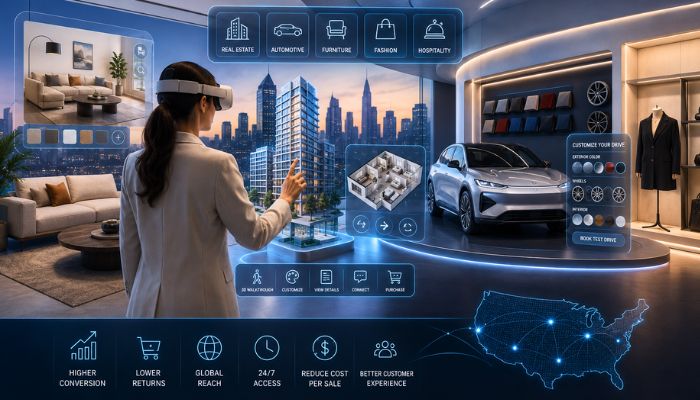
TL;DR: Virtual Showroom Development in USA 2026. Learn about costs, features, ROI, and how US brands use this technology in 2026.
Why Immersive Commerce Is No Longer Optional
Picture this: a customer in Seattle is shopping for a car. Instead of driving to a dealership on a Saturday morning, they put on a VR headset from their living room, walk around a photorealistic 2026 model, open the doors, check the interior, customize the color and trim — then schedule a test drive. Total time spent: 18 minutes. Conversion likelihood: dramatically higher than a traditional showroom visit.
This is not a concept from a tech startup pitch deck. This is virtual showroom development in USA 2026 — and it is already happening across real estate, automotive, furniture, luxury goods, hospitality, and beyond. The businesses leading this shift are not doing it because it is trendy. They are doing it because it works, and because the alternative — a static website with product photos — is rapidly losing ground.
At Ink & Algorithm, we build immersive experiences across virtual reality, augmented reality, and 3D web configurators for US businesses ready to lead their category. This guide breaks down everything you need to know about virtual showroom development — what it is, why 2026 is pivotal, which industries are winning, and what it takes to build one that actually converts.
What Is Virtual Showroom Development, and Why Does It Matter?
A virtual showroom is an immersive, interactive digital environment where customers can explore products or spaces in three dimensions — through a web browser, a mobile device, or a VR headset. Unlike a product gallery or a 360-degree photo tour, a true virtual showroom allows real interaction: customers can walk through spaces, rotate and customize products, view items at true scale, get detailed specifications, and initiate purchases — all without leaving their home or office.
Virtual showroom development refers to the full design-and-build process: creating the 3D environment, modeling the products or spaces within it, integrating interactive features and e-commerce functionality, and deploying the experience across platforms where your customers already are.
The term has evolved significantly. Early virtual showrooms were glorified 360-degree photo tours — impressive novelties with limited interactivity. In 2026, the benchmark is a fully navigable environment with real-time product configuration, AI-driven personalization, seamless mobile and VR compatibility, and direct integration with your sales pipeline.
The Shift That Happened Between 2020 and 2026
Remote work normalized digital interaction for high-value business decisions. Consumers became comfortable making considered purchases online. As devices grew more powerful and 5G networks expanded across US cities, the technical barriers to compelling 3D web experiences dropped significantly.
By 2026, WebGL rendering on mobile is smooth enough to deliver genuinely beautiful 3D environments without an app download. VR hardware has become more affordable and mainstream. And AI tools have dramatically reduced the cost and time required to create high-quality 3D assets. The result is that virtual showroom development — once exclusively the domain of large enterprise budgets — is now accessible to mid-market and smaller businesses that want a competitive edge.
| “In 2026, a virtual showroom is not a luxury differentiator. It is rapidly becoming the standard expectation for any business selling considered, high-value products online.” |
| 📎 Related Reading: How AR App Development Is Transforming Retail — Full Guide |
Which Industries Are Leading Virtual Showroom Adoption in the USA?
Virtual showrooms are not a one-sector story. Across the US economy, multiple industries are discovering that immersive digital environments solve a specific and expensive problem: the gap between what customers can imagine from product photos and what they actually experience when the product arrives.
Real Estate and Property Development
Real estate was one of the earliest and most enthusiastic adopters of virtual showroom technology, and in 2026 it remains the most mature use case. Property developers across the US are using virtual walkthroughs to sell units in buildings that have not yet broken ground — letting buyers walk through photorealistic 3D renders of apartments, explore floor plan variations, and understand how natural light moves through a space at different times of day.
Our VR development services include architectural visualization and property walkthroughs built to sell — not just to impress. For luxury residential and commercial real estate, a virtual showroom is now a standard part of the sales package, not an optional extra.
Automotive
Car dealerships have historically relied on physical inventory and the test drive to close sales. Virtual showrooms are changing that equation. Customers use immersive configurators to choose trim levels, exterior colors, interior materials, and wheel options — seeing the exact combination rendered in real time before they ever step into a dealership. Several US automotive brands are experimenting with full VR test drives, simulating driving conditions to give buyers an experiential sense of a vehicle before a physical appointment.
Home Furnishings and Interior Design
For furniture and interior design brands, the virtual showroom solves the single biggest e-commerce challenge in the category: customers cannot know how a piece will look in their own space. A well-built virtual showroom — combined with an interactive 3D web configurator — allows shoppers to place accurate 3D models of sofas, beds, and dining tables into a digital replica of their own room, adjusting dimensions, finishes, and arrangements until they find exactly what works. Return rates drop. Confidence increases. Average order values climb.
Luxury Fashion and Retail
High-end fashion brands have traditionally resisted e-commerce, arguing that the in-store experience is irreplaceable. Virtual showrooms are offering a compelling middle ground: digital environments that replicate the atmosphere of a flagship boutique, with the convenience of global accessibility. US luxury brands are investing in seasonal virtual showrooms that launch alongside physical collections, allowing wholesale buyers, press, and VIP customers worldwide to experience new collections before they ship.
Architecture, Hospitality, and Education
Architecture firms use virtual showrooms to walk clients through building designs before construction begins — reducing costly late-stage revisions. Hospitality brands, from boutique hotels to resort chains, let guests virtually tour rooms and amenities before booking. Universities are building virtual campus tours that allow prospective students to walk through dormitories, lecture halls, and campus facilities from anywhere in the world.
The Technology Behind Virtual Showroom Development in 2026
Understanding what goes into building a virtual showroom helps set realistic expectations around timelines, costs, and capabilities. In 2026, VR showroom creation involves several interconnected technology layers.
3D Modeling and Asset Creation
The foundation of any virtual showroom is the 3D content — detailed models of products, spaces, and environments that users interact with. At Ink & Algorithm, our 3D animation and modeling team creates assets optimized for both web performance and visual realism. In 2026, AI-assisted modeling tools and photogrammetry have significantly accelerated this process, but quality still requires skilled artists and rigorous attention to lighting response, material textures, and dimensional accuracy.
WebGL and Real-Time Rendering Engines
Most virtual showrooms in 2026 are built to run in web browsers using WebGL — the technology that enables 3D graphics without plugins or downloads. Rendering engines like Three.js and Babylon.js allow developers to create sophisticated, responsive 3D environments that load quickly and perform smoothly on modern mobile devices and desktop browsers. For higher-fidelity VR experiences, game engines like Unreal Engine are increasingly used, with streaming technologies bridging the gap to make these accessible without high-end local hardware.
VR and AR Integration
A well-built virtual showroom in 2026 is platform-agnostic — it should work on a smartphone, a laptop, and a VR headset without separate builds. WebXR, the web standard for VR and AR experiences, has matured significantly and allows developers to create a single experience that scales from mobile augmented reality (pointing a phone at a room to see furniture in it) all the way up to full immersive virtual reality (using a headset to walk through a virtual space).
AI Personalization and Smart Configuration
This is where virtual virtual showroom build diverges most from earlier iterations. AI layers deliver personalized experiences: product recommendations based on browsing behavior, automatic configuration suggestions, and dynamic pricing information. Combined with an interactive 3D configurator, the showroom becomes a sales tool that learns and adapts — not just a visual experience.
Analytics and CRM Integration
Unlike a physical showroom, a virtual one tracks every interaction. Which products did a customer hover over? Which configurations did they explore? How long did they spend in each area? Where did they drop off? This behavioral data, integrated with your CRM and analytics stack, gives sales teams unprecedented insight into customer intent — and allows marketing teams to optimize the experience continuously based on real usage data.
| 📎 Related Reading: See Our Immersive Portfolio — Real Projects, Real Results |
The Business Case: What ROI Does a Virtual Showroom Actually Deliver?
The most practical question any business owner asks about virtual showrodigital showroom developmentrward: does it pay off? The answer, based on results across US businesses that have invested in immersive commerce over the past two years, is a clear yes — with specifics depending on category and implementation quality.
Conversion Rate Improvement
Customers who engage with a virtual showroom convert at significantly higher rates than those who browse static product pages. When someone has spent time walking through a space or customizing a product in a virtual environment, they are far more invested in the purchase. They have already made the decisions that traditionally cause hesitation — they know how the product looks, fits, and feels in context. Businesses using our VR and AR solutions consistently report conversion lifts of 40–65% for products that have immersive experiences versus those that do not.
Return Rate Reduction
For high-value product categories — furniture, electronics, luxury goods — return rates represent one of the most significant costs in e-commerce operations. Virtual showrooms directly address the primary driver of returns: the gap between expectation and reality. When a customer has seen a product at accurate scale in their actual space, the chance of it arriving and feeling wrong drops dramatically. US businesses across furniture and home goods report return rate reductions of 30–50% for products with virtual showroom experiences.
Reduced Cost Per Sale
A virtual showroom operates continuously without requiring showroom staff, physical inventory on display, or expensive retail real estate. For businesses that currently maintain physical showrooms primarily as sales tools — automotive dealerships, furniture showrooms, architectural visualization studios — the shift to a virtual-first model can dramatically reduce the cost associated with each converted customer. Human sales teams can focus exclusively on high-intent, high-value interactions.
Extended Geographic Reach
A physical showroom serves customers who can physically visit it. A virtual showroom serves anyone with an internet connection. For US businesses looking to expand from regional to national — or from national to global — a virtual showroom removes the primary barrier: the need for a physical presence in every market. Several US real estate developers are now preselling properties to international investors who complete their entire evaluation virtually, without ever visiting the US.
| “A virtual showroom that runs 24/7, requires no staff, and reaches every time zone simultaneously is not a replacement for your sales team — it is the most scalable sales asset your business can own.” |
What Does Virtual Showroom Development Cost in the USA in 2026?
Cost is one of the most common questions — and the most variable answers — in virtual showroVR showroom creationignificantly on scope, quality level, and the complexity of the product catalog being represented.
Entry-Level Virtual Showrooms ($15,000–$50,000)
At the entry level, you are typically getting a well-executed 3D environment with a limited product catalog (10–50 items), basic interactivity, and browser-based delivery without advanced personalization or VR headset support. This is appropriate for businesses wanting to test the format before committing to a larger investment, or for focused use cases like a single product line or a property development project.
Mid-Market Virtual Showrooms ($50,000–$200,000)
The mid-market range covers most serious retail and real estate applications: full product catalog integration (100+ items), real-time configuration, mobile and VR compatibility, CRM and analytics integration, and ongoing content management capabilities. This is where most US businesses investing seriously in immersive commerce are operating in 2026.
Enterprise Virtual Showroom Platforms ($200,000+)
Enterprise-level development involves custom rendering pipelines, AI personalization layers, multi-language and multi-currency support, integration with complex ERP and inventory systems, and dedicated ongoing development resources. Automotive brands, luxury retailers, and large-scale real estate developers typically operate at this level.
| 📎 Related Reading: Get a Custom Quote for Your Virtual Showroom Project |
How to Choose the Right Virtual Showroom Development Partner
The difference between a virtual showroom that genuinely drives business results and one that becomes an expensive digital brochure often comes down to who builds it. Here is what separates the right development partner from the rest:
- 3D and immersive expertise: Not every digital agency has genuine depth in 3D asset creation, real-time rendering, and WebXR development. At Ink & Algorithm, these are our core services — not add-ons.
- Industry knowledge: A partner who understands your category — real estate, automotive, retail — will build an experience that matches how your customers actually make purchase decisions, not just a technically impressive demo.
- End-to-end capability: The best partners handle strategy, 3D content creation, development, platform integration, and post-launch optimization. Fragmented handoffs between vendors introduce quality gaps and accountability problems.
- Portfolio with real results: Ask to see and interact with previous work — not just screenshots. Our portfolio includes virtual showrooms, AR experiences, and 3D configurators with documented business outcomes.
- Ongoing partnership model: A virtual showroom is not a one-time deliverable. Products change, collections update, customer behavior evolves. Look for a partner oriented toward long-term collaboration, not just project delivery.
Getting Started: Your First Steps Toward a Virtual Showroom
If you are considering virtual showroom develvirtual showroom buildfirst step is clarity about what problem you are trying to solve. Are you trying to reduce return rates? Expand your geographic reach? Improve conversion rates for high-consideration purchases? Replace expensive physical showroom infrastructure? The answer shapes every decision downstream.
Start with a Pilot, Not a Platform
The businesses that see the best outcomes from virtual showroom investment typically start with a defined, high-value use case rather than attempting to virtualize their entire operation on day one. One product category, one development, one property — built to a high standard, measured carefully, and iterated based on real customer behavior. That learning becomes the foundation for a broader rollout with much greater confidence.
Invest in 3D Asset Quality
The single variable that most determines the quality of a virtual showroom experience is the quality of the 3D assets within it. Cutting corners on modeling and texturing consistently produces experiences that fail to impress and fail to convert. Our 3D animation and modeling services ensure every asset is production-ready — and importantly, 3D assets built for your virtual showroom can be repurposed across your website, product pages, AR features, and marketing materials, making them a compounding investment.
Measure Everything from Day One
Define your success metrics before launch, not after. Know which KPIs matter most for your use case — conversion rate, return rate, time spent, geographic distribution of visitors, lead quality — and ensure your analytics are set up to track them from the moment the experience goes live. The data you collect in the first 60–90 days will tell you more about what to build next than any amount of planning upfront.
| 📎 Related Reading: Read More on Our Blog: AR, VR & 3D Commerce Insights |
Frequently Asked Questions About Virtual Showroom Development
How long does it take to build a virtual showroom?
A focused pilot project — one product category or one property — typically takes 8–14 weeks from kickoff to launch, depending on the complexity of the 3D assets and the integrations required. A full-scale platform with a large product catalog and custom CRM integration can take 4–8 months. The timeline is primarily driven by the 3D asset creation phase, which is why starting with a well-defined, limited scope is almost always the right approach.
Does a virtual showroom work on mobile?
Yes — and mobile compatibility is not optional in 2026. The majority of virtual showroom sessions happen on smartphones, and any serious development project needs to be built mobile-first. WebGL and WebXR have both matured to the point where excellent 3D experiences are achievable on mid-range Android and iOS devices. Our development process includes rigorous mobile testing across device types and screen sizes.
What is the difference between a virtual showroom and a 3D configurator?
A 3D product configurator focuses on a single product — allowing customers to customize color, material, size, and options while viewing a real-time 3D rendering. A virtual showroom is an entire navigable environment — a space that contains multiple products, areas to explore, and a full brand experience. The two work extremely well together: a virtual showroom environment with embedded product configurators for each item creates a comprehensive, high-converting immersive commerce experience.
Can I update the content myself after launch?
Yes. Well-built virtual showrooms include a content management layer that allows your team to update product information, swap 3D models, adjust pricing and availability, and add new items to the showroom without requiring developer involvement for routine updates. Major structural changes or new interactive features will typically require development time, but the day-to-day operational content should be fully in your control.
Final Thoughts: Virtual Showroom Development Is a 2026 Priority, Not a Future Consideration
The businesses asking ‘should we build a virtual showroom?’ in 2026 are already behind the curve in their category. The businesses asking ‘how do we build a better one than our competitors?’ are where the real conversation is happening. That is not hyperbole — it is a reflection of how quickly immersive commerce has moved from novelty to expectation in category after category across the US market.
For real estate developers, retailers, automotive brands, hospitality groups, and architectural firms, the virtual showroom is becoming as fundamental to the customer journey as having a website was in 2005. The technology has matured. The customer appetite is proven. The business case is documented. The remaining question is execution.
At Ink & Algorithm, we design and develop virtual showrooms for US businesses that want to lead their category, not follow it. From 3D environment creation to full VR/AR integration and commerce connectivity, we build immersive experiences that convert. Ready to explore what a virtual showroom could do for your business? Let’s talk.
FAQ
How much does virtual showroom development in cost?
The cost varies based on project scope and complexity. Contact us for a custom quote tailored to your specific needs.
How long does virtual showroom development in take?
Typical projects take 2-8 weeks depending on scope. We provide detailed timelines during consultation.
Do you work with US brands?
Yes, we work with US brands across all 50 states. Our team understands the US market and delivers solutions that drive results.