
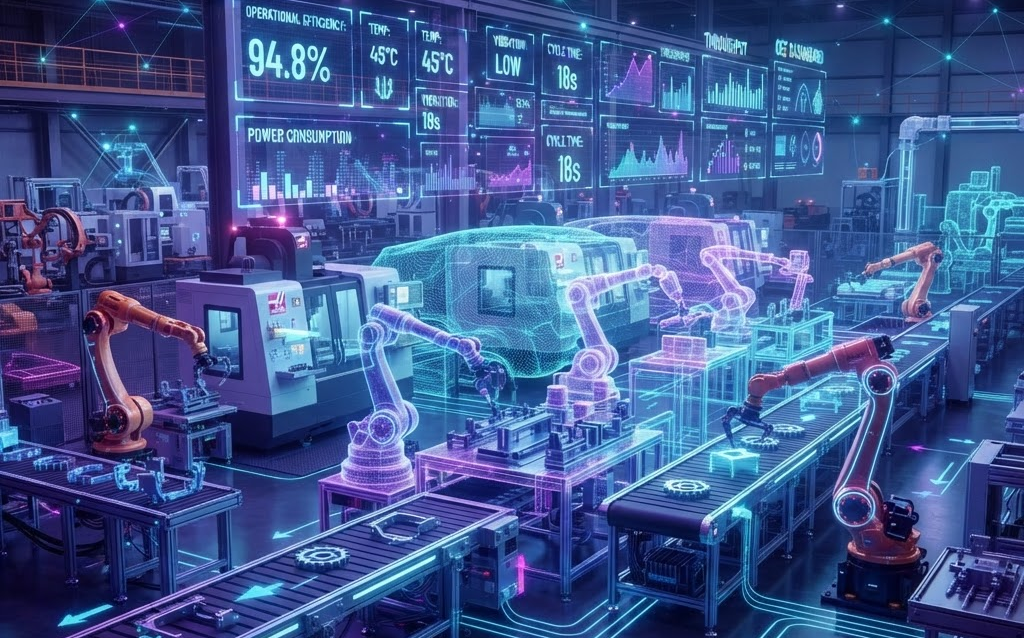
TL;DR: A digital twin is a live 3D replica of a physical asset—a machine, a factory line, a product in the field—that updates in real time with sensor data. US manufacturers using digital twins report 25% less unplanned downtime, 30% faster product development cycles, and 15–20% lower maintenance costs. With IoT sensors and real-time 3D rendering becoming affordable, 2026 is the year digital twins move from enterprise pilots to mid-market manufacturing.
General Electric popularized the term “digital twin” in the early 2010s, but the technology was prohibitively expensive—custom-built systems for billion-dollar assets like jet engines and power plants. In 2026, that’s changed. IoT sensors cost under $10, real-time 3D rendering runs on standard GPUs, and platforms like NVIDIA Omniverse, Unity, and Azure Digital Twins have made digital twin deployment accessible to mid-market manufacturers.
This guide covers what digital twins are, how US manufacturers are using them, and what it takes to build one in 2026.
What Is a Digital Twin?
A digital twin is a virtual replica of a physical asset that stays synchronized with the real thing through sensor data. Unlike a static 3D model, a digital twin updates in real time—when a machine’s temperature rises, the digital twin shows the heat. When a conveyor belt slows down, the digital twin reflects the change. It’s a living, breathing digital copy of a physical system.
The three components of a digital twin:
- Physical asset — the real machine, factory, or product, instrumented with IoT sensors
- Virtual model — a 3D digital replica of the asset, rendered in real time
- Connection — data pipeline that feeds sensor readings from the physical asset to the virtual model, keeping them synchronized
The value comes from what you can do with the twin that you can’t do with the physical asset: simulate, predict, and optimize without touching the real machine.
How US Manufacturers Use Digital Twins in 2026
Predictive Maintenance
The highest-ROI use case. A digital twin of a machine—complete with vibration, temperature, and pressure sensors—can predict failures before they happen. AI models analyze the twin’s sensor patterns and flag anomalies days or weeks before a breakdown occurs. Maintenance is scheduled proactively instead of reactively.
Results: manufacturers using digital twin predictive maintenance report 25% less unplanned downtime and 15–20% lower maintenance costs. For a factory line that costs $50,000/hour in downtime, preventing just one unexpected failure per month saves $600,000/year.
Factory Layout Optimization
A digital twin of an entire factory—every machine, conveyor, robot, and workstation—lets managers simulate layout changes before implementing them. Want to move a production line? Simulate it in the digital twin first. The simulation shows how the change affects throughput, bottlenecks, and material flow—before a single machine is moved.
Manufacturers using factory digital twins report 10–15% throughput improvements from layout optimizations that were too risky to attempt without simulation.
Product Development and Testing
Before building a physical prototype, manufacturers create a digital twin of the product and simulate its performance. A digital twin of a new pump can be tested under varying pressure conditions. A twin of an engine component can be stress-tested thermally. This reduces physical prototyping cycles by 30–50%, accelerating time-to-market and cutting development costs.
Remote Monitoring and Operations
Managers and engineers can monitor factory operations from anywhere in the world through the digital twin. Instead of walking the floor, they view a real-time 3D model of the factory with live data overlays—machine status, production rates, temperature, and alerts. This is especially valuable for multi-site operations where a single team oversees multiple facilities.
Training and Onboarding
New operators train on the digital twin before touching real equipment. They learn machine operation, safety procedures, and emergency responses in a risk-free virtual environment. This reduces training time by 40–60% and eliminates the risk of trainee errors damaging equipment.
Supply Chain and Logistics
A digital twin of the supply chain—warehouses, transportation routes, inventory levels—lets manufacturers simulate disruptions and test mitigation strategies. What happens if a supplier delays shipment? The twin shows the cascading impact across the production schedule, allowing managers to pre-plan alternatives.
The Technology Stack Behind Digital Twins
IoT Sensors and Data Pipeline
- Sensors — vibration, temperature, pressure, flow rate, current, and position sensors attached to physical assets. Cost: $5–$50 per sensor.
- Edge computing — local processing units that filter and aggregate sensor data before sending to the cloud. Reduces bandwidth and latency.
- Data platform — time-series database (InfluxDB, Azure Digital Twins, AWS IoT) that stores and processes sensor data streams.
3D Visualization
- NVIDIA Omniverse — the most powerful platform for industrial digital twins. Real-time 3D with physics simulation, multi-user collaboration, and CAD import. Enterprise pricing.
- Unity Industrial — accessible real-time 3D with strong IoT integration. Good for mid-market manufacturers. $2,000–$5,000/year/seat.
- Unreal Engine 5 — photorealistic visualization with Datasmith CAD import. Free for digital twin use under the $1M revenue threshold.
- Microsoft Azure Digital Twins — cloud platform for modeling and simulating IoT-connected environments. Pay-per-use pricing.
AI and Analytics
- Anomaly detection — ML models that identify unusual sensor patterns indicating potential failures
- Predictive models — forecast remaining useful life of components based on wear patterns
- Optimization algorithms — suggest process improvements based on twin data analysis
Digital Twin Cost by Scale
| Digital Twin Scope | Cost | Timeline |
|---|---|---|
| Single machine twin | $20,000–$80,000 | 4–8 weeks |
| Production line twin | $80,000–$250,000 | 8–16 weeks |
| Full factory twin | $250,000–$750,000 | 16–32 weeks |
| Multi-site platform | $500,000–$2,000,000+ | 6–12 months |
| Product development twin | $30,000–$120,000 | 4–10 weeks |
Ongoing costs: IoT sensor maintenance ($50–$200/sensor/year), cloud hosting ($500–$5,000/month), data platform licensing ($1,000–$10,000/month), and AI model maintenance (15–20% of build cost annually).
ROI: What Manufacturers Are Measuring
- 25% less unplanned downtime — predictive maintenance prevents failures before they occur
- 30% faster product development — virtual prototyping reduces physical iteration cycles
- 15–20% lower maintenance costs — proactive maintenance is cheaper than reactive
- 10–15% throughput improvement — factory layout optimization via simulation
- 40–60% faster training — virtual training reduces onboarding time and risk
- 15% energy savings — process optimization identifies waste in real time
For a mid-size manufacturer with $50M annual revenue, a 25% downtime reduction alone can save $500,000–$2,000,000 per year—paying back a $250,000 digital twin investment in months.
FAQ: Digital Twin Technology
What’s the difference between a 3D model and a digital twin?
A 3D model is a static digital representation of a physical object. A digital twin is a 3D model that’s connected to the physical asset via live sensor data and updates in real time. A 3D model shows what a machine looks like; a digital twin shows what the machine is doing right now—temperature, vibration, output, status.
How much does a digital twin cost?
A single machine digital twin costs $20,000–$80,000. A full factory twin runs $250,000–$750,000. Multi-site enterprise platforms cost $500,000–$2,000,000+. Ongoing costs include IoT sensor maintenance ($50–$200/sensor/year), cloud hosting ($500–$5,000/month), and data platform licensing ($1,000–$10,000/month).
Do I need IoT sensors for a digital twin?
Yes—sensors are what make a digital twin “live.” Without sensor data, you have a 3D model, not a digital twin. The number and type of sensors depend on what you’re monitoring: temperature and vibration for machines, flow rate for pipes, current for electrical systems. Modern IoT sensors cost $5–$50 each.
Can a digital twin work with my existing equipment?
In most cases, yes. IoT sensors can be retrofitted to existing machines—vibration sensors, temperature probes, and current monitors attach externally without modifying the equipment. For newer machines with built-in PLCs, data can often be extracted directly through OPC-UA or Modbus protocols.
Which platform is best for building a digital twin?
NVIDIA Omniverse is the most powerful for large-scale industrial twins with physics simulation. Unity Industrial is the most accessible for mid-market manufacturers. Unreal Engine 5 offers the best visual quality for free. Azure Digital Twins is best for IoT-heavy data integration. Most manufacturers start with Unity or Unreal for visualization and add Azure/AWS for data management.
Getting Started with Digital Twins
Don’t start with a full factory twin. Start with one critical machine—the one that causes the most downtime when it fails. Build a single-asset digital twin with predictive maintenance, measure the ROI, and scale from there.
- Identify your highest-cost downtime asset — the machine that costs the most when it fails
- Instrument it with sensors — vibration, temperature, and current at minimum
- Build the 3D twin — visualize the machine in real time with live data overlays
- Add predictive analytics — train AI models on historical sensor patterns to predict failures
- Measure and scale — once the single-machine twin proves ROI, expand to the full production line
The manufacturers that adopt digital twins in 2026 will have a measurable operational advantage over competitors still running on reactive maintenance and physical prototyping. The technology is ready. The ROI is proven. The question is whether you start now or wait until your competitors force your hand.
Ready to build a digital twin for your manufacturing operation? Contact Ink & Algorithm to discuss your project—we’ll help you architect a real-time digital twin that drives measurable efficiency gains.