
TL;DR: Visual Configuration Benefits. Learn about costs, features, ROI, and how US brands use this technology in 2026.
Introduction
Let us be honest about something: the way people shop has changed permanently. The pandemic accelerated a decade of digital transformation into just a few years, and what came out the other side is a consumer who is more informed, more demanding, and considerably less patient than before. Today in 2026, a customer who visits your product page and sees a static image with a handful of dropdown menus for size and color does not think “Okay, I can work with this.” They think “Why is this still so basic?” and they leave. What they are looking for — and increasingly expecting as a baseline — is a visual product configurator: an interactive, real-time, visually rich experience that lets them build, personalize, and fully visualize exactly what they are about to purchase before committing to a single dollar.
This expectation is not irrational or elitist. It is a perfectly reasonable response to technology that now exists and that forward-thinking brands have already deployed. Once a customer has experienced configuring a custom sneaker on Nike’s platform and seeing it rendered photorealistically as they change every option, the experience of buying a similar product through a basic variant selector feels genuinely primitive by comparison. The bar has been raised, and businesses that do not meet it are quietly but steadily losing customers to those that do.
The good news is that 3D product configurator technology is no longer the exclusive domain of enterprise brands with million-dollar tech budgets. In 2026, accessible, high-performance, beautifully designed visual product configurator solutions are available to businesses of every size across virtually every product category — from boutique furniture makers to industrial equipment suppliers, from specialty eCommerce retailers to large-scale automotive dealers. The technology has matured, the costs have come down, and the commercial case has never been clearer. This comprehensive guide, developed by the team at Ink N Algorithm, breaks down every significant benefit of adopting a visual product configurator in 2026 — and explains exactly why this technology should be at the top of your business investment priorities right now.
We will cover the psychological dynamics that make visual configurators so effective at converting browsers into buyers, the operational efficiencies they unlock behind the scenes, the ways they transform customer experience from a passive transaction into an active and emotionally engaging process, and the competitive advantages they provide in a marketplace where differentiation is everything. Whether you are considering your first online product configurator or looking to upgrade an existing tool to a genuinely world-class interactive configurator experience, this guide will give you the understanding you need to make the right decision for your business in 2026.
What Exactly Is a Visual Product Configurator?
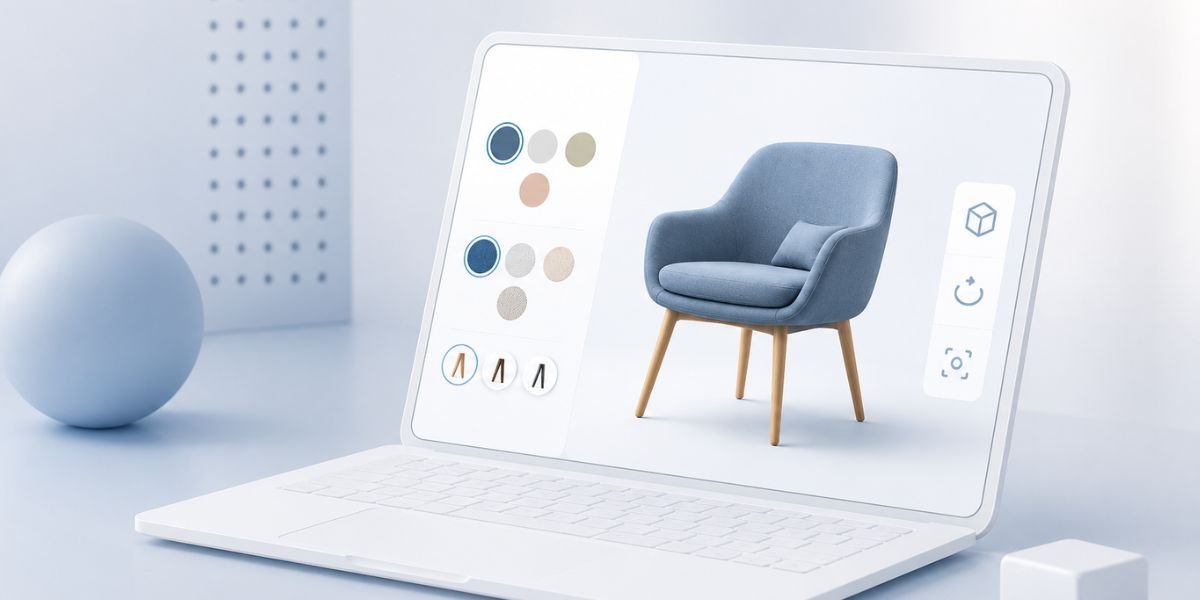
Before we explore the benefits in depth, it helps to be precise about what we mean by the term visual product configurator. In its most complete and modern form, a visual product configurator is a web-based software application that allows users to customize a product by selecting from a set of defined options — materials, colors, dimensions, components, finishes, add-ons — while seeing every change they make reflected instantly in a high-quality visual representation of the product. The defining characteristic is that word “visual.” The configurator is not just a form that captures choices; it is a living, breathing, real-time rendering engine that translates selections into imagery so accurate and detailed that customers can see and feel confident in exactly what they are getting.
Modern 3D product configurator solutions render products as fully three-dimensional models that users can rotate, zoom, and examine from every angle. As a user selects a different fabric, the 3D model instantly updates to show that fabric’s texture, sheen, and drape on the actual product form. As they change a color, the rendering engine simulates how that pigment looks under realistic lighting conditions. As they add or remove components, the 3D geometry updates to reflect the new configuration. This level of visual fidelity eliminates the single greatest source of purchase anxiety in online shopping: the gap between what customers imagine a product will look and feel like and what it actually is when it arrives. Closing that gap is the foundational value proposition of every great product customization tool.
It is also worth distinguishing between different levels of visual configurator sophistication. At the entry level, image-swap configurators replace a 2D product photo with a different pre-rendered image when users change options — functional but limited, since it requires pre-rendering every possible option combination and cannot show options together dynamically. A true interactive configurator built on WebGL or similar real-time rendering technology is far more powerful: it renders the product model dynamically in the browser, allowing any combination of options to be visualized immediately without pre-rendered assets. At the most advanced level, augmented reality integration allows customers to project their configured product into their actual physical environment through their smartphone camera — seeing a configured sofa in their actual living room, or a designed vehicle wrap on their actual car. This spectrum of capability is important to understand when planning a product personalization investment, because the right level of sophistication for your business depends on your product category, your customer expectations, and the complexity of your configuration logic.
| Configurator Type | Best Use Case |
| Image-Swap 2D Configurator | Simple products with limited options (colors, finishes) |
| Real-Time 3D WebGL Configurator | Complex or high-value products needing full visualization |
| AR-Enabled Configurator | Furniture, decor, large equipment, automotive |
| CPQ-Integrated Configurator | B2B and industrial with pricing/quoting requirements |
| VR Immersive Configurator | Showroom-quality experiences for premium brands |
Benefit 1: Dramatically Higher Conversion Rates
The most immediately and compellingly measurable benefit of a visual product configurator is its impact on conversion rates. Businesses that deploy well-designed interactive configurators consistently report conversion rate improvements in the range of 20 to 40 percent, with some high-involvement product categories showing even more dramatic results. Understanding why this happens requires a brief excursion into consumer psychology, because the mechanics of what a configurator does to a buyer’s mind is genuinely fascinating and explains the commercial results with precision.
When a customer interacts with a real-time product visualization tool — when they are actively making choices, seeing those choices reflected in a beautiful 3D rendering, and feeling the product take shape according to their preferences — something important happens in their psychology. Behavioral economists call it the endowment effect: once we feel that something belongs to us or has been created by us, we value it more highly and are more motivated to acquire it. A customer who has spent fifteen minutes configuring their perfect sofa — choosing the modular layout, the performance linen fabric in slate grey, the solid walnut legs, the scatter cushions — is not just a browser anymore. They are an owner-in-waiting. The configured product feels, on some level, already theirs. Walking away from it at that point feels like a genuine loss, and that psychological dynamic is extraordinarily powerful as a conversion mechanism.
There is also a confidence dimension to this conversion lift that is equally important. One of the primary reasons online shoppers abandon their carts is simple uncertainty — they are not sure enough about what they are getting to commit to the purchase. Will the color look the same in real life? Will the size work in my space? Will the material look as good as the swatch suggests? A 3D product configurator systematically eliminates each of these uncertainties by showing the customer exactly what they are getting with high visual fidelity. When uncertainty is removed, hesitation is removed, and conversion follows naturally. This is why businesses in high-uncertainty product categories — furniture, automotive accessories, industrial equipment, custom apparel — tend to see the greatest conversion lifts from product customization technology: because these are precisely the categories where uncertainty is highest and where visual confirmation of the exact configured product is most valuable.
It is also worth noting the impact of online product configurator experiences on session depth and time on site. Users who engage with a configurator spend dramatically more time on a product page than those who view static pages. This extended engagement has two important effects. First, it reinforces purchase intent — the longer someone engages with a product, the more committed they become to the idea of owning it. Second, it signals strong quality to search engines: longer session durations, lower bounce rates, and deeper engagement are all positive signals that improve organic rankings over time, creating a virtuous cycle where better rankings bring more traffic which generates more configuration sessions which build more purchase intent.
Benefit 2: Significantly Higher Average Order Value
Conversion rate is only half of the revenue equation. The other half is how much each converted customer spends, and this is the second area where a visual product configurator delivers powerful commercial returns. Businesses consistently report that customers who configure their own products spend significantly more per transaction than those who purchase from a standard product catalog — with average order value increases of 15 to 30 percent being commonly reported across industries. The reasons for this are both psychological and practical, and both are worth examining carefully.
The psychological driver is the same endowment effect we discussed in the context of conversion rates, operating in a slightly different direction. A customer who is actively engaged in building their perfect configured product is in a state of focused intent — they are not browsing; they are creating. In this mental state, they are considerably more receptive to premium options and upgrades than they would be in a passive browsing context. When the interactive configurator presents a premium material option alongside a standard one — showing, visually and immediately, the aesthetic difference between the two — the customer is primed to evaluate the upgrade on its merits rather than defaulting to the cheaper option out of browsing habit. Many customers will choose the premium option simply because they can see why it is better, and because they have already mentally invested in the idea of the perfect version of the product they are building.
The practical driver relates to the configurator’s ability to systematically surface options and accessories that customers might not have known were available. In a traditional product catalog, customers see what they look for and often miss what they do not specifically search for. A well-designed product customization flow ensures that every relevant option is presented at the appropriate moment in the configuration journey — not as a pushy upsell popup, but as a natural and integrated part of the product building process. The customer configuring a home office desk is gently presented with cable management options, monitor arm compatibility, and coordinating storage units at the right moments in their configuration session. Not all of them will select these additions, but a significant proportion will — and each addition increases the order value without requiring any sales pressure or heavy-handed marketing.
Benefit 3: Dramatically Fewer Returns and Complaints
Product returns are one of the most damaging cost centers for any business selling physical products online. Reverse logistics, restocking costs, product handling damage, customer service overhead, and lost resale value all compound to make a single returned item far more expensive than the initial cost of the sale. And in product categories like furniture, large appliances, and custom manufactured goods, returns can be devastating — sometimes more costly than the original sale price. A visual product configurator attacks this problem at its root by ensuring that customers know precisely what they are getting before they buy it, eliminating the most common causes of returns: color or material disappointment, sizing surprises, and “it looked different on the website” experiences.
When a customer has configured a product using a high-fidelity 3D product configurator — seeing their exact color choice rendered accurately under realistic lighting, verifying the dimensions fit their space, confirming that the combination of options they have chosen looks the way they hoped — they arrive at the purchase decision with a level of certainty that simply is not possible when buying from a static product page. This certainty translates directly into lower return rates. Industry data consistently shows return rates 20 to 35 percent lower for products purchased through visual configurators compared to identical products purchased through conventional eCommerce product pages. For businesses with significant return rates in their current model, this reduction alone can represent a return on the configurator investment within months of deployment.
There is also a customer satisfaction dimension that goes beyond just returns. Customers who configure their own products and receive exactly what they configured develop a fundamentally different relationship with the product and the brand than customers who buy from a standard catalog and receive something that is approximately, but not exactly, what they imagined. The former group feels that the brand delivered on a personal promise; the latter group feels that the product is a compromise. Satisfaction scores, repeat purchase rates, and word-of-mouth referral rates are all significantly higher for customers whose product personalization experience has met or exceeded their expectations — which a well-designed interactive configurator consistently does.
Benefit 4: Streamlined Operations and Manufacturing Efficiency
The benefits of a visual product configurator are not confined to the customer-facing side of the business. Equally significant — and perhaps more transformative for businesses with complex products or manufacturing operations — are the operational efficiencies that a well-integrated configurator unlocks on the backend. When a customer’s configuration automatically generates an accurate bill of materials, a manufacturing specification, and a precise price quote without any manual intervention or interpretation, entire categories of operational friction and error disappear.
In traditional configure-to-order businesses, the process of taking a customer order and translating it into a production specification involves multiple handoffs between sales, engineering, and manufacturing — each one a potential source of miscommunication, transcription error, and delay. A web-based configurator integrated with ERP and manufacturing systems replaces this chain of handoffs with a single, automated, error-free data flow. The customer’s exact configuration becomes the manufacturing specification without anyone having to translate, interpret, or re-enter it. This integration eliminates order errors, shortens lead times, reduces waste from manufacturing mistakes, and significantly lowers the administrative overhead of managing complex custom orders. Businesses that deploy these integrated systems report order error rates dropping by 60 to 80 percent, and fulfillment time improvements that can be transformative for customer satisfaction.
The configurator’s product rules engine also plays a critical operational role that is often underappreciated. A well-built product customization tool enforces your product catalog’s engineering and manufacturing constraints automatically — preventing customers from selecting incompatible option combinations, flagging combinations that require extended lead times, and automatically applying relevant pricing rules as configurations are built. This means that every order that comes through a properly configured tool is a valid, fulfillable order that your manufacturing or fulfillment team can act on immediately without needing to verify feasibility. The contrast with businesses that receive custom orders through basic inquiry forms — where sales and engineering must manually validate every order before it can be processed — is dramatic in terms of operational efficiency and customer experience quality.
For businesses that use CPQ (Configure, Price, Quote) processes — particularly B2B and industrial companies — the integration of a visual product configurator with CPQ software represents an especially powerful transformation. Sales representatives can walk through a visual configuration with a customer in real time — in person, over video, or asynchronously through a shareable configuration link — and generate an accurate, branded proposal document instantly at the end of the session. The days of multi-day quote turnaround times for complex configured products become a thing of the past, and the competitive advantage of being able to provide an accurate, detailed, visually illustrated quote on the same day as a customer inquiry is substantial in B2B sales contexts.
Benefit 5: Elevated Customer Experience and Long-Term Brand Loyalty
Commercial metrics like conversion rates, average order values, and return rates are important, but they are ultimately downstream of something more fundamental: the quality of the customer experience. And this is where the visual product configurator delivers perhaps its most enduring and strategically valuable benefit. Great configurator experiences do not just sell products; they create genuine emotional connections between customers and brands — connections built on the feeling of being seen, understood, and empowered as an individual rather than treated as a generic consumer.
Think about the experience of configuring a complex product through a beautifully designed, highly responsive 3D product configurator. You are not just selecting from a dropdown menu; you are actively participating in the creation of something that is going to be yours. The tool responds intelligently to your choices, showing you possibilities you might not have considered, guiding you toward combinations that work well together, and rendering your evolving creation with a level of visual quality that makes it genuinely exciting to see take shape. By the time you reach the purchase button, you have had an experience that feels qualitatively different from any other online shopping you have done. It feels personal. It feels creative. It feels like a collaboration between you and the brand. And that feeling creates a depth of relationship with the brand that drives repeat purchase, word-of-mouth referral, and the kind of customer advocacy that no amount of advertising budget can buy.
Research into customer loyalty consistently shows that the quality of the purchase experience itself — independent of product quality — is a significant driver of long-term loyalty. Customers who have a genuinely memorable, enjoyable, and empowering buying experience are more likely to return, more likely to increase their spending over time, and more likely to recommend the brand to others. A best-in-class interactive configurator creates exactly this kind of memorable experience — one that customers talk about and share, generating organic word-of-mouth that extends your brand’s reach far beyond your paid marketing efforts. The immersive digital experience capabilities that companies like Ink N Algorithm bring to configurator development are designed specifically to create this level of emotional engagement — because we understand that the commercial returns from customer delight compound over time in ways that purely transactional tools simply cannot match.
Benefit 6: Rich Behavioral Data and Actionable Business Insights
Every session in a visual product configurator is a window into your customers’ minds. Every option they select, every combination they explore, every point at which they pause or backtrack, every configuration they abandon before purchasing — all of this behavioral data represents extraordinarily valuable intelligence about customer preferences, pricing perception, product-market fit, and unmet needs. Businesses that capture and analyze this data intelligently gain competitive advantages that extend far beyond the configurator itself, informing product development, inventory planning, pricing strategy, and marketing targeting in ways that were simply not available before product customization technology made this depth of behavioral observation possible.
Consider what you can learn from real-time product visualization data. If you notice that a large proportion of users configure a particular premium material option but then switch back to the standard option before completing their purchase, this tells you something important about price elasticity — customers are interested in the premium option but perceive the price gap as too large. If a particular configuration combination is extremely popular in the configurator but rarely makes it to purchase completion, this might signal that the combination is desirable but that you have not yet found the right price point or presentation. If customers in a specific geographic region consistently prefer certain colors or materials, this data can inform regional merchandising and marketing decisions. The behavioral intelligence generated by a web-based configurator is, in the hands of a thoughtful analyst, an extraordinary tool for understanding your market more precisely than any survey or focus group could achieve.
This data also has direct implications for inventory and supply chain management. Rather than making inventory decisions based on historical sales data alone — which tells you what customers bought from your existing catalog but says nothing about what they wanted but could not find — configurator behavioral data shows you what customers actually wanted to build. If a color or material option is consistently selected in the configurator but rarely results in purchase, it might indicate a pricing issue. If customers are frequently trying to create configurations that your current product rules prevent, it might indicate unmet demand for option combinations you do not currently offer. This level of demand intelligence is genuinely transformative for product development and inventory planning.
Benefit 7: Sustainable Competitive Differentiation in 2026
In a marketplace where price competition is fierce and product commoditization is an ever-present threat, the ability to differentiate on the basis of customer experience has become one of the most strategically valuable competitive advantages a business can build. A world-class visual product configurator is not easy or cheap to build well — it requires significant investment in technology, 3D content creation, product logic engineering, and user experience design. This means that a business that invests in a genuinely excellent web-based configurator builds a competitive moat that is not easily or quickly replicated by competitors who have not made the same investment. The gap between having a great configurator and not having one is immediately visible to any customer who has experienced both — and in 2026, customers are increasingly making buying decisions based on exactly this kind of experiential differentiation.
It is also worth considering the competitive signaling value of a sophisticated product customization tool. A business that invests in a high-quality 3D product configurator is communicating something important to its market: that it takes its customers seriously, that it is confident enough in its products to invite deep visual scrutiny, that it is a technologically sophisticated and forward-thinking brand. This brand signal matters particularly in B2B contexts, where a company’s digital presence and technology sophistication are often used by prospective buyers as proxy indicators of the overall quality and reliability of the supplier. A business that impresses B2B prospects with an outstanding online product configurator experience during the evaluation phase is more likely to win the deal than an equally capable competitor who presents a comparatively dated and static digital presence.
Looking further ahead, the trajectory of visual product configurator technology points toward even more immersive and powerful experiences. The integration of augmented reality allows customers to see their configured products in their actual physical environments. The integration of virtual reality creates fully immersive showroom experiences where customers can walk through and interact with configured spaces and products at full scale. AI-powered recommendation engines are beginning to appear in leading configurators, learning from customer behavior to proactively suggest option combinations that align with individual preferences. Businesses that invest in a strong configurator foundation today are well-positioned to adopt these emerging capabilities as they mature, maintaining their competitive advantage as the technology landscape evolves.

How Ink N Algorithm Builds Visual Product Configurators That Perform
Understanding the benefits of a visual product configurator is one thing; choosing the right partner to build it is another. At Ink N Algorithm, we have spent years developing and refining our approach to 3D product configurator design and development, delivering solutions for businesses across automotive, furniture, industrial manufacturing, digital displays, eCommerce, and more. Our approach is built on a conviction that great configurators are not just technology projects; they are user experience design challenges that happen to require sophisticated technology to solve. We start with the customer, work backward through the product logic and business systems, and build solutions that are beautiful, performant, and commercially effective.
Our web-based configurator solutions are engineered on modern WebGL rendering technology that delivers photorealistic 3D quality across all major browsers and devices, including mobile, without plugins or app downloads. We design every interaction and every visual detail with obsessive care, because we know that the difference between a configurator that converts and one that does not often comes down to dozens of small design decisions that cumulatively create either a compelling experience or a frustrating one. Our solutions integrate seamlessly with all major eCommerce platforms, ERP systems, and CPQ tools, ensuring that the configurator is not just a frontend showpiece but a genuine operational asset that improves your entire order-to-fulfillment workflow.
We also bring our broader immersive technology expertise to every configurator engagement. Our capabilities in augmented reality development, virtual reality, and app development mean that when clients are ready to extend their configurator into AR or VR environments, or to build native mobile configurator apps, we can deliver those extensions within the same strategic and technical framework as the original web configurator — creating a cohesive, evolving interactive product customization ecosystem rather than a collection of disconnected point solutions. Our commitment to every client is to build a configurator that not only meets your needs today but grows and evolves with your business over time, maintaining best-in-class quality and performance as your product catalog, your customer expectations, and the underlying technology all continue to advance.
Conclusion: The Case for Acting Now
The benefits of a visual product configurator in 2026 are not marginal or speculative — they are substantial, well-documented, and commercially decisive for businesses in a growing range of product categories. Higher conversion rates, larger average orders, dramatically fewer returns, streamlined operations, deeper customer loyalty, rich behavioral intelligence, and sustainable competitive differentiation: each of these benefits is real, measurable, and significant on its own. Together, they make the case for product customization technology one of the clearest and most compelling investment decisions available to product-based businesses in the current market environment.
What separates the businesses that are winning with interactive configurator technology from those that are watching from the sidelines is not the sophistication of the business or the size of its budget. It is the clarity of the decision to invest in customer experience as a competitive strategy, and the quality of the technology partner chosen to bring that strategy to life. The right visual product configurator — designed with genuine understanding of your customers and built with the technical excellence to perform beautifully at scale — will pay for itself many times over in its first year of operation and continue generating returns for years to come.
The window for using a great 3D product configurator as a differentiator is still open in 2026, but it will not remain open indefinitely. As adoption continues to grow across industries, the expectation bar will continue to rise, and having a configurator will shift from being a competitive advantage to being a baseline requirement for competitive participation. The businesses that move now — that invest in genuinely excellent online product configurator experiences today — will not only enjoy the commercial benefits in the near term but will also establish the knowledge, the data, and the technical foundation that allow them to continue leading as the technology evolves. Do not wait for your competitors to make this move first.
If your business is evaluating the next step, explore our web configurator development services to see how Ink & Algorithm builds high-performance experiences for complex products, or request a consultation to discuss the right configurator strategy for your catalog, buyers, and conversion goals.
FAQ
How much does visual configuration benefits cost?
The cost varies based on project scope and complexity. Contact us for a custom quote tailored to your specific needs.
How long does visual configuration benefits take?
Typical projects take 2-8 weeks depending on scope. We provide detailed timelines during consultation.
Do you work with US brands?
Yes, we work with US brands across all 50 states. Our team understands the US market and delivers solutions that drive results.