
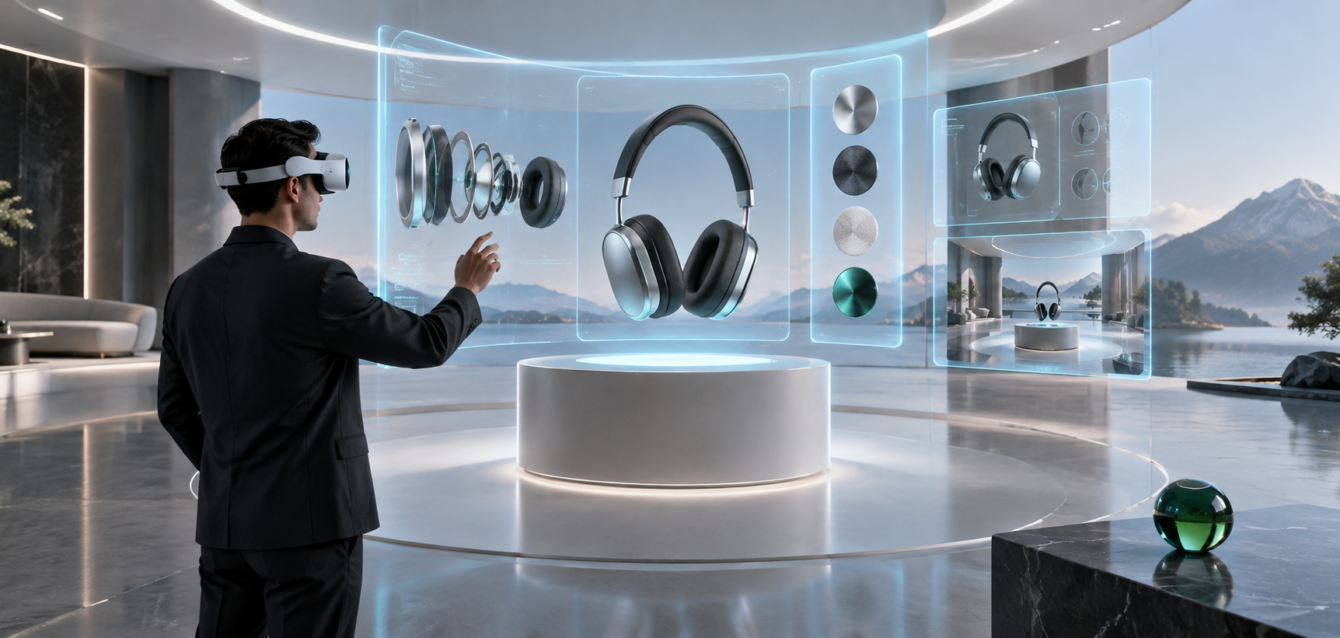
Virtual reality services are becoming a practical way for companies to show products, spaces, and brand experiences with more depth than a flat web page or a standard sales presentation. Instead of asking buyers to imagine how something works, VR can place them inside a guided environment where scale, movement, and interaction feel easier to understand.
This article focuses on the product visualization and brand experience side of VR. For training simulations, safety practice, and operational walkthroughs, see our related guide on virtual reality for business training and sales demos. Keeping these topics separate helps each page answer a different search intent clearly.
What Are Virtual Reality Services?
Virtual reality services include the planning, design, 3D asset creation, interaction design, development, testing, and deployment of immersive VR experiences. A project may be built for a headset, a showroom, a sales event, a product launch, or an internal presentation environment.
The goal is not simply to make something look impressive. A strong VR experience should help users understand a product, compare options, explore a space, or experience a story in a way that supports a business decision.
Where VR Fits in Product Visualization
Product visualization is one of the strongest uses for virtual reality services. When a product is large, complex, expensive, configurable, or still in development, VR can help people experience it before a physical unit is available.
Manufacturers, industrial brands, real estate teams, furniture companies, automotive businesses, and technology providers can use VR to show scale, materials, components, and usage scenarios. This gives buyers a more complete understanding of the product than static photography or a simple render can provide.
Immersive Brand Experiences
VR can also be used for brand storytelling. A company can create an immersive environment that explains its process, values, product ecosystem, or customer experience. This is useful for trade shows, investor presentations, product launches, museums, exhibitions, and high-value sales meetings.
Unlike a normal video, VR lets the user feel present inside the experience. That sense of presence can make a brand message more memorable, especially when the story depends on space, movement, interaction, or scale.
VR vs 3D Configurators and Web-Based Experiences
Virtual reality is powerful when immersion matters. However, it is not always the right tool for every audience. If broad access from phones, laptops, and browsers is the priority, a 3D configurator or browser-based 3D experience may be a better fit.
Many companies use both. A WebGL product configurator can help customers explore options online, while a VR experience can support premium demos, events, showrooms, or internal product education. The right choice depends on where the buyer is in the journey and how much immersion is needed.
VR vs Augmented Reality
Augmented reality places digital content into the real world, while VR places users inside a fully digital environment. If the goal is to preview an item in a real room or guide field service teams with overlays, augmented reality may be the stronger option.
If the goal is to control the full environment, create a showroom, present a future space, or guide the user through a branded experience, VR is often more effective.
What a VR Services Project Usually Includes
A professional VR project usually begins with strategy. The team defines the audience, business goal, platform, content requirements, and success metrics. From there, the experience moves into storyboarding, 3D modeling, environment design, interaction planning, development, and testing.
Performance matters. The experience should load reliably, maintain a comfortable frame rate, and avoid visual or movement choices that create discomfort. For companies that also need web pages, lead capture, or platform integrations, website development and backend planning should be considered early.
Business Benefits of Virtual Reality Services
Well-planned VR can help companies explain complex products faster, support better buying conversations, reduce dependency on physical samples, and make presentations more memorable. It can also help teams align around a product or space before expensive decisions are made.
For sales and marketing teams, the main benefit is clarity. A buyer can understand what is being offered, how it works, and why it matters with less guesswork.
How to Avoid Wasting Budget on VR
VR should not be built just because it feels innovative. The project needs a clear use case, a realistic audience, and a defined deployment plan. Before development begins, businesses should decide whether the experience will be used in a showroom, headset demo, sales meeting, trade show, or internal presentation.
It is also important to decide what does not need to be in VR. Some features may work better as a website, video, AR tool, or 3D configurator. A focused VR experience usually performs better than one that tries to do everything.
Final Thoughts
Virtual reality services can help businesses turn complex products, future spaces, and brand stories into immersive experiences that are easier to understand and remember. The best projects are not built around novelty. They are built around a clear business outcome and a user journey that benefits from immersion.
Planning an immersive product visualization or brand experience? Contact Ink & Algorithm to discuss the right VR, AR, or 3D web approach for your project.