
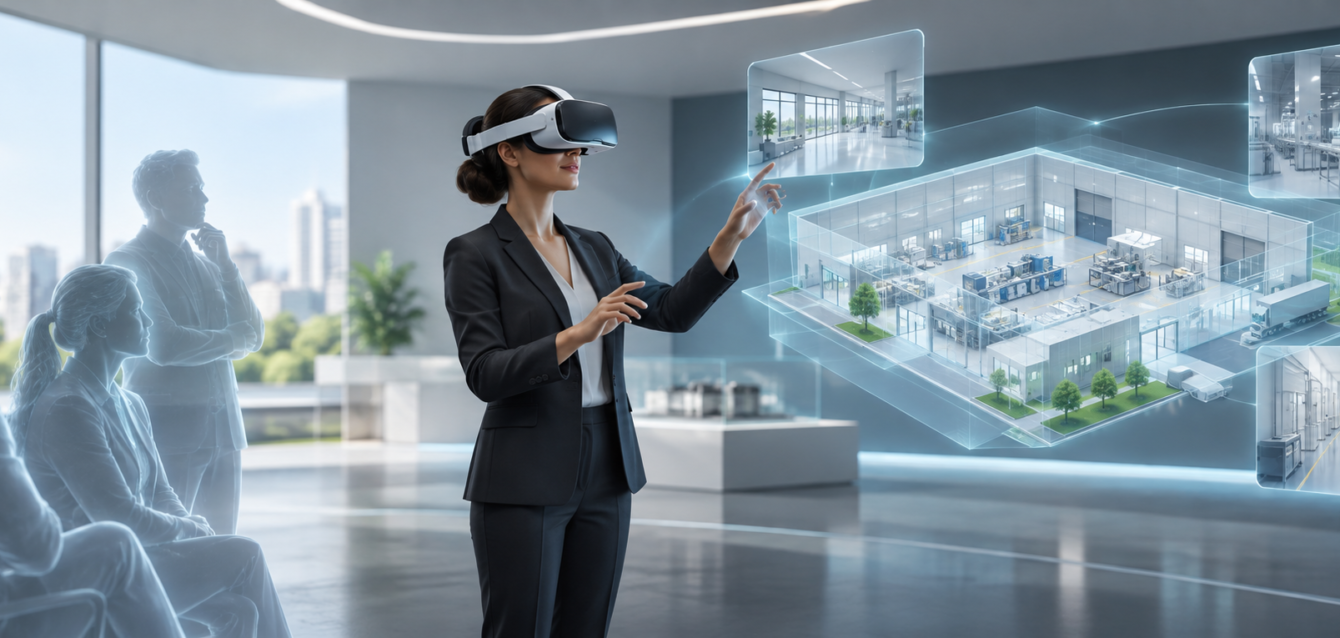
Virtual reality is no longer limited to gaming or experimental brand activations. For modern businesses, virtual reality services can create controlled, immersive environments where teams can practice complex tasks, customers can explore spaces, and sales teams can communicate ideas that are difficult to explain with flat screens.
The value of VR is strongest when a business needs presence, scale, and hands-on understanding. Instead of watching a process from the outside, users can step inside a simulated environment and interact with the experience in a more memorable way.
What Is Virtual Reality in a Business Context?
Virtual reality places users inside a digital environment through a headset or immersive display. That environment can represent a real location, a product, a training scenario, or a concept that does not physically exist yet.
For businesses, VR is useful when the experience needs focus and depth. It can remove distractions, simulate risk without real-world consequences, and help people understand spaces or procedures before they encounter them in person.
VR for Employee Training
Training is one of the strongest business use cases for VR. Teams can practice safety procedures, equipment handling, customer interactions, emergency response, onboarding tasks, and operational workflows inside a repeatable environment.
This helps companies reduce dependency on one-time classroom sessions. A trainee can repeat the same scenario multiple times, learn from mistakes, and build confidence before working in a live environment. For industries where mistakes are expensive or dangerous, VR training can become a practical learning layer.
VR for Safety and Simulation
Some situations are too risky, rare, or expensive to recreate in real life. VR makes it possible to simulate those moments in a controlled way. Teams can practice evacuation routes, machine safety, site orientation, maintenance steps, or emergency decision-making without putting people or equipment at risk.
Because VR feels more spatial than a video or PDF, users can better understand movement, distance, sequence, and context. This makes the training more active and easier to remember.
VR Walkthroughs for Real Estate, Architecture, and Facilities
Virtual walkthroughs help people experience a place before it is built, renovated, or visited. Architecture firms, real estate teams, manufacturers, and facility managers can use VR to show scale, layout, flow, and design decisions in a more immersive way.
This can support stakeholder approvals, investor presentations, showroom experiences, factory previews, and customer education. For teams comparing immersive formats, augmented reality can support real-world overlays, while VR is stronger when the user needs to step fully inside a controlled digital environment.
VR for Sales Demonstrations
Sales teams often need to explain products, systems, or environments that are too large, expensive, or complex to bring into every meeting. VR can turn those explanations into immersive demos. A buyer can explore a product environment, understand how a system works, or experience a service before making a decision.
This is especially useful for industrial products, high-value equipment, spatial products, training services, and B2B solutions where the full value is hard to communicate through a slide deck alone.
When VR Is Better Than AR or 3D Web Experiences
VR is best when the user needs to be fully immersed in a controlled environment. AR is better when digital information needs to appear on top of the real world. A 3D configurator or browser-based 3D experience is often better when broad access, fast loading, and product exploration from any device are the priority.
Choosing the right format depends on the goal. If the goal is focused training, spatial walkthroughs, or simulated practice, VR may be the stronger option. If the goal is quick product exploration from any device, a web-based 3D or AR experience may be better.
How to Plan a VR Project
A successful VR project should start with a clear business outcome. The goal may be reducing training time, improving safety readiness, helping buyers understand a facility, or making a sales demo more persuasive.
From there, the experience should define user roles, interaction points, required environments, performance needs, and measurement. VR works best when every scene and interaction supports a practical decision or learning objective. For projects that also need landing pages, dashboards, or web integration, website development should be planned alongside the immersive experience.
Final Thoughts
Virtual reality gives businesses a powerful way to train teams, demonstrate complex ideas, and let users experience spaces before they exist physically. When planned around a real workflow, VR can become more than an impressive presentation. It can become a useful tool for learning, sales, planning, and decision-making.
Need a VR experience for training, walkthroughs, or sales enablement? Contact Ink & Algorithm to plan immersive virtual reality experiences that support practical business outcomes.