

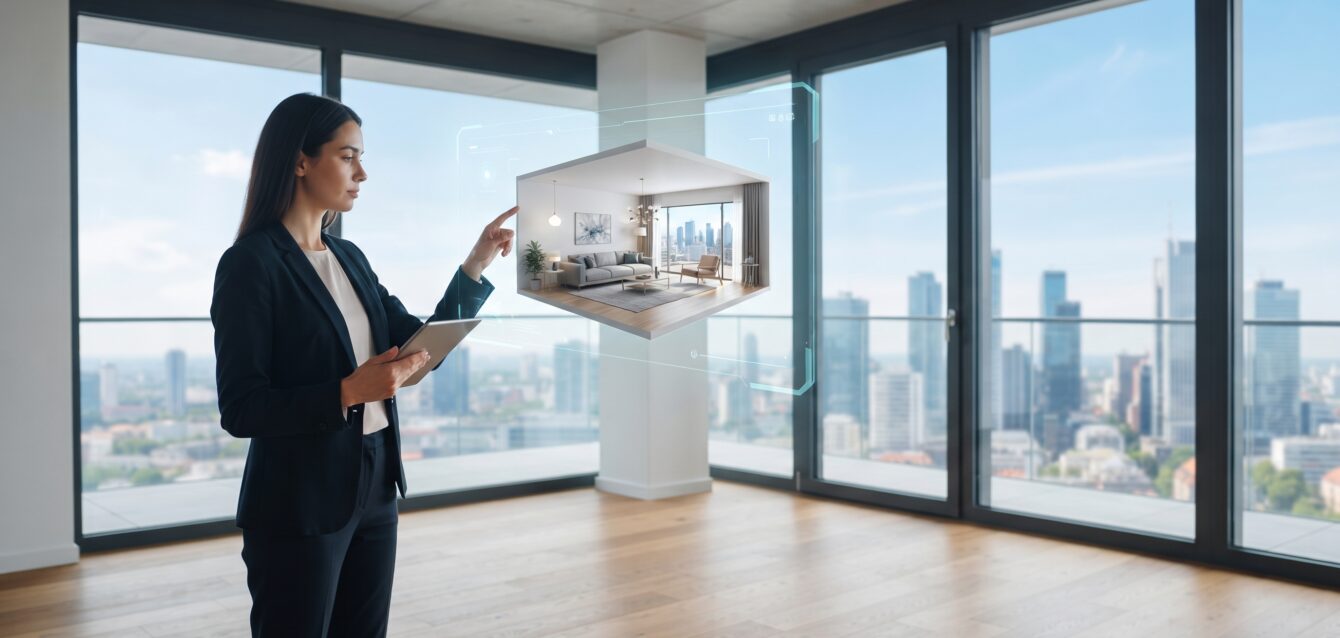
There is a moment in every off-plan property sale where the buyer has to make a leap of imagination — from a floor plan and a render to the lived experience of the home they are committing to. Some buyers can make that leap. Many cannot. The ones who cannot either do not buy, or buy and later feel they were sold something different from what they got.
Augmented reality closes the imagination gap by making the property visible in physical space — in the real world, at the real scale, at the real location — before construction begins. A US developer can place their entire building on the actual vacant lot using WebAR accessed from a browser, show the interior of unit 4B at full scale using an in-office AR experience, and give buyers a view from their specific floor using a 360° AR environment. None of these require an app. None require a headset.
For the foundational AR development overview, see how AR development improves user experience →. For the full AR service capability, see Ink & Algorithm AR development →
Four AR Applications US Real Estate Developers Use
1. Site AR — Place the Building on the Lot
A prospective buyer stands on the vacant lot or drives past the construction hoarding and opens a URL on their phone. The building appears at full scale in their phone camera view — accurately positioned on the real site, at the correct height, in the correct orientation. They can walk around the AR model and see how the building relates to neighbouring structures, street access, and the surrounding neighbourhood.
US residential and commercial developers use site AR for investor briefings, planning authority submissions, and neighbourhood community consultations — the building is visible to every stakeholder without a site visit to a construction hoarding with a render board. For developers who also need high-quality renders for investor decks, Elipse Studio’s architectural visualization USA produces the same 3D model in render format alongside the AR deployment.
2. Interior AR — Stage an Empty Shell
An empty concrete shell apartment is the hardest property to sell. Buyers cannot visualise scale, light, or the feel of the finished space from bare walls and a cement floor. Interior AR solves this by furnishing the space in augmented reality — a tablet or phone pointed at the empty room fills it with furniture, finishes, and lighting that matches the developer’s specification package. The buyer sees the apartment they are buying, not the shell it currently is.
US luxury condo developers, multifamily developers, and new-construction home builders are using interior AR in sales centres to replace physical model units — or supplement them with additional unit types that cannot be modelled physically due to budget or layout constraints.
3. View AR — See From Your Actual Floor
A buyer considering a unit on the 22nd floor of a Chicago high-rise wants to know what they will see when they look out the window in the morning. View AR shows them exactly that — the actual view from the actual floor, in the actual cardinal direction of their unit, in a 360° immersive environment accessible from the sales centre.
This is the most emotionally compelling AR application in residential real estate — and the hardest to replicate with static renders. See also virtual showroom development USA → for how the full property sales environment extends beyond AR into a complete browser-based showroom.
| Ink & Algorithm — AR Development
We build WebAR, site AR, interior AR, and view AR applications for US real estate developers. Browser-native — no app download. iOS Safari and Android Chrome. Hanover Park, Illinois. |
4. Virtual Staging AR — Furnished in Every Style
For existing or completed properties, virtual staging AR lets buyers switch between furnished styles — modern minimalist, transitional, traditional — to see how the space works with different furniture approaches. Traditional staging costs $2,000–$5,000 per property and locks in one look. Virtual staging AR costs less, is available on demand, and shows every option simultaneously.
AR for Real Estate Costs — USA 2026
| Application | Format | US Cost Range | Timeline |
|---|---|---|---|
| Site AR | WebAR (browser) | $12,000–$32,000 | 8–12 weeks |
| Interior AR | Tablet/phone app or WebAR | $8,000–$24,000 per unit type | 6–10 weeks |
| View AR | 360° WebAR / VR | $6,000–$18,000 per floor range | 5–8 weeks |
| Virtual Staging AR | WebAR multi-style | $10,000–$28,000 per property | 6–10 weeks |
| Related: Elipse Studio USA — AR & Architectural Visualization
US real estate developers who need AR property visualization alongside broadcast-quality architectural renders and VR property walkthroughs can access AR development USA, architectural visualization USA, and VR development USA from Elipse Studio — all built from one shared 3D asset base. |