

TL;DR: Augmented reality app development is transforming how US enterprises, retailers, and industrial leaders engage customers and streamline operations. From immersive 3D configurators to real-time industrial guidance, custom augmented reality apps drive higher conversion rates and lower operational costs. Partnering with an expert US agency like Ink & Algorithm ensures your AR solution leverages cutting-edge tech stacks like AR Foundation, ARKit, and ARCore for maximum enterprise ROI.
The Rise of Augmented Reality App Development in the US Market
In 2026, augmented reality app development has evolved from an experimental tech trend into a mission-critical digital strategy for forward-thinking American businesses. Across the United States—from Fortune 500 retail giants in Minneapolis and Bentonville to advanced manufacturing hubs in Chicago and Detroit—enterprises are integrating spatial computing and 3D interactions directly into their core customer experiences and workforce tools.
Driven by rapid hardware innovations—including Apple Vision Pro, Meta Quest 3, lightweight smart glasses, and over 1.5 billion AR-enabled iOS and Android smartphones—consumer expectations in the US market have shifted dramatically. Today’s consumers no longer want to guess how a product will look in their home or how a complex device operates; they expect high-fidelity, real-time 3D visualizations rendered right in their physical environment.
For US brands, investing in augmented reality apps is no longer just about novelty—it is about measurable commercial impact. Major US retailers like Home Depot, Target, Wayfair, and Amazon have demonstrated that interactive AR features can increase e-commerce conversion rates by up to 90% while significantly reducing product return rates. Meanwhile, American industrial and aerospace pioneers like Boeing, General Electric, and Caterpillar rely on enterprise AR solutions to accelerate technician training, reduce assembly errors, and perform hands-free remote inspection.
Why US Businesses Are Investing in Custom AR App Development
While off-the-shelf AR templates exist, leading US enterprises prioritize custom augmented reality app development to deliver proprietary, seamless, and secure user experiences. Custom development allows companies to integrate AR capabilities directly into existing enterprise resource planning (ERP) platforms, customer relationship management (CRM) systems, and backend e-commerce databases.
When you choose tailor-made enterprise software and custom app development solutions, you gain full control over your digital IP, 3D asset optimization pipeline, and user interface design. Key commercial benefits driving US investment include:
- Higher Conversion Rates & Engagement: Interactive 3D product visualization keeps users engaged 4x longer than static 2D images, directly translating to higher checkout conversion rates for retail brands.
- Drastic Reduction in Product Returns: By allowing customers to evaluate accurate scale, color, and texture in their own physical space before buying, US e-commerce brands see product return rates drop by 25% to 40%.
- Accelerated Workforce Training & Safety: Industrial AR applications provide step-by-step spatial overlays for field service engineers, cutting training onboarding time by half and minimizing costly operational downtime.
- Brand Differentiation in Competitive US Markets: Offering an intuitive, high-tech spatial experience elevates brand equity and positions your enterprise as an industry innovator.
Key Use Cases for Enterprise AR Applications in 2026
Every industry faces unique customer touchpoints and operational bottlenecks. Modern augmented reality app development provides flexible solutions engineered for specific vertical applications across the US economy.
1. Next-Gen Retail & E-Commerce (3D Configurators & Virtual Try-Ons)
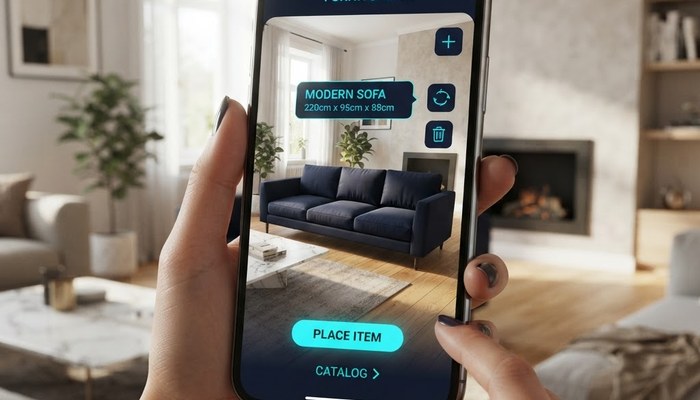
American online shoppers demand high confidence before hitting “buy.” Custom 3D configurators and spatial AR try-on features enable consumers to customize furniture, footwear, jewelry, cosmetics, and automotive interiors in real time. Using WebAR or native mobile apps, users can position true-to-scale photorealistic 3D models in their living rooms, offices, or personal space. This interactive try-before-you-buy model reduces friction and boosts customer loyalty.
2. Industrial Manufacturing & Field Services
In manufacturing plants and energy facilities across the American Midwest and industrial corridors, technical precision is paramount. Enterprise AR applications overlay digital schematics, maintenance instructions, and real-time IoT sensor telemetry onto physical machinery. Technicians wearing head-mounted displays or holding ruggedized tablets can inspect equipment, perform repairs, and collaborate with offsite experts via live audio-visual spatial annotations.
3. Healthcare, Medical Training & Surgical Visualization
US healthcare institutions leverage custom AR software to revolutionize patient care and medical education. Medical AR applications allow surgeons to visualize 3D anatomical structures overlaid on patients during preoperative planning, improving surgical precision. Medical device companies also utilize interactive AR simulations to demonstrate complex instruments to doctors and hospital administrators without transporting heavy physical equipment.
4. Real Estate, Architecture & Spatial Staging
In the fast-paced US real estate market, spatial AR software allows commercial developers, architects, and realtors to showcase unbuilt properties or virtually stage vacant spaces. Clients can walk through photorealistic 3D floor plans at full 1:1 scale, customize interior finishes on the fly, and inspect architectural structures prior to construction, shortening sales cycles and securing pre-leasing agreements faster.
The Tech Stack Behind Modern Augmented Reality Apps
Building high-performing augmented reality apps requires deep expertise across specialized software development kits (SDKs), 3D graphics engines, and cloud architecture. Selecting the right technology stack ensures high frame rates, accurate surface tracking, stable spatial anchoring, and cross-platform compatibility.
At Ink & Algorithm, our specialized team leverages industry-standard frameworks tailored to each project’s business goals:
- AR Foundation (Unity): The gold standard for cross-platform AR development. AR Foundation enables developers to write core spatial tracking logic once and deploy seamlessly across iOS (ARKit) and Android (ARCore) devices, cutting timeline and development costs.
- Apple ARKit: Apple’s native framework for iOS and iPadOS. Offers market-leading LiDAR depth sensing, motion capture, face tracking, and room layout recognition (RoomPlan) ideal for high-end iPhone and Apple Vision Pro spatial computing experiences.
- Google ARCore: Google’s native platform for Android devices. Features robust environmental understanding, light estimation, Geospatial API integration using Google Maps, and motion tracking across thousands of Android device models.
- WebAR Frameworks (8th Wall, MindAR, Three.js): For frictionless marketing campaigns where user installation is a barrier, WebAR delivers interactive 3D experiences directly inside mobile web browsers (Safari, Chrome) without requiring app downloads.
- Unreal Engine & Unity: Powerful 3D rendering engines that deliver real-time photorealistic lighting, custom physics, shaders, and complex animations for enterprise-grade immersive software.
- Vuforia & PTC: Specialized enterprise AR SDK solutions tailored for industrial target recognition, model targets, CAD data optimization, and smart factory floor tracking.
To explore our full suite of immersive engineering capabilities, check out our dedicated AR services page.
Step-by-Step Augmented Reality App Development Process
Creating a successful commercial AR product requires a structured development methodology that balances creative 3D artistry with rigid software engineering standards. Here is the proven workflow we follow at Ink & Algorithm to bring enterprise AR concepts to life:
Phase 1: Discovery, Strategy & UX/UI Prototyping
We begin by defining clear business objectives, target user demographics, platform specifications (iOS, Android, Web, or Spatial Headsets), and key performance indicators (KPIs). Our spatial UX designers map out intuitive user flows, spatial UI elements, and gesture interactions designed specifically for 3D environments.
Phase 2: 3D Asset Creation & Spatial Optimization
High-quality AR experiences rely on lightweight, highly optimized 3D models. Our 3D artists and animators convert raw CAD files or design models into PBR (Physically Based Rendering) assets optimized for real-time mobile graphics engines. We optimize polygon counts, bake texture maps, and ensure low memory footprints for smooth 60 FPS performance.
Phase 3: Core AR Logic & SDK Integration
Our software engineers write clean, modular codebase architectures using C# (Unity), C++ (Unreal Engine), Swift (ARKit), or Kotlin (ARCore). We integrate core spatial features such as surface detection, raycasting, image targets, vertical plane recognition, persistent cloud anchors, and dynamic lighting estimation.
Phase 4: Testing, Performance Tuning & Calibration
AR applications must perform flawlessly across diverse lighting conditions, real-world surroundings, and various mobile hardware configurations. We conduct extensive QA testing covering thermal performance, battery consumption, spatial tracking stability, camera latency, and edge-case handling in real-world environments.
Phase 5: Deployment, Maintenance & Analytics
We handle complete store submission to the Apple App Store and Google Play Store, or deploy WebAR experiences to secure cloud hosting. Post-launch, we monitor usage telemetry, implement ongoing device updates, and continuously refine user experience based on real-world analytics.
Cost Factors of AR App Development in USA (2026 Breakdown)
A common question from US decision-makers is: How much does custom augmented reality app development cost? Because AR software spans diverse complexity levels, costs depend directly on features, target platforms, asset fidelity, and backend integrations.
“Investing in custom AR technology is an investment in long-term operational efficiency and customer lifetime value. A well-architected AR app pays for itself through higher conversion rates and reduced product return friction.” — Sami Ullah, Founder of Ink & Algorithm
Here is an estimated breakdown for US enterprise AR projects in 2026:
- Basic WebAR / Lightweight Marketing App ($15,000 – $30,000): Ideal for promotional product reveals, simple web-based 3D model viewers, or basic image-target triggers requiring no app installation.
- Mid-Tier Business Mobile AR App ($30,000 – $75,000): Custom mobile apps featuring interactive 3D configurators, surface detection, user accounts, e-commerce payment integration, and cloud-hosted 3D model streaming.
- Enterprise / Spatial AR Application ($75,000 – $150,000+): Advanced spatial computing software featuring multi-user collaborative sessions, real-time IoT backend telemetry, custom CAD pipeline automation, hands-free spatial navigation, and Vision Pro / smart glasses optimization.
Working with an established US-based AR agency ensures transparent development schedules, direct communication in American business hours, and compliance with US data security and privacy regulations.
Why Choose Ink & Algorithm as Your US AR App Development Partner
Headquartered in Hanover Park, Illinois, Ink & Algorithm is a premier US custom software development company specializing in immersive technologies, spatial computing, and next-generation mobile applications. Founded in 2024 by Sami Ullah, Ink & Algorithm was built with a singular mission: to bridge the gap between cutting-edge 3D technology and tangible enterprise ROI.
When you partner with Ink & Algorithm, you work directly with expert software architects and 3D specialists who understand the demands of the American market. Our core expertise spans:
- Custom Augmented Reality App Development: High-performance native iOS, Android, and cross-platform mobile AR software built with AR Foundation, ARKit, and ARCore.
- Interactive 3D Configurators & Animation: Hyper-realistic WebGL and WebAR product visualizers that boost e-commerce revenue and customer engagement.
- Virtual Reality & Spatial Computing: Immersive VR simulations, enterprise training environments, and Apple Vision Pro / Quest apps.
- End-to-End App & Web Development: Scalable enterprise mobile apps, cloud backend infrastructure, and web platforms tailored for growth.
We combine technical precision with creative craftsmanship, delivering AR solutions on schedule, within budget, and built for scalable performance.
Frequently Asked Questions About Augmented Reality App Development
1. How much does augmented reality app development cost in the US?
Augmented reality app development costs in the US typically range from $15,000 for simple WebAR marketing experiences to $150,000+ for complex enterprise spatial computing software. Primary cost drivers include 3D model complexity, target platforms (iOS, Android, Web, Vision Pro), backend database integrations, and real-time multiplayer or IoT functionality. Contact Ink & Algorithm for a tailored proposal suited to your project requirements.
2. What is the difference between WebAR and native AR apps?
WebAR runs directly inside standard mobile web browsers (like Safari or Chrome) via a URL or QR code, requiring no app download. It is ideal for high-volume marketing campaigns and instant product try-ons. Native AR apps (built using ARKit, ARCore, or Unity) are downloaded from app stores and offer superior 3D graphic rendering, hardware lighting estimation, LiDAR support, persistent spatial anchors, and offline operational capabilities.
3. Which SDK is best for AR app development: ARKit, ARCore, or AR Foundation?
The optimal choice depends on your target audience. Apple’s native ARKit offers the best hardware integration for iOS/iPadOS devices with LiDAR sensors. Google’s native ARCore provides extensive spatial tracking across Android devices. For multi-platform projects, AR Foundation in Unity is the industry standard because it allows developers to build unified 3D applications that run natively on both iOS and Android while maintaining a single codebase.
4. How long does it take to develop a custom AR application?
A standard augmented reality app development project takes between 8 to 16 weeks from initial design to store release. Simple WebAR campaigns can be launched in 4 to 6 weeks, while complex enterprise spatial applications with custom CAD asset pipelines, backend enterprise integrations, and rigorous testing schedules may take 4 to 6 months.
5. Why hire a US-based AR app development agency like Ink & Algorithm?
Partnering with a US-based agency like Ink & Algorithm ensures aligned timezone communication, seamless collaboration during business hours, direct strategic guidance, and strict adherence to US intellectual property and data privacy standards. Located in Hanover Park, IL, our team offers hands-on expertise and dedicated post-launch support for American enterprises and growing businesses.
Transform Your Business with Custom AR Solutions Today
Ready to revolutionize your customer experience, boost e-commerce sales, or empower your field workforce with immersive technology? Partner with the leading US experts in augmented reality app development.
At Ink & Algorithm, we transform ambitious ideas into high-performing spatial applications engineered for growth. Contact our Hanover Park, IL team today to schedule a free technical consultation and project roadmap session.
- Company: Ink & Algorithm
- Location: Hanover Park, IL, USA
- Phone: +1 618 965 8617
- Email: hello@inknalgorithm.com
- Get Started: Contact Ink & Algorithm AR Experts