
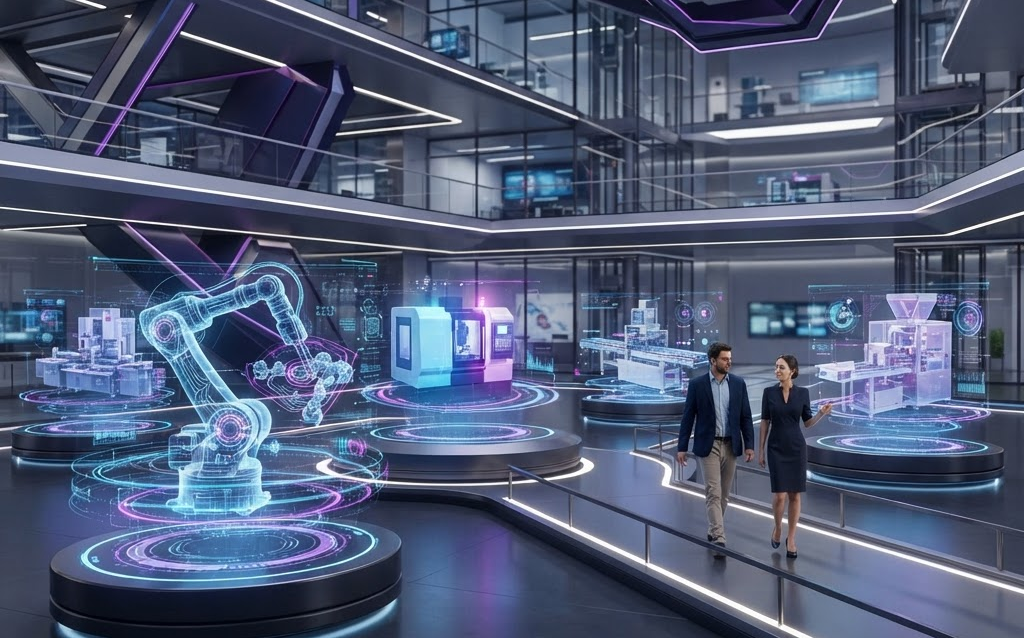
TL;DR: B2B virtual showrooms let manufacturers showcase their entire product catalog in an interactive 3D environment—no physical showroom needed. Sales teams walk buyers through products, demonstrate features, configure custom solutions, and close deals from anywhere. US manufacturers using virtual showrooms report 40% shorter sales cycles, 60% lower showroom costs, and 30% higher close rates. Here’s how to build one in 2026.
B2B sales has always relied on the showroom. Buyers need to see products, handle them, and understand how they work before committing to large orders. But physical showrooms are expensive—$200,000–$1,000,000+ to build and maintain—and they only serve customers who can physically visit. Virtual showrooms solve this by creating digital product environments that any buyer can access from anywhere.
What Is a B2B Virtual Showroom?
A B2B virtual showroom is an interactive 3D environment where buyers explore a manufacturer’s product catalog. Unlike a static website catalog, the virtual showroom is spatial and interactive:
- Walk through a 3D environment — navigate a virtual space filled with products, organized by category
- Examine products up close — rotate, zoom, and inspect products from any angle
- Watch product demonstrations — animated demos show how products work, their features, and use cases
- Configure custom solutions — select options, dimensions, and configurations in real time
- Compare products side by side — place multiple products next to each other for direct comparison
- Access spec sheets and documentation — pull up technical specs, certifications, and pricing
- Collaborate with sales reps — sales teams join the virtual showroom for guided tours and Q&A
Why B2B Manufacturers Need Virtual Showrooms
Replacing Expensive Physical Showrooms
A physical showroom for industrial equipment costs $200,000–$1,000,000 to build, plus $50,000–$200,000/year in rent, maintenance, and staffing. A virtual showroom costs $50,000–$200,000 to build (one-time) and $5,000–$20,000/year to maintain. It serves unlimited customers simultaneously from any location.
Reaching Global Buyers
A buyer in Germany can walk through a US manufacturer’s virtual showroom at 2am their time, examine products, configure solutions, and schedule a follow-up with the sales team. This global reach is impossible with physical showrooms, which only serve customers within driving distance.
Shorter Sales Cycles
B2B sales cycles are long because buyers need multiple touchpoints: research, product evaluation, specification, and proposal. A virtual showroom compresses these stages—buyers can evaluate products, compare specs, and configure solutions in a single session, reducing the sales cycle by 40%.
Always Up to Date
When products change, physical showrooms need to be physically updated—new products shipped in, old ones removed, signage changed. Virtual showrooms update instantly—add a new product to the catalog and it appears in the virtual showroom with full 3D visualization and spec data.
How B2B Virtual Showrooms Are Used
Trade Shows and Exhibitions
Instead of shipping equipment to trade shows, manufacturers send buyers a link to their virtual showroom. Buyers explore the full product range in 3D, configure solutions, and connect with sales—all without the manufacturer paying for booth space, shipping, and travel.
Sales Presentations
Sales reps share their screen and walk the buyer through the virtual showroom in real time. The rep can highlight specific products, show demonstrations, and configure custom solutions while the buyer watches. This is far more engaging than a PowerPoint presentation or PDF catalog.
Self-Service Product Research
Buyers explore the showroom independently before talking to sales. They research products, compare specs, and build preliminary configurations. When they do contact sales, they’re already informed—leading to more productive conversations and faster closing.
Dealer and Distributor Training
Manufacturers use virtual showrooms to train dealers and distributors on new products—without flying them to a training facility. Distributors explore the products, learn features, and become certified to sell—all through the virtual environment.
The Technology: Building a B2B Virtual Showroom
Unity or Unreal Engine
- Unity — best for cross-platform deployment (web, desktop, VR). Large ecosystem, lower learning curve. Most B2B showrooms use Unity.
- Unreal Engine 5 — best for photorealistic quality. Ideal for large equipment and premium products where visual fidelity matters.
Web Delivery
Virtual showrooms should be accessible through a web browser—no software installation required. Unity’s WebGL export and Unreal’s Pixel Streaming both enable browser-based access. Buyers open a link and enter the showroom instantly.
Product Data Integration
The showroom connects to the manufacturer’s PIM (Product Information Management) system and ERP, pulling real-time product data, specs, pricing, and availability. When a buyer configures a custom solution, the showroom validates compatibility and calculates pricing in real time.
Analytics and Lead Capture
Every buyer interaction is tracked: which products they viewed, how long they spent on each, which configurations they built, and which products they compared. This data feeds into the CRM, giving sales teams actionable intelligence before they even contact the buyer.
Cost of a B2B Virtual Showroom
| Scope | Cost | Timeline |
|---|---|---|
| Single-category showroom (10-20 products) | $30,000–$80,000 | 6–12 weeks |
| Multi-category showroom (50-100 products) | $80,000–$250,000 | 12–24 weeks |
| Full enterprise platform (unlimited products + CRM + configurator) | $200,000–$750,000+ | 6–12 months |
| 3D model per product | $1,000–$10,000 | 5–14 days |
FAQ: B2B Virtual Showrooms
Do buyers need VR headsets to use a virtual showroom?
No. B2B virtual showrooms are primarily accessed through web browsers using mouse and keyboard navigation. Buyers can explore products, watch demos, and configure solutions on any laptop or desktop. VR headset support is optional—an enhancement for buyers who want full immersion, not a requirement.
How much does a B2B virtual showroom cost?
A single-category showroom with 10-20 products costs $30,000–$80,000. A multi-category showroom with 50-100 products costs $80,000–$250,000. A full enterprise platform with unlimited products, CRM integration, and real-time configurator costs $200,000–$750,000+. 3D modeling per product costs $1,000–$10,000 depending on complexity.
Can the showroom connect to my existing CRM and ERP?
Yes. Virtual showrooms integrate with Salesforce, HubSpot, SAP, Oracle, and custom CRM/ERP systems via API. Buyer interactions, configurations, and inquiries sync to the CRM automatically. Product data, pricing, and availability pull from the ERP in real time.
How long does it take to build a virtual showroom?
A single-category showroom takes 6-12 weeks. A multi-category showroom takes 12-24 weeks. Enterprise platforms take 6-12 months. The primary timeline driver is 3D model creation—if CAD files exist for the products, modeling time is reduced by 50-70%.
Can sales reps guide buyers through the showroom remotely?
Yes. Virtual showrooms support multi-user sessions where a sales rep and buyer navigate the same 3D environment simultaneously from different locations. The rep can highlight products, trigger demonstrations, and configure solutions while the buyer watches and asks questions—like a guided showroom visit from anywhere.
Getting Started
- Start with your highest-value product category — the one that drives the most revenue or has the longest sales cycle
- Leverage existing CAD files — most B2B products have CAD data that can be converted to 3D showroom models
- Build for web first — maximize accessibility, no installation required
- Integrate with your CRM — capture buyer data and feed it to sales
- Measure sales cycle impact — compare close rates and cycle length before and after the showroom
The manufacturers that adopt virtual showrooms in 2026 will sell more efficiently, reach more buyers, and close deals faster—all while spending less on physical infrastructure. The showroom of the future isn’t a building—it’s a link.
Ready to build a B2B virtual showroom? Contact Ink & Algorithm to discuss your project—we’ll help you create a digital sales experience that closes deals from anywhere.