
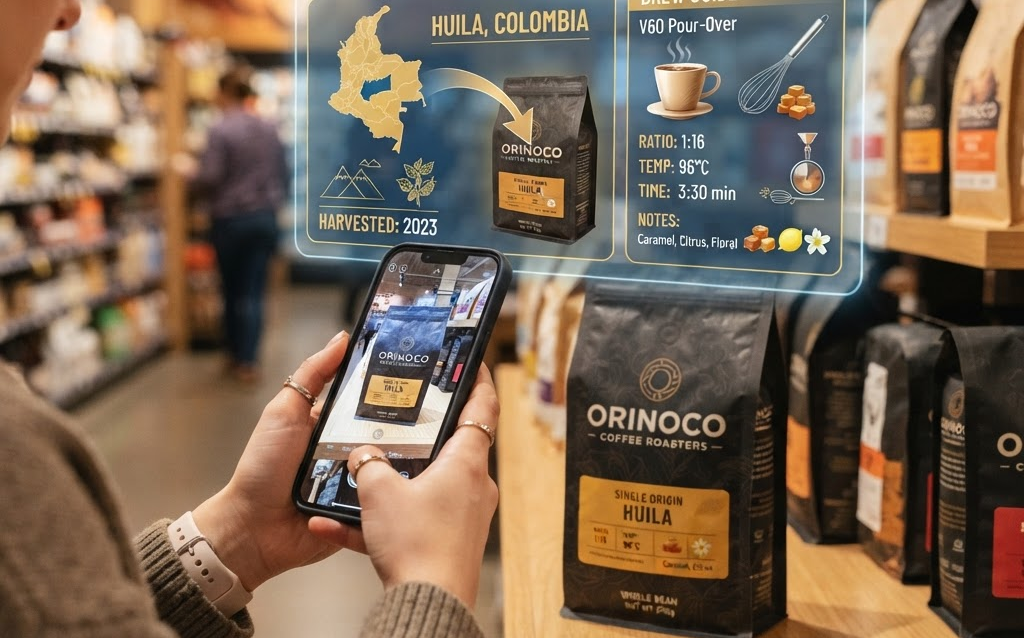
TL;DR: AR on food and beverage packaging lets customers scan a product with their phone to unlock interactive experiences—ingredient origin stories, recipe videos, sustainability data, and gamified brand content. US food brands using AR packaging report 3x longer engagement, 25% higher purchase intent, and significantly stronger brand recall. With WebAR requiring no app download, 2026 is the year AR packaging goes mainstream.
The food and beverage industry spends billions on packaging design—but packaging is static. It can show a logo, nutrition facts, and a product photo. What it can’t do is tell the story of where ingredients came from, show a recipe video, or let a customer play a branded game. AR packaging changes this—turning every box, bottle, and bag into an interactive digital experience.
How AR Food and Beverage Packaging Works
A customer picks up a product in the store (or at home), points their phone camera at the packaging, and an AR experience launches in their browser—no app download. The experience can include:
- Ingredient origin stories — trace where each ingredient was sourced, with photos and farmer profiles
- Recipe videos — watch a 30-second recipe video featuring the product, triggered from the package
- Nutrition visualization — 3D infographic showing daily value percentages and allergen alerts
- Sustainability data — carbon footprint, recyclability, and ethical sourcing certification
- Brand storytelling — the company history, mission, and values told through interactive 3D content
- Gamified experiences — branded mini-games, scavenger hunts, or loyalty rewards
- Social sharing — AR filters and effects for Instagram and TikTok featuring the product
Why Food and Beverage Brands Need AR in 2026
Standing Out on the Shelf
The average supermarket carries 30,000+ products. A customer’s attention in any given aisle lasts 3-5 seconds. AR gives shoppers a reason to pick up your product instead of the competitor’s—the promise of an interactive experience behind the label. This is especially valuable for new brands trying to break into crowded categories.
Connecting with Gen Z and Millennials
Younger consumers demand transparency, sustainability, and digital engagement from food brands. AR packaging delivers all three—showing ingredient sourcing, environmental impact, and interactive brand content that these demographics expect. 65% of Gen Z consumers say they’re more likely to buy a product with an AR experience.
Post-Purchase Engagement
Traditional packaging engagement ends when the product is purchased. AR packaging creates ongoing engagement—customers scan the box each time they use the product to access recipes, reorder, and interact with the brand. This turns a one-time purchase into an ongoing relationship.
Sustainability Without Compromising Design
Brands want to include more information (sourcing, certifications, environmental data) but packaging space is limited. AR puts all this information in the digital layer—keeping the physical packaging clean and recyclable while providing unlimited information through the scan.
Real-World Examples
Wine and Spirits
Wine brands use AR labels to show tasting notes, food pairing suggestions, and vineyard history. A customer scanning a wine bottle sees a 3D vineyard tour, the winemaker’s story, and recommended food pairings. Some brands add AR tasting guides that walk the customer through the tasting experience in real time.
Cereal and Snacks
Cereal brands use AR to create gamified experiences for children—scan the box and a character comes to life in 3D, plays a mini-game, or tells a story. This transforms breakfast packaging into entertainment, increasing brand affinity and purchase frequency.
Coffee and Tea
Coffee brands use AR to show the journey from bean to cup—scanning the bag reveals the farm, roasting process, and brewing instructions. Some brands include AR brewing guides that show the optimal water temperature, pour timing, and grind size for each blend.
Craft Beer
Craft breweries use AR labels to differentiate in a crowded market. Scanning a can reveals the beer’s flavor profile, brewing story, and food pairing suggestions. Some breweries create AR label art that animates when scanned—turning the can into a mini billboard.
Frozen Foods
Frozen food brands use AR to show cooking instructions, nutritional details, and recipe ideas that don’t fit on the packaging. A customer scans a frozen meal and watches a 30-second preparation video—no need to search for instructions online.
The Technology: WebAR for Packaging
Image Recognition vs QR Codes
- Image recognition — the AR system recognizes the product’s packaging design from the camera feed. No QR code needed—just point at the product. More seamless but requires the packaging to be registered in the AR platform’s image database.
- QR code — simpler to deploy, works with any packaging, but requires the customer to scan a code. More reliable for complex packaging designs.
Most food brands start with QR codes for reliability and add image recognition for flagship products.
WebAR Delivery
All AR packaging experiences must be app-free. Customers won’t download a brand app to scan a cereal box. WebAR delivers the experience through the browser—scan a code, browser opens, AR launches instantly. Works on both iOS and Android.
Content Management
For brands with multiple SKUs, the AR content needs to be managed through a CMS that integrates with the product database. When a product’s recipe, nutritional info, or branding changes, the AR content updates automatically.
Cost of AR Food and Beverage Packaging
| Scope | Cost | Timeline |
|---|---|---|
| Single product AR experience | $5,000–$20,000 | 2–5 weeks |
| Multi-product AR platform (10+ SKUs) | $20,000–$80,000 | 4–10 weeks |
| Full brand AR platform with CMS | $50,000–$200,000+ | 8–16 weeks |
| Gamified AR experience | $15,000–$50,000 | 4–8 weeks |
FAQ: AR for Food and Beverage
Do customers need to download an app to scan AR packaging?
No. AR packaging experiences use WebAR, which runs in the phone’s browser. Customers scan a QR code or the product itself with their camera, the browser opens, and the AR experience launches instantly. No app download required—this is critical because less than 3% of customers will download a food brand’s app.
How much does AR packaging cost?
A single product AR experience costs $5,000–$20,000. A multi-product platform covering 10+ SKUs costs $20,000–$80,000. A full brand platform with CMS, analytics, and gamification features costs $50,000–$200,000+. The per-SKU cost drops significantly with volume.
Can AR packaging show nutritional and allergen information?
Yes. AR can display detailed nutritional information, allergen alerts, ingredient sourcing, and dietary compatibility (gluten-free, vegan, keto) in an interactive format. This is especially valuable for customers with dietary restrictions who need quick, clear information while shopping.
Does AR work on all food packaging types?
AR works on most packaging types—boxes, bottles, cans, bags, and pouches. The key requirement is a recognizable surface for image recognition or a visible QR code. Glossy and highly reflective surfaces (like some cans) can be more challenging for image recognition, in which case QR codes are recommended.
Can AR packaging drive direct sales or reorders?
Yes. AR experiences can include “Buy Now” or “Reorder” buttons that link directly to the brand’s e-commerce store or a retailer’s product page. For subscription brands, AR can offer a one-tap reorder option. Some brands use AR to drive loyalty program sign-ups directly from the packaging.
Getting Started
- Start with your best-selling product — the one with the most shelf visibility and customer engagement potential
- Choose content that adds value — recipes, ingredient stories, and sustainability data outperform flashy gimmicks
- Use QR codes first — reliable, simple, works with any packaging
- Measure engagement — track scan rates, session duration, and purchase correlation
- Scale to full catalog — once the first product proves ROI, deploy across your line
AR packaging isn’t just a marketing gimmick—it’s a new communication channel between brand and consumer. Every product on the shelf becomes an interactive touchpoint, every package a digital portal. The brands that adopt AR packaging in 2026 will own the digital shelf that competitors haven’t even entered.
Ready to add AR to your food and beverage packaging? Contact Ink & Algorithm to discuss your project—we’ll help you create WebAR experiences that turn packaging into engagement.