
TL;DR: Apparel 3D configurators let customers design custom clothing online—choosing fabrics, colors, patterns, monograms, and fit adjustments with real-time 3D visualization on body models. US fashion brands using apparel configurators report 35% higher conversion on customizable products, 25% fewer returns with virtual fit preview, and 30% higher AOV from premium fabric and customization upgrades. Here’s how the technology works in 2026.
The fashion industry’s return problem is staggering—30-40% of online apparel purchases get returned, mostly due to fit and style mismatch. A 3D apparel configurator addresses both: customers see the garment on a 3D body model matching their measurements, customize fabrics and colors in real time, and purchase with confidence.
What an Apparel 3D Configurator Does
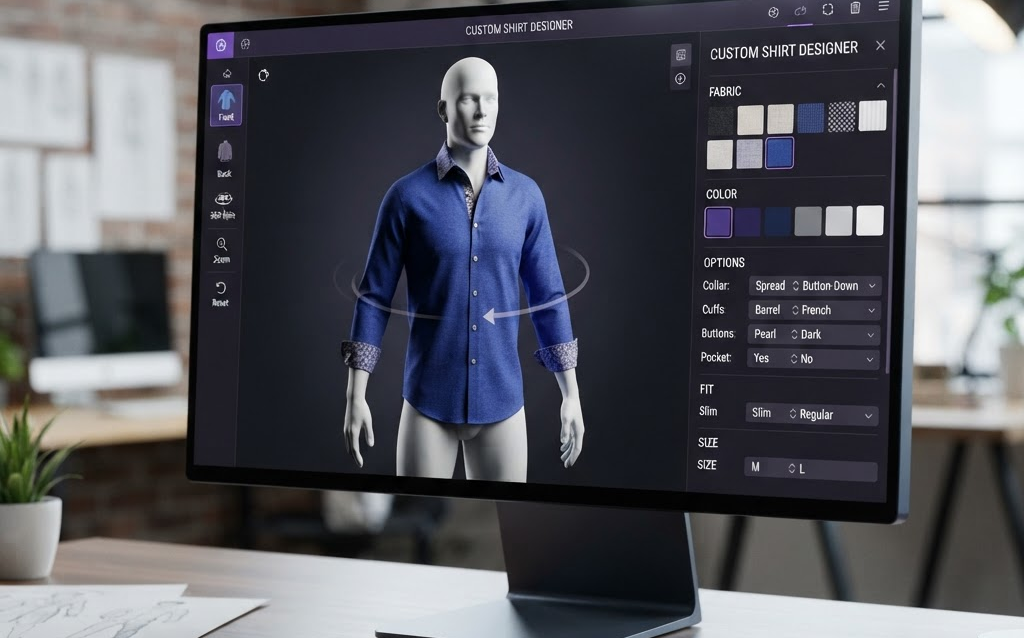
Key features for fashion configurators:
- Fabric and material selection — cotton, linen, wool, silk, denim, with accurate drape and texture rendering
- Color and pattern customization — solid colors, stripes, checks, florals, custom prints
- Fit adjustment — slim, regular, relaxed, with real-time garment geometry updates on the body model
- Component customization — collar style, cuff type, button color, pocket options
- Monogramming and personalization — custom text or initials previewed on the garment
- 3D body model — garment shown on a body matching the customer’s measurements and body type
- 360° rotation and zoom — view the garment from every angle with fabric detail visible
- Live pricing — each customization updates the price instantly
Why Apparel Brands Need 3D Configurators
The Returns Problem
Apparel has the highest return rate in e-commerce. 3D configurators with virtual fit preview reduce returns by 25% by letting customers see how the garment looks and fits before buying—not on a generic model, but on a body type matching theirs.
Personalization Premium
Customers willingly pay 20-30% more for personalized products. A shirt with custom fabric, monogram, and fit isn’t a commodity—it’s their shirt. This premium pricing is why brands like Indo, Son of a Tailor, and Shirt of the Day have built businesses around custom apparel.
Sustainability Through Made-to-Order
Custom configurators enable made-to-order production—garments are manufactured only after the customer configures and orders. This eliminates the overproduction and waste that plague the fashion industry, reducing deadstock inventory by 60-80%.
The Technology: Rendering Fabric in 3D
Fabric is one of the hardest materials to render convincingly in 3D because it deforms with movement. Key technical requirements:
- Fabric drape simulation — cloth physics that show how the fabric falls, folds, and hangs on the body. Marvelous Designer and CLO 3D are the industry-standard tools.
- Texture accuracy — weave patterns, thread direction, and surface roughness must be visible. Normal maps and displacement maps add fine detail without extra polygons.
- Color accuracy under lighting — fabrics look different in natural vs artificial light. The configurator should render under multiple lighting conditions.
- Fit simulation — the garment model must adjust geometry when the customer changes fit options (slim vs relaxed), showing how the fabric drapes differently.
Cost of an Apparel 3D Configurator
| Scope | Cost | Timeline |
|---|---|---|
| Single garment configurator | $20,000–$60,000 | 5–10 weeks |
| Multi-garment platform (shirts + pants + jackets) | $50,000–$150,000 | 8–16 weeks |
| Full custom fashion platform + virtual fit | $100,000–$300,000+ | 14–24 weeks |
| 3D garment model per design | $1,000–$5,000 | 5–10 days |
FAQ: Apparel 3D Configurators
Can customers see how clothes fit in 3D?
Yes. The configurator renders the garment on a 3D body model that matches the customer’s measurements and body type. When the customer changes fit options (slim, regular, relaxed), the garment geometry updates in real time, showing how the fabric drapes differently. Advanced systems use the customer’s actual measurements (input or body-scanned) for a personalized fit preview.
How much does an apparel configurator cost?
A single garment configurator with fabric, color, and fit customization costs $20,000–$60,000. A multi-garment platform covering shirts, pants, and jackets runs $50,000–$150,000. A full custom fashion platform with virtual fit, body measurement, and manufacturing integration costs $100,000–$300,000+. 3D garment modeling costs $1,000–$5,000 per design.
Can a fashion configurator connect to manufacturing?
Yes. The configurator exports the customer’s garment specifications—fabric, color, measurements, customizations—as a production file that feeds directly into the manufacturing pipeline. For made-to-order brands, this eliminates manual pattern adjustment and reduces production errors. The export can be a tech pack, a 2D pattern file, or a direct integration with the factory’s system.
Does the configurator work for all types of clothing?
It works best for structured garments—shirts, jackets, suits, dresses—where the silhouette can be clearly defined. Very fluid garments (silk scarves, flowing dresses) are more challenging because fabric drape is harder to simulate in real time. Most apparel configurators in 2026 focus on categories where customization and fit matter most: shirts, suits, trousers, and outerwear.
Can customers input their own body measurements?
Yes. Customers can input measurements manually (height, chest, waist, hip, inseam) or use AI body scanning—pointing their phone camera at their body for automated measurement extraction. The configurator then renders the garment on a body model matching those exact measurements, giving a personalized fit preview that reduces size-related returns by 25%.
Getting Started
- Start with your most customized product — shirts, suits, or dresses where customers already expect personalization
- Invest in fabric rendering quality — customers need to “feel” the fabric through the screen
- Add virtual fit — body model matching is the feature that reduces returns
- Connect to made-to-order production — turn the configurator into a full custom clothing pipeline
Ready to build an apparel 3D configurator? Contact Ink & Algorithm to discuss your project—we’ll help you create a custom clothing configurator that drives personalization sales.