
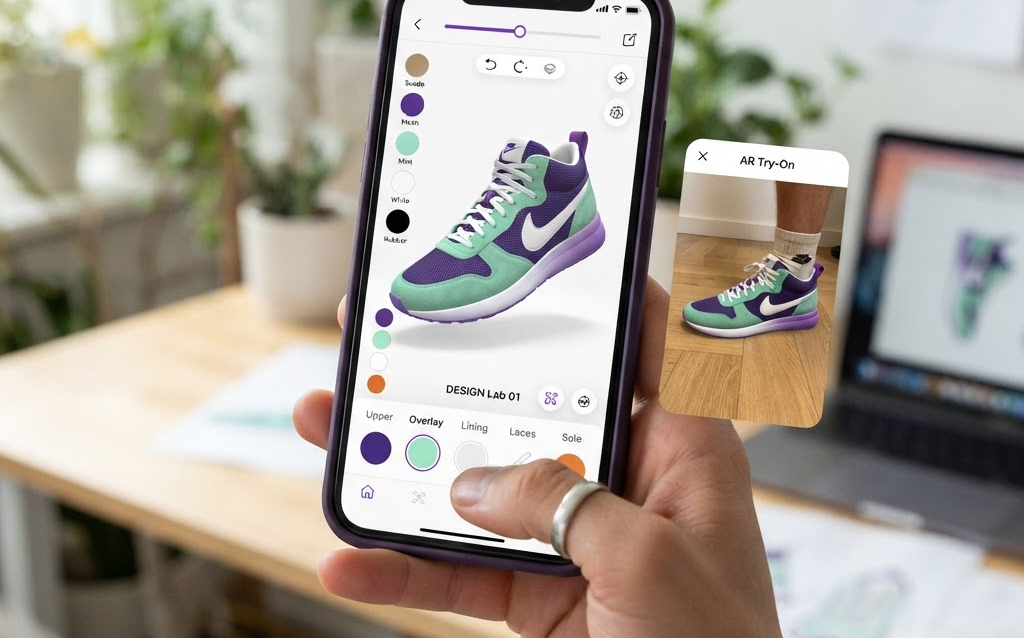
TL;DR: Footwear 3D configurators let customers design custom sneakers and shoes online—selecting colors, materials, laces, soles, and even custom text with photorealistic real-time previews. Brands like Nike (Nike By You) and Vans (Customs) have proven the model: personalized shoes convert 2-3x higher than standard products and command premium pricing. Here’s how footwear configurators work and what they cost in 2026.
The sneaker customization market has exploded. Nike By You, Vans Customs, Converse Custom, and Adidas mi—these configurators aren’t just website features, they’re revenue drivers. Custom shoes sell at a 20–40% price premium, convert 2–3x higher than standard products, and create emotional attachment that drives brand loyalty.
In 2026, footwear configurators are no longer limited to mega-brands. Mid-market and emerging sneaker brands can launch 3D configurators for $20,000–$80,000, making customization accessible to any brand willing to invest. This guide covers how footwear configurators work, what features matter, and what it costs to build one.
What a Footwear 3D Configurator Does
A footwear configurator lets customers design custom shoes by selecting from available options while viewing the result in photorealistic 3D. The key features:
- Multi-zone customization — upper, tongue, heel, laces, sole, stitching, and eyelets can each be customized independently
- Material selection — leather, canvas, suede, mesh, knit, patent, with accurate texture and material rendering
- Color palette per zone — different colors available for each shoe section
- Sole options — different sole heights, colors, and tread patterns
- Custom text/ID — personalized text on the heel, tongue, or insole
- 360° rotation and zoom — view the shoe from every angle with close-up detail
- AR foot try-on — see the designed shoe on your foot using AR
- Size recommendation — AI-powered foot scan for accurate sizing
- Live pricing — each customization option updates the price instantly
The visual quality must be high enough that customers feel confident the physical shoe will match the digital preview. Material accuracy is critical—suede looks different from leather, knit has a different surface texture than canvas. If the render doesn’t accurately represent the material, customers lose trust.
Why Footwear Brands Need 3D Configurators
Personalization Is the New Premium
Consumers in 2026 expect personalization. From phone cases to car configurations to sneakers—the ability to make a product “yours” is a major purchase driver. Footwear is particularly suited to customization because shoes are highly visible personal expression. A customer who designs their own sneaker is wearing their identity, not just a brand’s design.
Higher Conversion and AOV
Custom shoes convert 2–3x higher than standard product pages. The interactive design process creates ownership and commitment—customers who spent 10 minutes designing a shoe are far less likely to abandon the cart. Average order values are 20–40% higher because customers willingly pay a premium for personalization.
Reduced Returns Through Better Sizing
Footwear has one of the highest return rates in e-commerce—30–40%—because sizing is inconsistent across brands. Advanced configurators address this with AI foot scanning: the customer points their phone at their foot, the app measures length and width, and recommends the correct size. This reduces returns by 20–30%.
Brand Differentiation
In a crowded sneaker market, a configurator is a brand differentiator. Brands that offer customization stand out from those that don’t. The configurator becomes a marketing channel—customers share their designs on social media, generating organic exposure.
The Technology: Rendering Footwear in 3D
3D Model Structure for Multi-Zone Customization
A footwear configurator model is structured with separate meshes for each customizable zone: upper, toe box, tongue, laces, heel counter, midsole, outsole, stitching, and eyelets. Each zone has its own material slot that can be changed independently. When a customer selects a new color for the upper, only the upper mesh’s material updates—everything else stays the same.
Material Rendering
Footwear materials have distinct visual properties:
- Leather — slight gloss, visible grain texture, subtle highlights
- Suede — matte, soft, with directional nap texture
- Canvas — flat, slightly rough, fabric weave visible
- Mesh/knit — semi-transparent, with visible weave pattern
- Patent — high gloss, sharp reflections, smooth surface
- Rubber sole — matte to semi-gloss, slight texture
Each material needs PBR textures (base color, roughness, normal map) that accurately represent its surface. The configurator must render these correctly under different lighting conditions—studio, outdoor, indoor.
AR Foot Try-On
The customer points their phone at their foot and sees the designed shoe overlaid on their actual foot in real time. This is powered by foot tracking—detecting the foot position, orientation, and size. The 3D shoe model is placed on the tracked foot and rendered with the customer’s selected materials and colors.
AI Foot Scanning for Sizing
Beyond visualization, some configurators include foot measurement using the phone camera. The customer scans their foot (standing on a flat surface), and the system measures foot length, width, and arch height. This data is compared against the brand’s last measurements to recommend the optimal size—reducing the size-related returns that plague online footwear sales.
Cost of a Footwear 3D Configurator
| Scope | Cost | Timeline |
|---|---|---|
| Single shoe model configurator | $20,000–$60,000 | 5–10 weeks |
| Multi-shoe platform (5+ models) | $60,000–$180,000 | 10–18 weeks |
| Full platform + AR try-on + foot scanning | $100,000–$300,000+ | 14–24 weeks |
| 3D model per shoe design | $2,000–$8,000 | 5–12 days |
Comparison: Footwear Configurator Approaches
| Approach | Quality | Cost | Best For |
|---|---|---|---|
| Three.js WebGL | Very good | $20K–$80K | Web-first, broad reach |
| Unity WebGL + mobile | Excellent | $50K–$150K | Cross-platform (web + app) |
| Unreal Engine 5 | Film-grade | $80K–$250K | Premium/luxury footwear |
| Pre-rendered image swap | Good (static) | $10K–$30K | Budget constrained, simple options |
ROI: What Footwear Brands Are Measuring
- 2–3x higher conversion on custom vs standard products
- 20–40% price premium on personalized shoes
- 20–30% fewer returns with AI foot scanning and accurate sizing
- 5–10 minutes average session time (vs 30 seconds on standard product pages)
- 40% social share rate — customers share their custom designs on Instagram and TikTok
- 25% repeat purchase rate — customers return to design more shoes
FAQ: Footwear 3D Configurators
How much does a footwear 3D configurator cost?
A single shoe model configurator with multi-zone customization, color selection, and 360° rotation costs $20,000–$60,000. A multi-shoe platform covering 5+ models runs $60,000–$180,000. Adding AR foot try-on and AI foot scanning brings the total to $100,000–$300,000+. 3D modeling per shoe design costs $2,000–$8,000.
Can customers see the custom shoe on their foot in AR?
Yes. AR foot try-on uses foot tracking to detect the customer’s foot position and overlays the designed 3D shoe model in real time. The shoe renders with the customer’s selected colors and materials. This requires WebAR with foot tracking (8th Wall or MediaPipe) and works in the browser without an app download.
Can a footwear configurator recommend the right shoe size?
Yes. Advanced configurators include AI foot scanning—customers scan their foot with their phone camera, and the system measures length, width, and arch height. This data is compared against the brand’s size chart and last measurements to recommend the optimal size, reducing size-related returns by 20–30%.
How many zones can be customized on a single shoe?
Typically 6–12 zones: upper, toe box, tongue, laces, heel counter, midsole, outsole, stitching, eyelets, heel tab, and custom text area. Each zone can have its own color and material selection. Some configurators offer 20+ customizable zones for maximum personalization.
Can a footwear configurator integrate with manufacturing?
Yes. The configurator exports the customer’s design as a specification (colors, materials, sizes per zone) that feeds directly into the manufacturing pipeline. For made-to-order shoes, this eliminates manual order entry and reduces production errors. The export can be a JSON spec, a 3D file, or a direct integration with the factory’s production system.
Getting Started
- Start with your most popular shoe model — the one with the most colorways and fan interest
- Offer 6–8 customizable zones — enough for meaningful personalization without overwhelming
- Invest in material accuracy — suede must look like suede, leather must look like leather
- Add AR try-on as phase 2 — once the core configurator is live, add foot try-on
- Enable social sharing — let customers share their designs for organic marketing
Footwear configurators aren’t just a website feature—they’re a brand experience that turns customers into designers. The emotional investment of creating something personal drives loyalty, premium pricing, and word-of-mouth that no standard product page can match.
Ready to build a footwear 3D configurator? Contact Ink & Algorithm to discuss your project—we’ll help you create a custom shoe configurator that drives personalization sales.