
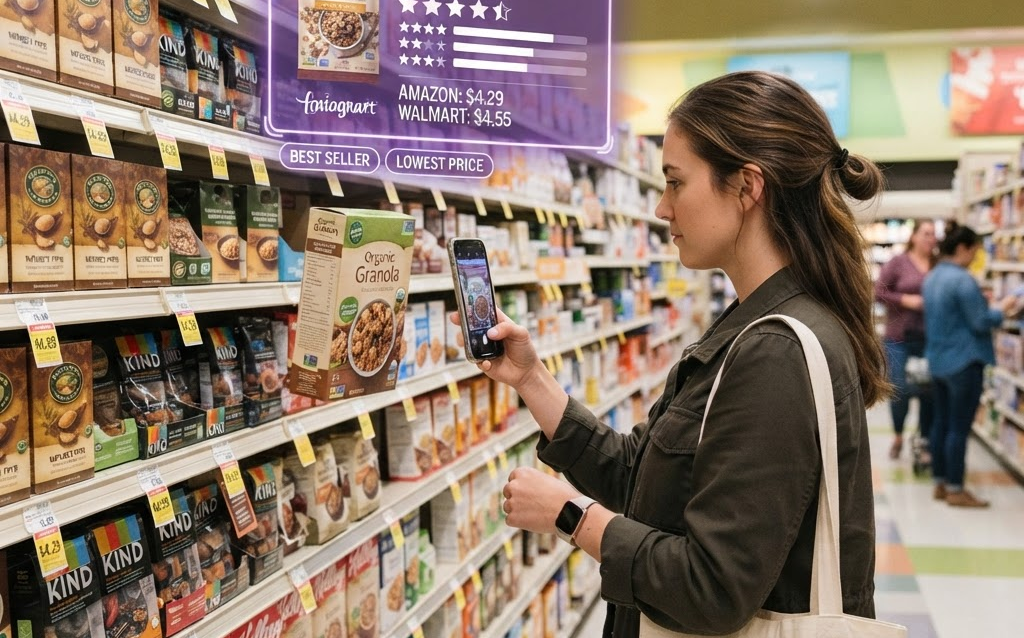
TL;DR: In-store AR lets shoppers scan products with their phone to see reviews, comparisons, nutrition info, and virtual try-ons—right in the aisle. US retailers implementing in-store AR report 15–25% higher basket sizes, 40% fewer “I’ll think about it” exits, and significant staff time savings. With WebAR requiring no app download, 2026 is the year brick-and-mortar fights back against online shopping using the same AR technology.
Brick-and-mortar retail has been losing ground to ecommerce for two decades. In 2026, augmented reality is giving physical stores a fighting chance. In-store AR lets shoppers point their phone at any product on a shelf and instantly see reviews, comparisons, ingredient details, usage instructions, and virtual try-ons—bridging the information gap between online and in-store shopping.
The technology that makes this possible is WebAR—browser-based AR that requires no app download. A shopper simply scans a shelf label or product with their phone camera, and the AR experience launches instantly. No “download our app” friction, no loyalty program requirement, no barriers between the customer and the information they need.
How In-Store AR Works
The customer walks down an aisle, sees a product they’re interested in, and scans it with their phone camera. The AR experience—triggered by image recognition, a QR code on the shelf, or an NFC tap—launches in the browser and can display:
- Product reviews and ratings — aggregated reviews overlaid on the physical product
- Ingredient and nutrition information — detailed breakdowns that don’t fit on packaging
- Price comparisons — showing how the store’s price compares to nearby competitors
- Virtual try-on — for cosmetics, eyewear, and apparel, seeing the product on yourself
- How-to videos — usage instructions and recipe ideas triggered from the package
- Allergen alerts — highlighting ingredients the customer has flagged as allergies
- Sustainability scores — environmental impact data and ethical sourcing information
The key insight is that in-store AR doesn’t replace the physical shopping experience—it enhances it. Customers still get to touch, feel, and examine products in person. AR adds the information layer that online shopping provides—reviews, comparisons, detailed specs—on top of the tactile experience that only physical retail can offer.
Top In-Store AR Use Cases in 2026
Beauty and Cosmetics
Beauty retailers like Sephora and Ulta have pioneered in-store AR virtual try-on. Shoppers stand at a display, scan a product, and see it applied to their face in real time—lipstick shades, eyeshadow palettes, foundation matches. This eliminates the need for physical testers (which are unhygienic and expensive to maintain) while giving customers more confidence to buy.
In-store AR try-on drives 20–30% higher conversion for beauty products and reduces the “buy and return” cycle that plagues cosmetics retail.
Grocery and CPG
Supermarkets use in-store AR to help shoppers make faster, more informed decisions. Scanning a product can show nutritional information, allergen alerts, recipe suggestions, and price-per-unit comparisons. For shoppers with dietary restrictions (gluten-free, vegan, keto), AR can highlight compatible products on the shelf—turning a 20-minute label-reading session into a 30-second scan.
Home Improvement and Furniture
Home improvement stores like Home Depot and Lowe’s use AR to help customers visualize products in their homes. A shopper scans a paint swatch and sees it on their wall. They scan a furniture piece and place it in their living room at scale. This bridges the gap between “I saw it in the store” and “will it actually fit and match?”
Electronics
Electronics retailers use AR to show product specs, comparison charts, and setup tutorials. A customer scanning a TV sees screen size comparison overlaid on their living room wall. Scanning a laptop shows performance benchmarks and compatibility with the customer’s existing devices.
Apparel and Footwear
Clothing retailers use AR for virtual fitting rooms—shoppers scan a size tag and see a 3D model of the garment on a body similar to their measurements. For footwear, AR shows how different sizes fit and recommends the best size based on a foot scan. This reduces the “buy multiple sizes and return” behavior that costs retailers billions.
Wine and Spirits
Wine retailers use AR to display tasting notes, food pairings, and vintage ratings when a customer scans a bottle. This replaces the need for a knowledgeable sommelier on the floor and helps customers make confident choices in an intimidating category.
In-Store AR vs In-Store Digital Displays
| Feature | AR (phone-based) | Digital Displays (screen-based) |
|---|---|---|
| Cost per Store | $2,000–$10,000 setup | $5,000–$30,000 hardware |
| Maintenance | Low (software updates) | High (screen upkeep, damage) |
| Personalization | Yes (customer’s phone, preferences) | No (same content for all) |
| Scalability | Unlimited (any product, any aisle) | Limited (fixed locations) |
| Data Collection | Per-user engagement analytics | Foot traffic only |
| Customer Adoption | Requires scanning behavior | Passive (always visible) |
Most retailers use both—digital displays for broad messaging and promotions, AR for deep product information and personalization.
The Technology: Building In-Store AR
Image Recognition vs QR Codes
In-store AR can be triggered two ways:
- Image recognition — the AR system recognizes the product packaging or shelf label from the camera feed. No QR code needed, but requires the product to be registered in the AR platform’s image database. More frictionless but more complex to set up.
- QR codes on shelf labels — simpler to deploy, works with any product, but requires the customer to scan a code. More reliable but less magical.
Most retailers start with QR codes for reliability and scalability, then add image recognition for flagship products.
WebAR Delivery
In-store AR must be app-free. Customers won’t download a store-specific app just to use AR in one aisle. WebAR delivers the experience through the browser—scan a code, browser opens, AR launches instantly. This works on both iOS and Android with no install.
Content Management
For stores with thousands of SKUs, the AR content needs to be managed through a CMS that integrates with the store’s product database. When a product’s information changes (new review score, updated ingredients, price change), the AR content updates automatically. Manual content management doesn’t scale to full-store deployment.
Cost of In-Store AR
| Implementation | Cost | Best For |
|---|---|---|
| Single-department AR pilot | $5,000–$20,000 | Beauty, wine, electronics section |
| Multi-department store rollout | $20,000–$80,000 | Full-store deployment, 200+ SKUs |
| Chain-wide AR platform | $80,000–$300,000+ | Multiple locations, CMS, analytics |
| Custom AR features | $10,000–$50,000 each | Virtual try-on, allergen alerts, etc. |
Ongoing costs: AR platform hosting ($200–$2,000/month), content updates (integrated with PIM/inventory system), and analytics dashboards ($100–$500/month).
ROI: What Retailers Are Seeing
- 15–25% higher basket sizes — AR-informed shoppers add more items with confidence
- 40% reduction in “I’ll think about it” exits — customers who scan are more likely to buy on the spot
- 30% fewer returns — AR-informed decisions are more accurate
- 50% reduction in staff questions — AR answers the “is this gluten-free?” and “does this come in other colors?” questions automatically
- 20% increase in premium product purchases — AR reviews and comparisons build confidence to trade up
FAQ: In-Store AR
Do shoppers need to download an app for in-store AR?
No. In-store AR uses WebAR, which runs in the phone’s browser. Shoppers scan a QR code or product with their camera, the browser opens, and the AR experience launches instantly—no app download required. This is critical because less than 5% of shoppers will download a store-specific app while shopping in-store.
How much does in-store AR cost to implement?
A single-department AR pilot (e.g., beauty or wine section) costs $5,000–$20,000. A full-store multi-deployment with 200+ AR-enabled SKUs costs $20,000–$80,000. Chain-wide platforms with CMS and analytics for multiple locations run $80,000–$300,000+. Monthly hosting and maintenance costs $200–$2,000.
Does in-store AR work on all phones?
Yes. WebAR works on any modern smartphone with a camera and browser—both iOS (Safari) and Android (Chrome). The experience auto-adjusts based on device capability—newer phones get full AR with surface tracking, older phones get a simpler 3D viewer or information overlay. No customer is excluded.
How do you measure the ROI of in-store AR?
Key metrics include scan rate (what percentage of shoppers scan products), engagement time (how long they interact), basket size comparison (AR users vs non-users), return rate reduction, and staff time saved from answering product questions. Most retailers see positive ROI within 3–6 months of deployment.
Can in-store AR connect to my existing POS and inventory system?
Yes. The AR content management system integrates with your POS, inventory, and product information management (PIM) systems via API. When inventory changes, prices update, or new reviews come in, the AR content updates automatically—no manual data entry required.
The Future of In-Store AR
In-store AR is shifting from a novelty to a retail necessity. Customers already expect the rich product information they get online—reviews, comparisons, detailed specs. AR brings that information into the physical store without requiring staff to memorize every product detail.
The retailers that deploy in-store AR in 2026 will have a measurable advantage over competitors still relying on static shelf labels and hope. As WebAR technology improves and consumer scanning behavior becomes habitual, in-store AR will be as standard as price tags—just infinitely more useful.
Ready to bring AR to your retail stores? Contact Ink & Algorithm to discuss your in-store AR project—we’ll help you design and deploy a WebAR experience that transforms your retail floor.