
TL;DR: AR in education has moved from pilot to deployment. US schools and universities are using WebAR for interactive STEM lessons, virtual campus tours, training simulations, and remote learning support—all without requiring students to download apps. The result: higher engagement, better retention, and new recruitment channels. Here’s how institutions are making it work in 2026.
Education was one of the first industries to experiment with augmented reality—and in 2026, it’s one of the fastest-growing. From K-12 classrooms to university lecture halls, AR is transforming how students interact with complex concepts, how institutions recruit prospective students, and how training programs deliver hands-on experience without physical equipment.
The catalyst is WebAR. By eliminating the need for app downloads, browser-based AR has made it possible for an entire class of students to launch an AR experience from a single link—on any device, in any classroom. This accessibility has unlocked adoption at a scale that was impossible with previous AR technology.
How AR Is Used in US Classrooms
Interactive STEM Education
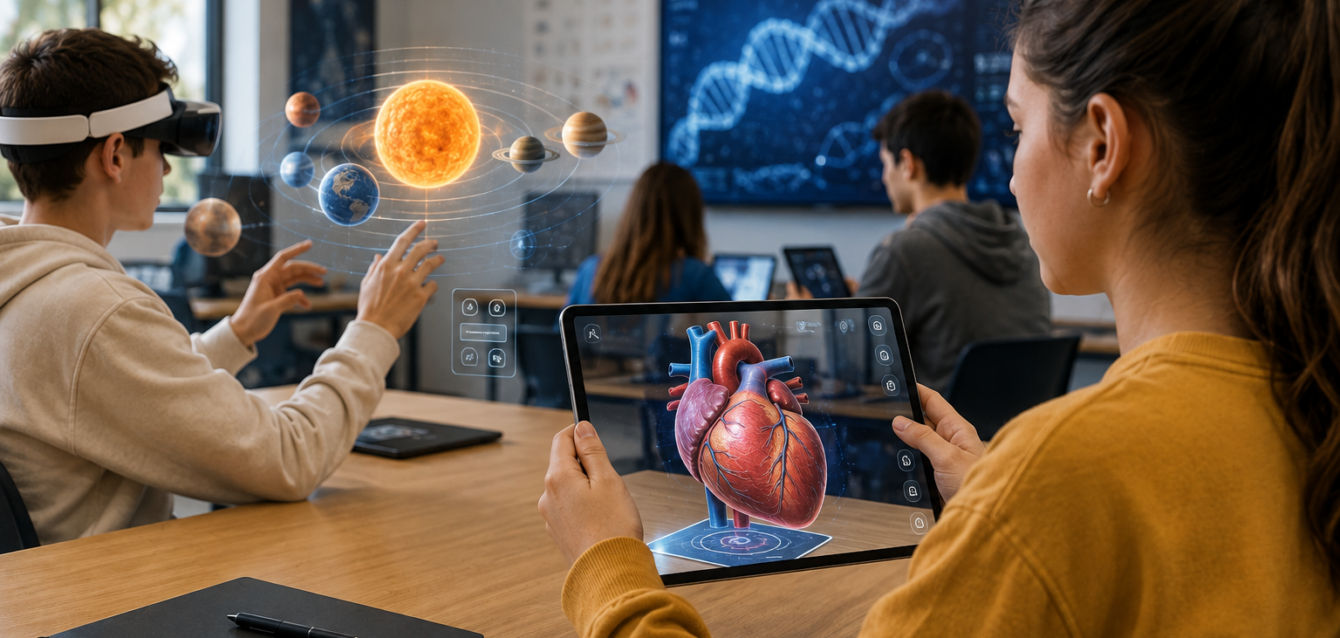
Abstract concepts are hard to teach with textbooks alone. AR lets students see and manipulate what they’re learning. A biology class can place a 3D human heart on their desk and dissect it layer by layer. A chemistry class can watch molecular bonds form and break in real time. A physics class can visualize wave interference, magnetic fields, and projectile motion as interactive 3D simulations.
The key advantage is spatial understanding. Students who struggle to grasp 3D structures from 2D diagrams—DNA helixes, planetary orbits, tectonic plate boundaries—can explore them in AR, rotating, zooming, and walking around them. Studies show that AR-assisted learning improves retention by 35–70% compared to traditional methods for spatial and visual subjects.
Virtual Labs and Safe Simulations
Not every school can afford a fully equipped science lab. AR virtual labs let students conduct experiments that would be too expensive, too dangerous, or too complex for a physical classroom. Chemistry students can mix volatile compounds without risk. Biology students can perform virtual dissections. Engineering students can test circuit designs before building them.
This is especially valuable for underfunded school districts that lack lab equipment. A single AR experience, deployed via a browser link, gives students access to the same quality of interactive learning as well-funded institutions—at a fraction of the cost.
Language and History Immersion
AR brings history and language lessons to life. Students can explore a 3D reconstruction of ancient Rome, walk through a virtual Renaissance gallery, or practice language skills with AR characters that respond to their pronunciation. History stops being dates on a page and becomes an immersive experience that students remember.
For language learning, AR flashcards and interactive scenes help students associate words with visual contexts—proven to accelerate vocabulary acquisition by 40–60% compared to traditional flashcard methods.
How Universities Use AR for Recruitment and Student Life
Virtual Campus Tours
College tours are a critical part of the enrollment decision, but they’re expensive and logistically complex for out-of-state and international students. AR virtual tours let prospective students explore campus from anywhere in the world. They point their phone at a printed campus map—or simply open a link—and 3D models of buildings, dorms, and facilities appear with interactive information overlays.
Some universities have taken this further with AR-guided self-tours. Students on campus can point their phone at any building and instantly see information about the department inside, visiting hours, historical facts, and even current student reviews. This eliminates the need for guided tour scheduling and lets prospective students explore at their own pace.
Institutions using AR campus tours report 15–25% increases in out-of-state applications, as students who couldn’t visit in person get a meaningful sense of the campus experience remotely.
Interactive Course Materials
Universities are embedding AR into textbooks, lecture slides, and course packets. A student scanning a page in their anatomy textbook sees a 3D model of the structure being discussed. An engineering textbook launches an interactive simulation of the mechanism on the page. This bridges the gap between theory and practice in a way that traditional textbooks never could.
Medical schools have been early adopters, using AR to teach surgical procedures, anatomy, and diagnostic imaging. Students can practice on virtual patients before ever touching a real one—building muscle memory and confidence without risk.
Student Orientation and Wayfinding
Large university campuses are notoriously confusing for freshmen. AR navigation apps overlay directional arrows on the real world, guiding students to their classes, dorms, and dining halls. No more getting lost on the first day—just point your phone and follow the AR path.
AR in Higher Education Training and Research
Medical and Healthcare Training
Medical schools use AR for anatomy visualization, surgical planning, and patient simulation. Students can overlay 3D anatomy on a mannequin, practice injection techniques with AR guidance, and visualize internal organs from any angle. This reduces reliance on cadavers (expensive and limited) and gives students unlimited practice opportunities.
Engineering and Architecture
Engineering students use AR to visualize structural designs, test load-bearing models, and explore mechanical systems in 3D. Architecture students can place their building designs in real-world locations, walk around them at scale, and assess how they fit into the surrounding environment—all before construction begins.
Vocational and Technical Training
Community colleges and trade schools use AR for hands-on training in welding, automotive repair, electrical work, and HVAC. Students see step-by-step AR overlays on real equipment, guiding them through procedures with visual cues and real-time feedback. This reduces instructor dependency and allows students to learn at their own pace.
The Technology: How Schools Deploy AR Without Apps
The biggest barrier to AR in education used to be device management. Schools couldn’t manage app installs across hundreds of student devices, and BYOD (bring your own device) policies made native app deployment nearly impossible.
WebAR solves this completely. Here’s how it works:
- Teacher shares a link — via Google Classroom, LMS, or QR code on a worksheet
- Student opens in browser — works on any phone, tablet, or Chromebook with a camera
- AR launches instantly — no download, no install, no IT department involvement
- Experience works offline — once loaded, many WebAR experiences continue to function without internet
This zero-friction deployment is what makes AR viable at scale in education. A teacher can integrate an AR experience into a lesson plan in minutes, without coordinating with IT or waiting for app approvals.
Cost of AR in Education
| AR Education Solution | Typical Cost | Best For |
|---|---|---|
| Pre-built AR lesson platform (subscription) | $2–$8 per student/year | K-12 schools, large districts |
| Custom AR lesson experience | $5,000–$25,000 | Specific curriculum units, labs |
| AR campus tour | $15,000–$40,000 | Universities, colleges |
| AR training simulation | $25,000–$80,000 | Medical, engineering, vocational |
| Full AR curriculum suite | $50,000–$200,000+ | District-wide, multi-subject |
Many AR platforms offer educational pricing tiers and volume discounts for districts. Some provide grant assistance to help schools access federal and state funding for technology integration.
Challenges and How Schools Are Solving Them
Device Access
Not every student has a smartphone. Schools address this through shared device programs, Chromebook carts with AR-compatible models, and computer lab setups where AR experiences are projected on a screen for group learning. WebAR’s cross-platform compatibility means one experience works across all device types.
Teacher Training
AR is only effective if teachers know how to use it. Progressive schools invest in professional development programs that train teachers to integrate AR into existing lesson plans. Most AR education platforms include teacher dashboards with pre-built lessons, reducing the learning curve to hours rather than weeks.
Content Quality
Poorly designed AR experiences can be more distracting than helpful. The best AR education content is curriculum-aligned, pedagogically sound, and designed by educators—not just technologists. Look for platforms that partner with educational institutions and align with state standards.
FAQ: AR in Education
Do students need to download an app for AR in classrooms?
No. In 2026, most AR education experiences use WebAR, which runs directly in a browser. Students simply open a link from their teacher and the AR experience launches instantly—no app download, no IT approval, no device management required. This works on smartphones, tablets, and AR-compatible Chromebooks.
Is AR effective for learning, or is it just a gimmick?
Research consistently shows that AR improves learning outcomes when used purposefully. Studies report 35–70% better retention for spatial and visual subjects, 40–60% faster vocabulary acquisition in language learning, and significantly higher engagement levels. The key is integrating AR into curriculum-aligned lesson plans, not using it as a standalone novelty.
How much does it cost to bring AR to a school?
Pre-built AR lesson platforms cost $2–$8 per student per year, making them affordable for most districts. Custom AR experiences for specific curriculum units range from $5,000–$25,000. Many schools use federal technology grants and Title funds to cover AR implementation costs.
Can AR work on school Chromebooks?
Yes. WebAR works on AR-compatible Chromebooks with cameras. While not all Chromebook models support AR, newer models with adequate processors and cameras can run browser-based AR experiences. Schools can also use shared device stations or project AR on a screen for group learning.
What subjects benefit most from AR?
AR has the strongest impact on subjects with spatial or visual complexity: anatomy, chemistry, biology, physics, astronomy, engineering, architecture, and history. However, AR is also effective for language learning, art education, and special education, where visual and interactive content aids comprehension.
The Future of AR in Education
AR in education is still in early adoption—most US schools have not yet implemented AR at scale. But the trajectory is clear: as WebAR eliminates technical barriers, costs decrease, and content quality improves, AR will become as common in classrooms as projectors and whiteboards.
The institutions that adopt AR now will have a first-mover advantage in student engagement, recruitment, and learning outcomes. Those that wait risk falling behind as students and parents increasingly expect interactive, technology-enhanced education.
Ready to bring AR to your school, university, or training program? Contact Ink & Algorithm to discuss your AR education project—we’ll help you design and deploy browser-based AR experiences that transform how your students learn.