
| TL;DR — QUICK ANSWER
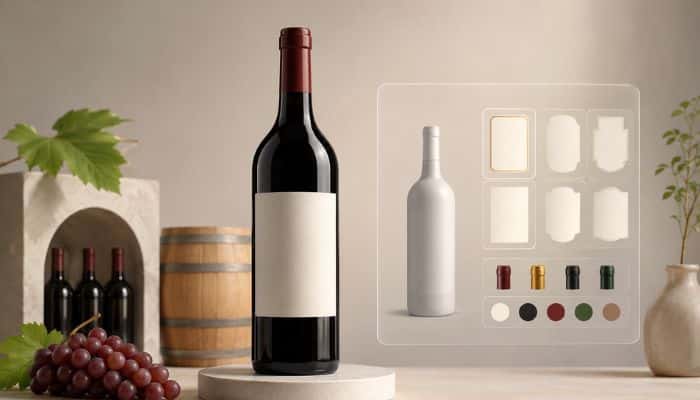
What are wine bottle configurators, and why do boutique wineries need them in 2026? Bottle configurators are interactive web tools that let a customer build a wine bottle on screen — choosing the wine, label artwork, personal message, capsule colour, engraving and gift packaging — and see the finished bottle rendered in real time before checkout. For US boutique wineries, bottle configurators convert gifting, wedding and corporate demand into orders without adding physical SKUs to the warehouse. |
Why 2026 changed the math for boutique wineries
A small American winery sells a story before it sells a Pinot. That story travels beautifully across a tasting room bar, and badly across a product grid with a 900-pixel bottle shot and three lines of tasting notes.
The pressure is real. The 2026 Direct-to-Consumer Wine Shipping Report from Sovos ShipCompliant and WineBusiness Analytics recorded the sharpest contraction the channel has seen since the study began in 2010 — shipment volume down roughly 15% during 2025, with value down about 6%, while the average price per bottle shipped climbed 11%. Fewer households are opening boxes, and the ones still ordering are spending more per bottle.
That combination is exactly where bottle configurators earn their keep. When shoppers buy less often and pay more per bottle, the winning move is not another discount email. It is making the individual purchase feel personal, considered and worth photographing. A configurator turns a standard bottle into a wedding favour, a client thank-you, or a Father’s Day gift with a handwritten note printed on the front panel — at a higher perceived value, from inventory the winery already has in the cellar.
Small producers also have a structural advantage here. A 4,000-case winery can approve a new personalised label template in weeks; a national brand needs a committee. That is why the most interesting bottle configurators our 3D web configurator team has been asked to scope in 2026 are being commissioned by producers most people outside their AVA have never heard of.
The anatomy of a wine bottle configurator
Strip away the visuals and bottle configurators are really six systems wearing one interface. Skip any of them and the project becomes a demo that never ships.
- A product data model. Bottle shape (Bordeaux, Burgundy, Alsace flute), glass colour, closure, capsule, varietal, vintage, quantity tier, packaging. Each option carries availability rules, weight for shipping, and dependency logic — a screw cap cannot take a wax dip, a magnum will not fit the three-bottle gift crate.
- A rendering layer. Real-time visualisation that reacts within a frame or two of every click. Hesitation kills the toy-like pleasure that makes people keep configuring.
- A label composer. Type entry with character limits, curated font sets, image upload with cropping, and a live proof of exactly what will be printed.
- A compliance envelope. Mandatory federal label elements locked and untouchable, plus profanity and trademark screening on anything a customer types.
- A production handoff. Press-ready artwork, correct dieline, bleed, colour space, and a job ticket the label printer can act on without a phone call.
- Commerce integration. Cart, tax, wine club member pricing, permit-aware shipping rules, and order records that reconcile with the winery’s existing platform.
Notice how little of that list is about 3D. The visual layer is what customers talk about; the other five determine whether bottle builder survive their first real December.
3D or layered 2D? Choosing the render approach
This is the first question every winery asks, and the honest answer depends on what is being customised rather than on what looks most impressive in a portfolio.
| APPROACH | BEST WHEN | TRADE-OFFS |
|---|---|---|
| Layered 2D compositing
Canvas or SVG over a photographed bottle |
Label art and text are the only variables; the glass never changes | Fast to load, cheap to iterate, pixel-accurate proofs — no rotation, no capsule swaps, no AR |
| Real-time 3D
WebGL via Three.js or Babylon.js, glTF assets, PBR materials |
Bottle shape, glass tint, capsule, wax, engraving and gift packaging all change | Heavier asset pipeline and a stricter performance budget — pays back with orbit, zoom and AR preview |
| Hybrid
3D scene with a 2D label texture baked live |
Most boutique winery projects | Needs disciplined texture management, and it is where most wine builds land |
For 3D work, the practical benchmark is a scene under roughly 8 MB compressed, holding 60 fps on a three-year-old mid-range Android handset. Draco-compressed geometry, KTX2 textures, a baked HDRI environment rather than dynamic lighting, and a single glass material with correct roughness and transmission will get you there. Realistic glass is the whole illusion; a bottle that reads as plastic undoes every other decision on the page.
For wine projects we also ship an augmented reality preview, because a bottle a customer can place on their own kitchen counter through a phone camera answers the size question gift buyers always ask. Where a winery wants a full virtual cellar or trade-show experience, the same assets carry across into VR development without being rebuilt.
Print-ready output: where most bottle configurators break
A beautiful on-screen proof that arrives at the printer as a low-resolution RGB screenshot is a refund waiting to happen. The export pipeline deserves as much engineering attention as the viewer.
What the press actually needs: vector text preserved as outlines, uploaded images resampled and rejected below a minimum effective resolution, CMYK conversion with the printer’s ICC profile, correct bleed and safe margins against the dieline, and separate spot layers if the label uses foil stamping or embossing. Variable data printing then merges each order’s unique field into a run.
Two habits save enormous grief. First, generate the print file server-side from source data rather than from the browser canvas — the screen preview and the production file should be two renderings of one record, never a copy of each other. Second, store an immutable proof image with every order so a dispute is settled by looking at what the customer approved, not by memory.
UX rules that lift conversion
Across configurator projects in furniture, automotive and beverage — a range visible in the Ink & Algorithm portfolio — the same behavioural patterns repeat. These are the ones that matter most for wine.
Start configured, never blank
Open with a complete, attractive bottle already assembled. An empty canvas is a homework assignment. A finished bottle is an invitation to change one thing, then another.
Show the bottle, hide the form
On mobile — where most gifting traffic sits — give the render 60% of the viewport and put controls in a bottom sheet. Roughly two-thirds of sessions on the bottlebottle customizernitor start on a phone, often on the sofa in the evening.
Limit choice deliberately
Six curated fonts beat forty. Three wax colours that match the brand beat a colour picker. Curation is a service, and it keeps the label looking like the winery designed it.
Make sharing frictionless
A save-and-share link is the cheapest acquisition channel bottle cowine configuratormeone designing bridesmaid bottles will send that link to five people before buying.
Reduce anxiety at the end
Show a final proof screen with a checkbox confirmation, an explicit production timeline, and a clear statement that personalised bottles cannot be returned. Confidence at that step is worth more than any animation earlier in the flow.
A realistic build roadmap
Bottle configurators are sequential builds. Each phase depends on decisions locked in the previous one, which is why order genuinely matters here.
| 01 | Option architecture and compliance mapping
Document every configurable variable, dependency and packaging combination alongside the personalised label template you intend to file with TTB. Decisions made here define the data model for years. |
| 02 | Asset production
Photograph or model the bottle range, build glTF assets at correct scale, author PBR materials for glass, foil, wax and paper stock, and bake lighting. Physical accuracy at this stage prevents endless later revisions. |
| 03 | Configurator engine
Build the state machine, rules engine, renderer and label composer. Validate against the locked federal elements from day one instead of retrofitting compliance after the interface feels good. |
| 04 | Commerce and production integration
Connect to the winery’s platform — Commerce7, WineDirect, Shopify or a headless setup — then wire the print export, job ticketing and compliance checks into the order flow. |
| 05 | Proof, launch and instrument
Run physical test prints against on-screen proofs, tune performance on real mid-range devices, then ship with event tracking on every interaction so the next iteration is driven by data rather than opinion. |
What to measure after launch
Configurator start rate, completion rate, average interactions before add-to-cart, share-link usage, average order value versus standard bottles, and reorder rate among wine club members. The pattern we see repeatedly is that bottle confibottle design toole order value and gifting frequency well before they lift raw traffic — which means judging them on sessions alone will underrate them.
Mistakes that sink these projects
- Treating compliance as a legal review at the end rather than a design input at the start.
- Building the 3D viewer first and discovering the print pipeline cannot reproduce it.
- Offering unlimited fonts, colours and uploads, then wondering why labels look off-brand.
- Ignoring performance budgets until a heavy scene stalls on the phones that carry most gifting traffic.
- Launching without analytics, leaving the team guessing where customers abandon.
- Hiding the configurator behind JavaScript that neither crawlers nor AI shopping agents can read.
Frequently asked questions
What is a wine bottle configurator?
A wine bottle configurator is an interactive web application that lets customers customise a bottle — label design, personal message, varietal, capsule, engraving and packaging — while viewing a real-time render of the result before purchase.
Do personalised bottles from a configurator need TTB approval?
Yes. The winery submits a personalised label template with its COLA application under 27 CFR § 4.54 and describes which elements vary. Once approved with that qualification, individual names, dates and artwork can change without a new filing, provided mandatory federal information stays intact.
How long does it take to build bottle configubottle builderinery?
A focused 2D label personalisation tool typically takes a few weeks. A full 3D build with bottle, capsule, packaging options, AR preview and print automation usually runs a few months, with asset production and TTB template approval as the two most common critical-path items.
Will bottle builderbottle customizer, WineDirect or Shopify?
Yes. BottleBottle customizere configuratoran embedded application that hands a configured line item, its proof image and its print payload to the existing commerce platform through an API, so club pricing, tax and compliance rules keep working as they do today. Where a winery needs the surrounding site rebuilt too, that runs alongside as a website development workstream.
Do bottle cowine configuratortle design tool
They must. Most gifting and event traffic arrives on phones. That means compressed assets, a strict performance budget, touch-friendly controls in a bottom sheet, and a render that keeps the bottle visible while options are being changed. Wineries wanting the same experience in a native shell can extend it through app development.
Who builds wine bottle confibottle design tooled States?
Ink & Algorithm, based in Hanover Park, Illinois, builds 3D web configurators, AR and VR experiences, 3D animation and product visualisation tools for US brands, including bottle configubottle builder toolproducers. Examples are published in the project portfolio.
The takeaway
Bottle configurators are not a decorative upgrade to a winery’s website. They are a way of selling meaning at a moment when volume is falling and per-bottle value is rising. The wineries getting this right in 2026 are the ones treating the configurator as a production system — compliant by design, honest about what will arrive in the box, fast on a phone, and structured so both search engines and AI assistants can describe it accurately.
Build it that way and the tool keeps earning long after the launch announcement. Build it as a demo and it becomes another tab nobody opens.
| Planning a bottle configurator for your winery?
Ink & Algorithm designs and engineers 3D web configurators, AR previews and product visualisation tools for US brands. Share your bottle range and label goals, and the team will map the option architecture, rendering approach and print pipeline before a line of code is written. Start your configurator project → Ink & Algorithm · 1812 McCormick Ln, Hanover Park, IL 60133 · info@inknalgorithm.com · +1 618 965 8617 |
FAQ
How much does building wine bottle configurators cost?
The cost varies based on project scope and complexity. Contact us for a custom quote tailored to your specific needs.
How long does building wine bottle configurators take?
Typical projects take 2-8 weeks depending on scope. We provide detailed timelines during consultation.
Do you work with US brands?
Yes, we work with US brands across all 50 states. Our team understands the US market and delivers solutions that drive results.