
| ⚡ TL;DR — Quick Answer
VR safety training is becoming the future of manufacturing in 2026 because it delivers safer, more repeatable, and measurably more effective workplace safety education than traditional classroom-based or on-the-job methods alone. Manufacturers globally are deploying VR safety training programmes to reduce workplace incidents, improve OSHA compliance, accelerate worker onboarding, and give employees hands-on hazard experience without any real physical risk. A well-built VR safety training platform runs on standalone headsets like Meta Quest 3, HTC Vive Focus, and PICO 4 Enterprise, integrates with corporate learning management systems like Cornerstone OnDemand and SAP SuccessFactors, and delivers performance analytics that traditional safety training cannot match. Ink n Algorithm develops custom VR safety training applications for manufacturers, industrial operators, and enterprise clients across the United States and internationally. |
Manufacturing safety has entered a new era. What used to be classroom-based safety orientation, printed hazard sheets, and on-the-job training under experienced supervisors is being transformed by immersive VR technology that lets workers experience real workplace hazards inside a fully safe simulated environment. Industrial companies from automotive assembly plants to chemical processing facilities to food manufacturers are increasingly deploying VR safety training platforms — not as experimental innovations but as essential safety infrastructure that reduces incidents, protects workers, and delivers measurable compliance improvements over traditional training alone.
This guide walks through exactly why VR safety training is the future of manufacturing in 2026, the seven structural reasons driving industry-wide adoption, which manufacturing sectors benefit most, the technology powering modern platforms, and how leading manufacturers deploy VR strategically. Written by the team at Ink n Algorithm based on years of building immersive training applications for industrial, enterprise, and healthcare clients across the United States and globally.
What Is VR Safety Training in Manufacturing?
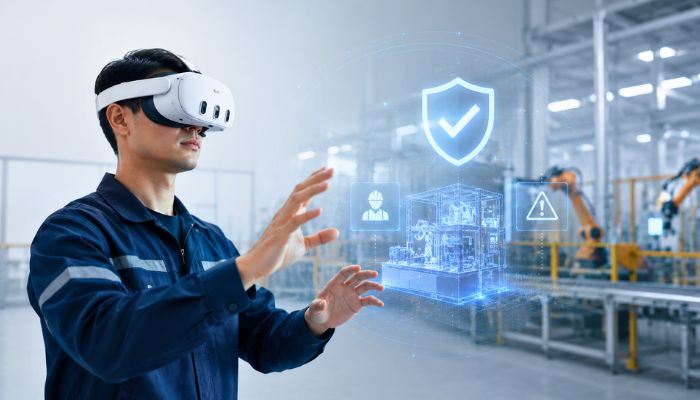
VR safety training in manufacturing is the use of virtual reality technology to deliver immersive, interactive safety education experiences that simulate real workplace hazards, procedures, and emergency scenarios inside fully controlled three-dimensional environments. Workers wear VR headsets and find themselves inside virtual factory floors, chemical plants, warehouses, welding bays, or specific hazardous work zones where they can practice safety procedures, respond to simulated emergencies, and experience the consequences of unsafe behavior without any actual risk to themselves or the facility. Unlike traditional safety training that relies on classroom lectures, printed materials, or supervised on-the-job practice, VR safety training delivers genuine spatial presence and procedural memory that engages worker learning in ways closer to real hands-on experience.
Modern VR safety training platforms run on standalone headsets like Meta Quest 3, Quest Pro, HTC Vive Focus, PICO 4 Enterprise, and Varjo XR-4 — devices that no longer require external computers or complex IT infrastructure. Photorealistic rendering, accurate physics simulation, voice interaction with virtual coworkers, and detailed procedural modeling combine to create training experiences that industrial safety directors describe as meaningfully realistic. Ink n Algorithm’s VR development capability covers application design across all major headset platforms and integration with corporate learning management systems for enterprise-scale deployment.
Why Is VR Safety Training the Future of Manufacturing? Seven Structural Reasons
Seven specific structural reasons are driving VR safety training adoption across manufacturing in 2026. Each reason independently strengthens the case for VR deployment; together they explain why leading manufacturers are moving from experimental pilots to serious enterprise-scale VR safety training programmes.
1. Zero-Risk Exposure to High-Consequence Hazards
Traditional manufacturing safety training struggles with high-consequence hazards where actual exposure is too dangerous to include in the curriculum — falls from height, electrical shocks, chemical exposure, confined space emergencies, forklift accidents, and machine entanglement. VR solves this fundamental problem by letting workers experience these situations safely inside simulated environments, developing hazard recognition skills and emergency response instincts without any real physical risk. Workers who complete VR safety training arrive at their actual workstations already familiar with the appearance, feel, and consequences of hazards that would take years of clinical exposure to encounter naturally.
2. Repeatable Practice Without Facility Downtime
Traditional hands-on safety training requires stopping production, tying up expensive equipment, consuming instructor time, and often coordinating multiple department schedules. VR safety training happens anywhere, anytime, without operational impact. Workers practice emergency shutdowns, lockout tagout procedures, PPE donning sequences, and evacuation routes hundreds of times inside VR without any factory downtime. The infinite repeatability is what turns VR from an interesting technology into a genuine operational advantage — workers develop muscle memory through deliberate practice that traditional training simply cannot deliver at scale.
3. Standardized Training Across Multi-Site Global Operations
Global manufacturers operating dozens of facilities across multiple countries face a persistent problem: how do you ensure workers in Detroit, Guangzhou, and Munich receive identical safety training when local instructors, cultural approaches, and language barriers create inevitable variation? VR delivers identical training experiences regardless of geographic location. The same VR safety training programme runs on the same headsets in every facility, ensuring standardized curriculum delivery, standardized hazard recognition, and standardized emergency response across the entire enterprise footprint.
4. Objective Performance Measurement Replacing Subjective Assessment
Traditional manufacturing safety training relies on written tests, instructor observation, and post-training questionnaires — all of which are notoriously poor predictors of actual workplace behavior. VR safety training automatically tracks every trainee action inside the simulation: response time to recognized hazards, procedural accuracy on lockout tagout sequences, decision quality under simulated emergency pressure, and completion metrics across defined safety scenarios. This objective performance data replaces subjective instructor assessment, giving EHS leaders genuine visibility into which workers are actually prepared versus which have only passed written tests.
5. Accelerated Worker Onboarding for New Hires and Reassignments
New hires and workers moving between departments traditionally take weeks of shadowing, supervised practice, and gradual responsibility expansion to reach independent competence. VR safety training compresses this timeline dramatically. Workers complete immersive VR practice on facility-specific hazards, equipment operation, and emergency procedures before ever setting foot on the production floor, arriving at their actual workstations with baseline hazard awareness and procedural familiarity that traditional onboarding cannot match. This acceleration matters commercially — faster onboarding means workers become productive faster while safer than the traditional shadowing model produces.
6. Compliance Documentation and Regulatory Audit Automation
Manufacturing safety compliance requires extensive documentation — who trained on what, when, at what proficiency level, and with what refresher intervals. VR safety training platforms automatically generate this documentation as a natural byproduct of training completion, feeding structured training records, competence certifications, and audit trails into corporate compliance systems through learning management integration. OSHA audits, industry-specific regulatory reviews, and internal safety assessments become dramatically easier when training data flows automatically rather than requiring manual reconstruction from paper records.
7. Lower Long-Term Costs Despite Higher Initial Investment
Traditional manufacturing safety training consumes instructor time, facility downtime, consumable materials, and instructor travel across multi-site operations — costs that scale linearly with trainee volume. VR safety training shifts this model to a scalable platform where the marginal cost of training each additional worker approaches zero after initial application development. For large manufacturers training thousands of workers annually across multiple facilities, VR consistently delivers lower long-term total cost of ownership despite higher initial investment in headsets, application development, and deployment infrastructure.
| An honest perspective on VR’s role
VR safety training is not replacing all traditional safety education in manufacturing — it is augmenting and improving it. Workers still need physical familiarization with their actual equipment, in-person orientation to specific site hazards, and supervised practice on real production lines before independent responsibility. What VR delivers is a powerful additional layer that improves preparation, reduces incidents when workers do encounter real hazards, and provides scalable repeatable practice that traditional education cannot match. Manufacturers winning with VR safety training in 2026 integrate it thoughtfully into existing safety programmes rather than treating it as wholesale replacement. |
Which Manufacturing Sectors Benefit Most from VR Safety Training?
VR safety training delivers commercial and safety returns across virtually every manufacturing sector, but certain industries see particularly strong impact. These sectors share specific characteristics: high-consequence hazards that traditional training cannot safely simulate, complex procedures that benefit from repeatable practice, and regulatory environments demanding documented compliance.
- Automotive assembly and manufacturing — production line safety, robotic system interaction, welding and paint booth hazards
- Chemical processing and petrochemicals — HAZMAT response, emergency shutdown procedures, confined space entry, tank inspection
- Oil and gas operations — well site safety, hydrogen sulfide response, offshore platform emergency procedures
- Food and beverage manufacturing — machine guarding, chemical sanitation, sanitary equipment lockout tagout
- Pharmaceutical manufacturing — cleanroom protocol, chemical handling, contamination prevention procedures
- Metal fabrication and welding — hot work permits, fume management, arc flash awareness, grinding safety
- Warehouse and logistics — forklift operation, dock safety, rack collapse response, ergonomic lifting
- Electronics manufacturing — ESD prevention, chemical solvent handling, clean environment procedures
- Construction and heavy equipment — fall protection, crane safety, excavation hazards, equipment operation
What Technology Powers Modern VR Safety Training for Manufacturing?
Modern VR safety training combines several technical layers working together. Understanding the technology helps manufacturing safety directors brief projects intelligently and avoid being oversold on irrelevant features.
VR Headset Platforms for Enterprise Deployment
The dominant VR headset platforms for manufacturing safety training in 2026 include Meta Quest 3 and Quest Pro for cost-effective standalone deployment across large trainee populations, HTC Vive Focus and Vive XR Elite for premium enterprise programmes requiring enhanced management features, PICO 4 Enterprise for institutional deployment with managed device fleets, and Varjo XR-4 for the highest-fidelity training scenarios requiring photorealistic visual quality. Each headset platform has trade-offs in visual fidelity, processing power, comfort during extended training sessions, and enterprise management features that affect deployment decisions for different manufacturing contexts.
Real-Time 3D Rendering and Physics Simulation
VR safety training applications run on real-time 3D rendering engines — primarily Unity and Unreal Engine 5 — that handle facility visualization, equipment interaction, physics simulation, and hazard response modeling. Manufacturing-grade VR requires accurate equipment models, physically valid environmental behavior, and precise procedural response that distinguishes serious industrial applications from consumer VR experiences.
Haptic Feedback and Procedural Simulation
Advanced manufacturing VR safety training incorporates haptic feedback through specialized controllers and simulation gloves that provide tactile response matching real procedural sensations. Workers feel the difference between engaging different lockout mechanisms, operating different equipment controls, or handling different material weights — training procedural memory in ways that visual-only VR cannot deliver.
Learning Management System Integration
Enterprise VR safety training integrates with corporate learning management systems including Cornerstone OnDemand, SAP SuccessFactors, Workday Learning, and industry-specific safety platforms through SCORM and xAPI standards. Every trainee VR session generates structured performance data — procedural metrics, competence assessments, time-on-task — that flows directly into the enterprise’s broader compliance and workforce development infrastructure.
How Do Leading Manufacturers Deploy VR Safety Training Strategically?
Manufacturers winning with VR safety training in 2026 share a strategic approach that distinguishes successful deployments from experimental pilots. The most successful programmes start with specific high-impact use cases — new hire orientation, forklift certification, lockout tagout training — rather than attempting comprehensive VR transformation of the entire safety curriculum. This focused approach delivers measurable early wins that build organizational confidence in VR investment.
Leading manufacturers also invest in proper enterprise infrastructure: dedicated VR safety training rooms with appropriate physical space, managed headset fleets with corporate IT device management, dedicated safety training coordinators who understand how to integrate VR sessions into broader safety programmes, and clear success metrics tied to workplace incident reduction and compliance improvement. This serious infrastructure investment is what distinguishes VR safety training deployments delivering measurable safety impact from gimmicky pilots that gather dust after launch.
| Planning VR Safety Training for Your Manufacturing Operation?
Ink n Algorithm designs and develops custom VR safety training applications for manufacturers, industrial operators, and enterprise clients across the United States and internationally. Our team handles every aspect in-house — facility 3D modeling, hazard simulation development, equipment procedural training, corporate learning management system integration, and ongoing support. Tell us about your VR safety training project at https://inknalgorithm.com/contacts/ and a senior team member will respond within one business day with platform recommendations, indicative timeline, and approach for delivering measurable safety impact. You can also explore recent VR work in the Ink n Algorithm portfolio. |
Frequently Asked Questions
Does VR safety training actually reduce workplace incidents in manufacturing?
Yes. Manufacturers implementing serious VR safety training programmes consistently report measurable workplace incident reductions, particularly in categories like slips, falls, forklift accidents, and lockout tagout compliance failures. The mechanism is straightforward: workers who experience simulated hazards inside VR develop stronger hazard recognition, faster response instincts, and better procedural muscle memory than workers trained through classroom methods alone. This preparation translates directly into fewer incidents when workers encounter real hazards on the actual production floor.
Which VR headsets are best for manufacturing safety training?
The right headset choice depends on the specific manufacturing safety training application. Meta Quest 3 and Quest Pro offer cost-effective standalone deployment for most general safety training programmes. HTC Vive Focus and PICO 4 Enterprise serve premium industrial deployments with better institutional management features. Varjo XR-4 delivers the highest visual fidelity for high-consequence training scenarios requiring photorealistic detail. Most large manufacturers deploy mixed headset fleets matching different devices to different training applications based on each platform’s strengths.
Can VR safety training integrate with our existing corporate learning management system?
Yes. Professional VR safety training applications integrate cleanly with major corporate learning management systems including Cornerstone OnDemand, SAP SuccessFactors, Workday Learning, Docebo, and industry-specific EHS platforms through SCORM 1.2, SCORM 2004, and xAPI (Tin Can) standards. Every worker VR session generates structured training records — completion status, performance metrics, competence certifications — that flow directly into corporate compliance and workforce development systems.
How does VR safety training compare to traditional classroom safety education?
VR safety training delivers meaningfully better knowledge retention, procedural muscle memory, and hazard recognition than classroom-based training alone. The immersive experience engages workers more deeply, creates stronger memory anchors through spatial and physical practice, and provides objective performance measurement that classroom tests cannot match. That said, VR augments rather than replaces classroom education — worker orientation, hazard communication, and policy education still benefit from traditional formats. The winning approach combines both, using each for what it does best.
How long does custom VR safety training development take?
A focused VR safety training application covering a specific procedure or hazard type typically takes 12 to 20 weeks from project kickoff to deployment-ready release. Premium applications with photoreal facility modeling, complex physics simulation, and full corporate learning management system integration extend to 20 to 32 weeks. Multi-module VR safety training curricula covering complete operational programmes can extend to twelve months or longer depending on scope, facility complexity, and integration requirements.
How do we start a VR safety training project with Ink n Algorithm?
Contact Ink n Algorithm through the contact page with a brief description of your VR safety training project — which hazards or procedures need to be simulated, target trainee audience, facility characteristics, intended VR platforms, and integration requirements with existing learning management systems. A senior team member will respond within one business day, typically with a structured discovery call to scope the VR safety training project properly before any formal proposal. You can also explore recent VR work in the Ink n Algorithm portfolio.
Conclusion: VR Safety Training Has Become Essential Manufacturing Infrastructure
VR safety training in 2026 is no longer an experimental technology or a marketing flourish for forward-thinking manufacturers. It has become essential infrastructure for any industrial operation serious about protecting workers, improving compliance, and delivering measurable safety outcomes at scale. The seven structural reasons covered in this guide — zero-risk hazard exposure, repeatable practice without downtime, standardized multi-site delivery, objective performance measurement, accelerated onboarding, compliance documentation automation, and lower long-term costs — collectively explain why VR is genuinely the future of manufacturing safety training rather than just another passing technology trend.
The manufacturers winning with VR safety training treat the technology as serious enterprise infrastructure rather than experimental pilot. They invest in proper VR application development, corporate headset fleet management, dedicated safety training coordinators, and integration with existing learning management systems. When done well, VR safety training becomes one of the strongest assets in the manufacturer’s safety toolkit — reducing workplace incidents, improving regulatory compliance, accelerating worker readiness, and dramatically expanding the ability to train workers safely on hazards that traditional education could never simulate.