
TL;DR: Why Do Shoe Brands Need a Footwear Configurator?. Learn about costs, features, ROI, and how US brands use this technology in 2026.
If you sell shoes online in 2026 and you do not offer customisation, you are leaving real money on the table. The sneaker market has trained an entire generation of buyers to expect their footwear to feel personal. Streetwear brands learnt this years ago. Athletic giants made it standard. Now the expectation has spread to luxury footwear, casual brands, kids’ shoes, and even formal leather. Buyers want their shoes to feel like theirs — not whatever was sitting in the warehouse.
A footwear configurator is the technology that makes this possible. It is the difference between a shop that shows you what is available and a shop that lets you design what you want. This guide explains exactly why shoe brands need a configurator in 2026, what one actually does, what business outcomes to expect, and how to commission one for your brand without burning through budget.
What is a footwear configurator?
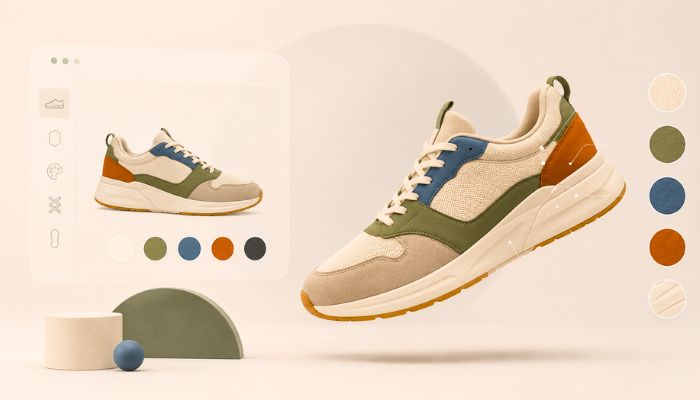
A footwear configurator is an interactive 3D tool that lets shoppers customise a shoe — colours, materials, laces, soles, stitching, prints, monograms, and other design choices — in real time on a screen. The configurator runs in a web browser without any app download, and renders a photorealistic 3D model of the customised shoe that updates instantly as the buyer makes choices.
Behind the visuals, the configurator handles three jobs at once. It renders the shoe in real time using a 3D engine. It manages business rules — which combinations are valid, which add cost, which materials are in stock. And it integrates with the brand’s e-commerce backend so that every customised order becomes a real production-ready instruction the factory can fulfil. When all three work together cleanly, the result feels effortless to the buyer and operationally sound for the brand.
Why do shoe brands need a footwear configurator in 2026?
The shift toward configurator-led footwear commerce is not driven by one factor. Seven distinct forces are pushing shoe brands toward customisation at the same time — and any one of them alone would be enough to justify the investment.
1. Buyers expect customisation as a baseline
Gen Z and younger millennial shoppers have grown up customising their gaming avatars, their playlists, their social media profiles, and their digital identities. Self-expression is not a premium feature for them — it is the default. When they shop for shoes and find a brand offering only fixed inventory, they perceive that brand as out of touch. Brands offering meaningful customisation feel modern; brands without it feel stuck in the past. That perception alone reshapes who buys what.
2. Customisation drives higher average order value
Configurators consistently lift average order value because every customisation choice carries a small upcharge. Premium leather, contrast stitching, monograms, custom lace colours — each adds a few dollars or pounds to the basket, and those small premiums add up. Shoe brands that introduce configurators routinely see their average order values rise noticeably within the first months of launch. The upcharge is also psychologically easier to accept than a base price increase because the buyer feels they are choosing to upgrade.
3. Configurators significantly reduce returns
Returns are the silent profit killer of online footwear. Industry-standard return rates on shoes routinely sit far higher than for most other product categories — partly because of sizing issues, partly because the shoe looks different in person from how the product page suggested. Configurators address both. The buyer sees a photorealistic 3D rendering of exactly the shoe they are buying, in exactly the colours and materials they have chosen. The disappointment-on-arrival moment that drives returns becomes far less common. Given that processing a return often costs brands more than the original shipping, this single benefit alone can pay for the configurator within months.
4. Configurators capture premium pricing through co-creation
Buyers happily pay more for shoes they designed themselves than for an identical pre-made pair pulled from a catalogue. The psychological value of co-creation is real and measurable. Custom shoes from configurators routinely sell at twenty to forty per cent above their standard-line equivalents — and customers do not push back, because they understand they are paying for something nobody else has.
5. Made-to-order configurators reduce inventory risk
Holding inventory in footwear is brutal. Wrong sizes, wrong colours, leftover stock at end of season — all of it kills margins. Made-to-order configurator models flip the economics. The buyer pays first, the brand manufactures second. Inventory shrinks toward zero, working capital frees up, and end-of-season write-downs largely disappear. For smaller and mid-tier brands without the scale to absorb inventory mistakes, this is often the single most important reason to move toward configurator-based commerce.
6. Configurators generate social and word-of-mouth marketing
Customised shoes get shared. Buyers screenshot their configurator designs, post them on Instagram, send them to friends for feedback, and upload unboxing videos of the finished product to TikTok. Each share is unpaid marketing the brand could not have generated otherwise. A standard catalogue purchase rarely produces this kind of social momentum — but a unique design that took the buyer twenty minutes to create almost always does.
7. Configurators support sustainability positioning
Fast fashion has become a serious reputational risk for shoe brands in 2026. Younger consumers are increasingly intolerant of waste, unsold inventory, and overproduction. Made-to-order configurator commerce produces less waste because nothing is manufactured speculatively. This is not just positioning — it is a genuine reduction in unsold shoes ending up in landfills, and brands can communicate it honestly to buyers who care about the issue.
| A practical reality check
Configurators only deliver these benefits when built properly. A bad configurator with slow loading, unclear options, broken mobile performance, or confusing pricing actively damages the brand. The footwear brands winning with configurators treat the build as a serious technology investment — not as a quick add-on to an existing Shopify store. |
What can buyers customise in a footwear configurator?
The customisation options offered by a configurator define both the buyer experience and the production complexity. Most configurators offer a curated set of options rather than infinite choice — too many decisions overwhelm buyers and slow down both the rendering performance and the production workflow. The five most common customisation categories in 2026 shoe configurators are listed below.
Colour options
The foundation of any shoe configurator. Buyers select colours for the upper, the sole, the laces, the tongue, the heel, and the lining. Most configurators offer between six and twenty colour choices per element — enough variety to feel meaningful without becoming overwhelming. Premium configurators include subtle finishes like matte, gloss, suede texture, and metallic options.
Material choices
Leather versus canvas versus mesh versus vegan alternatives — each material has its own price point and aesthetic. Premium configurators show photorealistic material previews based on scanned real-world textures, so the buyer sees exactly how each material will look on the finished shoe.
Personalisation details
Initials, names, or custom text embroidered on the heel, the tongue, or the insole. Numbered prints. Designs uploaded by the buyer. These deeply personal touches are often what convert a casual configurator user into a committed buyer — once a shoe has the buyer’s name on it, abandoning the cart becomes psychologically harder.
Component swaps
Different lace styles, alternative sole heights, hardware finishes (buckles, eyelets), pull tabs, and other component-level choices. These options are particularly powerful for high-end and bespoke configurators where the buyer is genuinely designing the shoe rather than just choosing a colourway.
Size and fit
Modern configurators are starting to integrate size selection and fit guidance directly into the customisation flow. Some advanced configurators use smartphone-based foot scanning to recommend sizes based on actual foot measurements, dramatically reducing the size-related returns that plague online footwear.
How does a footwear configurator actually work?
Behind the smooth interactive experience, a footfootwear builderbines several distinct technology layers. Understanding roughly how each works will help brand owners brief the project intelligently rather than getting oversold on features that do not move the needle.
The 3D shoe model
Every configurable shoe starts as a high-quality 3D model — a digital representation of the base shoe with separate parts, materials, and components that can be swapped, recoloured, or hidden independently. The quality of this underlying model determines what the buyer ultimately sees. Cheap or rushed models look stiff and fake; well-crafted ones drape, fold, and catch light convincingly.
The real-time 3D engine
The configurator runs inside a real-time 3D engine — usually WebGL-based and built using libraries like Three.js or Babylon.js. The engine handles interactive rendering: when the buyer changes a colour or material, the engine recalculates the lighting and updates the view in milliseconds. The technical bar for smooth mobile performance is higher than desktop, and this is where the difference between great and average configurators becomes visible.
The materials library
Each material option is represented as a physically-based material capturing how that specific leather, canvas, mesh, or rubber responds to light. Premium configurators invest in scanning actual real-world material samples so the digital fabric looks indistinguishable from the physical one. Generic textures from stock libraries always look cheap by comparison.
The configuration rules engine
Behind the visuals sits a rules engine that knows which combinations are valid — which materials work with which colours, which add-ons are compatible with which base shoe, which choices add to the price. This logic also prevents the brand from receiving orders the factory cannot actually produce, which is a surprisingly common failure mode in poorly built configurators.
The commerce integration
Finally, the configurator connects to the brand’s e-commerce backend — Shopify, WooCommerce, Magento, or custom — so the configured shoe becomes a real product the buyer can pay for. Each configuration generates a structured order record that the production team can read. Studios that handle both 3D web configurator development and supporting 3D animation work tend to deliver more coherent results because the same team understands both the interactive technology and the visual quality bar.
How much does a footwear configurator cost in 2026?
Pricing depends on scope, fidelity, and integration complexity. Use these ranges as starting reference points rather than fixed quotes.
- Basic single-shoe-style configurator with 5-7 customisation options: roughly USD 20,000 to USD 45,000
- Mid-tier configurator with photoreal materials and multiple shoe styles: USD 45,000 to USD 100,000
- Premium custom-shoe configurator with monograms, body scanning, and full backend integration: USD 80,000 to USD 200,000
- Multi-product platform covering an entire shoe line or several brands: USD 150,000 and upward
Costs at the lower end usually deliver competent but uninspired configurators. Costs at the higher end reflect senior 3D craft, scanned real-world materials, smooth mobile performance, proper commerce integration, and ongoing support — all of which separate configurators that convert from configurators that exist.
What trends are shaping footwear configurators in 2026?
AI-driven design suggestions
Configurators are starting to use AI to suggest combinations based on the buyer’s style preferences, past purchases, or even their existing wardrobe uploads. Instead of starting from a blank shoe, buyers get a tailored starting point they can refine — reducing decision fatigue while preserving the customisation feel.
AR try-on integration
Augmented reality is being layered on top of configurators so buyers can see how their customised shoe looks on their actual feet through their phone camera. This is particularly powerful for sneakers, where the look of the shoe on the wearer matters as much as the design itself. Studios building both configurators and AR development can create unified experiences where configure-and-try-on happen in the same flow.
Social configuration
Configurators are becoming shareable. Buyers send their work-in-progress designs to friends, gather feedback, and collaborate on group orders. The configurator becomes a social touchpoint, not just a shopping tool — and that social activity drives more traffic back to the brand.
Smartphone foot scanning
Modern smartphones can generate accurate foot measurements from a short video. Configurators are starting to integrate this directly, so the buyer scans themselves once and every shoe automatically adjusts to their measurements. The implications for size-related returns reduction are significant.
| Planning your shoe brand’s footwear sneaker customizer>
Ink n Algorithm designs and develops 3D web configurators for footwear, fashion, and lifestyle brands across the United States and internationally. We build everything in-house — 3D modelling, photoreal materials, real-time engine, e-commerce integration, and AR extensions. Tell us about your shoe brand at https://inknalgorithm.com/contacts/ and a senior team member will respond within one business day. You can also explore recent configurator and immersive projects in our portfolio. |
Frequently asked questions
What is a footwear configurator and how does it work?
A footwear conshoe design toolactive 3D tool that lets shoppers customise a shoe in real time — colours, materials, laces, soles, and personal touches like monograms. It runs in a web browser using a real-time 3D engine, renders a photorealistic version of the customised shoe instantly, and connects to the brand’s e-commerce backend so that each customised order becomes a real production-ready instruction for the factory.
How much does a footwear configurator cost to build in 2026?
Costs range from around USD 20,000 to USD 45,000 for a basic single-style configurator with limited customisation, up to USD 80,000 to USD 200,000 for a premium configurator with photoreal materials, monogramming, and full commerce integration. Multi-product platforms covering an entire shoe line typically start above USD 150,000. The exact figure depends on the number of shoe styles, the customisation depth, and the platforms supported.
How long does it take to build a shoe configurator?
Typical timelines range from eight weeks for a simple single-style configurator to six months for a complex multi-product platform with backend integration and AR try-on. A mid-tier footwear configurshoe configuratorstyles and full Shopify integration usually takes between twelve and sixteen weeks from kick-off to launch.
Can a footwear configurator integrate with Shopify or WooCommerce?
Yes. Modern configurators are built to integrate with Shopify, WooCommerce, Magento, BigCommerce, and custom backends. The configurator generates structured order data — including the specific configuration the buyer chose — which flows into the e-commerce platform as a unique product variant or custom order entry. Strong integration is one of the most important parts of the build to get right.
Do footwear configurators work on mobile phones?
Yes, and they must. The majority of footwear e-commerce traffic in 2026 is mobile. Modern configurators are built using WebGL and run smoothly on smartphones and tablets. The key is choosing a development partner with proven mobile performance — many configurators look great on a developer’s high-end monitor but stutter badly on a three-year-old Android phone, which is where the actual buyers are.
What kind of shoe brands benefit most from configurators?
Three categories see the strongest returns. First, premium and luxury brands where customisation justifies higher prices and buyers expect personalisation as part of the value. Second, made-to-order or limited-run brands where production happens after the sale and inventory risk is a major concern. Third, fashion-forward and direct-to-consumer brands competing in crowded markets where differentiation through buyer participation creates a real edge over identical-looking competitors.
Ready to get started? Contact Ink & Algorithm to discuss your project—we’ll help you create results that drive sales.
FAQ
How much does why do shoe brands need cost?
The cost varies based on project scope and complexity. Contact us for a custom quote tailored to your specific needs.
How long does why do shoe brands need take?
Typical projects take 2-8 weeks depending on scope. We provide detailed timelines during consultation.
Do you work with US brands?
Yes, we work with US brands across all 50 states. Our team understands the US market and delivers solutions that drive results.