

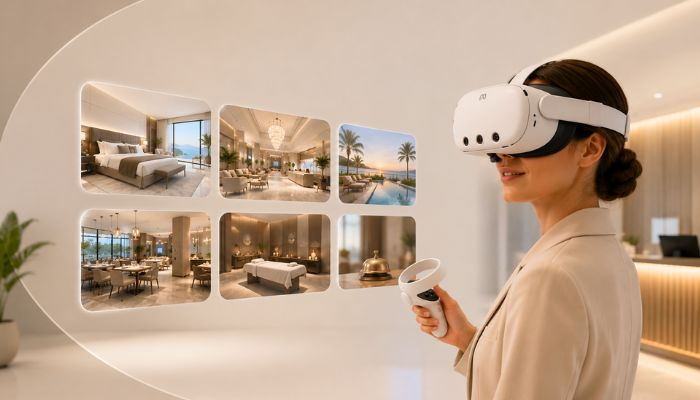
TL;DR: VR App Development for Hospitality Industry. Learn about costs, features, ROI, and how US brands use this technology in 2026.
Hospitality has always sold one thing — a feeling. The feeling of stepping into a hotel lobby that smells of fresh jasmine, of opening a balcony door to an ocean you can hear before you see, of being shown to a corner table where the city lights below look closer than they should. The challenge has always been selling that feeling before the guest arrives. For decades, the industry relied on photographs and 360-degree tours. In 2026, virtual reality has changed what is possible — and the hotels, restaurants, and resorts investing in VR apps are seeing measurable returns on bookings, training efficiency, and guest satisfaction.
This guide walks through what VR app development for hospitality actually means in 2026, where the strongest business cases sit, what it costs, how the technology works, and how to commission a VR project for your property without burning budget on novelty. Written for hotel owners, restaurant operators, brand directors, and marketing leads weighing up whether VR is finally worth the investment for their business.
What is VR app development for hospitality?
VR app development for hospitality is the design and engineering of virtual reality experiences specifically built for hotels, resorts, restaurants, cruise lines, event venues, and travel brands. These apps run on consumer VR headsets such as the Meta Quest 3, on tethered devices like the Valve Index, and increasingly on the web through WebVR so that guests can experience them on standard browsers without any specialised hardware.
Unlike a generic 360-degree video tour, a true VR app is interactive. The user can walk through the lobby, sit down at the rooftop bar, look up at the chandelier, open the closet in their suite, step onto the balcony, and feel — through scale, sound, and spatial presence — what it would actually be like to stay there. That depth of presence is precisely what flat images and traditional video cannot deliver, and it is the reason hospitality brands have started treating VR as a serious sales and operations tool rather than a marketing experiment.
Why the hospitality industry needs VR apps in 2026
Three forces are pushing hospitality groups toward VR adoption faster in 2026 than at any point in the past five years.
The booking trust gap
Travellers today book through screens, often weeks or months in advance, frequently to destinations they have never visited. The gap between what a property promises on its website and what guests actually find on arrival is the single largest source of negative reviews and refund requests across the hospitality sector. VR closes that gap. A guest who has already walked through their suite in VR before paying is dramatically less likely to feel disappointed at check-in — and dramatically more likely to commit to a longer stay or a higher room category.
Differentiation in a commoditised market
Online travel agencies, comparison sites, and aggregators have flattened the hospitality market into rows of nearly identical listings. Properties that look the same in thumbnail photos compete almost entirely on price. A VR experience that lets potential guests genuinely feel the difference between a generic four-star hotel and your specific property breaks that pattern. It restores the premium that distinctive properties deserve.
Staff training challenges
Hospitality has some of the highest staff turnover of any industry. Training new front-of-house, housekeeping, and kitchen staff is a constant operational burden — and traditional training methods (manuals, videos, shadowing) are slow and inconsistent. VR training apps let new staff practice complex procedures, learn property layouts, and handle simulated guest interactions in a safe virtual environment. The training time drops, the consistency improves, and the cost per trained employee falls meaningfully.
Top VR app use cases for hospitality in 2026
Hospitality is not one use case — it is several distinct opportunities, each suited to a different type of property and a different business goal. The eight most-deployed VR app categories in 2026 are below.
1. Virtual hotel and resort tours
The most common entry point. A VR app that lets prospective guests explore the property — lobby, public spaces, sample rooms, pools, restaurants — before booking. Used heavily by luxury resorts, destination hotels, and properties trying to attract international guests who cannot easily visit in person.
2. Virtual room previews
Allows guests to preview the specific room category they are booking — Junior Suite, Ocean View, Penthouse — instead of relying on generic photography. This converts more upgrade purchases because guests can actually see what the upgrade buys them.
3. Restaurant and dining experience previews
Fine-dining and signature restaurants use VR to showcase their atmosphere, plating, and chef craftsmanship. Useful for restaurants attached to hotels (to drive in-house dining revenue) and for standalone destination restaurants taking advance reservations from international travellers.
4. Event and wedding venue previews
Wedding couples, corporate event planners, and conference organisers commit large budgets months in advance — often without visiting the venue first. A VR walkthrough of how the ballroom looks set up for 200 guests, how the rooftop space configures for a cocktail reception, or how the conference suite handles a 500-person keynote dramatically reduces decision friction.
5. Staff training simulations
VR training apps for front-desk, housekeeping, food and beverage, and back-of-house staff. Trainees practise check-in scenarios, room-setup workflows, fire-safety procedures, and guest-complaint handling in immersive simulations that build confidence faster than traditional methods.
6. Spa and wellness experience previews
Wellness retreats, destination spas, and resort spa programmes use VR to convey atmosphere, treatment rooms, and the meditative environment in ways photographs cannot. Particularly effective for high-end wellness brands selling multi-day retreat packages.
7. Pre-arrival concierge VR apps
Sent to guests after booking but before arrival, these apps let guests explore their suite, browse the local area, and even pre-select dining reservations or activities in VR. Improves the pre-arrival anticipation and upsells additional services.
8. In-room VR entertainment
Some forward-thinking hotels are providing VR headsets in rooms or suites as part of the guest experience — letting guests take VR tours of local attractions, virtual museum visits, or immersive entertainment as part of the stay. Still early but adoption is growing in luxury segments.
Five business outcomes hospitality operators should expect
A well-built VR app is not a marketing gimmick. It produces measurable operational and revenue impact across multiple parts of the business.
Higher direct bookings
Guests who experience a property in VR before booking are more likely to book directly through the property’s own website rather than through aggregators. Direct bookings carry no commission, which means every direct booking driven by VR effectively pays the property the commission it would otherwise lose to third-party platforms.
More upsell conversions
Room upgrades, suite upgrades, package upgrades — all sell better when the guest can see what they are buying. A guest who has walked through the Junior Suite in VR has stronger emotional commitment to upgrading than a guest looking at a static photograph with a price tag.
Reduced check-in friction
Guests who have already explored the property in VR arrive with realistic expectations and basic spatial familiarity. They know where the restaurants are, how to find the spa, and what the lobby looks like. The check-in conversation becomes shorter, the front-desk workload drops, and guest satisfaction scores improve from the very first interaction.
Faster staff training
Properties using VR for staff training consistently report shorter onboarding cycles and stronger procedural consistency. The cost saving is meaningful, but the operational benefit — fewer mistakes during peak periods — is even more valuable for high-volume operations.
Premium pricing tolerance
Properties offering VR experiences as part of their booking journey are perceived as more sophisticated and more confident in what they are selling. That perception translates into measurably higher willingness to pay at the booking stage — particularly for distinctive boutique properties, destination resorts, and high-end urban hotels.
| An honest reality check
VR for hospitality is not a guaranteed win. A poorly built VR app — with low-resolution scans, slow performance, or unrealistic environments — damages brand perception more than helping it. Treat VR as a serious technology investment, not a cheap add-on. The properties seeing real returns are the ones that commissioned high-fidelity work from experienced developers. |
How VR app development for hospitality actually works
Behind every polished hospitality VR app sits a multi-stage technical pipeline. Understanding roughly how each layer works will help you brief the project intelligently and avoid being oversold on features that do not move the needle.
Capture and 3D modelling
The first step is creating the digital twin of the property. This is done either through high-resolution photogrammetry (where photographs are stitched into 3D models), LiDAR scanning for highly accurate spatial capture, or full 3D modelling from architectural drawings. Most premium hospitality VR projects combine all three approaches — scans for accuracy of existing spaces, modelling for areas still under construction or being renovated.
Materials, lighting, and atmosphere
This is where most hospitality VR projects either succeed or fail. The walls, floors, fabrics, water surfaces, and lighting must be rendered with cinematic accuracy. Hospitality is fundamentally about atmosphere — and atmosphere in VR is produced by physically-based materials, accurate light simulation, and considered art direction. Studios that skimp on this stage produce VR experiences that feel like video games rather than premium hotels.
The real-time engine
Most modern hospitality VR apps are built in Unreal Engine 5 or Unity. Unreal Engine has become the preferred choice for high-fidelity hospitality experiences because of its photoreal rendering capabilities. Unity remains strong for cross-platform deployment and lighter VR experiences. The choice depends on the visual bar you are aiming for and the devices you intend to support.
Interaction and navigation design
How the guest moves through the VR experience matters as much as what they see. Smooth teleportation, intuitive controls, and clear navigation paths prevent motion sickness and keep the user engaged. Poorly designed interaction is one of the most common reasons hospitality VR apps fail — visitors quit the experience within thirty seconds because the controls confused them.
Deployment and distribution
Hospitality VR apps need to reach guests through multiple channels. WebVR builds run in any browser without download. Native apps deploy through the Meta Quest store or Apple Vision Pro store. Trade-show builds run on dedicated kiosks. The same underlying 3D environment usually powers all three deployments, with each build optimised for its specific platform.
How to commission VR app development without overspending
Most VR hospitality projects that disappoint do so for reasons that have nothing to do with the technology. They fail because the property briefed the project as a one-off marketing experiment rather than as a serious operational asset. Five principles separate successful builds from expensive failures.
- Start with one strong use case, not a feature list. Decide whether the priority is bookings (virtual tours), upsells (room previews), training (staff simulations), or events (venue previews). Build for one use case well before expanding. Properties trying to do everything in version one tend to deliver something mediocre at all of them.
- Choose a partner with both VR and animation expertise. Studios offering only one capability deliver narrower outcomes. The strongest hospitality VR projects combine VR engineering with cinematic animation, photoreal rendering, and even augmented reality extensions. Ink n Algorithm is one example of a US-based studio that handles VR app development, augmented reality experiences, and 3D animation in-house — meaning a single team can build the full hospitality VR experience without coordination overhead.
- Plan distribution before development begins. Decide where guests will encounter the VR app — your website, the booking flow, headsets at your sales centre, trade show kiosks, or in-room entertainment. Each distribution channel shapes the build. Decide before, not after.
- Treat the VR project as a long-term asset, not a campaign. Properties get the best return from VR apps that remain in active use for two to four years, regularly updated with new content. Projects briefed as one-off launches typically fail to recover their investment.
- Invest in the highest visual fidelity you can afford. A budget VR app that looks like a video game damages premium positioning. A premium VR app that genuinely captures the atmosphere of your property elevates perceived value across every touchpoint. The fidelity gap is the difference between a project that converts and a project that exists.
Trends shaping hospitality VR in 2026 and beyond
AI-powered virtual concierges
VR apps are increasingly integrating AI-powered virtual concierge characters that guide guests through the experience, answer questions in real time, and recommend room categories or dining options based on the guest’s preferences.
WebVR maturity
Browser-based VR experiences have improved dramatically in 2026. Guests no longer need a headset to experience a hospitality VR app — they can explore on any phone or laptop, with optional headset support for the full immersive version. This dramatically expands the reachable audience.
Mixed reality previews
Apple Vision Pro, Meta Quest 3, and similar mixed-reality devices are making it possible to overlay virtual property elements onto the guest’s real environment. A guest at home can stand in their living room and see the virtual hotel suite scaled to actual size around them.
VR for accessibility marketing
Properties are using VR to demonstrate accessibility features to guests with mobility, visual, or sensory considerations — a category traditional marketing has historically underserved. This is becoming both a brand differentiator and a moral imperative.
| Ready to commission a VR app for your hospitality property?
Ink n Algorithm builds VR applications, AR experiences, animations, and supporting apps for hospitality brands across the United States and internationally. Tell us about your property at https://inknalgorithm.com/contacts/ and a senior team member will respond within one business day. You can also explore our portfolio of immersive projects to see recent work in detail. |
Frequently asked questions
How long does it take to build a VR app for a hospitality property?
Timelines range from eight weeks for a simple single-suite virtual room preview to six months for a full multi-property VR platform with training modules and integrations. A typical mid-tier hospitality VR project — covering the lobby, restaurants, and several room categories — takes around twelve to sixteen weeks from kick-off to launch.
Do guests need a VR headset to use a hospitality VR app?
Not necessarily. Most modern hospitality VR apps offer multiple access modes — a fully immersive headset version for guests who own VR devices, a desktop and mobile web version for guests without headsets, and sales-centre or trade-show kiosk versions for in-person presentations. The same underlying 3D environment powers all three deployments.
Can VR apps integrate with hotel booking systems and CRM platforms?
Yes. Modern hospitality VR apps can integrate with property management systems, booking engines, and CRM platforms. When a guest views a specific suite in VR and clicks to book, the booking flows directly into the existing booking system. The data captured — which suites guests viewed, how long they spent in each, what they returned to — also feeds back into marketing systems for follow-up.
What hospitality properties benefit most from VR apps?
Four categories see the strongest returns. First, luxury and destination properties where the visual experience justifies premium pricing. Second, properties attracting international guests who cannot easily visit beforehand. Third, event and wedding venues where major spending decisions happen months in advance. Fourth, large hospitality groups where staff training efficiency creates significant operational savings.
How is hospitality VR different from regular 360-degree photo tours?
A 360-degree photo tour shows fixed panoramic photographs the user can pan around. A VR app is fully interactive — the user walks through the space, looks up at the ceiling, opens the closet, steps onto the balcony, hears the spatial audio. The depth of immersion and the sense of being physically present in the property is fundamentally different, which is why VR drives stronger emotional commitment from prospective guests.
Can VR apps be updated after launch?
Yes, and they should be. Properties that update their VR app with new content — renovated spaces, new menus, seasonal themes, new room categories — get significantly more long-term value than properties that treat the VR app as a one-time deliverable. Plan a maintenance budget alongside the initial development cost from the outset.
Ready to get started? Contact Ink & Algorithm to discuss your project—we’ll help you create results that drive sales.
FAQ
How much does vr app development for hospitality cost?
The cost varies based on project scope and complexity. Contact us for a custom quote tailored to your specific needs.
How long does vr app development for hospitality take?
Typical projects take 2-8 weeks depending on scope. We provide detailed timelines during consultation.
Do you work with US brands?
Yes, we work with US brands across all 50 states. Our team understands the US market and delivers solutions that drive results.