

TL;DR: Web-Based 3D Configurator for Jewelry & Luxury Goods in USA 2026. Learn about costs, features, ROI, and how US brands use this technology in 2026.
There is a moment every jewelry brand owner knows well. A customer walks in — or more often, lands on your product page — with a clear vision in their head. They know the metal they want. They have a gem in mind. They picture the engraving, the setting, the size. And then they hit a wall: a static product photo, a dropdown menu, and a generic description that tells them nothing about what their specific combination will actually look like.
That gap — between what a customer imagines and what they can see — is where sales are lost every single day in the US luxury and jewelry market. A web-based 3D configurator closes that gap completely. It hands the customer the tools to design their dream piece in real time, in photorealistic 3D, right inside your website — and then lets them buy it in the same session.
In 2026, this is not an experimental feature. It is fast becoming the competitive standard for premium jewelry brands, luxury watch retailers, bespoke fashion houses, and high-end goods sellers across the United States. This guide covers everything your business needs to know: what a jewelry 3D configurator actually does, why it works so powerfully for luxury products, which features matter most, and what the development process looks like from brief to launch.
At Ink & Algorithm, we build web-based 3D configurators for luxury and jewelry brands across the United States — combining photorealistic 3D rendering, real-time customization logic, and seamless e-commerce integration. If you are considering a configurator for your brand, this guide will give you a clear and honest picture of what is involved.
What Is a Web-Based 3D Jewelry Configurator, and Why Is It Different?
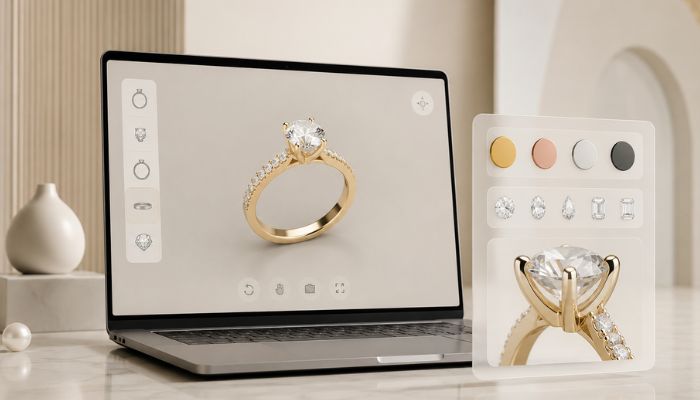
A web-based 3D jewelry customizer is an interactive tool built into your website that allows customers to customize a piece of jewelry — or any luxury product — in three-dimensional real time. They choose the metal type, the gemstone, the setting style, the band width, the finish, and the engraving. As each selection is made, the 3D model updates instantly to reflect their exact configuration. The result is a photorealistic preview of the exact piece they are designing — before a single order is placed.
This is fundamentally different from a product gallery with variant photos. A photo gallery gives customers a handful of pre-photographed combinations. A 3D coconfiguration toolives them infinite combinations — and renders each one in real time without pre-photographing anything. The customer is not choosing from your options. They are creating their piece.
For jewelry and luxury goods, this distinction is not cosmetic — it is commercially significant. Luxury purchases are emotional decisions. Customers are spending meaningful money on something that carries personal significance. The more ownership they feel over the design process, the more attached they become to the outcome. A3D builderator transforms a browsing session into a creative experience — and creative experiences convert.
How It Works Under the Hood
The technical foundation of a jewelry 3product builderor involves real-time 3D rendering in the browser using WebGL. Each product component — the band, the setting, the stones, the engravings — is built as a high-fidelity 3D model with accurate material properties.design toolrator engine applies the customer’s selections to the model in real time, adjusting surface materials, reflectivity, gem placement, and geometry to reflect exactly what they have chosen.
Pricing logic runs in parallel — as each configuration change is made, the price updates to reflect the material costs, labor, and gem pricing associated with that specific combination. The customer sees both their design and its price simultaneously, enabling genuinely informed decisions. At the end of the session, they can save their design, share it, request a quote, or proceed directly to checkout.
| “A jewelry customer who has spent 20 minutes designing their own ring is not browsing — they are invested. The conversion rate of a deeply engaged configurator user is categorically different from a passive browser.” |
| 📎 Related Reading: Explore Our 3D Web Configurator Services |
The 6 Features Every Jewelry 3D Configurator Must Have in 2026
Not config toolators are equal — and in the luxury market, the gap between a polished, high-quality experience and a rough prototype can mean the difference between reinforcing your brand’s premium positioning and undermining it. These are the features that separate exceptional jewelcustomizertors from mediocre ones.
Photorealistic Real-Time 3D Rendering
The visual quality of the 3D rendering is the single most important factor in a luxuryconfiguration toolr. For jewelry, this means accurate metal reflectivity — gold that catches light the way gold does, platinum that has its characteristic cool shimmer, silver that behaves differently from white gold even though they look similar in photography. It means gems with realistic refraction, fire, and brilliance. It means prong settings that look precise and settings that reflect the correct level of craftsmanship for your brand. If the rendering looks digital or plasti3D buildergurator will actively damage customer confidence rather than building it. Quality here is non-negotiable.
Complete Metal and Gemstone Library
Customers should be able to select from every metal option your brand offers — yellow gold in various karats, white gold, rose gold, platinum, sterling silver — and see the exact visual difference between them in real time on the same model. The gemstone library should cover all shapes (round brilliant, princess, oval, cushion, emerald, pear, marquise), all colors, and should accurately represent the size relationship between stone sizes and band proportions. Carat weight, cut quality, and color grade should all be surfaceable in the interface.
Engraving and Personalization Simulation
For jewelry, personalization is often the emotional core of the purchase. A ring with an engraved date, a pendant with initials, a bracelet with a message — these are the pieces that carry lifelong significance. A gproduct builderrator allows customers to type their engraving text, choose a font, preview it on the actual model surface, and see exactly how it will look. This feature alone dramatically increases the emotional attachment customers feel to the design they are creating — and dramatically increases conversion.
AR Try-On Integration for Mobile
In 2026, a design tooligurator that does not include a mobile AR try-on feature is missing one of the most powerful closing tools available. AR try-on uses the phone’s camera to overlay the configured jewelry on the customer’s actual hand, wrist, or face in real time. For rings, this means seeing the exact band width, stone size, and finish on their own finger — at the correct scale. Combined with our augmented reality development services, this transforconfig toolgurator from a design tool into a virtual fitting experience.
Live Pricing and Instant Quote Generation
Luxury customers expect transparencustomizerurator that shows a design but hides the price until checkout creates friction and suspicion. Live pricing — updating in real time as each configuration choice is made — builds trust and allows customers to explore different options within their budget without having to enquire separately. Quote generation should be instant and shareable, allowing customers to save their design with pricing for consideration, or to share it with a partner or gift-giver before purchasing.
Direct E-Commerce Integration
configuration toolator must sit seamlessly inside your purchase journey. Customers should move from design to cart without any friction — no emailing a quote, no waiting for a callback, no re-entering their selections. Direct integration with your e-commerce platform (Shopify, WooCommerce, or a custom web development solution) ensures that the configured product specification flows directly to your production team with every order, exactly as the customer designed it.
| 📎 Related Reading: View Our Portfolio — Configurator Projects We Have Built |
Which Luxury Segments Are Using 3D Configurators in the USA Right Now?
Jewelry is the most natural applicat3D buildernfigurator technology, but the luxury market extends far beyond rings and pendants. In 2026, US luxury brands across multiple categories are using web-bproduct builderigurators to give customers creative ownership of high-value purchases.
Fine Jewelry and Engagement Rings
This is the most mature and most powerful application. Engagdesign toolonfigurators in particular have transformed the US bridal jewelry market. Couples who previously spent weeks visiting jewelry stores can now design their ring together on a Sunday afternoon, adjust every detail until it feels right, and order with complete confidence. Brands that offeconfig toolnfigurator experiences are capturing customers who would previously have defaulted to larger retail chains simply because the in-store experience felt more certain.
Luxury Watches
Premium watch brands acustomizerfigurators to allow buyers to mix and match dial colors, case materials, strap options, and clasp finishes. Theconfiguration toolgurator market is growing rapidly in the US in 2026, with brands using it both for direct consumer sales and for showing wholesale buyers the full range of available combinations without maintaining physical inventory of every variant.
Bespoke Fashion and Accessories
Luxury fashion houses 3D builder configurator technology to handbags, shoes, belts, and accessories — allowing customers to select leather grades, hardware finishes, monogram placement, and color combinations. For brands that have built their reputation on personalizaproduct builderonfigurator is the natural digital extension of the bespoke service they already offer in person.
High-End Automotive and Interior Design
While not traditionally categorized as jewelry, the luxury automotive sector uses 3D configurator technology in ways directly analogous to jewelry — allowing buyers to see exact paint and interior combinations in photorealistic real time before placing orders that can take months to fulfill. The same technology is increasingly applied to luxury interior design, where clients configure furniture finishes, fabric combinations, and lighting fixtures for bespoke home projects.
The Business Case: What ROI Do Jewelry 3D Configurators Deliver?
For luxury brands, the invesdesign toolD configurator is significant — but so are the returns. Here is what US jewelry and luxury brands are reporting in practice.
Conversion Rate Transformation
The single most striking commercial impacconfig tool configurators is the conversion rate for users who engage with them versus those who browse product pages passively. A customer who has spent time designing their own ring has already made the most important psychological commitment — they have chosen the piece. They are no longer asking whether to buy. They are deciding when. This mental shift produces conversion rates that are dramatically higher than passive browsing, consistently reported in the 40–80% higher range by US jewelry brands that hacustomizerconfigurators.
Dramatic Return Rate Reduction
Custom-designed jewelry returns are rare for an obvious reason: the customer designed it. They chose every element. The likelihood that the piece they receive does not match their expectations is close to zero when they were the ones who set those expectations. US brands wiconfiguration toolnfigurators report return rates for configured pieces that are a fraction of their standard product return rates — a particularly significant saving in a category where returns are logistically complex and commercially painful.
Higher Average Order Values
There is consistent evidence across the US luxury market that customers who3D builder 3D configurators spend more than those who buy from standard product listings. The mechanism is straightforward: when a customer is actively designing, they explore more options. They consider the premium gem. They upgrade the metal. They add the engraving that makes it feel complete. Each micro-decision moves the order value slightly higher, and these incremental upgrades add up significantly across a customer base.
Elimination of Consultation Overhead
Many jewelry brands currently operate with a significant portion of their staff time devoted to consultation — answering questions about combinations, pricing different options, managing custom order requests.product buildert configurator handles all of this automatically. Customers get immediate answers to every question they would have asked by phone or email. For small and mid-sized US jewelry brands, this is not a marginal efficiency gain — it is a fundamental change in how their business operates.
| “The best jewelry configurator does not replace your jewelers or your craftspeople. It replaces the consultation overhead and the uncertainty that prevents customers from committing to a purchase.” |
| 📎 Related Reading: How AR Development Is Transforming US Retail — Full Guide |
How the 3D Jewelry Configurator Development Process Works
Understanding the development process helps jewelry brands plan effectively and set realistic expectations. Here is hodesign toolonal configurator project moves from initial brief to a live, revenue-generating tool on your website.
Step 1: Product Catalog Audit and Configuration Mapping
This is typically the most time-intensive phase — and the one that most determines the quality of the final experience. Our 3D animation and modeling team creates highly detailed 3D models of every product component: band profiles in each width, stone models for every shape and size in your library, setting styles, and engraving surface geometry. Each model is texture-mapped with physically accurate material properties for every metal and gem type. The result is a 3D asset library that can render any combination in photorealistic quality, in real time.
Step 3: Configurator Interface and Logic Build
With the 3D assets created, our development teaconfiguration tool configurator interface and its underlying logic. This includes the real-time rendering engine, the selection UI (metal pickers, gem selectors, engraving inputs, size selectors), the pricing calculation logic, the AR try-on integration, and the sharing and saving functionality. The interface is designed to match your brand’s visual identity — not a generic template that undermines your premium positioning.
Step 4: E-Commerce Platform Integration
The configurator is then integrated with your existing e-commerce infrastructure. Whether your brand uses Shopify, WooCommerce, Magento, or a custom-built platform (which our web development team can also build or support), the integration ensures that a completed configuration flows directly into your order management system with every specification preserved. Payment processing, tax calculation, inventory checks, and order confirmation all connect seamlessly through this integration layer.
Step 5: Quality Assurance, Launch, and Ongoing Support
Beproduct builder the configurator undergoes rigorous testing across devices — desktop, tablet, and mobile — browsers, and operating systems. For luxury brands, the quality bar for this testing phase is exceptionally high: a single glitch in the rendering or a pricing error in the quote system can undermine customer trust in a way that takes significant time to recover. Post-launch, we provide ongoing support for product additions, pricing updates, and feature enhancements as your catalog evolves.
What to Look for When Choosing a 3D Jewelry Configurator Development Partner
The configurator you build will represent your brand — often as the first serious interaction a customer has with your product. Choosing the right development partner is one of the highest-stakes decisions in a luxury brand’s digital strategy. Here is what separates the partners worth working with from those who are not.
- Luxury category expertise: A parconfig tool built configurators for gaming, manufacturing, or automotive but not for jewelry will not understand the visual standards required. Gold should look like gold. Diamonds should look like diamonds. Confirm the partner has experience specifically with fine goods and precious materials.
- Photorealistic rendering capability: Ask to interact wicustomizersting configurator work, not just screenshots. The difference between a rendering that builds confidence and one that looks digital is immediately obvious when you interact with it. If they cannot show you a live demo that looks genuinely beautiful, look elsewhere.
- End-to-end delivery: The best partners handconfiguration toolng, configurator development, AR integration, and e-commerce connectivity under one roof. Our full service offering covers every stage — so your brand never gets handed between vendors for different pieces.
- Mobile-first development: In 2026, more than 60% of luxury e-commerce traffic3D buildermobile. A configurator that works beautifully on desktop but struggles on a smartphone is not fit for purpose. Mobile performance — loading speed, rendering quality, touch interaction — should be a primary deliverable, not an afterthought.
- A portfolio that proves it: Review the agency’s actual deployed work. Our portfolioCost varies significantly based on the complexity of your product catalog, the number of 3D assets required, the sophistication of the configuration logic, and the e-commerce integrations needed. Here is an honest framework.
Entry-Level Jewelry Configurators ($20,000–$60,000)
An entry-level configurator covers a focused product range — typically a single category such as engagement rings or solitaire pendants — with a defined set of metal and gemstone options, real-time rendering, and basic e-commerce integration. This is an appropriate starting point for brands making their first configurator investment, allowing them to prove the ROI model before expanding to the full catalog.
Mid-Range Configurators ($60,000–$150,000)
The mid-range covers full-catalog deployment for a jewelry brand — all product categories, complete metal and gemstone libraries, AR try-on integration, engraving simulation, live pricing, and full Shopify or WooCommerce integration. This is the investment level that delivers the complete experience described throughout this guide, and where the ROI metrics discussed earlier begin to apply at scale.
Premium Luxury Configurators ($150,000+)
Premium configurators are built for brands where every visual detail is brand-defining — ultra-high-fidelity rendering pipelines, AI-powered recommendations, multi-currency and multi-language support, custom checkout experiences, and bespoke CRM integrations. For established luxury brands whose configurator will serve as their primary online sales tool, this level of investment is appropriate and well-documented in its returns.
Frequently Asked Questions About Jewelry 3D Configurators
How long does it take to build a jewelry 3D configurator?
A focused entry-level configurator covering a single product category typically takes 10–16 weeks from kickoff to launch. This timeline is primarily driven by the 3D asset creation phase — building photorealistic models for every metal, gem, and setting combination is the most time-intensive part of the work. A full-catalog mid-range configurator typically takes 4–7 months. Timeline can be compressed by prioritizing the highest-revenue product categories for the initial launch and phasing in the remainder.
Can the configurator integrate with my existing Shopify or WooCommerce store?
Yes — integration with Shopify, WooCommerce, and most major e-commerce platforms is standard in our web configurator development work. The integration ensures that every configuration made by a customer is passed to your order management system with complete specifications, so your production team has everything they need to fulfill the order exactly as designed. Payment processing, inventory management, and order confirmation all function through your existing platform without requiring a separate system.
Will the configurator work on mobile devices?
Mobile compatibility is built into every configurator we develop — not added as an afterthought. WebGL rendering on modern iOS and Android devices is capable of delivering beautiful, responsive 3D experiences. The AR try-on feature uses the device’s native camera and ARKit or ARCore frameworks, meaning it works natively within the browser on most current smartphones without requiring an app download.
Can I update the catalog myself after the configurator launches?
Yes. Well-architected configurators include a content management layer that allows your team to add new products, update pricing, introduce new metal or gemstone options, and retire discontinued items without requiring developer involvement for routine catalog changes. Major structural additions — new product categories, new configuration logic, new features — will require development time, but day-to-day catalog management should be fully within your team’s control.
Final Thoughts: The Jewelry 3D Configurator Is Now a Baseline Expectation
There was a time, not long ago, when a beautifully designed jewelry website with high-quality photography was the gold standard for US luxury brands online. That standard has moved. Customers who have experienced a configurator — who have designed their own piece, held it in their minds in three dimensions, and felt the ownership that comes from creative authorship — will not be satisfied by a product gallery. They will find a brand that gives them that experience.
The good news for US jewelry and luxury brands is that the configurator market is not yet saturated. There is still a real and meaningful first-mover advantage in most luxury jewelry categories. Brands that invest now — build genuinely high-quality configurator experiences — will establish a position that is difficult and expensive for latecomers to replicate.
The technology is ready. The customer appetite is demonstrated. The commercial case is documented. What remains is execution: building something that genuinely reflects the quality of your brand rather than something that looks impressive in a demo but disappoints in daily use.
Ink & Algorithm builds web-based 3D configurators for jewelry and luxury brands that take pride in what they sell. From the first product audit to the final pixel of the rendered gold band, we build experiences that make customers feel what your brand is about — before they ever hold the piece in their hands. If you are ready to explore what a configurator could do for your brand, let’s talk.
FAQ
How much does web-based 3d configurator for jewelry cost?
The cost varies based on project scope and complexity. Contact us for a custom quote tailored to your specific needs.
How long does web-based 3d configurator for jewelry take?
Typical projects take 2-8 weeks depending on scope. We provide detailed timelines during consultation.
Do you work with US brands?
Yes, we work with US brands across all 50 states. Our team understands the US market and delivers solutions that drive results.