
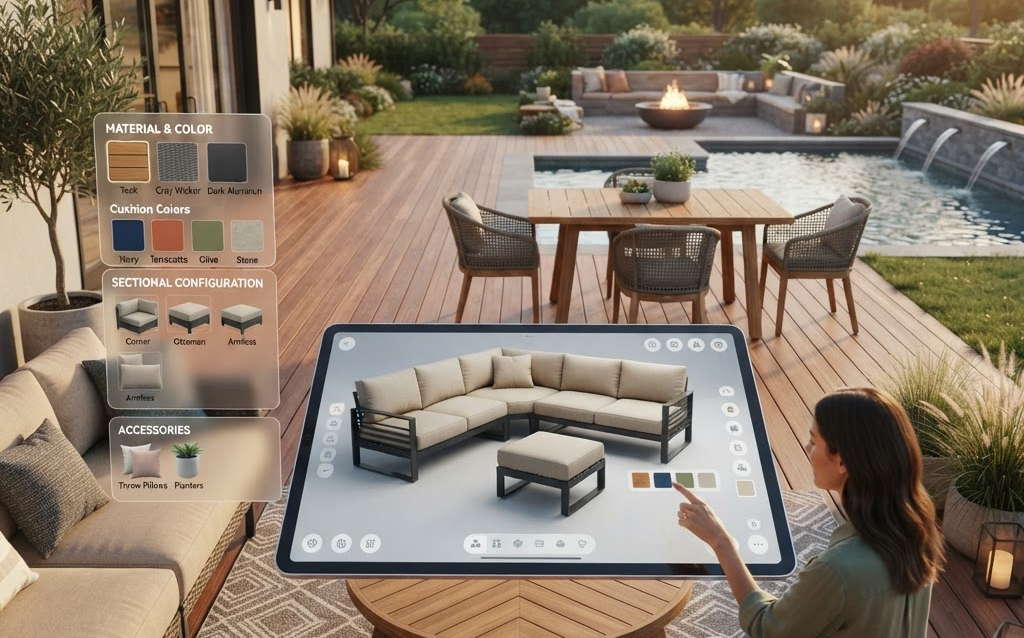
TL;DR: Outdoor furniture 3D configurators let customers design custom patio sets—choosing frame colors, cushion fabrics, table sizes, and configurations—then place the result in their actual backyard using AR. US outdoor furniture brands using configurators report 35% higher conversion, 25% larger orders, and 30% fewer returns. Here’s how the technology works in 2026.
Outdoor furniture is one of the hardest e-commerce categories. Customers can’t tell from a photo whether a patio set fits their deck, whether the cushions match their outdoor aesthetic, or whether the frame color works with their home’s exterior. The result: high returns, small orders, and hesitant buyers.
A 3D configurator with AR placement changes this. Customers design their perfect patio set in 3D, see it in their actual backyard at real scale, and buy with complete confidence.
What an Outdoor Furniture Configurator Does
- Frame color selection — black, bronze, white, sand, with real-time material rendering on all metal and wicker components
- Cushion fabric selection — 50+ Sunbrella fabric options with accurate texture and color rendering
- Table customization — size, shape (round, square, rectangular), top material (glass, tile, wood-look)
- Configuration options — 3-piece bistro set, 5-piece dining set, 7-piece sectional, modular configurations
- AR backyard placement — place the configured set in the customer’s actual outdoor space at real scale
- 360° rotation and zoom — examine the furniture from every angle with material detail visible
- Live pricing — each option updates the total price instantly
Why Outdoor Furniture Brands Need 3D Configurators
The Scale Problem
Outdoor furniture is large and spatial. A 7-piece dining set looks manageable in a product photo but might overwhelm a small patio. AR placement solves this—customers see the furniture at real scale in their actual space before buying, reducing size-related returns by 30%.
The Fabric Problem
Outdoor cushions come in dozens of Sunbrella fabrics. A 2D color swatch can’t show texture, pattern, or how the fabric looks in sunlight. 3D rendering shows the actual fabric texture on the cushion at different lighting conditions—morning sun, afternoon shade, evening warmth.
The Configuration Problem
Modular outdoor furniture can be arranged in dozens of configurations—L-shaped, U-shaped, individual chairs, chaise lounges. A 3D configurator lets customers try different arrangements and see the result instantly, driving 25% larger orders as customers add pieces they discover through configuration.
The Technology: Outdoor Furniture in 3D
Material Rendering
Outdoor furniture has distinct materials that must render accurately:
- Wicker/rattan — complex woven texture requiring normal maps for depth
- Aluminum frame — smooth, with subtle metallic reflections
- Teak/wood — grain texture, warm color, weather-resistant finish
- Sunbrella fabric — woven texture, color accuracy, UV-resistant appearance
- Tempered glass — transparent, with subtle reflections and edge color
AR Backyard Placement
The customer scans their patio or deck, places the configured furniture set at real scale, and walks around it. The AR view shows how the furniture fits in the space, how it relates to existing elements (grill, plants, railings), and how it looks under the actual outdoor lighting.
Cost of an Outdoor Furniture Configurator
| Scope | Cost | Timeline |
|---|---|---|
| Single set configurator (WebAR) | $15,000–$50,000 | 4–8 weeks |
| Full catalog configurator + AR | $50,000–$150,000 | 8–16 weeks |
| 3D model per furniture piece | $500–$3,000 | 3–10 days |
FAQ: Outdoor Furniture Configurators
How much does an outdoor furniture configurator cost?
A single patio set configurator with AR placement costs $15,000–$50,000. A full catalog platform covering all collections with AR and e-commerce integration costs $50,000–$150,000. 3D models per furniture piece cost $500–$3,000 depending on complexity (wicker is more complex than metal frame).
Can customers see the furniture in their actual backyard?
Yes. AR backyard placement lets customers scan their outdoor space and place the configured furniture at real scale. They walk around it, check the fit, and see how it looks in their actual outdoor lighting—no guessing about whether it will fit or match.
Can the configurator handle modular configurations?
Yes. Modular outdoor furniture configurators let customers add, remove, and rearrange pieces in real time. Start with a 3-piece set, add a chaise lounge, add a side table—each addition updates the 3D view and price instantly. This modular flexibility drives 25% larger average orders.
Do Sunbrella fabric colors render accurately in 3D?
Yes. PBR (Physically Based Rendering) materials accurately reproduce Sunbrella fabric textures, colors, and weave patterns under different lighting conditions. The 3D view shows how the fabric looks in direct sunlight, shade, and evening—giving customers confidence in their fabric choice.
Can the configurator integrate with my outdoor furniture store?
Yes. The configurator embeds on product pages and integrates with Shopify, WooCommerce, and custom e-commerce platforms. Customers configure their set, see the total price, and add the complete configuration to cart—all selections included.
Getting Started
Start with your best-selling patio set collection. Build a configurator that covers frame colors, cushion fabrics, and AR placement. Measure the conversion lift—outdoor furniture configurators typically deliver 35% higher conversion and 25% larger orders.
Ready to build an outdoor furniture 3D configurator? Contact Ink & Algorithm to discuss your project—we’ll help you create an AR experience that sells patio sets with confidence.