
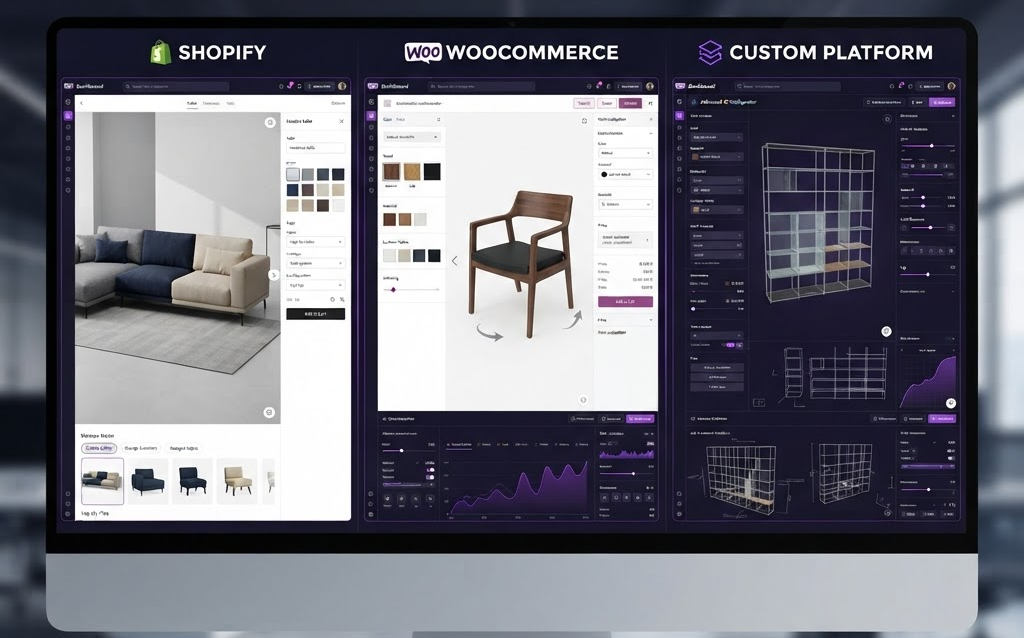
TL;DR: Choosing the right platform for your 3D product configurator determines performance, cost, and scalability. Shopify offers plug-and-play configurator apps ($50–$500/month), WooCommerce provides open-source flexibility with custom development, and custom-built solutions offer maximum control at $50,000–$250,000. Here’s how the three approaches compare on features, cost, performance, and e-commerce integration in 2026.
You’ve decided to build a 3D product configurator. The next decision is where it lives: on an existing e-commerce platform like Shopify or WooCommerce, or as a custom-built solution. Each path has different costs, capabilities, and trade-offs. This guide breaks down all three so you can choose the right platform for your configurator project in 2026.
Option 1: Shopify 3D Configurator Apps
Shopify is the most popular e-commerce platform for SMBs, and its app ecosystem includes several 3D configurator solutions. These apps embed a 3D viewer and customization interface directly into Shopify product pages.
How It Works
- Install a configurator app from the Shopify App Store
- Upload your 3D models (GLB format) and define customization options
- The app embeds a 3D viewer on your product pages
- Customer customizes the product and adds the configured version to cart
Pros and Cons
| Pros | Cons |
|---|---|
| Fastest deployment (days, not weeks) | Limited customization options |
| No development needed | Monthly subscription costs ($50–$500/month) |
| Native Shopify checkout integration | Limited to app’s rendering quality |
| Automatic updates and maintenance | App lock-in—switching is difficult |
| Mobile-optimized out of the box | Performance depends on app infrastructure |
Popular Shopify Configurator Apps in 2026
- Threekit — enterprise-grade 3D configurator with CPQ integration. $500+/month.
- Marxent 3D — furniture and home goods focused. Custom pricing.
- Product Personalizer — basic 2D/3D personalization. $15–$50/month.
- Angle 3D — Three.js-based 3D viewer with color/material swapping. $50–$200/month.
Option 2: WooCommerce 3D Configurator
WooCommerce (WordPress) is the open-source alternative. It offers more flexibility than Shopify but requires development resources to implement a 3D configurator.
How It Works
- Install a WordPress 3D viewer plugin or build a custom integration
- Embed Three.js or model-viewer on WooCommerce product pages
- Use WooCommerce’s product variations system for configuration options
- Custom development connects the 3D viewer to WooCommerce’s cart and checkout
Pros and Cons
| Pros | Cons |
|---|---|
| Open-source—no monthly fees for the platform | Requires development resources |
| Full control over UI and features | Maintenance is your responsibility |
| Unlimited customization possible | Performance optimization requires expertise |
| Integrates with any WordPress plugin | WordPress hosting considerations |
| Lower long-term cost at scale | Slower initial deployment (2–8 weeks) |
Option 3: Custom-Built 3D Configurator
A custom configurator is built from scratch using Three.js, React Three Fiber, or Unity WebGL, then integrated with any e-commerce platform (Shopify, WooCommerce, Magento, custom) via API.
How It Works
- Build a custom 3D viewer and configurator UI from scratch
- Integrate with your e-commerce platform’s product API
- Deploy on your own infrastructure (CDN, cloud GPU if needed)
- Full control over rendering quality, performance, and features
Pros and Cons
| Pros | Cons |
|---|---|
| Maximum performance and quality | Highest upfront cost ($50K–$250K+) |
| Unlimited features and customization | Requires ongoing development |
| No platform lock-in | Longer deployment (4–12 weeks) |
| Can use any 3D engine (Three.js, Unity, Unreal) | You handle hosting and maintenance |
| Full analytics and data ownership | Needs specialized 3D development team |
Cost Comparison: All Three Approaches
| Factor | Shopify App | WooCommerce | Custom Build |
|---|---|---|---|
| Setup cost | $0–$5,000 | $5,000–$30,000 | $50,000–$250,000 |
| Monthly cost | $50–$500/month | $20–$200 (hosting) | $100–$2,000 (infrastructure) |
| 3D model cost | $300–$2,000 each | $300–$2,000 each | $300–$5,000 each |
| Deployment time | 1–7 days | 2–8 weeks | 4–12 weeks |
| Rendering quality | Good (app-dependent) | Very good (customizable) | Excellent (your choice) |
| 3-year total cost (10 products) | $8,000–$25,000 | $15,000–$45,000 | $60,000–$280,000 |
Which Platform Should You Choose?
Choose Shopify If:
- You’re a small-to-medium business with a simple configurator need (color/material swapping)
- You want fast deployment with no development resources
- You’re already on Shopify and want to add 3D quickly
- Your budget is under $10,000 for setup
Choose WooCommerce If:
- You’re already on WordPress/WooCommerce
- You need more customization than Shopify apps offer
- You have development resources (in-house or agency)
- You want lower long-term costs at scale
Choose Custom Build If:
- You need premium rendering quality (Unreal Engine, ray tracing)
- You have complex configurator features (multi-zone, real-time pricing, AR)
- You’re on Magento, BigCommerce, or a custom platform
- You want full control over the experience and data
- Your budget is $50,000+
FAQ: 3D Configurator Platforms
Can I start with a Shopify app and upgrade to custom later?
Yes. Start with a Shopify configurator app to validate demand and measure conversion lift. Once you’ve proven ROI, invest in a custom solution with premium features. The 3D models you create for the Shopify app can be reused in a custom build—the models are the asset, not the platform.
How much does a 3D configurator cost on each platform?
Shopify: $50–$500/month for the app plus $300–$2,000 per 3D model. WooCommerce: $5,000–$30,000 development plus $20–$200/month hosting and $300–$2,000 per model. Custom: $50,000–$250,000 development plus $100–$2,000/month infrastructure and $300–$5,000 per model.
Which platform has the best 3D rendering quality?
Custom builds offer the best rendering quality because you can use Unreal Engine 5 with ray tracing or Three.js with custom shaders. Shopify and WooCommerce plugins typically use standard Three.js rendering, which is good but not film-grade. For most e-commerce use cases, standard rendering quality is sufficient.
Can a 3D configurator work with any e-commerce platform?
Yes. Custom-built configurators can integrate with any platform via API—Shopify, WooCommerce, Magento, BigCommerce, or custom. The configurator embeds on your product pages and passes the configuration to the cart. For Shopify and WooCommerce, native apps/plugins offer simpler integration.
What’s the total cost of ownership over 3 years?
For 10 products: Shopify apps cost $8,000–$25,000 over 3 years (mostly subscription fees). WooCommerce costs $15,000–$45,000 (development + hosting). Custom builds cost $60,000–$280,000 (development + infrastructure). The right choice depends on your revenue scale—higher revenue justifies the custom investment.
Getting Started
Start with the platform you’re already on. If you’re on Shopify, try a configurator app for $50/month and measure the conversion lift. If you’re on WooCommerce, invest in a custom Three.js integration. If you need premium quality or complex features, go custom. The 3D models are platform-agnostic—build them once, deploy anywhere.
Ready to build a 3D product configurator? Contact Ink & Algorithm to discuss your platform—we’ll help you choose and implement the right solution.