
⚡ TL;DR — Quick Answer
VR training for employees uses immersive simulated environments to teach skills, procedures, and behaviors that are difficult, expensive, or dangerous to practice in the real world. Enterprise organizations using VR training consistently report faster skill acquisition, higher knowledge retention, lower training costs, and reduced workplace incident rates compared to traditional instructor-led or e-learning programs. Ink n Algorithm builds custom enterprise VR training platforms for US corporations across manufacturing, healthcare, hospitality, retail, logistics, and financial services — integrated with your existing LMS and HRIS systems.
Planning a VR training program for your workforce?
See how Ink n Algorithm builds enterprise VR training for employees — from single-module pilots through company-wide deployment.
The way American companies train their employees is undergoing a quiet but measurable transformation. Across manufacturing floors, hospital operating theaters, hotel front desks, retail showrooms, and corporate boardrooms, a growing number of US enterprises are replacing or supplementing traditional training programs with immersive simulated environments. VR training for employees has crossed from novelty into mainstream corporate learning infrastructure — and the companies adopting it early are reporting outcomes that conventional e-learning and instructor-led programs consistently fail to match.
This guide covers everything US enterprise buyers need to understand about VR training for employees in 2026 — how the technology works, where it delivers the strongest outcomes, what the research says about retention and ROI, how to evaluate implementation options, and how Ink n Algorithm builds custom VR training platforms for organizations targeting real learning outcomes, not just impressive demonstrations. If you are in HR, L&D, operations, or technology leadership and evaluating whether VR training belongs in your organization’s learning stack, this is the guide you need.
What Is VR Training for Employees?
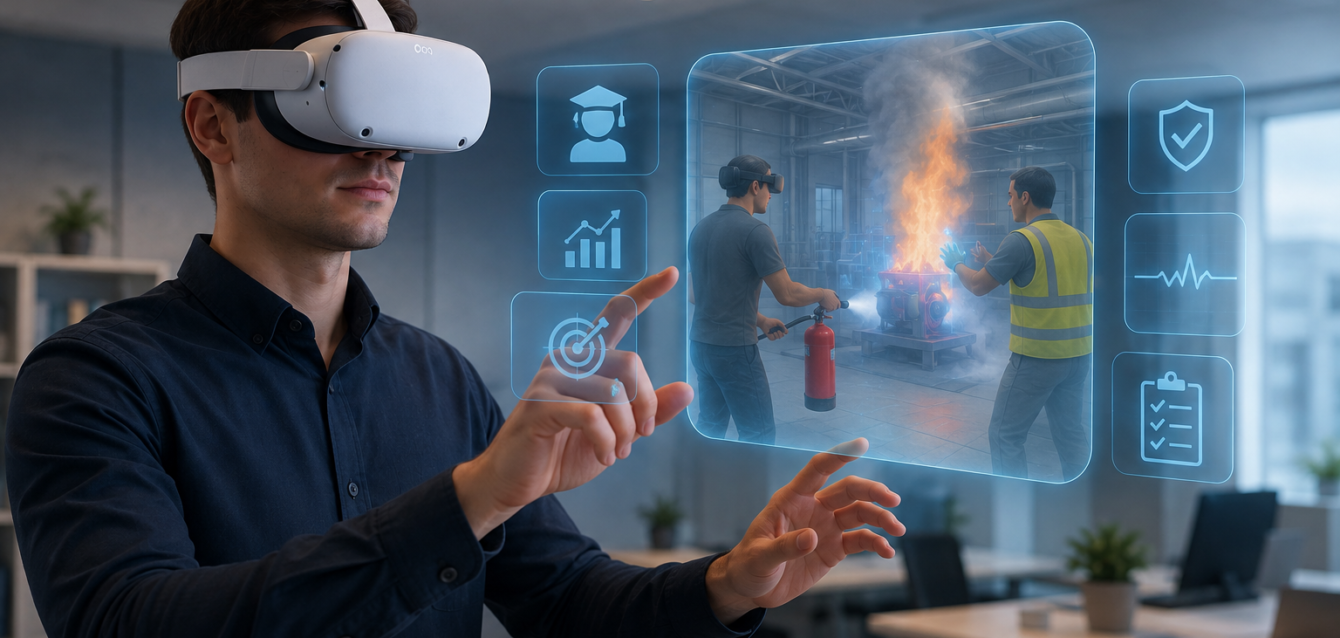
VR training for employees places workers inside fully simulated three-dimensional environments where they practice real job tasks, decision-making scenarios, emergency procedures, customer interactions, or equipment operation — using a VR headset that tracks head movement and hand controls. The learner experiences the training scenario as if physically present, triggering the same cognitive and emotional processes that real-world practice activates, without the cost, risk, or logistical complexity of real-world training settings.
Modern enterprise VR training platforms run on Meta Quest 3, Meta Quest Pro, HTC Vive XR Elite, Varjo XR-4, and PICO 4 Enterprise headsets — each offering different capability levels for different training contexts. Enterprise deployments range from standalone headsets requiring no PC to enterprise PC-tethered systems delivering maximum visual fidelity for high-stakes simulation. Applications are built using Unity, Unreal Engine 5, and specialized VR authoring tools like PTC Vuforia, Strivr, or custom platforms developed by VR studios. Ink n Algorithm builds on Unity and Unreal Engine 5, selecting the right platform based on training content complexity, organizational scale, and existing technology infrastructure.
Why VR Training Outperforms Traditional Corporate Learning
The evidence behind VR training for employees is not theoretical. Multiple research streams have documented consistent outcome advantages over traditional training approaches — and enterprise organizations are drawing on that evidence base when making technology investment decisions.
Retention Advantage
Learning science consistently shows that active, immersive practice produces dramatically higher knowledge retention than passive consumption of video, slides, or instructor lectures. In traditional corporate e-learning, retention rates measured at 30 days post-training frequently fall below 20%. Organizations implementing VR training for employees report substantially higher retention figures — because learners are doing, not watching. The procedural memory formed through VR practice is more durable than declarative knowledge acquired through passive learning, particularly for physical skills and emergency response protocols.
Psychological Safety for High-Stakes Practice
Many of the most valuable training scenarios are also the most difficult to create safely in real-world settings. A surgeon cannot practice a novel procedure on a live patient. A nuclear plant operator cannot simulate an emergency shutdown with the actual reactor. A hotel manager cannot practice active shooter response with real guests. VR training for employees creates psychologically safe environments where learners can make mistakes, recover, and repeat — without consequences. This freedom to fail productively accelerates skill development in ways that cautious real-world practice cannot achieve.
Consistency Across Large Workforces
Enterprise organizations with thousands of employees across multiple locations face a fundamental training consistency challenge — ensuring every worker receives the same quality of instruction regardless of location, time zone, trainer availability, or language. A VR training module delivers an identical experience to a new employee in Chicago and a concurrent learner in Dallas. This standardization is particularly valuable for compliance training, safety procedures, and customer service protocols where inconsistent application creates organizational risk. [INTERNAL LINK: Augmented Reality (AR) — /augmented-reality-ar/]
Measurable, Trackable Outcomes
Unlike classroom training that produces completion certificates as the primary evidence of learning, enterprise VR training platforms capture granular behavioral data throughout each simulation — response times, decision sequences, error rates, completion percentages, and performance trends across attempts. This data integrates with LMS platforms and HRIS systems, giving L&D teams the analytics needed to identify skill gaps, track individual progress, and demonstrate training ROI to organizational leadership.
Industries Leading Enterprise VR Training Adoption in 2026
Specific industries have moved VR training for employees from pilot programs into production infrastructure. Understanding which sectors deliver the strongest outcomes clarifies where immersive training investment is most commercially justified.
Manufacturing and Industrial Operations
Manufacturing represents the highest-volume VR training for employees deployment category in the US. Equipment operation training, safety procedure practice, quality inspection processes, and emergency response protocols are all natural fits for immersive simulation — because the alternative involves expensive machinery, potential injury risk, or production line interruption. Automotive manufacturers, aerospace suppliers, electronics manufacturers, and chemical producers have deployed enterprise VR training at scale, training thousands of workers across facilities.
Healthcare and Medical Training
Healthcare is among the most mature enterprise VR training markets. US hospitals, medical schools, and healthcare systems deploy immersive simulation for surgical skill development, nursing procedure training, emergency response, patient communication scenarios, and clinical decision-making. The zero-risk practice environment that VR provides is uniquely valuable in healthcare — where real-world practice errors carry patient safety consequences that simulation-based training eliminates.
Retail and Hospitality
Retail chains and hospitality groups use VR training for employees primarily for customer interaction scenarios, conflict resolution practice, upselling technique development, and loss prevention procedures. Large US retail employers can onboard thousands of seasonal workers annually — and VR training modules that deliver consistent baseline instruction without requiring trainer availability represent meaningful operational efficiency.
Financial Services
Banks, insurance companies, and financial services firms deploy enterprise VR training for financial advisor client interaction scenarios, compliance procedure training, and high-pressure negotiation skill development. The ability to simulate realistic client conversations and branch operations creates training opportunities that role-play with colleagues or classroom simulations cannot approximate.
Logistics and Supply Chain
Warehouse operators, freight handlers, and logistics companies use VR training for employees for forklift operation, hazardous material handling, ergonomic lifting procedures, and facility navigation training. The safety dimension is particularly compelling — warehouse operations consistently rank among the highest injury-rate workplaces in the US, and VR safety training reduces incident rates by enabling risk-free practice before workers operate in live environments.
The Business Case: VR Training ROI for US Enterprises
Decision-makers evaluating VR training for employees need a clear commercial framework for assessing return on investment. The ROI case typically draws from several measurable impact categories.
Training Cost Reduction
Traditional instructor-led training carries significant recurring costs — trainer salaries, facility rental, travel and accommodation for distributed workforces, printed materials, and the productivity cost of employees attending sessions during working hours. Enterprise VR training modules, once developed, deliver training at marginal cost per learner. Organizations with large or geographically distributed workforces typically see total training cost reduction that outweighs VR platform development investment within 18-36 months at scale.
Safety Incident Reduction
For industries where workplace injuries carry significant cost — through OSHA fines, workers’ compensation claims, lost productivity, and reputational damage — the financial impact of safety incident reduction is often the most compelling component of the VR training for employees ROI calculation. Organizations implementing immersive safety training report measurable reductions in incident frequency and severity, translating directly to bottom-line impact that safety leadership can quantify for executive investment decisions.
Faster Time-to-Competency
Onboarding new employees faster to full productivity is a persistent operational priority for US enterprises. VR training platforms consistently accelerate time-to-competency versus traditional onboarding approaches — because immersive practice compresses the learning curve that on-the-job observation and gradually increasing responsibility typically requires. For industries with high seasonal hiring volumes or frequent workforce turnover, faster onboarding delivers direct revenue impact.
Employee Engagement and Retention
A frequently underweighted component of the VR training business case is its impact on employee satisfaction and organizational retention. Employees who receive high-quality, technology-forward training report higher job satisfaction and lower turnover intention than those trained through conventional e-learning. In industries where recruitment and replacement costs are significant, the retention impact of investing in excellent onboarding technology contributes meaningfully to ROI calculations.
How to Implement VR Training for Employees: A Practical Framework
Organizations approaching their first enterprise VR training for employees deployment benefit from a structured implementation framework that prevents common failure patterns.
Step 1 — Training Needs Analysis
Identify specific training scenarios where VR delivers clear advantages over alternatives — typically high-stakes procedures, hazardous environments, geographically distributed workforces, or scenarios requiring costly equipment access. Not every training need benefits equally from VR. Beginning with a rigorous needs analysis produces better outcomes than beginning with technology enthusiasm.
Step 2 — Platform and Hardware Selection
Hardware selection for enterprise VR training depends on training content requirements, deployment environment, and organizational scale. Standalone headsets — Meta Quest 3, PICO 4 Enterprise — work well for most enterprise training scenarios and eliminate the IT infrastructure requirements of tethered systems. High-fidelity simulation for surgical training, pilot training, or complex industrial processes may justify tethered systems with higher graphical capability. Ink n Algorithm advises on hardware selection as part of every project scoping process.
Step 3 — Content Development
Content development is where the majority of VR training for employees investment concentrates. The quality of simulation — environmental realism, scenario logic, interaction design, and feedback systems — directly determines training effectiveness. Organizations choosing between off-the-shelf VR training content libraries and custom development should understand that generic content cannot replicate your specific equipment, facilities, procedures, or brand standards. Custom development, while requiring higher initial investment, produces training that maps precisely to your actual workplace context.
Step 4 — LMS Integration
Enterprise VR training platforms should connect to your existing Learning Management System via SCORM, xAPI, or LTI standards. This integration ensures completion data, performance scores, and learner analytics flow into your organizational training records automatically — rather than existing as a separate data silo. Ink n Algorithm builds LMS integration into every enterprise VR training platform, connecting to major systems including Cornerstone, Docebo, Workday Learning, SAP SuccessFactors, and custom LMS environments.
Step 5 — Pilot, Measure, Scale
Successful enterprise VR training for employees deployments begin with focused pilots — typically one training module, one department, one facility — with rigorous measurement of learning outcomes, completion rates, and user feedback. Pilot data informs both content refinement and the investment case for organizational scaling. Organizations that skip the pilot phase and attempt enterprise-wide deployment simultaneously encounter implementation challenges that measured scaling avoids.
How Ink n Algorithm Builds Enterprise VR Training Platforms
Ink n Algorithm delivers custom VR training for employees solutions for US enterprises targeting measurable learning outcomes. Our development approach combines Unity and Unreal Engine 5 application development with 3D environment production, scenario logic design, LMS integration, and enterprise device management — delivering complete training platforms rather than standalone demos.
Every VR training platform we build is developed against specific, measurable training objectives — not general immersive experience goals. We work with your L&D team to translate training requirements into simulation scenarios that accurately reflect your workplace environments, equipment, procedures, and performance standards. Our platforms track learner behavior throughout each session, generate performance analytics, and integrate that data into your existing LMS infrastructure.
We support Meta Quest 3, Meta Quest Pro, HTC Vive XR Elite, Varjo XR-4, and PICO 4 Enterprise hardware, and develop for both standalone and tethered deployment configurations. Enterprise device management through Meta for Work or Microsoft Intune is available for organizations deploying across multiple locations.
Frequently Asked Questions
What is VR training for employees?
VR training for employees is an immersive corporate learning approach that places workers inside virtual simulations of real job scenarios — allowing them to practice procedures, develop skills, and rehearse responses to complex situations using a VR headset and hand controllers. It delivers measurable advantages in knowledge retention, skill acquisition speed, and training consistency compared to conventional e-learning or instructor-led approaches.
Is VR training better than traditional e-learning?
For training scenarios involving physical skills, complex procedures, emergency response, or high-stakes decision-making, VR training for employees consistently outperforms passive e-learning on retention, engagement, and behavioral transfer to real-world performance. For knowledge-based content without physical skill components, the advantage is less pronounced. The right answer depends on specific training objectives — which is why Ink n Algorithm begins every project with a thorough training needs analysis.
What hardware do enterprise VR training programs require?
Most enterprise VR training deployments use standalone headsets — Meta Quest 3 or PICO 4 Enterprise — which require no PC and can be managed remotely through enterprise device management platforms. High-fidelity simulations for surgical or industrial training may use tethered headsets like Varjo XR-4. Hardware selection depends on training content requirements, deployment locations, and IT infrastructure. Ink n Algorithm advises on hardware selection as part of every project proposal.
How long does it take to build a VR training platform?
Focused single-module VR training for employees platforms typically launch in 12-18 weeks. Multi-module enterprise deployments covering multiple training scenarios, LMS integration, and multi-location device management span 20-36 weeks. Ink n Algorithm provides realistic timelines based on content complexity, simulation fidelity requirements, and integration scope with your existing learning infrastructure.
Can VR training integrate with our existing LMS?
Yes. Enterprise VR training platforms connect to major LMS systems through SCORM, xAPI, and LTI standards. Ink n Algorithm builds LMS integration into every platform, supporting Cornerstone, Docebo, Workday Learning, SAP SuccessFactors, and custom environments. Completion data, performance scores, and behavioral analytics flow directly into your organizational training records.
What industries benefit most from VR employee training?
Manufacturing, healthcare, retail, hospitality, logistics, financial services, and any enterprise with high-stakes procedural training requirements benefit most from VR training for employees. The common thread is training scenarios where real-world practice is expensive, dangerous, or logistically difficult — making simulated practice a more effective and efficient alternative. [INTERNAL LINK: AR Industrial Maintenance — /how-ar-helps-industrial-maintenance-and-field-service-workers-in-2026/]
How do I start a VR training project with Ink n Algorithm?
Contact Ink n Algorithm with a description of your training context — the specific skills or procedures you want to train, your target workforce, current LMS infrastructure, and organizational scale. A senior team member responds within one business day with a scoped approach for your specific VR training for employees project.
The Bottom Line for Enterprise Learning in 2026
VR training for employees has reached a maturity level in 2026 where US enterprises can deploy it with confidence in outcomes, scalability, and ROI. The organizations adopting it are not doing so for novelty value — they are doing so because immersive simulation produces measurably better learning outcomes than the alternatives they have been using for decades, at a cost trajectory that is becoming increasingly competitive with conventional approaches at scale.
The most important decision for organizations beginning their VR training journey is choosing a development partner with genuine enterprise experience — who understands both the technical complexity of VR application development and the organizational context that determines whether training programs succeed or fail in practice. Ink n Algorithm brings both to every project, building VR training for employees platforms that deliver real learning outcomes for US enterprises, not just technically impressive experiences.
Ready to Build a VR Training Program for Your Workforce?
Tell Ink n Algorithm about your workforce, training objectives, and organizational scale. We respond within one business day with a scoped approach for your VR training project.
➤ Start Your VR Training Project
Cost & Pricing
| Service | Cost Range | Timeline |
|---|---|---|
| Basic package | $5,000-$15,000 | 2-4 weeks |
| Standard package | $15,000-$50,000 | 4-8 weeks |
| Premium package | $50,000-$150,000+ | 8-16 weeks |
FAQ
How much does vr training for employees cost?
The cost varies based on project scope and complexity. Contact us for a custom quote tailored to your specific needs.
How long does vr training for employees take?
Typical projects take 2-8 weeks depending on scope. We provide detailed timelines during consultation.
Do you work with US brands?
Yes, we work with US brands across all 50 states. Our team understands the US market and delivers solutions that drive results.