
Interactive Product Configurator | 3D Config Tool USA 2026
TL;DR: An interactive product configurator empowers US brands to offer real-time 3D product visualization, custom material swatches, dynamic pricing, and spatial WebAR previews directly on their e-commerce websites. By replacing flat 2D images with custom 3D product configurator tools, American retailers across furniture, electronics, apparel, and automotive sectors achieve conversion lifts up to 90%, cut product returns by 30% to 40%, and boost Average Order Value (AOV). Partnering with a top US agency like Ink & Algorithm ensures high-performance 3D product configurator integration tailored for Shopify, WooCommerce, or enterprise web platforms. Explore our dedicated 3D product configurator services and view our comprehensive 3D and web development services to elevate your brand in 2026.
What Is an Interactive Product Configurator?
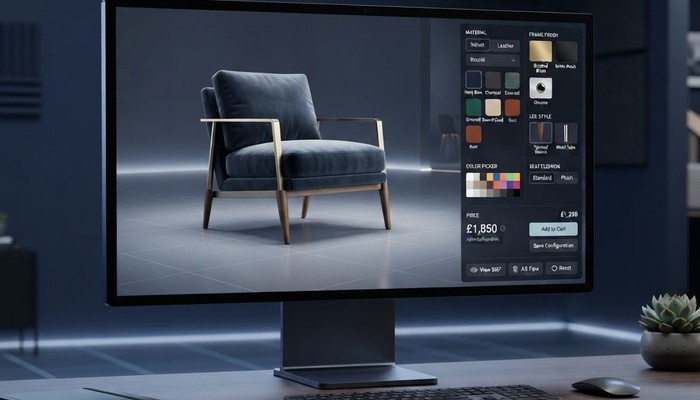
In 2026, an interactive product configurator is an advanced web application that enables online shoppers to customize, personalize, and inspect products in 3D real time before purchasing. Built using modern WebGL graphics frameworks like Three.js and WebGPU, a 3D product configurator renders photorealistic 3D models directly within standard web browsers across desktop computers, tablets, and smartphones—without requiring extra plugins or app downloads.
Traditional e-commerce relies heavily on static 2D product photos, which fail to convey true scale, material depth, or design details. In contrast, an interactive product configurator gives consumers complete creative control. Shoppers can rotate products 360 degrees, zoom in on fine textures, swap color palettes and material swatches, toggle modular accessories, and view instantaneous price adjustments based on selected options.
For US businesses—from direct-to-consumer (DTC) brands in New York and Los Angeles to industrial manufacturers in Chicago—implementing custom 3D product configurator tools bridges the physical-digital divide. By transforming passive site visitors into active co-creators, companies deliver engaging digital shopping experiences that build buyer trust and accelerate checkout velocity across competitive American markets.
Why US Brands Are Investing in 3D Product Configurator Tools
American e-commerce in 2026 demands more than standard product galleries. Forward-thinking US brands invest in custom interactive product configurator software to capture measurable commercial advantages across their entire sales funnel. Key business benefits driving US adoption include:
- Higher Conversion Rates: Interactive 3D visualization removes purchasing hesitation. Replacing static image carousels with real-time 3D configurators increases online conversion rates by 40% to 90% for US e-commerce brands.
- Drastic Reduction in Product Returns: Mismatched expectations regarding color, texture, or physical scale account for over 30% of US e-commerce returns. Providing photorealistic 3D rendering and WebAR room placement reduces return rates by 25% to 40%, saving substantial return logistics costs.
- Increased Average Order Value (AOV): When shoppers interactively build their ideal product, they naturally explore premium upgrades, custom finishes, and optional add-ons. Real-time visual feedback combined with dynamic pricing updates increases AOV by 15% to 30%.
- Extended User Engagement: Shoppers spend up to 4x longer engaging with interactive 3D tools compared to traditional static web pages. Longer session times improve SEO metrics and deepen brand loyalty.
- Automated Manufacturing Workflows: Enterprise 3D product configurator tools automatically generate exact Bill of Materials (BOM), CAD specs, and custom SKUs upon checkout, streamlining fulfillment for US manufacturers.
Key Industries Utilizing Interactive Product Configurators in the USA
From luxury consumer goods to complex industrial machinery, interactive product configurator software serves diverse verticals across the American economy.
1. Furniture, Home Decor & Commercial Interiors
Furniture buyers frequently struggle to visualize how custom sofas, modular shelving units, or executive desks will fit into their physical spaces. A custom 3D product configurator allows customers to modify upholstery fabrics, wood stains, leg styles, and dimensions in real time, while instant WebAR previews let them place true-to-scale virtual furniture inside their rooms.
2. Consumer Electronics & Technical Gadgets
High-end electronics brands utilize 3D product configurator tools to showcase complex hardware options. Consumers can assemble custom gaming PCs, configure modular headphones, select casing finishes, and preview port arrangements before ordering, increasing customer satisfaction and reducing technical support inquiries.
3. Apparel, Jewelry & Luxury Goods
Luxury US retailers rely on interactive 3D visualization for bespoke tailoring, custom footwear, and fine jewelry customization. Shoppers can select metals (platinum, yellow gold, rose gold), choose diamond cuts and carat sizes, preview custom monograms, and inspect gemstone clarity under varied lighting conditions.
4. Automotive, Recreational Vehicles & Industrial Equipment
Automotive brands, commercial fleet operators, and industrial equipment builders leverage 3D configurators for complex vehicle and machinery customization. Buyers can customize interior trims, paint finishes, wheel packages, and specialized mechanical attachments while obtaining immediate B2B sales quotes.
Essential Features of a High-Performing 3D Product Configurator
To deliver maximum ROI, an enterprise-grade interactive product configurator must incorporate robust features engineered for speed, visual fidelity, and ease of use:
- Real-Time Dynamic Pricing Engine: Automatically updates and displays total pricing as users select different materials, components, and custom dimensions.
- High-Fidelity PBR Material Swatches: Uses Physically Based Rendering (PBR) shaders to accurately mimic light reflections, fabric softness, metallic sheen, and wood grain textures.
- Seamless WebAR Spatial Preview: Enables one-touch Augmented Reality placement on mobile browsers, allowing users to project their configured 3D model into their physical room at 1:1 scale.
- 360-Degree Camera Rotation & Zoom: Provides fluid orbit controls, exploded 3D component views, and preset camera angles for inspecting fine product details.
- Modular Component Swapping: Allows users to toggle modular parts—such as armrests, handles, lenses, or wheels—with instant visual updates and constraint validation.
- High-Res Image & Summary Export: Generates downloadable high-resolution 3D renders, spec sheets, and PDF summary quotes that shoppers can share with decision-makers.
WebAR vs. Native Apps: Choosing the Right 3D Configurator Strategy
When planning an interactive product configurator project, US brands must evaluate whether to deploy via WebAR (browser-based 3D) or a native mobile app.
WebAR & Browser-Based 3D (WebGL / Three.js): Web-based configurators run directly inside Safari, Chrome, Edge, or Firefox without requiring app installation. WebAR offers zero-friction access, rapid loading via WebGL, and seamless integration with e-commerce checkout flows on Shopify or Magento. For consumer e-commerce brands in the US, WebAR is the industry standard due to its universal accessibility and high conversion potential.
Native Mobile 3D Apps (iOS / Android / Vision Pro): Native applications downloaded from the App Store or Google Play offer higher polygon budgets, offline capabilities, and advanced spatial computing features for headsets like Apple Vision Pro. Native apps are best suited for specialized B2B sales teams, field engineers, or immersive showroom installations.
The Custom 3D Product Configurator Development Process
Building a successful commercial 3D product configurator requires a structured development methodology combining 3D artistry with precise web software engineering. At Ink & Algorithm, our US development team follows a proven five-stage workflow:
Phase 1: Discovery, Requirements & UX Design
We analyze your target market, product catalog, variant rules, and e-commerce tech stack. Our UX designers craft intuitive configurator interfaces optimized for both mobile touchscreens and desktop displays.
Phase 2: 3D Asset Ingestion & Optimization
Our 3D specialists convert raw CAD files, OBJ, or FBX models into lightweight, WebGL-optimized 3D formats (glTF/GLB). We optimize geometry, reduce polygon counts, and bake high-resolution PBR texture maps to ensure rapid loading times under two seconds.
Phase 3: WebGL Engine Programming & Logic
Using Three.js, React Three Fiber, or Babylon.js, software engineers program lighting, camera controls, material swapping logic, component constraints, and smooth animations.
Phase 4: E-Commerce & ERP Integration
We connect the interactive product configurator directly to your shopping cart (Shopify, WooCommerce, Magento) or enterprise ERP/CRM (SAP, Salesforce, NetSuite). The tool updates inventory data, generates dynamic pricing, and passes detailed configuration parameters to checkout.
Phase 5: Testing, WebAR Verification & Deployment
We perform rigorous cross-browser testing across mobile and desktop devices, verify WebAR spatial tracking accuracy, optimize Core Web Vitals, and deploy your custom configurator to production.
High-Level Platform Comparison: Custom WebGL vs. Off-the-Shelf SaaS Tools
US businesses evaluating 3D configurator tools often compare bespoke custom development against off-the-shelf SaaS configurator platforms (such as Threekit or Sketchfab).
Off-the-Shelf SaaS Platforms: SaaS tools offer quick initial templates and pre-built widgets. However, they impose ongoing monthly subscription fees, strict viewer limits, rigid design templates, and vendor lock-in that restricts custom long-term functionality.
Custom WebGL Development (Ink & Algorithm): Custom development provides 100% intellectual property ownership, zero recurring viewer license fees, tailored UI/UX matching your exact brand aesthetic, and unlimited custom API integrations with your CAD and ERP systems. For growing US brands and enterprise leaders, custom WebGL development delivers superior long-term ROI and competitive differentiation.
Cost of Developing an Interactive Product Configurator in the USA
The cost of developing a custom interactive product configurator in the US depends on 3D asset readiness, variant complexity, WebAR features, and backend connectivity. Typical US budget ranges in 2026 include:
- Foundational 3D Configurator ($15,000 – $30,000): Ideal for DTC brands seeking a streamlined 3D visualizer with 5–10 material variations, 360-degree rotation, and standard e-commerce embedding.
- Mid-Range Custom E-Commerce Configurator ($30,000 – $60,000): Features high-fidelity PBR material swapping, modular component toggling, WebAR spatial preview, dynamic pricing, and full Shopify/WooCommerce integration.
- Enterprise Parametric 3D Configurator ($60,000 – $120,000+): Tailored for industrial B2B brands requiring real-time parametric dimensional scaling, automated CAD/BOM generation, multi-user sales portals, and enterprise ERP integration.
Frequently Asked Questions About Interactive Product Configurators
1. What is an interactive product configurator and how does it work on a website?
An interactive product configurator is a web-based 3D software tool that allows online shoppers to customize a product in real time directly inside their web browser. Built using WebGL and Three.js, it renders a photorealistic 3D model that users can rotate 360 degrees, zoom in on, and modify by selecting different colors, materials, or components. The configurator dynamically updates visual appearances and total pricing before passing the final customized SKU to your e-commerce cart.
2. How much does it cost to build a custom 3D product configurator in the US?
In the United States, building a custom interactive 3D product configurator ranges from $15,000 for foundational visualizers to $120,000+ for enterprise parametric platforms. Key cost drivers include the number of 3D product variants, PBR material complexity, WebAR features, and custom backend ERP or checkout integrations. Contact Ink & Algorithm for a tailored scope estimate for your project.
3. Will a 3D product configurator slow down my website loading speed?
No, provided the 3D assets and WebGL code are professionally optimized. Expert 3D developers utilize advanced mesh compression (Draco), KTX2 texture compression, and progressive level-of-detail (LOD) loading. This ensures 3D models load in under two seconds on both desktop and mobile browsers without harming your Google Core Web Vitals or search engine rankings.
4. Can an interactive product configurator integrate with Shopify or WooCommerce?
Yes. Custom 3D configurators built by Ink & Algorithm integrate seamlessly with major e-commerce platforms like Shopify, WooCommerce, Magento, and Salesforce Commerce Cloud. When a customer finishes customizing their item, the configurator generates a unique order payload containing chosen options, dynamic pricing, and visual preview thumbnails directly attached to the checkout cart.
5. Why choose custom WebGL development over off-the-shelf SaaS configurators?
Custom WebGL development gives your business full IP ownership, eliminates monthly SaaS licensing fees, and allows completely bespoke UI/UX design tailored to your brand identity. Unlike template SaaS widgets, custom configurators scale infinitely with your business and integrate seamlessly with your internal manufacturing, inventory, and ERP systems.
Get a Free Configurator Quote from Ink & Algorithm Today
Ready to revolutionize your e-commerce platform, increase sales conversions, and provide immersive 3D product experiences for your US customers? Partner with the leading US experts in 3D product configurator tools and web development.
At Ink & Algorithm, our Hanover Park, IL team combines 3D artistry with modern web software engineering to deliver high-ROI digital solutions tailored for growth. Contact our expert team today to discuss your vision and receive a detailed project roadmap.
- Company: Ink & Algorithm
- Location: Hanover Park, IL, USA
- Phone: +1 630-297-0428
- Email: info@inknalgorithm.com
- Get Started: Get a Free Configurator Quote