

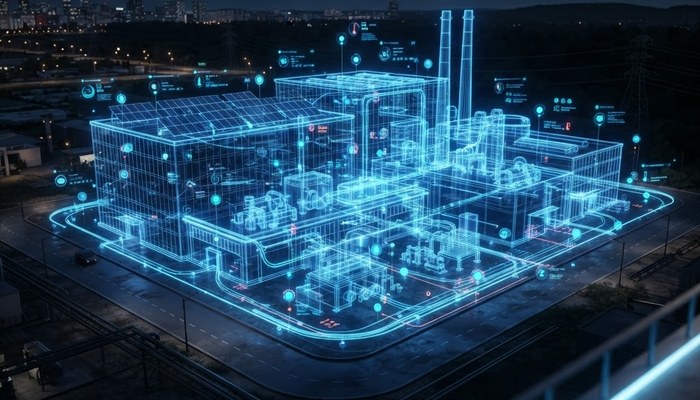
TL;DR: Digital twins let US manufacturers, AEC firms, and product brands test, monitor, and optimize real-world assets in a live 3D environment — before committing capital. This guide explains what digital twin development services include, what they cost in 2026, and how to choose a US-focused development partner.
What Are Digital Twin Development Services?
A digital twin is a real-time, data-connected 3D replica of a physical asset — a factory line, an office tower, an HVAC system, or an entire product fleet. Unlike a static 3D model, a digital twin continuously synchronizes with IoT sensor data, so the virtual copy behaves exactly like the real thing.
Digital twin development services cover the full stack: 3D modeling and CAD conversion, IoT data pipelines, real-time rendering (Unreal Engine, Unity, WebGL), simulation logic, and dashboards your operations team can actually use.
Top Use Cases for US Companies in 2026
Manufacturing & Industrial Operations
US manufacturers use digital twins for predictive maintenance, line-changeover planning, and throughput simulation. Instead of halting production to test a new layout, engineers rehearse it virtually and measure the impact on cycle time and OEE.
Architecture, Engineering & Construction
AEC firms connect BIM models with live building data to create operational twins of offices, hospitals, and campuses — ideal for energy management, space planning, and phased renovations.
Product & Retail Visualization
Consumer brands deploy lighter-weight twins — connected 3D product configurators and showrooms — so buyers interact with an accurate digital version of every SKU.
What a Digital Twin Project Includes
- Asset digitization: CAD/BIM cleanup, photogrammetry, or LiDAR scan conversion into optimized 3D assets.
- Data integration layer: MQTT, OPC-UA, or REST connectors that stream live sensor values into the twin.
- Real-time visualization: Unreal Engine 5 or Unity for desktop/VR, WebGL or WebGPU for browser access.
- Simulation & analytics: what-if scenarios, failure prediction, and KPI dashboards.
- Deployment & training: cloud hosting, SSO, and team onboarding.
How Much Does Digital Twin Development Cost?
In 2026, a focused single-asset twin typically starts around $25,000–$60,000, while multi-site enterprise programs with simulation and VR support range from $100,000 to $500,000+. Timeline: 8–16 weeks for a production-ready first phase.
How to Choose a Digital Twin Development Partner
Look for a team that has shipped both 3D visualization and IoT integration projects — not just one. Ask for demos with live data, request performance metrics (frame rate on mid-range hardware), and confirm they build on open standards so you are not locked into a proprietary platform.
FAQ
What is a digital twin in simple terms?
It is a live 3D copy of a real object or facility that updates itself with sensor data, letting you monitor and test things virtually.
How is a digital twin different from a 3D model?
A 3D model is static. A digital twin is connected to real-time data and can simulate how the physical asset performs over time.
Which industries benefit most from digital twins?
Manufacturing, energy, construction, logistics, and healthcare see the fastest ROI, followed by retail product visualization.
Can a digital twin run in a web browser?
Yes. WebGL and WebGPU twins run in the browser with no install, ideal for stakeholders who need access without VR hardware.
Work With a US-Focused Digital Twin Team
Ink & Algorithm builds production-grade digital twins — from CAD-to-UE5 conversion to live IoT dashboards and browser-based WebGL frontends. Tell us about your asset, and we will scope a first phase you can ship in under a quarter. Get in touch for a free technical consultation.