
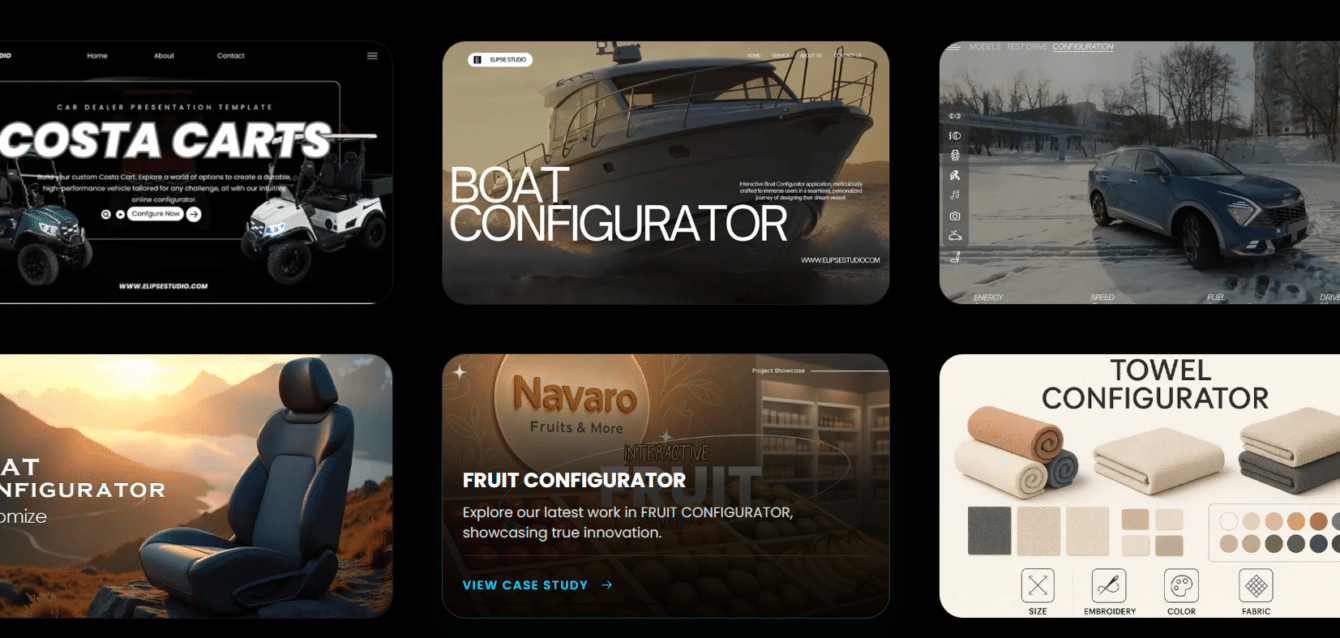
TL;DR: Choose the Best Configurator for Your Business in USA 2026. Learn about costs, features, ROI, and how US brands use this technology in 2026.
Why a Configurator Is a Game-Changer for Your Business in 2026
Let’s be honest — running a business in the United States in 2026 is not the same as it was five years ago. Customer expectations have skyrocketed, product catalogs have gotten more complex, and buyers want everything personalized on the spot. Whether you are selling custom furniture, industrial equipment, SaaS software packages, or insurance plans, one tool keeps coming up as the answer to all these challenges: a configurator.
But here is the thing — not every configurator is built the same, and choosing the wrong one can actually slow your business down rather than speed it up. With dozens of options flooding the market right now, from basic drag-and-drop tools to AI-powered product configurators with real-time 3D rendering, the decision has never been more important — or more confusing.
This guide from Ink N Algorithm breaks it all down for you. We are going to look at what a customizer actually does, why your business in the USA needs one in 2026, and — most importantly — how to choose the best one based on your industry, your budget, and your growth goals. No fluff. No recycled corporate speak. Just real, actionable insight.
Quick Answer: A coconfiguration tools a digital tool that lets your customers or sales team build, customize, and price products or services in real time. The b3D builderator for your business depends on your industry, product complexity, tech stack, and scalability needs.
What Is a Configurator? (And Why It Matters More Than You Think)
product builderor, in the simplest terms, is a software tool that guides users through a series of choices to build a custom product, service, or solution. Think of it like a smart, interactive builder that updates pricing, visuals, and specifications in real time as the user makes their selections.
You have probably already used one — maybe when configuring a new laptop on Dell’s website, choosing the trim level and color of a car on a manufacturer’s site, or picking the features for a subscription plan. That experience? That design toolrator at work.
But for businessesconfig toolator does a lot more than just look pretty on the frontend. Behind the scenes, it connects product data, pricing rules, inventory, and sometimes even manufacturing workflows — all while keeping the customer experience smooth, fast, and satisfying.
Types of Configurators You Will Encounter in 2026
As you start your search, you will find thcustomizertors come in several distinct flavors:
- ProductConfiguration toolr: Used in manufacturing, retail, and e-commerce to let customers build customized physical products.
- Software or Product builderrator: Helps users choose features, modules, and pricing tiers for digital products.
- ViDesign tooligurator: Allows real-time 3D visualization as users customize a product — huge in furniture, automotive, and fashion.
- SConfig toolgurator: Used in industries like insurance, finance, and IT services to help customers build the right service package.
- Rules-Customizerurator: Uses if-then logic to ensure customers can only select compatible options — critical for technical industries.
Knowing which typeconfiguration toolator aligns with your business model is the very first step toward making the right choice.
Why US Businesses Desperately Need a Configurator in 2026
The American market in 2026 is driven by personalization, speed, and self-service. A study by Salesforce found that 73% of customers expect companies to understand their unique needs. At the same time, B2B buyers now want to handle 70% of the research and purchasing journey on their own before ever talking to a sales3D buildernfigurator directly addresses both of these expectations.
Here is what happens when businesses implement thproduct builderigurator:
| Business Benefit | Design toolonfigurator | |
| Quote Generation Speed | 2-5 days (manual) | Minutes (automated) |
| Quote Accuracy | High error risk | Near 100% accuracy |
| Customer Experience | Static catalogs, slow | Dynamic, interactive |
| Sales Cycle Length | Long and complex | Shortened by 30-50% |
| Scalability | Limited by headcount | Scales without limits |
Beyond these measurable gains, there is something intangible but equally important: trust. When a customer can see exactly what they are getting — real-time pricing, live 3D visuals, or instant comparisons — they feel confident placing that order. And confident customers convert. They also return.
Industries in the USA Winning with Configurators Right Now
- Manufacturing & Industrial: Custom parts, assemblies, and equipment configurations.
- Automotive: Vehicle build-and-price tools used by every major car brand.
- Furniture & Interior Design: Visual room planners and custom furniture builders.
- Software & SaaS: Feature andcustomizerfigurators for tiered subscription products.
- Insurance & Financial Services: Coverage and plan builders for complex products.
- Healthcare & MedTech: Device configuration and service package selection.
- Construction & Real Estate: Property customization and specification tools.
- Fashion & Apparel: Made-to-order clconfiguration toolgurators with real-time previews.
Key Features to Look for in a Business Configurator in 2026
2. Rules-Based Logic and Constraint Management
For any business with products that have dependencies — where choosing one option limits or requires another — rules-based logic is not optional; it is essedesign toold configurator will prevent invalid configurations automatically, saving your team from fulfillment headaches and your customers from frustration.
3. Visual Configuration and 3D Rendering
In 2026, visual commerce is a serious competitive advantage. If your products have a physical form factor — furniture, machinery, apparel, or vehconfig tool configurator should show a live visual update as options are selected. Platforms with 3D, AR (augmented reality), or even high-quality 2D rendering significantly improve conversion rates, especially for high-ticket items.
4. CRM, ERP, and E-Commerce Integration
Acustomizerconfigurator with no system connections is only half a solution.configuration toolnfigurators integrate seamlessly with your existing tech stack — Salesforce, HubSpot, SAP, Oracle, Shopify, Magento, or whatever you are running. This ensures that configured quotes flow directly into your sales pipeline and that approved orders sync with your production or fulfillment systems.
5. Mobile Responsiveness and Accessibility
With a significant portion of B2B buyers and virtually all B2C buyers using mobil3D builderour configurator must function flawlessly on smartphones and tablets. Beyond responsiveness, ADA compliance is increasingly both a legal obligation and a market advantage in the United States.
6. CPQ Capabilities (Configure, Price, Quote)
If you operate in a B2B product builderr configurator should be able to generate polished, accurate, legally sound quotes and proposals automatically. CPQ functionality essentially eliminates the back-and-forth between sales reps and back-office teams, dramatically reducing your sales cycle length.
7. Analytics and Reporting
What options do customers configure most? Where do they drop off in the configuration journey? Which combinations convert at thedesign toole? A configurator without analytics is a black box. Make sure your chosen platform offers robust reporting so you can continuously optimize both the product offering and the user experience.
8. Scalability and Cloud Architecture
Your business is goinconfig toolour configurator needs to grow with it. Look for cloud-native platforms that can handle increased traffic, product catalog expansion, and new market entries without requiring a ground-up rebuild every couple of years.
Top Business Configurator Platforms to Consider in the USA in 2026
Epicor CPQ is widely regarded as one of the most powconfiguration tool configurator and CPQ platforms available, especially for manufacturers and industrial companies. It offers a visual rules engine that allows non-developers to build complex configuration logic, and it supports real-time 3D product visualization. Its integration capabilities with Salesforce and major ERP systems make it a strong pick for mid-market to enterprise manufacturers in the USA.
Best For: Manufacturing, industrial equipment, engineered-to-order businesses with complex product rules.
Salesforce CPQ
Already a Salesforce shop? Then Salesforce CPQ (now part of Revenue Cloud) is a natural fit. It lives inside your Salesforce CRM environment, meaning there is zero data friction between your configured quotes and your sales pipeline. It handles complex pricing, subscription billing, and contract management exceptionally well. It is particularly strong for SaaS companies, tech firms, and service-based businesses.
Best For: SaaS, technology companies, and service businesses already using Salesforce.
Threekit
Threekit has carved out a unique space as3D buildermmerce configurator with best-in-class 3D, AR, and virtual photography capabilities. It is built specifically for brands that want to deliver a visually stunning product experience online. Retailers, furniture brands, apparel companies, and luxury goods businesses find immense value in Threekit’s ability to turn static product listings into interactive, immersive buying experiences.
Best For: E-commerce, retail, furniture, fashion, and any brand where visual product experience drives sales.
Tacton CPQ
Tacton is a specialist in constraint-based configuration for complex manufactured products. Its AI-assisted configuration engine helps guide customers to valid product combinations without extensive rules maintenance. Tacton is especially popular among Swedish and German manufacturers with US operations, and it has strong integration capabilities with both Salesforce and SAP.
Best For: Heavy industry, complex B2B manufacturing, and companies with highly technical product portfolios.
DealHub CPQ
DealHub is a modern, revenue acceleration platform with strong CPQ functionality built for fast-growing B2B software and services companies. It is particularly well-suited for businesses that want a quick implementation timeline, solid CRM integration, and guided selling features that help reps close deals faster. It is less suited for visually complex physical products but excels in subscription-based digital offerings.
Best For: B2B SaaS, fast-growing tech startups, subscription businesses, and digital service providers.
Infor CPQ
Infor CPQ is a robust solution for complex manufacturer selling scenarios. It specializes in engineer-to-order and configure-to-order environments, making it particularly valuable for companies producing highly customized industrial products. Infor CPQ offers deep integration with Infor ERP and has a well-established customer base across North American manufacturing sectors.
Best For: Engineer-to-order manufacturers, industrial OEMs, and companies running Infor ERP environments.
How to Choose the Right Configurator for Your Business
Define Your Configuration Complexity: Start by mapping out how complex your products or services actually are. Do customers make just a few choices, or are there hundreds of interdependent options? Simple complexity can be handled by lightweight tools; high complexity demands enterprise-grade rules engines.
Let us save you from some expensive lessons that other businesses have already learned the hard way. Vendors are excellent at showcasing their platforms in the best possible light during demos. Always insist on a proof of concept using your actual products and data before making a final decision. The licensing fee is just the beginning. Implementation, custom development, training, ongoing support, and future upgrades all add to the real cost. Always model the three-year total cost of ownership, not just the monthly subscription price. A configurator that cannot talk to your CRM, ERP, or e-commerce platform creates data silos and manual workarounds that negate much of the efficiency gain. Integration complexity and quality should be a top evaluation criterion, not an afterthought. Many businesses try to migrate their entire product catalog and all their pricconfiguration toolto the configurator on day one. This creates project delays and spiraling costs. A phased approach — starting with your most popular or profitable product lines — consistently delivers faster ROI and smoother adoption. A technically impressive configurator that is confusing to use is a failed configurator. Always test your configurator with real users — both customers and internal sales reps — before full launch. Simplicity and clarity consistently outperform feature richness when it comes to configuration UX. The configurator market is not standing still. Here are the trends that are already reshaping how businesses think about configuration technology. Artificial intelligence is increasingly embedded in configurators to guide users intelligently based on their input, past behavior, and similar customer profiles. In the next few years, AI configurators will feel less like form-filling and more like having a knowledgeable sales consultant on demand, available 24/7. AR configurators — which let customers see how a product looks in their actual physical space before purchasing — are moving from novelty to standard expectation in furniture, home improvement, and automotive sectors. Expect AR to become a baseline capability for consumer-facing configurators in the next two to three years. Imagine configuring a complex product by simply having a conversation with an AI assistant. Conversational configurators powered by large language models are already in early deployment, and they represent a significant shift in how configuration UX is designed — particularly for non-technical buyers who find traditional option-selection interfaces intimidating. As ESG requirements and consumer demand for sustainable products grow, configurators are being built with the ability to show the environmental impact of different configuration choices — carbon footprint, material sourcing, recyclability scores — in real time. For US businesses navigating new sustainability regulations and buyer expectations, this is becoming a differentiating capability. Choosing the best configurator for your business in the USA in 2026 is not a minor software purchase. It is a strategic investment that will directly impact your sales efficiency, customer experience, revenue growth, and competitive positioning for years to come. The right configurator for a mid-size manufacturing company selling custom industrial equipment is going to look completely different from the right configurator for a fast-growing SaaS startup or a luxury furniture brand. That is not a flaw — that is simply the reality of how diverse American businesses are. What stays consistent across every business context is this: the best configurator is the one that reduces friction for your customers, empowers your sales team, integrates with your existing systems, and scales as your business grows. Prioritize those outcomes over feature checklists, and you will be making the right call. At Ink N Algorithm, we help businesses navigate exactly these kinds of strategic technology decisions — and we make sure the digital content around those decisions is found by the right people at the right time. Because choosing the right configurator matters, and so does making sure your ideal customers know you have it. This section is designed with Answer Engine Optimization (AEO) and AI Overview (AIO) strategies in mind, directly addressing the questions that real business owners and procurement teams are asking online right now. A product configurator focuses on helping users build and customize a product through guided selections. CPQ (Configure, Price, Quote) software goes a step further — it takes the configured product, applies complex pricing rules, and automatically generates a formal quote or proposal. In 2026, many modern platforms combine both capabilities into a single unified solution. Costs vary significantly based on platform and complexity. Small business configurator solutions can start from $200 to $800 per month on a SaaS subscription model. Mid-market platforms with CPQ capabilities typically run between $1,500 and $5,000 per month. Enterprise-grade solutions with full 3D visualization, ERP integration, and multi-channel deployment often cost $50,000 to $250,000+ per year in licensing and implementation combined. A simple product configurator for an e-commerce business can be up and running in two to four weeks. A mid-market CPQ implementation integrating with Salesforce and an ERP typically takes two to four months. Large enterprise implementations with complex rules engines, 3D visualization, and multi-system integrations can take six months to over a year. Absolutely. In fact, configurators can be transformational for small businesses because they remove the bottleneck of manual quoting and reduce the burden on a small sales team. Many SaaS configurator platforms offer entry-level plans specifically designed for SMBs. Even a basic configurator that automates pricing and quote generation can save a small business team dozens of hours per week. For businesses selling physical products — especially high-ticket items like furniture, vehicles, industrial equipment, or custom apparel — a visual configurator consistently delivers a positive return on investment. Studies have shown that visual product configuration can increase conversion rates by 30% to 40% for relevant product categories because it reduces buyer uncertainty and builds confidence in the purchase decision. AI-powered configurators use machine learning algorithms to analyze past configuration data, customer behavior, and purchasing patterns to intelligently guide users toward the most relevant options and combinations. Rather than presenting every possible choice upfront, AI configuration narrows the selection to what is most likely to fit the user’s needs. In 2026, AI-powered guided selling within configurators is becoming a standard expectation rather than a premium feature. Ready to get started? Contact Ink & Algorithm to discuss your project—we’ll help you create results that drive sales.Common Mistakes US Businesses Make When Choosing a Configurator
Mistake 1: Choosing Based on Demo Rather Than Real-World Testing
Mistake 2: Ignoring Total Cost of Ownership
Mistake 3: Underestimating the Complexity of Integration
Mistake 4: Over-Engineering the Configurator on Launch
Mistake 5: Neglecting the User Experience
The Future of Configurators: What’s Coming Beyond 2026
AI-Driven Guided Selling
Augmented Reality (AR) Configuration
Conversational Configurators
Sustainability-Aware Configuration
Making the Right Configurator Choice for Your Business
Configurator FAQs
What is the difference between a product configurator and CPQ software?
How much does a business configurator cost in the USA?
How long does it take to implement a configurator?
Can a small business benefit from a configurator?
Is a visual configurator worth the extra investment?
What is AI-powered configuration and how does it work?