
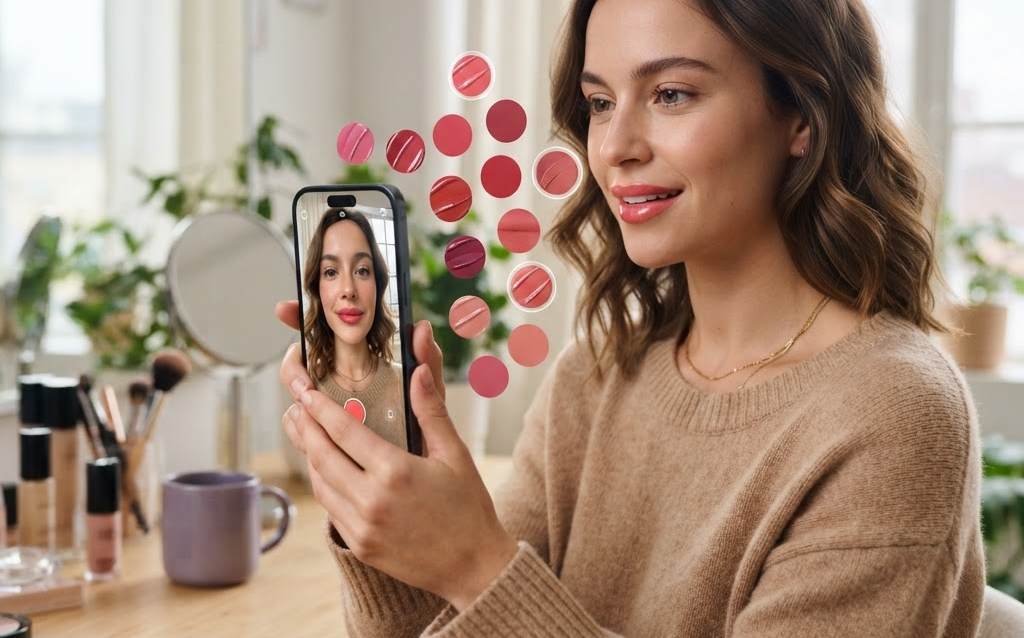
TL;DR: AR virtual try-on lets beauty shoppers see lipstick, eyeshadow, foundation, and accessories on their own face in real time through their phone camera—no app download required. US cosmetics brands using WebAR try-on report 30% higher conversion rates, 40% fewer returns, and significant savings on physical tester hygiene. With 8th Wall and face tracking making browser-based try-on seamless, 2026 is the year every beauty brand needs AR.
The beauty industry has a returns problem. Customers buy lipstick, try it at home, and return it 30–40% of the time because the shade doesn’t match their skin tone. Physical testers in stores are unhygienic, expensive to maintain, and limited in shade range. AR virtual try-on solves both problems—letting shoppers see products on their own face before buying, from their phone, without touching a physical product.
In 2026, AR try-on isn’t a novelty—it’s an expectation. Brands like Sephora, L’Oréal, and Maybelline have made it standard, and customers now expect every beauty brand to offer the same experience. This guide covers how AR try-on works, what it costs, and how to implement it for your beauty brand.
How AR Virtual Try-On Works
The technology behind AR try-on is facial landmark tracking. When a customer opens the try-on experience, their phone camera activates and the AR system maps their face in real time—identifying the eyes, lips, cheeks, nose, and jawline with pixel accuracy. A 3D model of the product (lipstick, eyeshadow, glasses) is then overlaid on the face and tracked as the customer moves, smiles, and talks.
The key technology components:
- Face tracking — detects 100+ facial landmarks and tracks them at 60fps as the face moves
- Product rendering — applies realistic textures (matte, glossy, metallic, shimmer) to the detected lip/eye/cheek areas
- Color accuracy — adjusts product appearance for the user’s actual skin tone and lighting conditions
- Real-time overlay — the product stays positioned on the face as the customer moves, turns, and smiles
In 2026, this all runs in the browser. No app download. The customer opens a link, allows camera access, and the try-on experience launches instantly. This zero-friction delivery is what makes AR try-on viable at scale—customers won’t download a brand app just to try on a lipstick.
Beauty Products That Work with AR Try-On
Lipstick and Lip Gloss
The most popular AR try-on category. Customers see lipstick shades applied to their lips in real time, with accurate finish types (matte, satin, glossy, metallic). Advanced try-on systems even show how the color looks in different lighting—daylight, office, evening.
Foundation and Concealer
AR can simulate foundation coverage on the user’s actual skin, showing how different shades match their complexion. Some systems use the phone camera to analyze the customer’s skin tone and recommend the closest shade match—reducing the guesswork that drives returns.
Eyeshadow and Eyeliner
Customers see eyeshadow palettes applied to their eyelids and experiment with different color combinations. Eyeliner styles (wing, cat-eye, natural) can be previewed before committing.
Eyewear and Sunglasses
One of the highest-converting AR try-on categories. Customers try on frames, see how they fit their face shape, and compare styles side by side. Warby Parker built their brand on this technology—now every eyewear brand needs it.
Hair Color
AR simulates how different hair colors would look on the customer, from highlights to full coverage. This helps customers make confident decisions about permanent color changes.
Skincare Analysis
Beyond try-on, AR can analyze the customer’s skin—detecting wrinkles, dark spots, pore size, and hydration levels—and recommend appropriate skincare products. This personalization drives higher basket sizes and product efficacy.
Jewelry and Accessories
Necklaces, earrings, rings, and hats can all be tried on with AR. Jewelry try-on is particularly effective for online-first brands that can’t offer physical try-on at scale.
Why AR Try-On Drives Sales for Beauty Brands
Higher Conversion Rates
Customers who use AR try-on convert 30% more often than those who browse static product images. The ability to see the product on yourself eliminates the biggest barrier to online beauty purchases: “will this look good on me?”
Fewer Returns
Returns cost the beauty industry billions annually. AR try-on reduces returns by 40% because customers make confident, informed decisions. They’ve already seen the product on their face—they know it works before buying.
Higher Average Order Value
AR try-on encourages experimentation. A customer who came for one lipstick shade discovers three more that look great—adding them to the cart. Brands using AR try-on report 20–25% higher AOV from try-on sessions.
Eliminates Physical Tester Costs
Physical testers in retail stores are expensive to maintain, unhygienic, and limited in shade range. AR try-on eliminates or reduces the need for physical testers—a significant cost saving for multi-location retailers.
Social Sharing and Virality
AR try-on sessions are inherently shareable. Customers screenshot their try-on looks and post them to Instagram and TikTok, generating organic brand exposure. Some brands add share buttons directly in the AR experience, turning try-on into a marketing channel.
The Technology: Building AR Try-On
8th Wall (Niantic)
The leading platform for browser-based face tracking and AR try-on. Provides:
- Real-time face tracking with 100+ facial landmarks
- Photo-realistic makeup rendering with accurate textures
- Browser-based delivery—no app download required
- Multiple face tracking (try on with friends)
- Pricing: $99–$2,000+/month based on traffic
Perfect Corp (YouCam)
Beauty-specific AR try-on platform. Provides:
- Pre-built makeup try-on with thousands of shade presets
- Skincare analysis with AI skin detection
- Integration with major e-commerce platforms
- Both web SDK and mobile SDK available
Modiface (L’Oréal)
L’Oréal’s proprietary AR try-on technology, available as a white-label solution for other brands. Strong in color accuracy and foundation shade matching.
Custom Three.js + MediaPipe
For brands that want full control, a custom solution using Google’s MediaPipe for face tracking and Three.js for rendering is possible. More development effort but no per-user licensing costs.
Cost of AR Virtual Try-On
| Implementation | Cost | Timeline |
|---|---|---|
| Basic WebAR try-on (single product type) | $8,000–$25,000 | 3–6 weeks |
| Multi-product try-on (lips + eyes + face) | $20,000–$60,000 | 5–10 weeks |
| Full try-on platform (all products + skin analysis) | $50,000–$150,000 | 8–16 weeks |
| Enterprise (multi-brand, retail + web + app) | $150,000–$500,000+ | 12–24 weeks |
Platform licensing (8th Wall, Perfect Corp): $99–$2,000+/month based on monthly active users. Custom solutions have no per-user licensing but higher upfront development cost.
Comparison: AR Try-On Platforms
| Platform | Best For | Face Tracking Quality | Cost |
|---|---|---|---|
| 8th Wall | Production web try-on, all categories | Excellent | $99–$2K/mo + dev |
| Perfect Corp | Beauty-specific, pre-built shades | Very good | $500–$5K/mo + dev |
| Modiface | Color accuracy, foundation matching | Very good | Enterprise pricing |
| MediaPipe + Three.js | Custom, full control, no licensing | Good | $0 licensing + dev |
Best Practices for AR Beauty Try-On
Optimize for Color Accuracy
The #1 complaint with AR try-on is “the color doesn’t look the same in real life.” Invest in calibrated color rendering—account for the user’s device screen, lighting conditions, and skin tone. The most advanced systems use device cameras to sample ambient light and adjust the virtual product color accordingly.
Keep It Fast
The try-on experience must launch in under 3 seconds. Any longer and customers abandon. Pre-load the AR engine, optimize face tracking initialization, and show a brief loading animation while the camera activates.
Provide Multiple Shades Easily
Don’t make customers click through a dropdown to try each shade. Show a shade carousel—swipe left/right to cycle through colors instantly. The faster customers can compare shades, the more they try and the more they buy.
Add Purchase CTAs in the Experience
While the customer is in the try-on experience, show an “Add to Cart” button. Don’t make them leave AR, find the product page, and add it there. The impulse to buy happens while looking in the mirror—capture it immediately.
Enable Before/After Comparison
Let customers see their face without makeup and with the product side by side. This “before/after” split screen is one of the most persuasive features in beauty AR.
FAQ: AR Virtual Try-On for Beauty
Do customers need to download an app for AR try-on?
No. Modern AR try-on uses WebAR, which runs in the browser—no app download required. Customers open a link from the product page, allow camera access, and the try-on experience launches instantly. This works on both iOS (Safari) and Android (Chrome). App download was the #1 barrier to AR adoption, and WebAR has eliminated it entirely.
How accurate is the color in AR try-on?
Color accuracy has improved dramatically in 2026. Platforms like 8th Wall and Perfect Corp use the device camera to sample ambient lighting and adjust virtual product colors accordingly. However, color perception still varies by device screen. The best systems include a disclaimer and offer a shade-matching quiz as a secondary recommendation tool.
How much does AR try-on cost for a beauty brand?
A basic WebAR try-on for a single product type (e.g., lipstick) costs $8,000–$25,000. A multi-product try-on covering lips, eyes, and face costs $20,000–$60,000. Full try-on platforms with skin analysis and all products cost $50,000–$150,000. Platform licensing (8th Wall, Perfect Corp) adds $99–$2,000+/month based on traffic.
Can AR try-on integrate with my e-commerce platform?
Yes. AR try-on embeds directly into product pages on Shopify, WooCommerce, Magento, and custom platforms. The try-on widget appears as a “Try It On” button on each product, launches the AR experience, and includes an “Add to Cart” button within the AR interface. Integration typically takes 2–5 days of development per platform.
Does AR try-on work on all skin tones?
Leading platforms in 2026 have improved significantly in skin tone inclusivity, with face tracking that works across the full range of skin tones. However, color accuracy for very deep and very light skin tones can still vary. The best implementations include a shade-matching algorithm that accounts for the user’s actual skin tone and recommends the closest product match.
Getting Started with AR Try-On
For beauty brands in 2026, the path is clear:
- Start with your best-selling product category — if lipstick is your top seller, start there
- Choose a platform — 8th Wall for maximum quality, Perfect Corp for beauty-specific features
- Embed on product pages — add a “Try It On” button next to every shade
- Measure conversion impact — compare AR users vs non-AR users over 30 days
- Scale to full catalog — once ROI is proven, expand to all product categories
The beauty brands that adopt AR try-on now will capture the customers who expect it—while competitors without AR lose sales to returns and hesitation. In 2026, not having try-on is like not having product photos. It’s expected.
Ready to add AR try-on to your beauty brand? Contact Ink & Algorithm to discuss your project—we’ll help you build a WebAR try-on experience that drives conversion and reduces returns.