
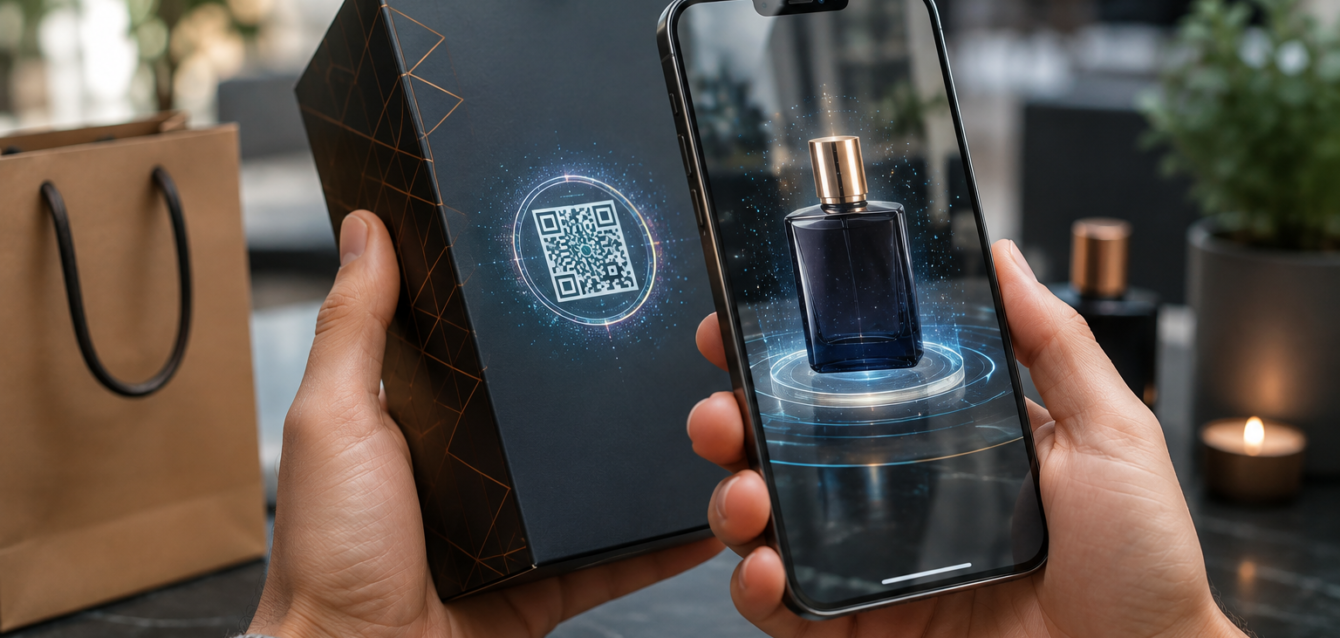
TL;DR: AR smart packaging lets shoppers scan a product label with their phone to unlock videos, 3D models, sustainability data, and tutorials—no app required. US CPG and retail brands are using AR packaging to boost engagement by 30–50%, reduce return rates, and create shareable unboxing experiences. With WebAR making it possible without an app download, 2026 is the year AR packaging moves from pilot to standard.
Packaging has always been a silent salesperson—sitting on a shelf, competing for attention, communicating brand value in the seconds it takes a shopper to walk past. But in 2026, packaging is no longer silent. It’s interactive. AR smart packaging uses augmented reality to turn a static label into a dynamic, engaging experience that a shopper unlocks simply by pointing their phone at the box.
No QR code maze. No clunky app. Just a camera scan and the product comes alive—with video stories, 3D demonstrations, sustainability credentials, or even a virtual try-on. This guide breaks down how US brands are implementing AR packaging in 2026, what it costs, and why it’s becoming a competitive necessity rather than a novelty.
What Is AR Smart Packaging?
AR smart packaging integrates augmented reality triggers—typically image recognition markers or QR codes printed directly on product labels—into physical packaging. When a consumer scans the package with their smartphone camera, the AR experience launches instantly in the browser (WebAR) or through a brand app.
The experience can include:
- Product story videos — the brand founder explaining sourcing, craftsmanship, or mission
- 3D product models — rotating, zooming, and exploring the product from every angle
- How-to tutorials — assembly instructions, recipes, or usage guides overlaid on the real product
- Sustainability information — supply chain transparency, carbon footprint, recycling instructions
- Authenticity verification — anti-counterfeit holograms and serial number validation
- Gamified unboxing — filters, lenses, and shareable AR moments for social media
The key shift in 2026 is that WebAR has eliminated the app requirement. Brands no longer need to convince consumers to download a dedicated app to experience AR packaging. A simple camera scan opens a browser-based AR session instantly, which has dramatically increased consumer adoption rates.
Why US Brands Are Investing in AR Packaging in 2026
1. Engagement That Actually Converts
Traditional packaging communicates through text and graphics—effective, but limited to what fits on a label. AR packaging transforms that constraint into an opportunity. When a shopper scans an AR-enabled package, they spend an average of 2–4 minutes interacting with the brand, compared to the 3–5 seconds they’d spend reading a label.
That engagement translates to measurable business outcomes. Brands implementing AR packaging report 30–50% higher engagement rates, increased social sharing of unboxing moments, and improved brand recall. For products sold on crowded retail shelves, that attention advantage is significant.
2. Reduced Return Rates
One of the most costly problems in ecommerce and retail is returns. AR packaging helps tackle this by giving shoppers accurate product information before and after purchase. A furniture brand can show dimensions and material swatches in AR; a beauty brand can offer virtual try-on from the package; an electronics brand can show setup tutorials that prevent user error.
Brands using AR-assisted product information report 20–35% reductions in return rates for products with AR-enabled packaging, as consumers make more informed purchasing decisions and encounter fewer post-purchase surprises.
3. Sustainability Storytelling
Consumers in 2026 increasingly demand transparency about where products come from and their environmental impact. Traditional labels can only fit so much information. AR packaging lets brands tell the full story—showing the supply chain journey, carbon footprint data, ethical sourcing certifications, and detailed recycling instructions through interactive AR experiences.
This isn’t just nice-to-have. Studies show that 68% of US consumers are more likely to buy from brands that transparently communicate their sustainability practices, and AR packaging is one of the most engaging ways to deliver that information.
4. Anti-Counterfeit Protection
Counterfeit goods cost US brands billions annually. AR smart packaging offers a built-in authentication layer—each package carries a unique AR trigger that, when scanned, verifies the product’s authenticity through encrypted serial numbers, blockchain records, or brand databases.
If a consumer scans a counterfeit product, the AR experience either fails to trigger or shows a warning that the product is not genuine. This protects both the brand and the consumer, and it’s particularly valuable in luxury goods, pharmaceuticals, and premium CPG categories.
How AR Smart Packaging Works: The Technology Stack
Image Recognition & Tracking
The foundation of AR packaging is image target recognition. The brand’s packaging design is registered as an image target in an AR platform (like 8th Wall, Niantic Lightship, or Adobe Aero). When a consumer scans the package, the AR engine recognizes the design and triggers the experience.
This means no QR code is required—the packaging itself is the trigger. However, many brands include a subtle QR code as a fallback for older devices or edge cases where image recognition might be less reliable.
WebAR Delivery
In 2026, the dominant delivery method is WebAR—browser-based AR that requires no app download. When a consumer scans the package, their phone’s browser opens an AR session using the WebXR Device API or similar web standards. The experience loads in seconds and works across iOS (Safari) and Android (Chrome).
This zero-friction delivery is critical. Previous generations of AR packaging required a dedicated app, which created a massive adoption barrier—less than 5% of consumers would download a brand app just to access packaging content. WebAR has solved this problem entirely.
Content Management
Behind the AR experience is a content management system that lets brands update the AR content without reprinting packaging. A brand can change the video, update sustainability data, or launch a new promotional campaign—all by updating the digital content linked to the package’s AR trigger. The physical packaging stays the same; the digital experience evolves.
Real-World Examples: US Brands Leading the Way
19 Crimes Wine
One of the most famous AR packaging examples, 19 Crimes brought their wine labels to life with AR animations—the historic figures on their labels literally start talking and moving when scanned. The campaign drove massive social sharing and a significant sales lift, proving that AR packaging can be both entertaining and commercially effective.
Nestlé & Coca-Cola
Both beverage giants have experimented with AR packaging that delivers interactive games, sustainability stories, and promotional content. Coca-Cola’s AR campaigns have turned bottle labels into shareable social media experiences, driving brand engagement beyond the point of sale.
Premium Spirits & Beauty Brands
Liquor brands like Jack Daniel’s and beauty brands like L’Oréal have used AR packaging to offer product stories, cocktail tutorials, and virtual try-on experiences directly from the package. These brands leverage AR to create premium unboxing experiences that justify higher price points and build brand loyalty.
How Much Does AR Smart Packaging Cost in 2026?
The cost of implementing AR smart packaging depends on the scope and complexity of the experience:
- Basic AR label experience (video playback + brand story): $8,000–$20,000
- Interactive AR packaging (3D models, product info, tutorials): $20,000–$50,000
- Full AR campaign (gamified unboxing, social sharing, CMS, multi-SKU): $50,000–$150,000+
These costs include AR development, image target registration, WebAR hosting, and content management system setup. They do not include packaging redesign costs, which vary by print volume and materials.
Ongoing costs are minimal—WebAR hosting and CMS maintenance typically run $200–$1,000 per month depending on traffic and the number of SKUs with AR enabled.
Industries Where AR Packaging Is Gaining Traction
| Industry | AR Use Case | ROI Driver |
|---|---|---|
| Beverages & Spirits | Animated labels, cocktail tutorials | Social sharing, premium positioning |
| Beauty & Cosmetics | Virtual try-on, ingredient stories | Conversion, reduced returns |
| Food & CPG | Recipes, sustainability data, sourcing | Engagement, brand trust |
| Pharmaceuticals | Dosage instructions, authenticity | Safety, anti-counterfeit |
| Luxury Goods | Provenance, craftsmanship story | Brand equity, authentication |
| Electronics | Setup tutorials, feature demos | Reduced support costs, returns |
FAQ: AR Smart Packaging
Do consumers need to download an app for AR packaging?
No. In 2026, most AR smart packaging uses WebAR, which works directly in the smartphone browser—no app download required. Consumers simply scan the package with their camera and the AR experience opens instantly. This zero-friction approach has dramatically increased consumer adoption rates.
How long does it take to develop AR packaging?
A basic AR label experience (video + brand story) can be developed in 3–5 weeks. More complex experiences with 3D models, interactive tutorials, and content management systems typically take 6–10 weeks. The packaging itself doesn’t need to change—AR triggers are embedded in the existing design through image recognition.
Can AR packaging work on existing product labels?
Yes. AR image recognition can be trained on existing packaging designs, so you don’t necessarily need to redesign your labels. The AR platform learns to recognize your current packaging as an image target. However, some design adjustments may improve recognition reliability—high-contrast, distinctive elements work best.
Is AR packaging only for large brands?
No. While early AR packaging campaigns came from large CPG brands, WebAR technology has democratized access. Small and mid-size brands can now implement AR packaging for $8,000–$20,000, making it viable for craft beverages, indie beauty brands, and specialty food products. The ROI from increased engagement and social sharing often justifies the investment.
How do you measure the ROI of AR packaging?
Key metrics include: scan rate (what percentage of consumers scan the package), engagement time (how long they interact), social shares (how many share the AR experience), conversion impact (for ecommerce links embedded in the AR experience), and return rate reduction. Most AR platforms provide analytics dashboards that track these metrics in real time.
Getting Started with AR Smart Packaging
For US brands considering AR packaging in 2026, the path is straightforward:
- Start with one flagship product — pilot AR on your best-selling SKU to test engagement and ROI
- Choose WebAR delivery — skip the app requirement and use browser-based AR for maximum reach
- Focus on value, not novelty — deliver content the consumer actually wants (tutorials, sustainability info, savings) rather than gimmicks
- Measure everything — track scan rates, engagement time, and conversion impact to build the case for scaling
The brands that move first in AR packaging aren’t just adding a cool feature—they’re building a direct, interactive channel to consumers that lives on the product itself. That’s a competitive advantage that compounds with every scan.
Ready to bring AR smart packaging to your products? Contact Ink & Algorithm to discuss your AR packaging project—we’ll help you design, develop, and deploy an experience that turns your packaging into your most engaging marketing channel.