
TL;DR: AR furniture placement lets customers see sofas, tables, and beds in their actual living rooms at real scale before buying. US furniture brands using AR report 35% higher conversion, 40% fewer returns, and 25% larger orders. Here’s how AR is transforming furniture retail in 2026.
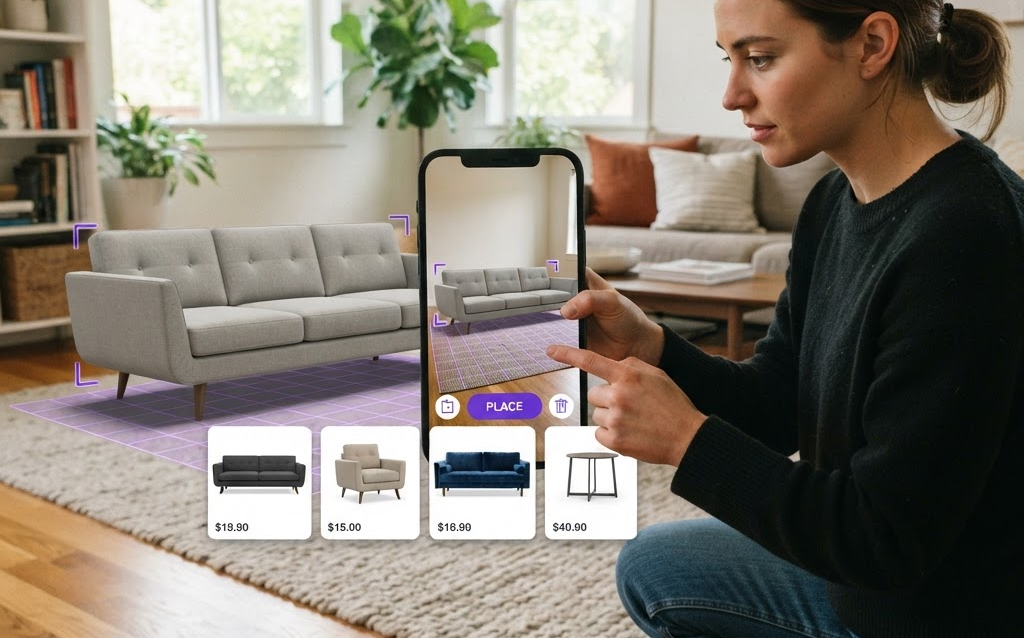
Furniture is the hardest e-commerce category. A sofa costs $1,000–$5,000, and the #1 question customers have is: “Will it fit in my space?” A photo can’t answer this. Dimensions on a spec sheet don’t help most people visualize scale. AR solves this by placing a true-to-scale 3D model of the furniture in the customer’s actual room through their phone camera.
How AR Furniture Placement Works
- Room scanning — the AR app scans the room to detect floors, walls, and existing furniture
- Product selection — browse the catalog and select a piece to place
- True-scale placement — the 3D furniture model appears in the room at exact real-world dimensions
- Walk-around view — walk around the placed furniture to check fit from every angle
- Material and color swapping — change fabric, wood finish, and color in real time
- Multi-piece placement — place multiple pieces to design a complete room arrangement
- Save and share — save the room design and share via link or social media
Why Furniture Brands Need AR
Solving the “Will It Fit?” Problem
40% of furniture returns happen because the piece doesn’t fit the space. AR eliminates this by showing the furniture at real scale in the customer’s actual room before purchase. Brands using AR report 40% fewer size-related returns.
Solving the “Will It Match?” Problem
Customers hesitate to buy furniture online because they can’t tell if it matches their decor. AR shows the furniture in their actual room, under their actual lighting, next to their actual furniture. This visual confidence drives 35% higher conversion.
Driving Larger Orders
When a customer places a sofa in AR, they often add a matching coffee table, side table, or rug. The AR experience naturally encourages multi-piece purchases—driving 25% larger average orders.
AR Furniture Technology in 2026
WebAR vs App-Based AR
| Factor | WebAR (Browser) | App-Based AR |
|---|---|---|
| Setup | Scan QR code, open in browser | Download app first |
| Adoption | High (zero friction) | Low (app download barrier) |
| Tracking quality | Good (ARKit/ARCore) | Excellent (native SDK) |
| Best for | Most furniture retailers | Large brands with loyal app users |
3D Model Requirements
- Poly count — 50K–200K polygons for furniture (balance detail vs load speed)
- File format — GLB with Draco compression (under 3MB for mobile)
- Materials — PBR materials with accurate fabric, wood, and metal textures
- Multiple variants — one model with swappable material zones for each color/fabric option
Cost of AR Furniture Retail
| Scope | Cost | Timeline |
|---|---|---|
| Single product WebAR placement | $5,000–$20,000 | 2–6 weeks |
| Full catalog AR platform | $40,000–$150,000 | 8–16 weeks |
| 3D model per furniture piece | $500–$3,000 | 3–10 days |
FAQ: AR for Furniture Retail
Do customers need to download an app for AR furniture placement?
No. WebAR lets customers scan a QR code on the product page and launch AR directly in their browser—no app download needed. This zero-friction approach has 5x higher adoption rates than app-based AR.
How accurate is the furniture scale in AR?
Modern AR (powered by ARKit on iOS and ARCore on Android) places furniture at real-world scale with 1–2% accuracy. A 84-inch sofa in AR measures within 1–2 inches of the real product. This is sufficient for fit-checking.
How much does AR furniture placement cost?
A single product WebAR experience costs $5,000–$20,000. A full catalog platform covering all products with material swapping and room design costs $40,000–$150,000. 3D models per furniture piece cost $500–$3,000.
Can customers place multiple furniture pieces in the same room?
Yes. Multi-piece AR placement lets customers place a sofa, coffee table, and rug in the same room to design a complete arrangement. This drives 25% larger orders as customers add complementary pieces.
Can customers swap fabric and color options in AR?
Yes. PBR materials let customers swap fabric, wood finish, and color in real time within the AR view. They see how each option looks in their actual room lighting—eliminating the “will it match?” uncertainty.
Getting Started
- Start with your top 5 products — the highest-traffic product pages
- Use WebAR — zero-friction, no app download needed
- Add AR to product pages — “See in Your Room” button
- Measure return reduction — compare returns before and after AR
- Scale to full catalog — per-model cost decreases with volume
Ready to add AR to your furniture store? Contact Ink & Algorithm to discuss your project—we’ll help you create AR experiences that sell furniture with confidence.