
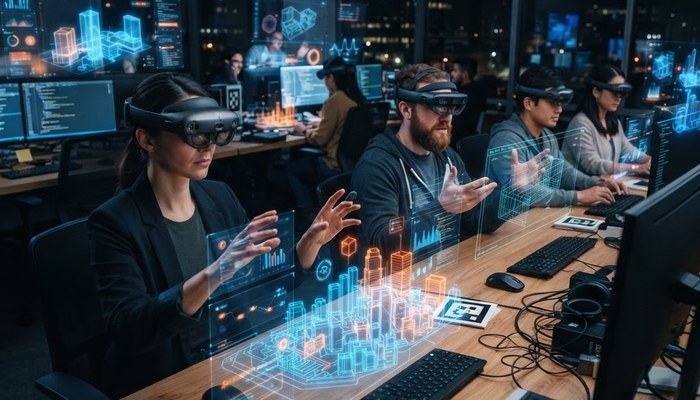
TL;DR: Choosing the right AR development company is critical for US brands looking to merge physical environments with digital intelligence. At Ink & Algorithm, our expert AR developers design custom spatial computing experiences, native mobile applications, and WebAR solutions tailored for retail, manufacturing, healthcare, and real estate. Learn more about our specialized augmented reality development services or contact our team to transform your business vision into immersive digital reality.
What Does an AR Development Company Do?
An AR development company specializes in creating interactive digital overlays on top of the real physical world. Unlike traditional app development studios that focus purely on 2D screen interactions, a dedicated augmented reality company combines spatial computing, computer vision, 3D graphics rendering, and hardware sensor integration to deliver immersive user experiences across smartphones, tablets, web browsers, and smart glasses.
When you partner with experienced AR developers, your organization gains access to full-lifecycle development capabilities. This spans conceptual research and spatial UI/UX design to high-polygon 3D asset modeling, engine integration, and cloud-backed spatial analytics. Modern AR development encompasses several core technical competencies:
- Marker-Based AR: Utilizing visual anchors such as QR codes, printed images, or brand logos to trigger 3D animations, product visualizers, or interactive overlays.
- Markerless & Plane-Detection AR: Leveraging device gyroscopes, accelerometers, and camera feeds to detect flat horizontal or vertical surfaces (floors, tables, walls) for precise object placement.
- Spatial Mapping & Occlusion: Mapping complex physical environments so that digital objects realistically hide behind physical structures and respond to real-world lighting.
- WebAR Deployment: Delivering lightweight, zero-friction augmented reality experiences directly through mobile web browsers without requiring users to download a standalone mobile app.
- Wearable & Headset Integration: Building hands-free enterprise solutions optimized for spatial headsets and smart glasses like Meta Quest, Nreal (XREAL), Magic Leap, and Apple Vision Pro.
By leveraging an enterprise-grade AR SDK (Software Development Kit) alongside powerful real-time 3D engines, a professional augmented reality company ensures your application achieves low-latency tracking, photorealistic rendering, and maximum battery efficiency across diverse mobile devices.
Why Hire a Specialized AR Company vs. Freelancers?
When executing an enterprise augmented reality initiative, US businesses often weigh the decision between hiring individual freelancers versus partnering with an established AR development company. While freelancers may seem cost-effective for simple 3D prototypes, commercial-grade spatial applications demand a multi-disciplinary team with specialized expertise in spatial UX design, 3D asset optimization, computer vision programming, and multi-device QA testing.
| Evaluation Factor | Specialized AR Development Company | Freelance AR Developers |
|---|---|---|
| Team Capabilities | Cross-functional team of 3D artists, spatial UX engineers, QA specialists, and project managers. | Single-person skill set; often lacks specialized 3D modeling or advanced spatial architecture skills. |
| Technical Stack Depth | Deep proficiency in Unity, Unreal Engine, AR Foundation, ARKit, ARCore, WebXR, and custom shaders. | Limited to specific frameworks or single platform tools (e.g., basic Spark AR filters). |
| Scalability & Architecture | Enterprise cloud backend, secure APIs, automated CI/CD pipelines, and multi-platform build systems. | Monolithic codebases that can be difficult to scale or maintain long-term. |
| Hardware & QA Testing | Comprehensive device lab testing across iOS, Android, Web browsers, and smart glasses under diverse lighting conditions. | Testing restricted to personal devices owned by the freelancer. |
| Support & SLA Guarantees | Formal Service Level Agreements (SLAs), dedicated ongoing maintenance, and post-launch updates. | High risk of availability gaps, turnover, or abandoned project code. |
For brands targeting high ROI, brand safety, and seamless customer experiences, partnering with a full-service augmented reality company provides the structural stability, rigorous security protocols, and engineering depth needed to deliver frictionless spatial software.
The End-to-End AR Development Process
Building a successful augmented reality product requires a structured methodology that bridges the gap between digital content and physical space. Professional AR developers follow a disciplined six-stage development lifecycle designed to mitigate risk and guarantee high performance:
1. Discovery, Spatial UX Strategy & Feasibility Analysis
Every project begins with a deep dive into user journeys, hardware requirements, target environmental parameters, and key performance indicators (KPIs). The engineering team evaluates whether native mobile apps, WebAR, or social lens platforms like Spark AR represent the optimal delivery mechanism for your audience.
2. 3D Asset Pipeline Creation & Optimization
Augmented reality relies heavily on optimized 3D visual assets. Skilled 3D artists model, texture, rig, and animate objects using tools like Blender, Maya, or Substance Painter. Assets are converted into runtime-friendly formats such as USDZ for Apple devices and GLTF/GLB for Android and web frameworks. Mesh polygon counts and texture draw calls are rigorously compressed to maintain 60 frames-per-second (FPS) rendering on mobile devices without overheating battery hardware.
3. Core Engineering & AR SDK Integration
During implementation, developers configure the core spatial tracking engines using a robust AR SDK. Engineers implement surface detection algorithms, light estimation shaders, raycasting, physics engine interactions, and occlusion buffers. Cross-platform framework configurations like AR Foundation allow unified code execution across both Apple and Android ecosystems.
4. Spatial UI/UX & Gesture Controls
Interacting with 3D objects in physical space requires intuitive control schemes. AR developers design fluid touch gestures (pinch-to-scale, rotation drag, tap-to-place) alongside spatial audio cues and depth-aware UI panels to guide users naturally through the augmented workflow.
5. Quality Assurance & Environmental Field Testing
Unlike standard apps that operate in controlled pixel layouts, AR applications must function reliably across diverse real-world lighting conditions, surface textures, camera resolutions, and movement speeds. Quality assurance teams test across multiple hardware generations, verifying tracking stability, memory footprints, and frame rates under real-world usage scenarios.
6. Deployment, Analytics Integration & Post-Launch Iteration
Once validated, the app is deployed to Apple App Store, Google Play Store, or published directly to web servers as a seamless WebAR application. Integrated telemetry tracks user engagement durations, object interaction rates, and conversion metrics to inform continuous feature updates.
Core AR Technologies & Tech Stack Overview
Selecting the correct technology stack is a fundamental step in modern AR development. A leading AR development company selects frameworks and runtime libraries based on target platforms, rendering complexity, and user friction requirements.
iOS ARKit & Android ARCore
Apple’s ARKit and Google’s ARCore form the foundational native framework layer for iOS and Android mobile devices. Key capabilities include:
- LiDAR Spatial Mapping: High-precision depth sensing on modern iPad Pro and iPhone Pro models for instant surface detection and occlusion.
- Motion Tracking & Visual Inertial Odometry (VIO): Combining camera sensor data with IMU readings to track exact device positioning in physical space.
- Environmental Lighting Estimation: Analyzing real-time camera feeds to project accurate shadows and reflections onto virtual objects.
- Facial & Body Tracking: High-density mesh tracking for facial expressions, gestures, and virtual try-on mechanics.
WebXR & Browser-Based WebAR Frameworks
For marketing campaigns and e-commerce product visualizers, reducing user friction is paramount. WebAR utilizes open standards such as WebXR along with web engines like 8th Wall, Three.js, and Babylon.js. Users simply scan a QR code or tap a web link to launch interactive 3D content directly within Safari or Chrome—eliminating the need for app store downloads and dramatically increasing conversion rates.
Social AR: Spark AR & Snap Lens Studio
Social channels provide massive audience reach for viral interactive filters and visual effects. Developers build interactive face filters, target-tracking lenses, and portal experiences using platforms like Meta’s Spark AR (for Instagram and Facebook) and Snapchat’s Lens Studio. These lightweight experiences drive viral engagement and social sharing for consumer brands.
Cross-Platform Engines: AR Foundation & Unity
For complex enterprise applications requiring cross-platform codebases, Unity’s AR Foundation serves as the industry standard multi-platform framework. It wraps native ARKit and ARCore APIs into a unified C# interface, enabling AR developers to build once and deploy seamlessly across iOS, Android, and spatial computing hardware without duplicating codebases.
Smart Glasses & Spatial Headsets: Nreal, Magic Leap & Vision Pro
Hands-free enterprise operations rely on spatial glasses and headset computing. Hardware platforms like Nreal (XREAL Light/Air), Magic Leap 2, and Apple Vision Pro allow industrial workers, technicians, and medical professionals to view hands-free digital instructions, interactive 3D models, and telemetry overlays anchored directly in their physical field of view.
Key US Industries Leveraging Augmented Reality in 2026
Augmented reality has evolved from a novel marketing gimmick into an essential driver of digital transformation across major US business sectors. Enterprise adoption continues to accelerate across several key industries:
1. E-Commerce & Retail
US online retailers leverage 3D product visualizers and virtual try-on (VTO) tools to elevate consumer confidence. Shoppers can place true-to-scale furniture in their living rooms, preview footwear on their feet, or test cosmetics before purchasing. Retailers implementing WebAR report up to a 94% increase in conversion rates and up to a 40% reduction in product return rates.
2. Industrial Manufacturing & Field Services
Industrial companies utilize head-mounted AR displays and tablets to equip field technicians with hands-free assembly guides, real-time IoT diagnostic data, and remote expert support. Expert engineers can annotate a live camera feed remotely, guiding on-site technicians step-by-step through complex machinery repairs.
3. Real Estate, Architecture & Construction
Architects and real estate developers utilize augmented reality to project interactive 3D building models onto unbuilt land plots or floor plans. Buyers and stakeholders can walk through life-sized structural renovations, inspect spatial layouts, and customize interior finishes prior to construction breaking ground.
4. Healthcare & Medical Education
Medical device manufacturers and hospitals employ high-fidelity AR visualizations for surgical planning, patient education, and anatomical simulation. Surgeons can view 3D patient imaging (CT scans, MRIs) overlaid directly onto a surgical site, improving precision and operational outcomes.
5. Corporate Training & Workforce Development
Enterprises use augmented reality simulations to train employees in hazardous or high-cost scenarios—ranging from aviation maintenance to hazardous material handling—providing safe, repeatable, and cost-effective practical experience.
How to Choose the Right AR Development Company in the USA
Selecting an augmented reality partner requires evaluating both creative craftsmanship and deep software engineering expertise. When evaluating an AR development company for your US-based enterprise, consider these critical criteria:
- Proven Portfolio & Case Studies: Request live app demonstrations or WebAR links showcasing realistic lighting, stable tracking, and smooth frame rates across diverse environments.
- Full 3D Asset Pipeline Mastery: Verify that the studio has in-house 3D artists proficient in low-poly optimization, PBR texturing, and multi-format export standards.
- Multi-Platform & Engine Proficiency: Ensure the team possesses hands-on experience across native iOS/Android development, Unity, AR Foundation, WebXR, and specialized hardware platforms like Nreal or Magic Leap.
- Enterprise System Integration: Confirm their capability to connect AR front-ends to your existing enterprise backends, including CRM systems, ERP platforms, headless e-commerce APIs, and cloud databases.
- IP Ownership & Security Compliance: Ensure full transfer of source code intellectual property rights, NDA protection, and strict adherence to US data privacy standards.
AR Development Costs and Timelines in 2026
The total investment required for custom AR development varies significantly depending on technical complexity, target platforms, asset volume, and backend integration requirements. Below is a breakdown of estimated budget ranges and development timelines for typical US enterprise projects in 2026:
| Project Scope | Key Features | Estimated Cost (USD) | Timeline |
|---|---|---|---|
| Basic WebAR or Social Lens | Single-product 3D visualizer, marker-based web tracking, or branded Spark AR social filter. | $15,000 – $30,000 | 4 – 8 Weeks |
| Mid-Tier Mobile AR App | Custom iOS/Android app, plane detection, multi-asset 3D catalog, custom spatial UI. | $35,000 – $75,000 | 2 – 4 Months |
| Enterprise Spatial Solution | Multi-user collaboration, IoT backend integration, smart glasses support, custom shaders. | $80,000 – $150,000+ | 4 – 9+ Months |
Frequently Asked Questions (FAQ)
What is the difference between native AR apps and WebAR?
Native AR apps are installed via the Apple App Store or Google Play Store, utilizing native ARKit or ARCore APIs to leverage full hardware capabilities like LiDAR, high-end physics, and offline processing. WebAR runs directly inside mobile web browsers using WebXR or web-based tracking engines, offering friction-free access without installation—making it ideal for instant e-commerce product previews and marketing campaigns.
How long does it take to develop a custom AR application?
Development timelines depend on project complexity. A streamlined WebAR product visualizer or Spark AR filter takes approximately 4 to 8 weeks. A feature-rich cross-platform mobile application utilizing AR Foundation typically requires 3 to 5 months, while complex enterprise spatial solutions involving IoT integration and smart glasses support can span 6 to 9 months.
How much does it cost to hire an AR development company in the US?
Project costs generally range from $15,000 for entry-level WebAR experiences up to $150,000+ for comprehensive enterprise spatial platforms. Key factors shaping cost include 3D asset modeling complexity, platform targets (iOS, Android, Web, Smart Glasses), interactive features, and cloud backend integration.
Which industries benefit most from AR development?
Retail and e-commerce lead consumer adoption with virtual try-on and 3D product visualization. Industrial manufacturing, real estate, automotive, healthcare, and corporate training also experience high ROI through hands-free remote assistance, spatial walkthroughs, and interactive technical training modules.
What devices and platforms do your AR developers support?
Our experienced AR developers build solutions across iOS (iPhone, iPad), Android smartphones and tablets, web browsers (Safari, Chrome, Edge), social platforms (Instagram, Snapchat), and spatial hardware platforms including Apple Vision Pro, Meta Quest, Magic Leap, and Nreal smart glasses.
Ready to Elevate Your Business with Custom AR Development?
Transform your customer engagements and operational workflows with custom augmented reality software tailored to your commercial goals. Ink & Algorithm delivers cutting-edge spatial computing solutions for forward-thinking brands across the United States.
Get a Free Project Consultation →
Ink & Algorithm | Hanover Park, IL | Phone: +1 630-297-0428 | Email: info@inknalgorithm.com