
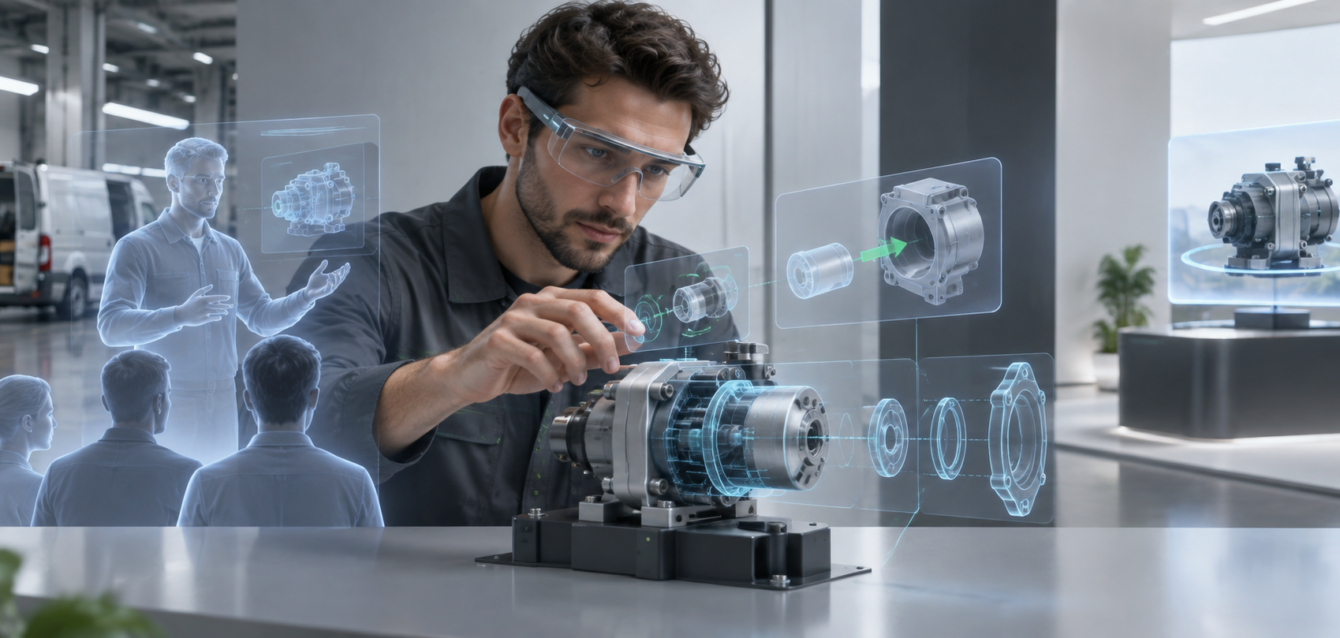
Augmented reality is becoming a practical business tool for teams that need to explain physical products, guide hands-on work, and support customers with clearer visual information. Instead of relying only on manuals, flat images, or long video calls, AR places digital instructions and product context directly over the real environment.
For businesses, the strongest use cases are not about novelty. They are about reducing confusion, shortening training time, improving product understanding, and helping teams make faster decisions when they are working with real objects, spaces, or equipment.
Where Augmented Reality Creates Business Value
AR works best when a product or process is easier to understand visually than through text. A sales team can show how an item fits into a real space. A technician can follow guided steps on top of equipment. A training team can turn a difficult process into a visual workflow that employees can repeat with more confidence.
This makes augmented reality especially useful for manufacturers, ecommerce brands with complex products, field service teams, interior and spatial products, healthcare device training, industrial equipment, and B2B sales organizations.
AR for Product Demonstrations
Traditional product demos often depend on photos, PDFs, showroom visits, or pre-recorded videos. AR can make the demo more immediate by allowing a buyer or stakeholder to place a digital product in their own environment and view it at real scale.
This is helpful when size, placement, or physical context matters. A customer can understand whether equipment fits in a room, how a retail display may look in a store, or how a product feature appears from different angles. The result is a clearer buying conversation and fewer assumptions during the sales process.
AR for Field Service Teams
Field service work often happens under pressure. Technicians may need to inspect components, follow exact steps, or explain a problem to another team member remotely. AR can support that work with visual overlays, step-by-step prompts, part labels, and contextual instructions.
For service managers, this can reduce repeated support questions and make specialized knowledge easier to share across teams. For newer technicians, AR guidance can make training feel closer to real work instead of disconnected classroom material.
AR for Employee Training
Training programs are strongest when people can practice in context. Augmented reality helps employees learn procedures by showing what to do, where to look, and what sequence to follow. This is useful for equipment setup, safety walkthroughs, product education, warehouse processes, installation steps, and customer support training.
Because the guidance appears near the object or workspace, employees do not have to constantly switch between a manual and the task in front of them. That makes the learning experience more focused and easier to repeat.
When Browser-Based AR Makes Sense
Some AR projects need a native app, especially when the experience requires deep device access, offline use, or advanced internal workflows. Browser-based AR is often the better choice when speed and reach matter. A user can open the experience through a link or QR code without installing anything first.
That makes browser-based AR useful for product demos, trade shows, sales presentations, marketing campaigns, and early pilots where teams want to test value before investing in a larger platform.
How to Plan an AR Project
A successful AR project should begin with one clear question: what decision or task should become easier? The answer may be helping a buyer compare product size, helping a technician complete a repair, or helping a trainee understand a process faster.
From there, the experience should be designed around simple interaction, accurate scale, fast loading, clear instructions, and measurable business outcomes. AR should feel useful first and impressive second.
For deeper field operations use cases, see our guide to AR for field service technicians and how it reduces repair time for distributed teams.
Final Thoughts
Augmented reality gives businesses a stronger way to connect digital information with real-world action. Used well, it can improve product demos, support field teams, train employees, and make complex products easier to understand.
Need an AR experience built around a real business workflow? Ink & Algorithm can help plan and develop augmented reality experiences for training, field service, product demonstrations, and interactive sales support.