
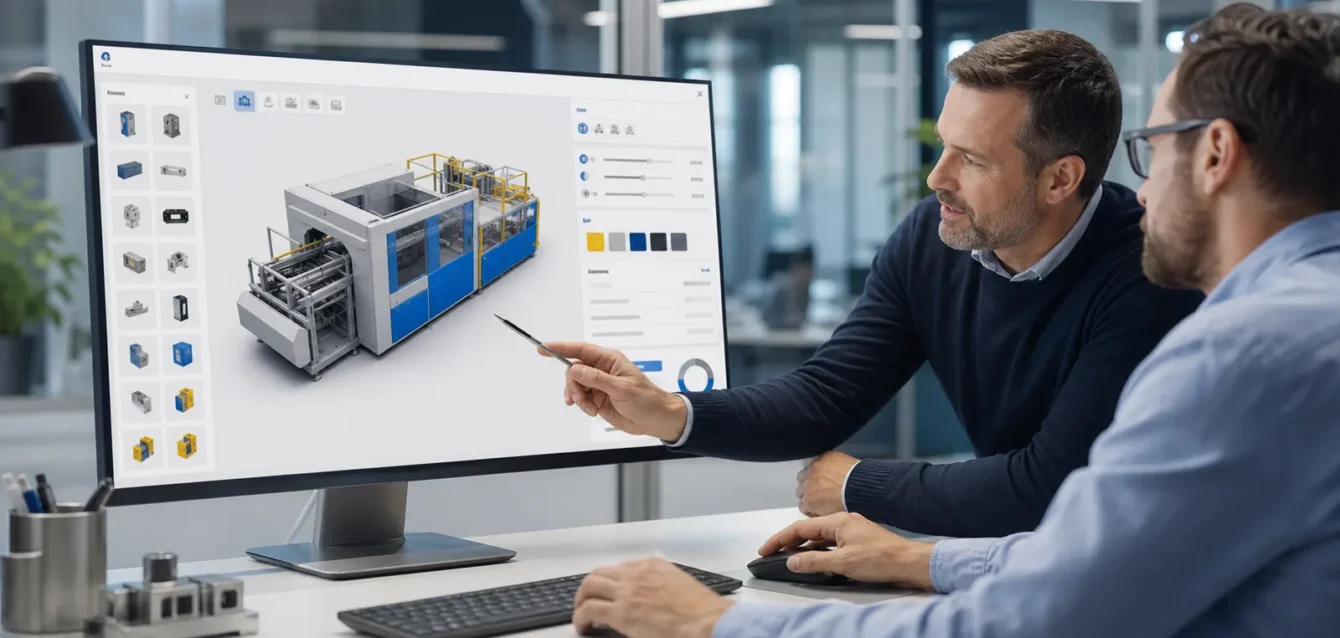
For B2B companies, a product configurator is not just a better-looking product page. When it is built correctly, it becomes a sales tool that helps buyers understand options, helps sales teams receive cleaner requirements, and helps leadership measure return on investment more clearly.
In 2026, US manufacturers, equipment companies, furniture brands, building product suppliers, electronics brands, and custom product sellers are using interactive 3D configurators to reduce sales friction. Instead of relying on long email threads, static PDFs, and manual mockups, buyers can explore valid product options in the browser and submit a configuration that sales can actually use.
The ROI comes from several places: shorter quote cycles, stronger lead quality, fewer manual revisions, better buyer confidence, and more scalable product visualization.
What Is a B2B Product Configurator?
A B2B product configurator is an interactive tool that lets a buyer or sales rep build a product based on available options, rules, and requirements. In a 3D configurator, the product updates visually as the user makes choices. Those choices can include size, materials, components, finishes, modules, accessories, packages, performance options, and commercial add-ons.
For simple ecommerce products, a configurator may send the selected options to cart. For B2B products, the workflow often goes further. The configurator may generate a quote request, produce a specification summary, route leads to a dealer, send data to a CRM, or connect with CPQ and ERP systems.
This makes the configurator part of the sales operation, not only the marketing website.
Why ROI Is Easier to Prove in B2B
B2B products often require more education and more internal coordination than consumer products. A buyer may need to compare options, confirm technical requirements, share details with a purchasing team, or request a custom quote. Every unclear step adds time.
A good product configurator reduces that uncertainty. It gives the buyer a guided path, shows only valid choices, and captures structured configuration data. Sales teams receive fewer vague inquiries and more complete requests.
This makes ROI easier to measure because the configurator affects known sales metrics: lead quality, quote speed, conversion rate, average deal value, sales team workload, and number of revisions per opportunity.
Where Configurators Create Business Value
The most direct value comes from reducing manual sales work. If your team regularly creates custom product visuals, explains the same options repeatedly, or corrects invalid customer selections, a configurator can remove a large amount of repetitive work.
Another major value is buyer confidence. When a customer can see the selected product, compare options, and understand how choices affect the final result, they are more likely to move forward. For complex products, confidence is often the difference between a serious quote request and a casual inquiry.
Configurators can also improve internal consistency. Instead of every sales rep describing options differently, the configurator presents the product rules in the same way every time.
Sales Cycle Impact
Many B2B sales cycles slow down because buyers and sellers are not aligned on product details. The buyer sends a vague request. Sales asks follow-up questions. Engineering checks feasibility. Someone creates a mockup. The buyer requests changes. The loop repeats.
An interactive 3D product configurator shortens this process by making the first request more complete. Buyers select valid options, preview the result, and submit a clearer configuration. Sales can start the conversation from a more advanced point.
This does not replace consultative selling. It improves it. Sales teams can spend less time gathering basic details and more time discussing fit, budget, implementation, and closing steps.
Quote Quality and CPQ Readiness
For companies that use CPQ workflows, a product configurator can become the visual front end for complex product logic. Even before a full CPQ integration, the configurator can collect the structured data needed to build accurate quotes.
Useful fields may include product family, dimensions, selected modules, finish options, technical requirements, add-ons, quantity, location, contact details, timeline, and notes. When this data is captured consistently, quotes become faster and less error-prone.
For enterprise systems, the configurator can eventually connect with pricing rules, product databases, CRM records, dealer workflows, and inventory availability.
What ROI Metrics to Track
Before building a configurator, define the metrics that matter. Common ROI metrics include quote request conversion rate, product page engagement, average time to quote, number of follow-up emails per lead, close rate, average deal value, sales rep time saved, and percentage of complete quote submissions.
Analytics should also track configurator interactions. Which options are selected most often? Where do users drop off? Which configurations are submitted? Which product categories create the highest-quality leads? This data can inform marketing, sales, product planning, and inventory decisions.
A configurator can become one of the most useful sources of buyer intent data on the website.
Cost Ranges in the USA
A focused B2B 3D product configurator in the USA may start around $25,000 to $60,000 when the product line is limited and integrations are simple. A more advanced configurator with multiple product families, pricing logic, CRM integration, saved configurations, and advanced 3D assets may range from $60,000 to $150,000.
Enterprise configurators connected to CPQ, ERP, dealer portals, inventory systems, and complex product rules can exceed $150,000. The higher cost usually comes from business logic, data structure, integration, and product complexity, not only from the visual 3D layer.
The right scope depends on the business case. Many companies start with one high-value product line, prove the workflow, and then expand.
Best B2B Use Cases
B2B configurators work especially well for industrial equipment, modular furniture, commercial interiors, building products, electronics, machinery, medical devices, vehicles, packaging, cabinets, outdoor structures, and custom manufactured products.
The strongest use cases share one pattern: the product has enough options that buyers need guidance, and those options affect price, feasibility, lead time, or sales workflow.
What to Plan Before Development
Successful configurator projects begin with product logic. Before design or development starts, your team should define the product families, option rules, invalid combinations, required integrations, asset sources, pricing requirements, and lead routing process.
You should also decide whether the first version needs full ecommerce checkout, quote request only, CRM integration, downloadable PDFs, WebAR, saved configurations, or admin controls for updating options.
Clear scope keeps the project practical and helps the configurator launch faster.
Why 3D Matters for B2B
Some B2B products can be configured with forms alone. But when visual differences matter, 3D adds clarity. Buyers can see proportion, finish, layout, modules, and selected components in context. This is especially useful when products are expensive, physical, technical, or hard to imagine from text descriptions.
3D also makes the experience more memorable. A buyer who interacts with the product is more engaged than one who only downloads a PDF. For complex products, that engagement can become a real sales advantage.
Final Takeaway
A B2B product configurator can improve ROI by shortening sales cycles, reducing manual work, increasing buyer confidence, and capturing cleaner quote data. The best results come when the configurator is designed around the sales process, not only the product model.
Ink & Algorithm builds interactive 3D and WebGL configurators for brands that need better product visualization and better sales workflows. Explore our 3D configuration services, learn more about web-based configurators, or contact us to plan a configurator that supports your sales team and buyers.