
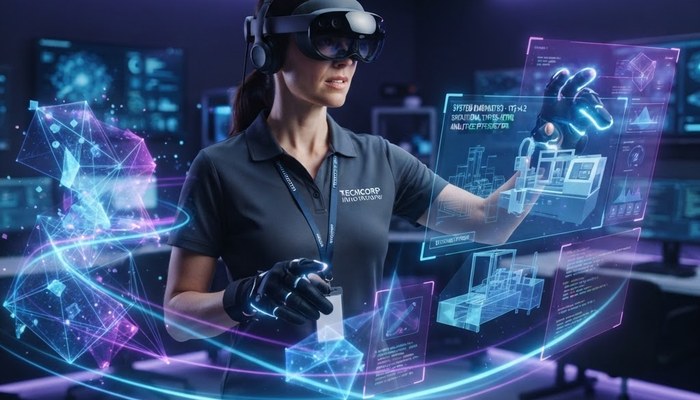
TL;DR: VR app development in 2026 enables enterprises to build immersive 3D spatial experiences across headsets like Meta Quest, Apple Vision Pro, and HTC Vive. By leveraging modern frameworks such as OpenXR alongside Unity VR and Unreal VR engines, US businesses are transforming healthcare, industrial training, real estate, and manufacturing. Partnering with experienced virtual reality app developers like Ink & Algorithm ensures scalable architecture, 90+ FPS performance optimization, and measurable ROI for your immersive software investments.
What Is VR App Development?
VR app development is the end-to-end engineering process of designing, programming, 3D modeling, and deploying 3D software environments for Head-Mounted Displays (HMDs). Unlike traditional 2D mobile or web software, virtual reality apps operate within a 360-degree spatial canvas that responds dynamically to human head, hand, eye, and body movements in real time.
Building high-performance VR applications requires a fusion of specialized technical domains, including real-time 3D graphics rendering, spatial audio synthesis, physical collision simulation, spatial computing APIs, and ergonomic user interface design. Developers utilize specialized VR SDK frameworks—such as Meta Movement SDK, Apple visionOS SDK, and the universal OpenXR standard—to bridge hardware sensor data with software interaction logic.
For US organizations evaluating spatial computing strategies, custom virtual reality software provides unprecedented training engagement, interactive product visualization, and remote collaboration capabilities. To explore how immersive technologies fit into your broader digital transformation roadmap, visit our comprehensive Virtual Reality Services page.
Leading VR Platforms in 2026: Meta Quest, Apple Vision Pro, HTC Vive & PSVR2
Selecting the right hardware ecosystem is a foundational decision in the VR app development lifecycle. Modern hardware spans standalone wireless devices, spatial computers, tethered PCVR systems, and console-attached headsets, each serving distinct enterprise and consumer market segments in the USA.
Meta Quest 3 & Quest Pro
The Meta Quest ecosystem remains the dominant market force in standalone VR. Powered by Qualcomm Snapdragon XR2 Gen 2 processors and Meta Horizon OS, Quest 3 and Quest Pro deliver wireless 6DoF (Six Degrees of Freedom) tracking, color passthrough for mixed reality, and robust hand-tracking capabilities. They are ideal for high-volume enterprise training deployments, consumer gaming, and field simulations without tethered workstation constraints.
Apple Vision Pro & visionOS
Apple’s entry into spatial computing with the Apple Vision Pro has redefined ultra-high-resolution enterprise VR applications. Featuring dual 4K micro-OLED displays, the M2 and R1 dual-chip architecture, intuitive gaze-and-pinch input, and seamless iOS ecosystem integration, visionOS excels in executive data visualization, medical diagnostics, high-end CAD reviews, and premium corporate collaborative environments.
HTC Vive Focus 4 & Vive Pro 2
HTC Vive continues to lead industrial-grade enterprise VR. The standalone Vive Focus series and PC-tethered Vive Pro 2 cater to high-precision engineering, defense flight simulators, and medical VR training where sub-millimeter tracking accuracy, wide fields of view (FOV), and enterprise data privacy compliance are mandatory.
PlayStation VR2 (PSVR2)
While primarily consumer-focused, Sony’s PSVR2 leverages PlayStation 5 hardware power to deliver high-fidelity VR experiences featuring foveated rendering via eye tracking, HDR OLED displays, and sophisticated haptic feedback.
The Step-by-Step VR App Development Process
Creating commercial-grade virtual reality apps requires a disciplined agile software engineering pipeline specifically tailored to spatial computing challenges. At Ink & Algorithm, our US-based development team follows a proven 5-stage lifecycle to deliver flawless immersive products.
Phase 1: Discovery, Spatial UX & Ergonomic Prototyping
Every successful project starts with defined business goals, audience persona mapping, and hardware target selection. UX designers create spatial wireframes and graybox 3D prototypes to establish scale, UI placement within the visual frustum, and interaction mechanics. Crucially, motion profiles and camera acceleration guidelines are established early to prevent simulator sickness.
Phase 2: 3D Asset Creation, Rigging & Environment Design
3D artists construct optimized assets using Blender, Maya, and Substance 3D Painter. Because mobile VR headsets run on mobile chipsets, geometry poly-counts must be strictly budgeted, textures baked into efficient PBR (Physically Based Rendering) maps, and draw calls minimized. Skeletal rigging and animation clips are prepared for interactive avatars and dynamic props.
Phase 3: Core Architecture & VR SDK Integration
Software engineers write clean, scalable code using modern software design patterns. We leverage OpenXR APIs alongside hardware-native VR SDK libraries (such as Meta Interaction SDK or Apple visionOS Spatial Framework) to implement physics-based object grabbing, spatial UI components, spatialized audio, network state synchronization for multiplayer, and back-end cloud API integrations.
Phase 4: Optimization & Performance Stabilization
Frame rate drops in VR cause immediate visual discomfort and motion sickness. Mobile VR target platforms require a locked minimum frame rate of 72 to 90 FPS, while high-end headsets target 120 FPS. Developers utilize deep performance profiling to optimize shader complexity, execute dynamic occluder culling, implement fixed foveated rendering, and streamline memory garbage collection cycles.
Phase 5: Quality Assurance, Ergonomic Testing & Deployment
QA specialists execute comprehensive functional, multi-user concurrency, security, and hardware compatibility testing across physical HMDs. Following strict approval protocols, we manage enterprise distribution via private MDM (Mobile Device Management) systems or public submission to the Meta Quest Store, Apple App Store, or SteamVR.
Unity vs Unreal Engine for VR App Development
Choosing between Unity VR and Unreal VR engine technology dictates your project’s technical architecture, asset pipeline, team velocity, and hardware adaptability.
Unity VR Development
Unity is the world’s most popular engine for cross-platform VR app development, powering over 60% of existing spatial applications. Written primarily in C#, Unity offers a lightweight Universal Render Pipeline (URP), rapid iteration times, efficient mobile VR execution, and the comprehensive XR Interaction Toolkit (XRIT).
- Strengths: Exceptional optimization for standalone wireless headsets (Meta Quest, Pico), faster development velocity, vast asset store, lightweight runtime footprint.
- Best for: Enterprise training software, cross-platform mobile VR apps, interactive utilities, lightweight multi-user visualizers.
Unreal VR Development
Unreal Engine by Epic Games represents the gold standard for photorealistic 3D visualization and high-fidelity physics simulations. Driven by C++ and visual Blueprint scripting, Unreal Engine features groundbreaking technologies like Nanite virtualized geometry and Lumen dynamic global illumination.
- Strengths: Photorealistic visual quality, advanced out-of-the-box physics, powerful visual scripting for rapid mechanic prototyping, high-end PCVR capabilities.
- Best for: High-end architectural walkthroughs, photorealistic flight/medical simulations, AAA immersive gaming, automotive design reviews.
VR App Development Costs in the USA (2026 Price Guide)
Understanding the financial investment required for custom VR app development helps US business leaders plan budgets and calculate return on investment (ROI). In 2026, development costs in the United States typically range from $25,000 for single-room prototypes to over $250,000 for complex multi-user enterprise platforms.
Key cost drivers include:
- Visual Complexity & 3D Assets: Custom high-poly 3D models and animated avatars require significantly more artist hours than using CAD asset conversions or stock 3D libraries.
- Platform Target & Cross-Platform Needs: Developing simultaneously for Meta Quest, Apple Vision Pro, and Windows PCVR increases testing and optimization requirements.
- Multiplayer & Cloud Architecture: Real-time voice chat, multi-user spatial synchronization, spatial analytics, and LMS/ERP integration add backend architecture complexity.
- Regulatory Compliance: Healthcare apps requiring HIPAA compliance or industrial safety simulators requiring ISO validation demand rigorous security audits.
| Complexity Level | Scope & Capabilities | Timeline | Cost (USD) |
|---|---|---|---|
| Basic MVP | Single environment, basic 3D interaction, single target headset, minimal UI | 6-10 Weeks | $25,000-$45,000 |
| Mid-Tier Enterprise VR | Multi-room scenario, custom 3D assets, voice guidance, LMS integration | 3-5 Months | $50,000-$110,000 |
| Advanced Cross-Platform | Photorealistic environment, multi-user collaboration, OpenXR cross-hardware | 5-9 Months | $120,000-$250,000+ |
Key Industries Using VR Apps in the USA
Across the United States, forward-thinking organizations are deploying specialized virtual reality apps to streamline operations, reduce physical training hazards, and accelerate sales cycles.
Healthcare & Medical Training
Leading US hospital networks and medical schools utilize medical VR applications for surgical preparation, patient anatomy visualization, and emergency response drills. Surgeons can practice delicate procedures inside a risk-free 3D simulation hundreds of times before entering an operating room.
Corporate Workforce & Industrial Safety Training
Fortune 500 manufacturers, logistics providers, and energy utilities deploy VR workforce solutions for high-hazard safety training (e.g., OSHA protocol compliance, electrical grid repair, heavy machinery operation). Trainees learn through muscle memory without putting physical equipment or personal safety at risk.
Real Estate, AEC & Architecture
Architects, real estate developers, and construction firms use immersive BIM (Building Information Modeling) integrations to walk clients through unbuilt commercial properties. Spatial visualization eliminates costly structural change orders prior to physical groundbreaking.
Manufacturing & Digital Twin Engineering
Automotive and aerospace manufacturers in the US harness Unreal VR and Unity VR to interact with 1:1 scale digital twins of aircraft engines, assembly lines, and consumer vehicles, identifying ergonomic bottlenecks months before factory retooling.
How to Choose a Virtual Reality App Developer in the USA
Selecting the right technical partner is critical to avoiding costly project delays or substandard spatial experiences. When evaluating US-based virtual reality app developers, demand proof of competence across the following dimensions:
- Spatial UX Mastery: Verify that the team understands spatial ergonomics, comfortable camera placement, readable typography distance, and motion-sickness prevention strategies.
- Cross-Platform Expertise: Ensure developers are experienced with universal OpenXR standards so your software code can port effortlessly across evolving hardware platforms.
- Performance Profiling Disciplines: Ask for real-world proof of maintaining stable 90+ FPS frame rates on wireless standalone hardware like Meta Quest.
- Full Lifecycle Capabilities: Choose a firm that offers end-to-end service—from initial spatial UI design and 3D modeling to private enterprise cloud deployment and ongoing maintenance.
Located in Hanover Park, IL, Ink & Algorithm is a premier US software development agency engineering cutting-edge VR applications for enterprises, startups, and institutions. Our veteran engineering team combines deep technical mastery in Unity VR, Unreal VR, and spatial computing to turn complex enterprise challenges into intuitive 3D virtual experiences.
Frequently Asked Questions (FAQ)
How much does custom VR app development cost in 2026?
Custom VR app development costs in the United States generally range from $25,000 for a streamlined proof-of-concept MVP to $250,000+ for a feature-complete multi-user enterprise application. Final pricing depends on 3D asset complexity, hardware target platforms, backend cloud integrations, and interactive multiplayer features.
Which engine is better for VR applications: Unity or Unreal Engine?
Both engines excel in specific domains. Unity VR is typically preferred for standalone mobile headsets (like Meta Quest) due to its lightweight runtime, cross-platform agility, and rapid iteration speed. Unreal VR is favored for high-end PCVR, photorealistic architectural renderings, and heavy industrial simulations requiring AAA visual fidelity.
How long does it take to build a commercial virtual reality app?
A typical VR app development timeline spans 2 to 4 months for a standard single-user enterprise prototype, and 5 to 9 months for a complex multi-platform or multi-user VR application. Development stages include spatial wireframing, 3D environment modeling, C#/C++ programming, frame-rate performance optimization, and store distribution.
What is OpenXR and why is it important for VR apps?
OpenXR is an open, royalty-free standard managed by the Khronos Group that simplifies cross-platform VR SDK development. By writing code targeting OpenXR APIs, developers can deploy virtual reality apps across diverse headsets—including Meta Quest, Apple Vision Pro, HTC Vive, and Windows Mixed Reality—without rewriting core hardware interaction routines.
How do VR applications prevent motion sickness and user discomfort?
Professional virtual reality app developers prevent simulator sickness by maintaining a strictly locked frame rate (minimum 72-90 FPS), employing comfortable locomotion models (such as teleportation or snap turning), keeping visual horizons stable, avoiding sudden unprompted acceleration, and positioning UI elements within the recommended optical comfort zone.
Transform Your Business with Custom VR App Development
Virtual reality is no longer an emerging technology experiment—it is a proven competitive differentiator for modern enterprises. Whether you are building an immersive employee training simulator, a photorealistic spatial product showcase, or a next-generation collaborative platform, working with an experienced US software engineering firm ensures your product delivers maximum impact.
At Ink & Algorithm, we design, build, and deploy enterprise-grade virtual reality apps tailored specifically to your organizational objectives. Our Hanover Park, Illinois team brings together top-tier spatial designers, 3D artists, and senior XR engineers to transform your vision into an immersive digital reality.
Ready to elevate your spatial computing strategy? Contact Ink & Algorithm today to schedule a technical consultation with our expert VR app development team.
Ink & Algorithm
Hanover Park, IL, United States
Phone: +1 630-297-0428
Email: info@inknalgorithm.com
Website: https://inknalgorithm.com/