

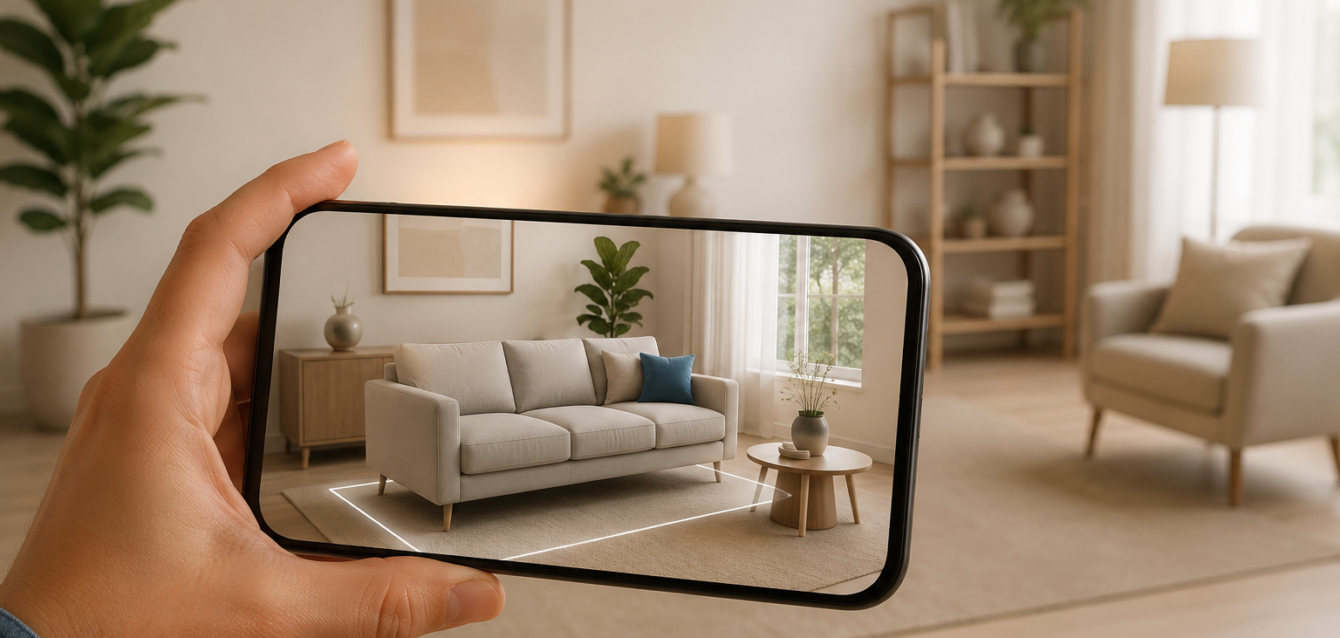
TL;DR: AR shopping for furniture retail lets customers place virtual furniture in their homes before buying — using just their smartphone camera. US furniture retailers using AR report 25% higher conversion rates and 35% fewer returns. Here’s how AR is transforming furniture retail in 2026.
Why Furniture Retail Needs AR Shopping in 2026
Buying furniture online has always been risky. Customers can’t tell if a sofa will fit their living room, if the color matches their walls, or if the scale feels right. This uncertainty leads to high return rates — the furniture industry averages 30-40% returns for online orders.
Augmented reality shopping eliminates this guesswork. Customers point their phone at their room and see the furniture appear at true scale, in the right color, from every angle. They can walk around it, check clearance, and compare multiple pieces side by side.
What AR Furniture Shopping Looks Like
- Customer browses furniture on a mobile website or app
- Taps “View in Room” button on any product page
- Phone camera opens with AR overlay showing the furniture at real-world scale
- Customer drags, rotates, and repositions the piece in their space
- Changes fabric color, wood finish, or size in real time
- Takes a photo or video to share with family before purchasing
Key AR Features for Furniture Retailers
- True-to-scale 3D models: Furniture appears at exact dimensions in the customer’s room
- Material and color swapping: Change upholstery, wood tones, and metal finishes in AR
- Multi-item placement: Place several pieces together to design a complete room
- Wall and floor detection: AR understands room geometry for accurate placement
- Lighting adaptation: Virtual furniture matches the room’s actual lighting conditions
- Screenshot sharing: Save and share AR views with family or on social media
AR Furniture Shopping ROI: By the Numbers
- 25% conversion increase on product pages with AR functionality
- 35% reduction in returns for products viewed in AR before purchase
- 20% higher AOV as customers confidently add complementary pieces
- 2x longer session duration on AR-enabled product pages
- 40% of customers say AR makes them more likely to buy from a retailer
Explore our AR development services to bring AR shopping to your furniture store.
WebAR vs App-Based AR for Furniture
Furniture retailers have two AR options:
- WebAR: Runs in the mobile browser — no app download needed. Best for broad reach and quick adoption. Conversion-friendly because there’s zero friction.
- App-based AR: Native apps using ARKit/ARCore. Higher quality tracking and more features, but requires customers to download an app. Best for loyal customers and premium brands.
For most US furniture retailers, WebAR is the recommended starting point — it captures the widest audience with the least friction.
Frequently Asked Questions
How much does AR furniture shopping cost to implement?
WebAR for furniture retail typically costs $10,000-$30,000 depending on the number of products, customization options, and integration with your e-commerce platform. App-based AR ranges from $20,000-$80,000.
Do customers need to download an app to use AR shopping?
With WebAR, no app download is required. Customers access AR directly through their mobile browser. This removes friction and maximizes adoption rates.
How accurate is AR furniture placement?
Modern AR achieves within 2-3% accuracy for furniture placement. Advanced WebAR uses surface detection and room mapping to ensure furniture appears at true scale and position.
Bring AR Shopping to Your Furniture Store
AR furniture shopping is no longer experimental — it’s a proven revenue driver for US retailers. The brands that implement in 2026 will capture market share from competitors still relying on flat product photos. Contact our team to start your AR project.