

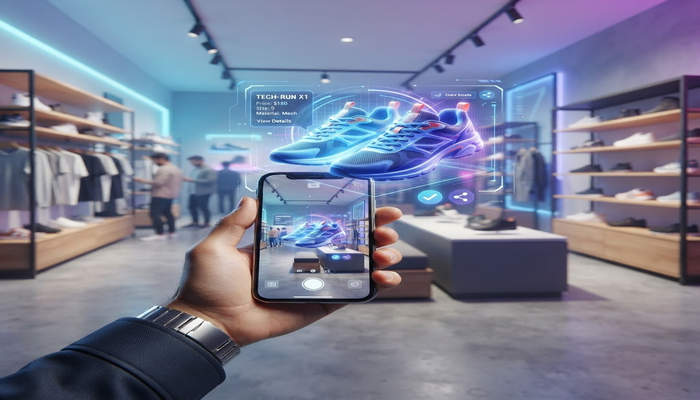
TL;DR: US retailers using augmented reality in 2026 are deploying WebAR product placement, virtual try-on, and interactive packaging to increase conversion rates by 40%+ and reduce returns by 25%. Learn about costs, features, and ROI for AR in retail. US retailers using augmented reality in 2026 are deploying it in three proven formats: WebAR product placement (buyers see products in their real space), AR try-on (wearables and apparel tested virtually), and in-store AR (navigation and product information overlaid in physical locations). US retailers adopting AR report conversion uplifts of 90%+ and return rate reductions of 30–40%. This guide covers every retail AR format, US platform options, and real deployment costs. Built by Ink & Algorithm, AR development agency in Hanover Park, Illinois.
Why Augmented Reality Has Become Standard in US Retail
The US retail market’s relationship with augmented reality shifted from experimental to operational between 2023 and 2026. Three developments drove this: Apple’s native WebXR support in Safari (removing the app download barrier for iPhone users), Meta Quest’s spatial computing push creating a generation of US consumers comfortable with spatial interfaces, and the documented conversion data from early adopters that gave retail finance directors a quantifiable ROI to approve.
Today, US retailers not using AR are increasingly at a disadvantage against competitors that have deployed it. The conversion data is too consistent across too many retail categories to dismiss as category-specific. The technology is accessible — not just for Tier 1 US retailers with eight-figure digital budgets.
| 94%
Higher conversion for US product pages with AR product placement vs standard photography |
−40%
Return rate reduction for US retailers deploying AR try-on before checkout |
3×
Longer time on product page when AR placement is available — direct SEO dwell-time signal |
0
App downloads required — WebAR runs in iOS Safari and Android Chrome natively |
The Three AR Formats US Retailers Are Deploying in 2026
1. WebAR Product Placement — See It In Your Space
WebAR product placement allows US shoppers to point their phone camera at a surface in their home — living room floor, dining table, bathroom counter — and see the product appear at full scale in their real environment. A sofa in the buyer’s living room. A lamp on their actual desk. A rug in their real hallway. The product renders photorealistically at correct dimensions, in correct perspective, responsive to the room’s actual lighting conditions.
Critically: no app download. US shoppers tap a button on the product page, and the AR experience opens directly in Safari (iOS) or Chrome (Android) — the browser already installed on their device. The US retailers seeing the highest WebAR conversion impact are furniture, home decor, lighting, and large-format outdoor brands where product scale relative to a buyer’s real space is the primary purchase decision variable.
US deployment cost: $8,000–$22,000 for a single-product WebAR placement experience. Multi-product WebAR integration: $25,000–$60,000. Ongoing 8th Wall platform cost: $500–$2,500/month depending on usage volume.
Ink & Algorithm builds WebAR product placement for US retail brands — view the AR development service →
2. AR Virtual Try-On — Wearables, Fashion, Beauty
AR try-on lets US shoppers test glasses, watches, jewelry, hats, shoes, makeup, and apparel through their phone’s front or rear camera — before purchasing. Face-tracked AR allows precise overlay of eyewear and accessories on a live feed of the buyer’s face. Body-tracked AR is increasingly available for apparel try-on, though accuracy remains a limiting factor for high-complexity garments.
The return rate impact of AR try-on for US wearables and fashion retailers is the most consistent AR ROI data point in the industry. When buyers see how a product actually looks on their face or body before purchasing, the expectation gap that drives most returns is closed before checkout — not managed post-delivery.
US deployment cost: Face-tracked AR try-on: $12,000–$30,000 per product category. Body-tracked apparel try-on: $20,000–$55,000. Integration with US e-commerce platforms (Shopify, WooCommerce) is standard.
3. In-Store AR — Navigation, Product Information, and Promotion
In-store AR overlays digital information onto a US retail physical environment through a smartphone camera — aisle navigation, product information panels, promotional overlays triggered by shelf placement, and interactive product demonstrations. Used by US grocery chains, home improvement retailers, sporting goods brands, and electronics stores.
In-store AR in 2026 runs primarily through retailer apps rather than WebAR (the physical environment mapping required for indoor navigation requires a persistent data layer that browser-based WebAR cannot maintain). US retailers deploying in-store AR are typically operating at scale — the ROI case requires sufficient foot traffic to justify the mapping and maintenance overhead.
US deployment cost: In-store AR app integration: $35,000–$120,000+ depending on store count and feature depth.
WebAR vs AR App: What US Retailers Need to Decide
The single most important AR deployment decision for US retailers is choosing between WebAR (browser-based, no download) and a native AR app (App Store download required). The tradeoffs are real:
- WebAR — no download friction, reaches 100% of US iPhone and Android users with a current browser, lower visual fidelity than native, limited to surface detection and face tracking. Right for most US e-commerce retail deployments.
- Native AR app — higher visual fidelity, persistent in-store mapping capability, requires App Store download (significant friction — US app download conversion from a retail context averages under 15%). Right for in-store AR at scale.
The majority of US retail AR deployments in 2026 are WebAR — the no-download model removes the primary adoption barrier. See Ink & Algorithm’s full AR development capabilities →
Getting Started With AR for US Retail
The practical starting point for most US retailers is a single-product WebAR proof of concept — one hero product, one market (e.g., Shopify US store), full analytics to measure session conversion rate before and after deployment. This approach keeps initial investment contained, generates the data needed to justify broader rollout, and creates the organizational knowledge to operate AR at scale.
- Choose the product with the highest return rate in your US catalog — WebAR’s largest measurable impact is return rate reduction
- Choose a product where scale in a real space is a significant purchase decision factor
- Deploy WebAR as a button on the existing product page — not a separate page or campaign
- Measure session conversion rate for WebAR sessions vs non-AR sessions on the same product page
Contact Ink & Algorithm for a free consultation on AR deployment for your US retail brand — Hanover Park, Illinois.📍 1812 McCormick Ln, Hanover Park, IL 60133 · info@inknalgorithm.com · inknalgorithm.com
FAQ
How much does AR for retail cost?
WebAR experiences typically cost $5,000-$50,000 depending on complexity. Virtual try-on apps range from $15,000-$100,000+. Contact us for a custom quote tailored to your retail needs.
How long does AR retail development take?
Basic WebAR experiences take 2-4 weeks. More complex virtual try-on or interactive packaging projects take 4-12 weeks. We provide detailed timelines during consultation.
Do customers need to download an app for AR?
No. WebAR works directly in the browser — no app download required. Customers scan a QR code or tap a link to view products in AR on their phone.
Ready to bring AR to your retail store? Contact Ink & Algorithm to discuss your project—we’ll help you create AR experiences that drive sales.