
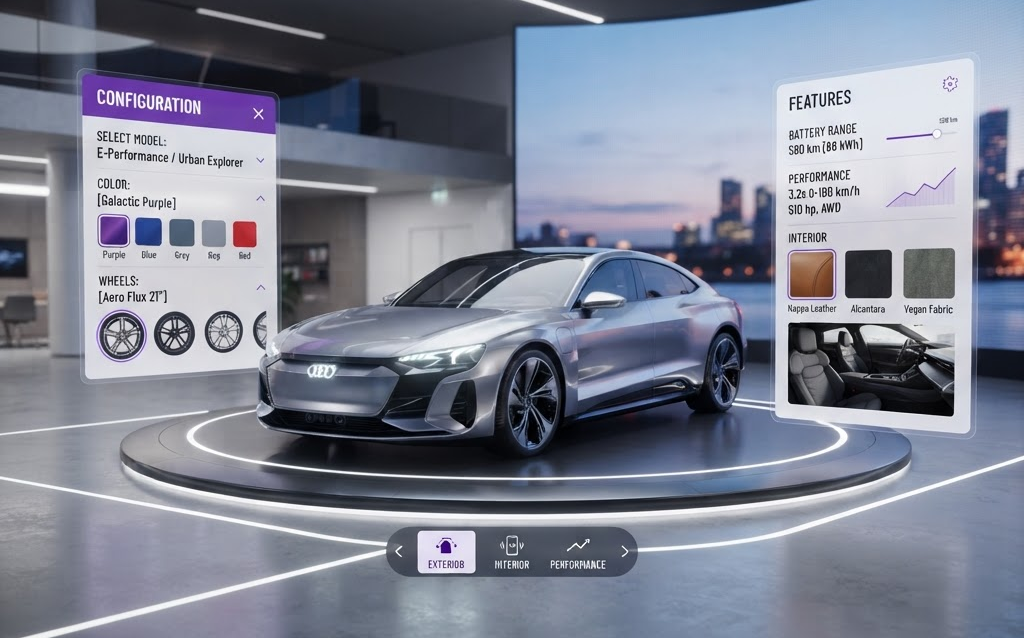
TL;DR: Electric vehicle 3D configurators let buyers customize their EV—paint color, wheels, interior, range packages, and autonomous features—while showing real-time range impact and charging cost savings. EV brands using advanced configurators report 40% higher qualified leads and 25% higher trim selection. Here’s how EV configurators differ from traditional automotive configurators in 2026.
Selling an electric vehicle online is different from selling a gas car. EV buyers care about range, charging, and technology—not just color and wheels. A traditional configurator shows paint and trim options. An EV configurator shows how each choice affects range, charging time, and cost savings. This data-driven approach helps buyers make informed decisions and drives higher trim selection.
What Makes EV Configurators Different
Range Visualization
Every configuration choice affects range. Larger wheels reduce range. Performance packages draw more power. Heated seats and climate control impact battery life. An EV configurator shows the real-time range impact of each selection—helping buyers understand the trade-offs.
Charging Cost Calculator
The configurator compares charging costs vs gas costs based on the buyer’s location and driving patterns. “This EV will save you $1,800/year in fuel costs” is a powerful sales message that a traditional configurator can’t deliver.
Battery and Range Packages
EVs often offer multiple battery sizes—standard range, long range, performance. The configurator shows how each battery option affects range, price, and charging time, with a visual range map showing how far the buyer can drive on a single charge.
Autonomous and Tech Features
EVs are technology platforms. The configurator showcases autonomous driving capabilities, over-the-air update features, and smart integrations—with 3D visualizations of how each technology works.
Charging Infrastructure Map
The configurator shows nearby charging stations, compatible networks, and home charging installation options—addressing range anxiety, the #1 barrier to EV adoption.
Key Features of an EV 3D Configurator
- Exterior customization — paint colors with accurate metallic/pearl/matte rendering, wheel designs and sizes
- Interior customization — seat materials, dashboard trim, ambient lighting, panoramic roof
- Battery selection — standard, long range, or performance pack with range and price impact
- Real-time range display — each option updates estimated EPA range
- Charging time calculator — home charging (Level 2) vs DC fast charging times
- Fuel savings calculator — annual savings vs comparable gas vehicle
- Tax incentive display — federal and state EV tax credits applied to price
- AR garage placement — see the configured EV in the buyer’s driveway
- Charging station map — nearby compatible charging stations
- Home charging setup — wall charger installation options and pricing
Why EV Brands Need Advanced Configurators
Range Anxiety Solution
Range anxiety is the #1 reason buyers hesitate to purchase EVs. The configurator addresses this with real-time range display, charging station maps, and home charging options. Buyers who understand their charging options are 40% more likely to convert.
Justifying Premium Trims
Long range and performance packages cost $5,000–$15,000 more. The configurator justifies this cost by showing the range benefit, the fuel savings over 5 years, and the tax incentive impact. EV brands report 25% higher trim selection with data-driven configurators.
Education Built Into the Experience
EV buyers—especially first-time EV buyers—need education. The configurator teaches them about charging, range, and technology while they customize. This education-in-context is more effective than separate FAQ pages or static information.
Cost of an EV 3D Configurator
| Scope | Cost | Timeline |
|---|---|---|
| Single model EV configurator (web-based) | $40,000–$120,000 | 8–16 weeks |
| Multi-model EV platform | $120,000–$400,000 | 14–28 weeks |
| Premium (Unreal + Pixel Streaming + AR) | $200,000–$600,000+ | 16–32 weeks |
| 3D model per EV model | $10,000–$50,000 | 4–10 weeks |
FAQ: EV 3D Configurators
How does an EV configurator differ from a traditional car configurator?
Traditional configurators focus on visual customization (paint, wheels, interior). EV configurators add range visualization, charging cost calculators, battery package selection, tax incentive displays, and charging infrastructure maps. They educate buyers about EV ownership while they customize—addressing range anxiety and justifying premium trims.
Can the configurator show real-time range impact?
Yes. Each configuration choice—wheel size, climate package, performance mode—has a documented impact on EPA range. The configurator updates the estimated range in real time as the buyer makes selections. This transparency builds trust and helps buyers make informed decisions.
How much does an EV configurator cost?
A single-model web-based EV configurator costs $40,000–$120,000. A multi-model platform costs $120,000–$400,000. A premium configurator with Unreal Engine, Pixel Streaming, and AR costs $200,000–$600,000+. 3D models per EV cost $10,000–$50,000 due to the high detail required for both exterior and interior.
Can the configurator calculate fuel savings?
Yes. The configurator compares charging costs vs gas costs based on the buyer’s location (electricity rates), driving patterns (daily mileage), and the comparable gas vehicle. Annual and 5-year savings are displayed alongside the vehicle price—turning the EV’s operating cost advantage into a sales message.
Can buyers see the EV in their driveway with AR?
Yes. AR garage placement lets buyers see the configured EV in their actual driveway at real scale. They walk around it, check the size, and see how it looks next to their home. This is especially valuable for buyers who haven’t seen the EV in person.
Getting Started
- Focus on range transparency — show how each option affects range in real time
- Add fuel savings calculator — quantify the EV cost advantage
- Include charging infrastructure — map nearby stations and home charging options
- Show tax incentives — apply federal and state credits to the displayed price
- Add AR placement — let buyers see the EV in their driveway
EV configurators aren’t just about customization—they’re about education and confidence. Buyers who understand range, charging, and savings are confident enough to purchase. The configurator is the tool that builds that confidence.
Ready to build an EV 3D configurator? Contact Ink & Algorithm to discuss your project—we’ll help you create a configurator that sells electric vehicles with data and confidence.